

#SocialFarming enhancing lives for many people by natural connections with farmers & growers and provides new opportunities for community inclusion and equality
Ireland
Joined September 2012
- Tweets6K
- Following4.6K
- Followers3.7K
- Likes6.4K


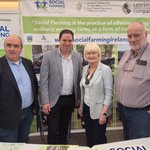



We wrapped up #socialfarmingawarenessweek2026 today on Ruth Young’s farm in Co. Laois!
Thank you to everyone who joined us throughout the week at our open days across the country
#connectingpeople #enhancinglives #newopportunities #laois


Yesterday evening, we headed to Waterford to Liam McGoldrick's farm for our #socialfarmingawarenessweek2026


A sincere thank you to everyone who joined us yesterday morning at JP Murphy's farm, Co. Cork, for our 4th day of #socialfarmingawarenessweek2026. Special thanks to our host farmer, JP Murphy, for generously welcoming us onto his farm and sharing his experiences.


Social Farming Ireland 🥕🐄🌾 retweeted

Join Our Team! We're hiring a Social Farming Regional Coordinator to support inclusion, wellbeing and participation through Social Farming.
📅 Closing Date: 12 October 2026, 5 pm
📧 Apply: [email protected]
🔗 View Job Details: Careers - Waterford Leader Partnership (WLP)
#hiring

Great interest in #SocialFarming @NPAIE Ploughing day 1 with Minister @martinheydonfg & Minister of State
@MarianHarkin @leitrimdevco


Free On-farm Health and Safety training is taking place this Friday, Sep 4th, in County Roscommon, 11am - 1pm
Places still available!
Book now!
Click the link below:
eventbrite.ie/e/on-farm-heal…
@LeaderRoscommon @teagasc @IFAmedia

Join us tomorrow at 11am in Kill #Kildare on Stephen Morrison's farm farmingfornature.ie/nominees… for our first on-farm in person health & safety event. @PPN_Kildare @KildareGAA @HSECHO7 @CountyKildareLP eventbrite.ie/e/health-and-s…

Social Farming Ireland 🥕🐄🌾 retweeted

🌾 Field of Her Own 🌾
Join us for a day dedicated to celebrating, supporting and empowering the women of Irish agriculture. 💚
📍 Coolamber House & Gardens, Lismacaffrey, Co. Westmeath
📅 Thursday, July 23rd
🕥 From 10:30am
Hear from inspiring women who are shaping the future of farming, connect with others across the sector, and be part of important conversations- including our Women's Health Panel, featuring leading experts discussing everything from preventative care and heart health to mental wellbeing and rural health.
Whether you're farming, working in agri-business, studying agriculture, or simply passionate about rural Ireland, everyone is welcome.
🎟️ This event is free to attend. Register now at ifa.ie/WomenAgWestmeath.
#FieldOfHerOwn #WomenInAgriculture #IrishFarming

Congratulations to everyone in #Mayo @MayoGAA on all Ireland success and all of our social farmers there and our #socialfarming partners South West Mayo Development Company

Social Farming Ireland 🥕🐄🌾 retweeted

During #FarmSafetyWeek2026 register for 1 of our 6 on farm safety events led by Jim Dockery looking at safey where farms are hosting events, walks, open days, visitors or social farming. @lairdhse06
Register at this link
eventbrite.ie/e/health-and-s…

Our partner out west @southwestmayo sent us this photo from #socialfarming in Newport today celebrating success and anticipating more for @MayoGAA this weekend in the @officialgaa all Ireland final.
Connecting people Enhancing lives with new opportunities with social farming

Our South East Co-ordiantor Tanya is in Johnstown Castle, Co. Wexford today for the #Teagasc Farming for a Better Future 2026 event.
Social Farming supports people to connect with farming, nature and their local communities. Drop by to find out more about #SocialFarmingIreland

Delivered three sessions of the next stage #socialfarming training for farmers 2026 this past week - final one in Carrick-on-Shannon #Leitrim today. New Opportunities

Contributed at @EURuralPact on engagement with rural networks & building NRPPs from the ground up 2027 2031
ruralpact.rural-vision.europ…
Experience of developing & sustaining our national #Socialfarming network demonstrates how engagement can be built & maintained in future


Social Farming Ireland 🥕🐄🌾 retweeted
An Taoiseach Michael Martin addressing the National Social Inclusion Forum & launching the Roadmap for Social Inclusion 2026-2030 with Department of Rural and Community Development and the Gaeltacht & @daracalleary #socialfarming
#socialinclusion #EUinmyregion #SICAP


We attended @ruralnetireland @irishrurallink Dept of Rural Community Development & Gaeltacht LEADER capacity building event to showcase farm diversification through social farming & LEADER funded projects on our social farms. @leitrimdevco @WLPLeader @southwestmayo @WLResources


Social Farming Ireland 🥕🐄🌾 retweeted

A Norwegian neuroscientist spent 20 years proving that the act of writing by hand changes the human brain in ways typing physically cannot, and almost nobody outside her field has read the paper.
Her name is Audrey van der Meer.
She runs a brain research lab in Trondheim, and the paper that closed the argument was published in 2024 in a journal called Frontiers in Psychology. The finding is brutal enough that it should have changed every classroom on Earth.
The experiment was simple. She recruited 36 university students and put each one in a cap with 256 sensors pressed against their scalp to record brain activity. Words flashed on a screen one at a time.
Sometimes the students wrote the word by hand on a touchscreen using a digital pen, and sometimes they typed the same word on a keyboard. Every neural response was recorded for the full five seconds the word stayed on screen.
Then her team looked at the part of the data most researchers had ignored for years, which is how different parts of the brain were communicating with each other during the task.
When the students wrote by hand, the brain lit up everywhere at once.
The regions responsible for memory, sensory integration, and the encoding of new information were all firing together in a coordinated pattern that spread across the entire cortex. The whole network was awake and connected.
When the same students typed the same word, that pattern collapsed almost completely.
Most of the brain went quiet, and the connections between regions that had been alive seconds earlier were nowhere to be found on the EEG.
Same word, same brain, same person, and two completely different neurological events.
The reason turned out to be something nobody had really paid attention to before her work. Writing by hand is not one motion but a sequence of thousands of tiny micro-movements coordinated with your eyes in real time, where each letter is a different shape that requires the brain to solve a slightly different spatial problem.
Your fingers, wrist, vision, and the parts of your brain that track position in space are all working together to produce one letter, then the next, then the next.
Typing throws all of that away. Every key on a keyboard requires the exact same finger motion regardless of which letter you are pressing, which means the brain has almost nothing to integrate and almost no problem to solve.
Van der Meer said it plainly in her interviews.
Pressing the same key with the same finger over and over does not stimulate the brain in any meaningful way, and she pointed out something that should scare every parent who handed their kid an iPad.
Children who learn to read and write on tablets often cannot tell letters like b and d apart, because they have never physically felt with their bodies what it takes to actually produce those letters on a page.
A decade before her, two researchers at Princeton ran the same fight using a completely different method and ended up at the same answer. Pam Mueller and Daniel Oppenheimer tested 327 students across three experiments, where half took notes on laptops with the internet disabled and half took notes by hand, before testing everyone on what they actually understood from the lectures they had watched.
The handwriting group won by a wide margin on every question that required real understanding rather than surface recall.
The reason was hiding in the transcripts of what the two groups had actually written down.
The laptop students typed almost word for word, capturing more total content but processing almost none of it as they went, while the handwriting students physically could not write fast enough to transcribe a lecture in real time, which forced them to listen carefully, decide what actually mattered, and put it in their own words on the page.
That single act of choosing what to keep was the learning itself, and the keyboard had quietly skipped the choosing and skipped the learning along with it.
Two studies. Two countries. Same answer.
Handwriting makes the brain work. Typing lets it coast.
Every note you have ever typed instead of written went into your brain through a thinner pipe. Every meeting, every book highlight, every idea you captured on your phone instead of on paper was processed at half depth.
You did not forget those things because your memory is bad. You forgot them because typing never woke the part of the brain that would have made them stick.
The fix is the thing your grandmother already knew.
Pick up a pen. Write the thing down. The slower road is the faster one.
