

Making physics easier to understand, from the fundamentals to the latest discoveries.
Joined July 2024
- Tweets2K
- Following1.1K
- Followers36.2K
- Likes927
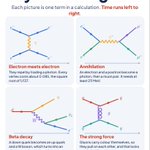




Richard Feynman introduced these diagrams in 1948 as bookkeeping for quantum electrodynamics. Each picture stands for an integral. Lines are particles, vertices are interactions, and time runs left to right. An arrow pointing against the flow of time is an antiparticle, which is how the e+ line in the annihilation graph is drawn.
The number of vertices sets the size. Each photon vertex multiplies the amplitude by about the square root of 1/137, which is 0.085, so diagrams with more vertices matter less and the calculation converges. The electron g minus 2 calculation sums 12,672 diagrams at tenth order, and it matches experiment to about ten digits.
Annihilation shows a calculable result. The cross section for an electron and positron to make a muon pair is 4 pi alpha squared over 3 s, which works out to 0.87 nanobarns at 10 GeV and falls as one over the energy squared. The strong force differs because gluons carry colour, so a gluon can attach to another gluon, and that is why quarks are never found alone.

The speed of light is 299,792 km/s only in a vacuum. In any material, light is slowed by a factor equal to its refractive index, so it moves at 225,000 km/s in water, 197,000 km/s in glass and 124,000 km/s in diamond. Silicon, the material of computer chips, slows infrared light to 86,000 km/s.
In 1999 Lene Hau and her Harvard team sent a laser pulse through a cloud of sodium atoms cooled to 435 nanokelvin, a Bose Einstein condensate, and slowed it to 17 meters per second. The pulse is a group of waves moving through the cloud, which responds to the light in a way that carries the pulse at bicycle speed.
A later experiment stopped the pulse inside the cloud and then released it.

A black hole's interior is cut off from us forever. Is it still part of the universe we can claim to understand?

A million seconds is 11.6 days and a billion is 31.7 years, so the jump from one to the next feels small and is not. Each step is a factor of 1,000, and a trillion seconds lasts 31,688 years. Counting back from today, a billion seconds ago was 1995 and a trillion seconds ago was the height of the last Ice Age, before farming, writing or the pyramids.
This is why the word trillion is easy to read past in a budget or a market headline. One trillion dollars at one dollar per second would take longer than all of recorded history to spend.

These nine are the electrically charged building blocks of matter, split into three generations. Each column is a heavier copy of the one before: up, charm and top share a charge of +2/3, down, strange and bottom share -1/3, and the electron, muon and tau share -1.
Apart from mass, the copies behave almost identically, and nobody knows why nature repeats itself three times. The neutrinos, which carry no charge, are left out here.

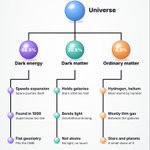
The percentages are shares of the universe's total energy density today, measured mainly from the cosmic microwave background by the Planck satellite. They are not fixed. As space expands, matter thins out and the dark energy density stays about constant, so its share has been growing, and matter dominated the universe until roughly 4 billion years ago.
Dark matter was first inferred in the 1930s from galaxy clusters moving too fast, and made convincing in the 1970s by Vera Rubin's rotation curves. Dark energy came from two supernova teams in 1998, who found distant explosions dimmer than a decelerating universe predicts.

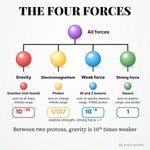
The 10³⁶ comes from comparing the electric and gravitational forces between two protons, and it holds at any distance because both fall as 1/r². Gravity still rules the sky because matter is nearly neutral, so electric pulls cancel while every mass adds.
The weak force is short ranged because its carriers are heavy, about 80 and 91 times a proton.

The rows are evenly spaced but the temperatures are not. From the Sun's surface to its core is a factor of about 2,700, and the top row is roughly 15 billion times boiling water.
Absolute zero stays at the bottom because it cannot be reached by any finite number of cooling steps, the third law of thermodynamics.

Since 2019 the kilogram, ampere, kelvin and mole are defined by fixing h, e, k and N, so those four carry no measurement uncertainty at all. G is the outlier: its uncertainty is about 22 parts per million and repeat experiments still disagree by more than their stated errors.
Alpha, the electron mass, the permittivity and the permeability are still measured and keep small uncertainties.

An electron trapped in a square box, shown as a probability cloud.
Each colour is twice as dense as the one below it. Exact Schrödinger solution, one full cycle takes about 11 femtoseconds in a 1 nm box.
This is an atomic-resolution image of a single hexabenzocoronene molecule (a ~1.4 nm nanographene) captured by IBM using non-contact atomic force microscopy with a CO-functionalized tip.
The bright lines show individual carbon-carbon bonds and atoms. Higher-order bonds appear brighter and slightly shorter. The image is a force map, taken in ultrahigh vacuum at ~5 K.
Credit: IBM Research.

Henrietta Swan Leavitt spent years comparing glass photographs of the night sky, looking for stars whose brightness changed.
At the Harvard College Observatory, she studied Cepheid variables in the Magellanic Clouds. In 1912, she reported a remarkably simple pattern: the brighter a Cepheid truly was, the longer its cycle of brightening and dimming.
That relationship transformed a blinking star into a cosmic measuring tool. Once astronomers calibrated it, they could compare a Cepheid’s true brightness with how faint it looked from Earth and estimate its distance.
Edwin Hubble later used Cepheids to show that the Andromeda “nebula” lay far beyond the Milky Way. The same distance ladder helped reveal an expanding universe.
Leavitt died in 1921, before the full scale of her discovery became clear. Her patient work with tiny points on fragile plates gave astronomy a way to measure distances which was instrumental for us to understand our place in the universe.

Each speed is measured against a different reference, which is the point. Speed only means something relative to something else, and the cosmic microwave background is the closest thing the universe offers to a rest frame.
The 14.5 billion light year distance is not the edge of the visible universe. The observable universe reaches about 46 billion light years.

Venus is hot because of a carbon dioxide atmosphere about 90 times thicker than Earth's, which traps sunlight. Saturn would only float in a bathtub big enough to hold it, and none exists.
The Moon drifts because of tides, as Earth's rotation slows while the Moon moves outward.

The way out is time.
The universe is about 13.8 billion years old, so light from beyond the cosmic horizon has not had time to arrive, and stars have only existed for a limited stretch. Expansion also stretches starlight to longer wavelengths, which dims it.

At 72 °C water boils but cooks food slowly, so mountaineers and high altitude kitchens use pressure cookers, which raise the boiling point to about 120 °C.
Boiling temperature also shifts with the weather. A deep low pressure system can lower it by a degree or two.

Light reaches the observer almost instantly, covering 1 km in about 3 millionths of a second, while sound takes nearly 3 seconds.
Sound travels more slowly in cold air, about 331 m/s at 0 °C, so the rule shifts a little. Thunder is usually inaudible beyond about 15 km because sound bends upward away from the ground.

Several of these needed little more than a stick, a ramp, a pendulum or a torsion balance.
The last three show physics moving from the classical picture to the quantum one, since atoms turned out to have a tiny nucleus, spin took only two values and electrons behaved as waves.

Cecilia Payne looked at the dark lines in starlight and reached a conclusion astronomy was not ready to accept.
For her 1925 doctoral thesis, she combined quantum theory with thousands of stellar spectra recorded at Harvard College Observatory. The pattern of absorption lines revealed not only temperature but abundance. Her calculations showed that hydrogen and helium were enormously more common in stars than heavier elements.
The accepted view held that stars had roughly the same elemental composition as Earth. Princeton astronomer Henry Norris Russell urged caution, and Payne weakened the conclusion in her published thesis, calling the hydrogen and helium abundances almost certainly unreal.
They were real. A few years later, Russell reached the same conclusion through other evidence and acknowledged her work. Stars, including the Sun, are overwhelmingly made of hydrogen and helium. Payne’s analysis had identified the basic chemical composition of the universe.
Her thesis was later praised as one of the most brilliant ever written in astronomy. Recognition inside Harvard came slowly. She spent years in poorly defined positions before becoming the university’s first woman promoted to full professor from within its Faculty of Arts and Sciences and its first woman to chair a department.
