
I love to travel
- Tweets342
- Following1.7K
- Followers1.1K
- Likes235








ALT Many thousands of stars shine brightly against the black backdrop of space, seen in hues of white, blue, and yellow.

ALT This image is a multiwavelength view of the Small Magellanic Cloud (SMC), one of the Milky Way's closest galactic neighbors. X-ray data from NASA’s Chandra telescope data is shown in purple, optical data from Hubble is shown in red, green and blue, and infrared data from Spitzer is shown in red. The image is dominated by a massive open circle of hazy brownish-pink clouds with dozens of larger, bright white and pink objects inside of it. The edges of the image are speckled with dimmer stars, galaxies, and other objects on a black background. The image is watermarked with the words “Credits: X-ray: NASA/CXC/Univ.Potsdam/L.Oskinova et al; Optical: NASA/STScI; Infrared: NASA/JPL-Caltech.”

ALT A multitude of stars glitter across this Hubble image in varying shades of white, blue, and orange.


ALT Four distinct composite images presented in a two-by-two grid. Upper left, an image of five galaxies known as Stephan's Quintet. Upper right, is an image of the Cartwheel galaxy, a neon pink disk with an outer ring, and a solid, slightly off-center spiraling core. Lower left, an image of the galaxy cluster SMACS 0723 which contains hundreds of individual galaxies in a sea of black space. Lower right, an image of the Carina Nebula, which resembles a rust brown mountain range backed by a hazy blue night sky. Full visual descriptions of these images are available at the link in the post and as alternative text for the individual images below.



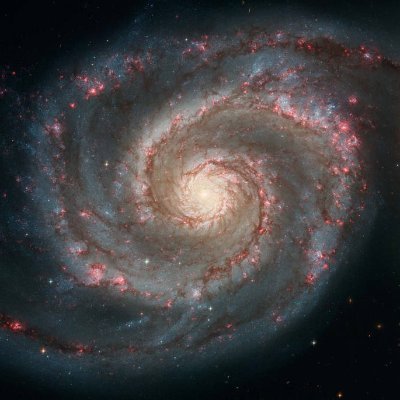
ALT Like our Milky Way, the galaxy NGC 3949 has a disk full of young, blue stars peppered with pink star-birth regions. In contrast to the blue disk, the galaxy's bright center is made up of mostly older stars and appears more yellow.


ALT A large galaxy on the right, with two much smaller companion galaxies to the left at 10 o’clock and 9 o’clock. The large galaxy resembles a speckled wheel, with an oval outer ring and a small, off-center inner ring. The outer ring contains pink plumes like wheel spokes, with dusty blue regions in between. The pink areas are silicate dust, while the blue areas are pockets of young stars and hydrocarbon dust. The inner ring is smoother, filled in with a more uniform pale pink. This smaller ring is interwoven with thin, orange-pink threads. On the galaxy's right edge, a bright white star with 8 diffraction spikes shines. The two companion galaxies to the left, one above the other, are about the same size and both spiral galaxies. The galaxy above is a reverse S shape but similar in coloring and texture as the large ring galaxy. The galaxy below is smoother and largely white, with a blue tinge. The background is black and full of more distant, orange-red colored galaxies of various sizes.


ALT The image is divided horizontally by an undulating line between a cloudscape forming a nebula along the bottom portion and a comparatively clear upper portion. Speckled across both portions is a starfield, showing innumerable stars of many sizes. The smallest of these are small, distant, and faint points of light. The largest of these appear larger, closer, brighter, and more fully resolved with 8-point diffraction spikes. The upper portion of the image is blueish, and has wispy translucent cloud-like streaks rising from the nebula below. The orangish cloudy formation in the bottom half varies in density and ranges from translucent to opaque. The stars vary in color, the majority of which, have a blue or orange hue. The cloud-like structure of the nebula contains ridges, peaks, and valleys – an appearance very similar to a mountain range. Three long diffraction spikes from the top right edge of the image suggest the presence of a large star just out of view.

ALT A group of five galaxies that appear close to each other in the sky: two in the middle, one toward the top, one to the upper left, and one toward the bottom. Four of the five appear to be touching. One is somewhat separated. In the image, the galaxies are large relative to the hundreds of much smaller (more distant) galaxies in the background. All five galaxies have bright white cores. Each has a slightly different size, shape, structure, and coloring. Scattered across the image, in front of the galaxies are number of foreground stars with diffraction spikes: bright white points, each with eight bright lines radiating out from the center.

ALT The background of space is black. Thousands of galaxies appear all across the view. Their shapes and colors vary. Some are various shades of orange, others are white. Most stars appear blue, and are sometimes as large as more distant galaxies that appear next to them. A very bright star is just above and left of center. It has eight bright blue, long diffraction spikes. Between 4 o’clock and 6 o’clock in its spikes are several very bright galaxies. A group of three are in the middle, and two are closer to 4 o’clock. These galaxies are part of the galaxy cluster SMACS 0723, and they are warping the appearances of galaxies seen around them. Long orange arcs appear at left and right toward the center.

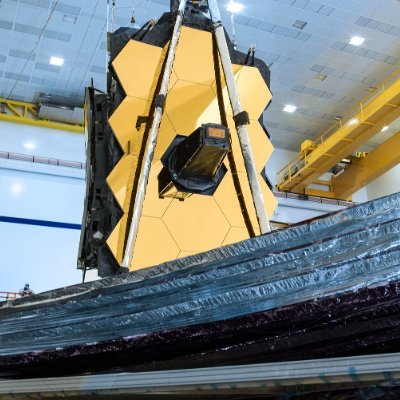
ALT The Webb telescope's primary mirror is inside a facility laying on its side, with engineers in white protective suits. The mirror's two wings that give it its honeycomb shape are not deployed in this image. Its secondary mirror, held by a long boom, is deployed in front of the primary mirror. The primary mirror is made up of multiple hexagonal mirrors assembled into one shape, and are covered in gold.