

Independent think tank focusing on transforming resilience to extreme AI and biological risks - both in the UK and internationally.
Westminster
Joined November 2019
- Tweets1.7K
- Following532
- Followers3.2K
- Likes174



The Centre for Long-Term Resilience strongly welcomes the launch of the AI Biosecurity Lab (AIBL). CLTR has long argued that the UK should use frontier AI deliberately to strengthen biological defence.
AIBL cements UK leadership in AI-enabled biosecurity, harnessing AI’s benefits to build resilience to its most extreme risks.

2/7 We're launching a £165m National AI Biosecurity Initiative, including £100m for a world-first AI Biosecurity Lab.
This will harness British scientific expertise and latest AI to detect biological threats and protect people from emerging risks.
As with our @AISecurityInst, I want the new AIBL to lead the world in capability.
✍️ Our latest Substack article ‘The UK Government needs access to external, security-cleared AI expertise’ is out now: governingtransformativeai.su…
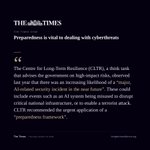
📰 The Times: "CLTR recommended the urgent application of a 'preparedness framework'"
thetimes.com/article/a0a573b…

🦠 Is the EU's AI Act fit to manage biological risks of AI?
🔬 Check out @GovAIOrg's new report by Bhuvana Sudarshan with co-authors including CLTR’s Scott Allen, Michael Mahar, Carl Mayers and Cassidy Nelson here: governance.ai/research-paper…
The Centre for Long-Term Resilience retweeted

I shared my views on #newsnight yesterday in reaction to Sir Ken McCallum's annual threat update regarding biological security.
There is no silver bullet. But there are interventions that can have an outsized effect on the ability to do harm from biology. #biosecurity #ai

“Can we ensure that people who are ordering this synthetic DNA are doing so for the right reasons”
Scott Allen, our Associate Director of Biosecurity Policy, makes the case on #Newsnight for why the UK should shift to a mandatory screening regime for synthetic nucleic acids
“Can we ensure that people who are ordering this synthetic DNA are doing so for the right reasons”
Scott Allen, our Associate Director of Biosecurity Policy, makes the case on #Newsnight for why the UK should shift to a mandatory screening regime for synthetic nucleic acids
📣 Our new Substack exploring today’s most pressing biosecurity challenges is now live.
Our first article dives into the intersection of AI loss-of-control and biological threats – and the priority interventions the UK must make to mitigate this risk.
🔗 biologicalsecurity.substack.…

Dr Jess Whittlestone, our Senior Advisor for AI Policy, joined BBC Radio 4 to discuss OpenAI’s recent decision not to release its latest AI model, GPT-6.1 Astra, following safety concerns.
🎙️Listen to the full interview below or on BBC Sounds:
bbc.co.uk/sounds/play/m00324…
(1:09:41)
In recent weeks, the leaders of several of the largest frontier AI companies have openly called to slow down the race to develop AI — a consensus that reflects the extraordinary pace of AI advancement.
James Ginns, our Director of Risk Management Policy, shares what lessons the industry can take from other high-risk sectors on how to mitigate and manage AI risks👇
longtermresilience.org/repor…

As leaders of AI companies argue for 'pacing the frontier’, our Senior Advisor, Dr Jess Whittlestone, shares thoughts on what doing this successfully might look like.
governingtransformativeai.su…

It’s time for all frontier AI companies to adopt ‘three lines’ risk governance as proven in safety-sensitive industries to ensure checks and balances, independence and whistleblower protections.
theguardian.com/commentisfre…

As the European Biotech Act approaches adoption, we share our recommendations in response to the amendments tabled by the joint SANT and ITRE committees and to the ENVI and JURI opinions👇
longtermresilience.org/repor…

Lord Hague argues that the risk landscape at the intersection of AI and Bio cannot be ignored.
We agree.
You can see some of our recommendations on this issue here: longtermresilience.org/repor…

The Five Eyes intelligence network has warned that rapid advances in AI mean an onslaught of sophisticated cyber-attacks is imminent.
Every business must act quickly. Governments must act too, particularly on the misuse of AI to create new diseases or biological weapons.
My column in @thetimes today 👇
thetimes.com/comment/columni…

On 1 May, the US signed contracts with eight leading AI companies to run their models on Secret and Top Secret networks.
The classified AI ecosystem now exists. The UK needs to secure its place.

But secure sovereign compute for classified inference is scarce, strategically vital, essential to future AI security work, and already named as a constraint in the Defence Investment Plan.
This is our pitch for the UK’s high-leverage play: stay relevant in geopolitical development of AI and defend against rapidly escalating threats by investing in secure AI inference compute.
governingtransformativeai.su…
💬 How is AI shifting the offense-defense balance in biosecurity?
Dr Paul-Enguerrand Fady, our Senior Biosecurity Policy Manager, joins the the @FLI_org Podcast to discuss how AI is changing biosecurity, from faster vaccines and diagnostics to lower barriers for misuse.

He also discusses threats from mirror life and mitigations; medical supply chains and stockpiles; and why synthetic nucleic acid screening should be mandatory.
Listen to the full episode:
podcast.futureoflife.org/how…