

🏏 Cricket | 🎬 Cinema | 🌎 | 🔥 Unfiltered Takes | Updates & Conversation That Matter. ❤️ @ImRo45
Joined April 2021
- Tweets28.8K
- Following1.5K
- Followers5.8K
- Likes112K

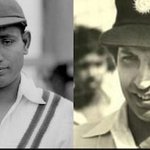





A father and his son achieved something incredibly rare in Test cricket.
Both scored centuries on their Test debuts!
The father made his debut against England in 1933 and scored India’s first-ever Test century.
More than four decades later, his son made his own Test debut against New Zealand in 1976.
He scored a brilliant 124 in his first innings.
Interestingly, neither father nor son managed to score another Test century during their respective careers.
Two generations.
Two debut centuries.
One extraordinary cricketing family.
Can you name the father and his son? 🤔

He achieved something that very few cricketers in Test history have ever managed.
Throughout his Test career, he batted at EVERY position from No. 1 to No. 11.
Yes, even at No. 11!
But that wasn’t his only achievement.
He scored 2,109 Test runs and picked up 162 wickets in just 44 matches.
In 1956, he scored a magnificent 231 against New Zealand and shared a historic 413-run opening partnership.
That partnership remained a world record for 52 years!
He was also involved in one of cricket’s most famous non-striker run-out incidents.
A legendary all-rounder whose contribution to Indian cricket deserves much more recognition.
Can you identify him? 🤔

417 FIRST-CLASS WICKETS… BUT ONLY THREE TEST MATCHES!
He was a talented Indian leg-spinner who spent much of his career living in the shadow of his own elder brother.
Despite taking 417 wickets in first-class cricket, he received only three opportunities to represent India in Test cricket.
His brother was already considered one of the finest leg-spinners of his generation.
Interestingly, his opportunity to play for India came after his elder brother was dropped.
He had the talent, the numbers and the determination.
But international recognition never came on the scale his domestic performances deserved.
Sometimes, even extraordinary talent struggles to find its place in cricket history.
Can you identify this forgotten Indian spinner? 🤔

🚨 HE TOOK MORE TEST WICKETS THAN HE SCORED RUNS!
He was one of India’s most unusual spin bowlers.
As a young boy, he suffered from polio, which weakened his right hand.
Doctors could hardly have imagined that the same hand would eventually help him become one of India’s greatest match-winning bowlers.
He went on to claim 242 wickets in just 58 Test matches.
But here’s the unbelievable statistic:
He finished his Test career with fewer runs than wickets!
He was also instrumental in some of India’s most memorable overseas victories.
His bowling action was unlike anything batters were accustomed to facing.
Can you identify this legendary cricketer? 🤔

🚨Mayank Yadav’s short-ball strategy worked, but India’s other bowlers struggled to execute it🤯
The analysis highlighted an interesting difference in India’s bowling attack.
Ambati Rayudu said : 🗣️
Mayank Yadav managed to trouble the batters with his hard lengths and short deliveries.
However, the same strategy wasn’t equally effective for the other Indian bowlers.
The discussion also highlighted how Mayank’s natural strength is generating bounce and hitting hard lengths, while yorkers aren’t necessarily his most natural delivery.
Against aggressive T20 batters, bowlers need more than just pace. Variations, lengths and execution make all the difference.

🚨India could have used Kuldeep Yadav to slow down New Zealand’s scoring - Bowling strategy analysed🤯
The discussion highlighted an interesting tactical point:
Dinesh Kartik said : 🗣️
India could have used Kuldeep Yadav to slow things down and force New Zealand batters to target the longer square boundaries.
Axar Patel and other Indian spinners were bowling at a pace that allowed batters to play their shots comfortably.
A little more variation in pace, combined with Kuldeep’s attacking spin, could potentially have made things difficult for the batters.
Sometimes, it’s not just about taking wickets. It’s about controlling where the opposition scores their runs.

India were struggling at 145/7 at Lord’s in 2014. 🇮🇳
England had the momentum, and India’s batting lineup was falling apart.
Shikhar Dhawan, Murali Vijay, Virat Kohli, Cheteshwar Pujara and MS Dhoni had all been dismissed.
But one Indian batter refused to give up.
He scored a magnificent 103 off 154 balls, smashing 15 fours and a six.
His crucial partnership with Bhuvneshwar Kumar helped India reach 295 in the first innings.
India eventually won the Test by 95 runs, securing their first Test victory at Lord’s in 28 years!
One innings. Immense pressure. A memorable Indian victory.
Can you name the batter who scored that century? 🧐


🤯 ONE OF ENGLAND’S GREATEST TEST OPENERS… NEVER PLAYED AN ODI WORLD CUP! 🏏🏴
Alastair Cook was one of England’s finest Test batters, famous for his patience, concentration and remarkable consistency at the crease.
He scored 12,472 runs in Test cricket, including 33 centuries, and became one of the most successful opening batters in the history of the format.
But here’s the surprising fact: Cook never played in an ODI Cricket World Cup!
Despite representing England in Test and ODI cricket, his international career never included an appearance at the men’s ODI World Cup.
It’s a reminder that even legendary cricketers can have careers with unexpected gaps.


In 1975, he underwent major surgery on both knees.
Doctors had doubts about whether he could return to bowling at the highest level.
But he refused to let the setback define his career.
He came back and became one of the most feared fast bowlers in cricket history.
He was known for his long run-up, relentless pace and ability to trouble even the best batters.
Here is another incredible fact:
He once held the Test record for the most not-outs by a batter at No. 11, with 55.
He also bowled 939 no-balls in Test cricket!
A legendary career filled with pace, determination and remarkable longevity.
🤔 *Can you name this former fast bowler?

LUCK7773 retweeted
Imagine opening the batting AND bowling for your country in the same ODI! 😳🏏
This legendary Indian all-rounder did exactly that during the 1992 Cricket World Cup.
• Opened the batting against Zimbabwe.
• Took the new ball and bowled the opening over.
• Was better known for his explosive all-round abilities than for opening the innings!
A surprising role for one of India’s greatest cricket legends.
Can you guess the player? 🧐

🚨 PAT CUMMINS’ UNUSUAL WICKETLESS STREAK! 😳
302 DELIVERIES. ZERO WICKETS.
Pat Cummins has reportedly bowled 50.2 overs in Test cricket without taking a wicket — his longest wicketless spell since making his Test debut in 2011.
For a bowler of Cummins’ quality, that’s a remarkable statistic. Known for his pace, accuracy and ability to deliver in crucial moments, he will be eager to end this unusual drought.
But cricket can be unpredictable. Even the best bowlers go through spells when wickets refuse to come, despite their efforts.
Imagine opening the batting AND bowling for your country in the same ODI! 😳🏏
This legendary Indian all-rounder did exactly that during the 1992 Cricket World Cup.
• Opened the batting against Zimbabwe.
• Took the new ball and bowled the opening over.
• Was better known for his explosive all-round abilities than for opening the innings!
A surprising role for one of India’s greatest cricket legends.
Can you guess the player? 🧐
🚨 SOUTH AFRICA PUT UP 329 AS STARC LEADS AUSTRALIA’S FIGHTBACK! 🇿🇦🇦🇺
South Africa finished their first innings on 329 after being bowled out in 82.3 overs at Cape Town.
The hosts looked well placed at 203/1 before Australia fought back brilliantly, reducing them to 232/6.
Mitchell Starc then produced a devastating spell with the second new ball, helping Australia take control of the final stages.
From a comfortable position to an all-out total of 329, South Africa experienced a dramatic turnaround.
Now the pressure shifts to Australia’s batting lineup.
Can the visitors build a substantial first-innings lead, or will South Africa’s bowlers strike early?
This Test is getting interesting.
Played just ONE Test match for India, but created a unique piece of cricket history! 🤯🏏
• Opened the bowling attack on his Test debut.
• Was promoted to open the batting in the second innings.
• Hit the winning runs to seal India’s victory against England.
He got only ONE Test opportunity, yet made it unforgettable. 🔥
Can you guess the player without googling? 🧐

157 WITNESSES. 255 PIECES OF DOCUMENTARY EVIDENCE. STILL, NO CLEAR ANSWER.
The case involving Rashmi Bhave, a woman from Gujarat whose death was investigated as a suspected murder, illustrates how even lengthy investigations can fail to resolve a mystery.
According to The Times of India, Rashmi’s husband, a doctor from Gandhinagar, filed a complaint alleging that his wife had been murdered. The investigation involved Gujarat Police and the Central Bureau of Investigation.
Investigators reportedly examined evidence, questioned 157 witnesses and reviewed 255 pieces of documentary material. A reward was also announced for information that could help solve the case.
Despite those efforts, the investigation did not produce sufficient evidence to establish who was responsible.
In May 2024, a special CBI court accepted the agency’s closure report, bringing the long investigation to a formal close.
That decision does not mean every question surrounding a death has necessarily been answered. It means investigators did not establish a prosecutable case through the investigation described in the report.
Cases like this reveal a difficult reality: the number of witnesses interviewed or documents collected does not guarantee that the crucial evidence will be found.
For families, an investigation ending without a clear explanation can leave painful questions unresolved.
The mystery is this case is not proof of a hidden conspiracy. It is the gap between years of investigative.
📷 Source: The Times of India
🚨 A LAWYER WAS SHOT DEAD IN 1989. MORE THAN THREE DECADES LATER, QUESTIONS REMAIN. 💔
Tika Lal Taploo was a Kashmiri Pandit lawyer and political figure who was killed in Srinagar on 14 September 1989, during the early period of escalating militancy in Kashmir.
According to ThePrint, Taploo had reportedly received a warning shortly before his death. On the day of the killing, masked gunmen shot him as he was leaving for the High Court.
His murder became one of the cases associated with the violence that forced many Kashmiri Pandit families to leave the Valley.
Yet the case remained unresolved for decades.
In August 2026, ThePrint reported that Jammu and Kashmir’s State Investigation Agency had reopened several cases involving the killings of Kashmiri Pandits, including long-pending cases from the militancy years. The broader effort reflects renewed attempts to examine old files, locate witnesses and pursue leads that may have been missed or unavailable during the original investigations.
But reopening a case does not automatically mean it has been solved. The passage of time can make investigations especially difficult: witnesses may be harder to trace, memories may fade, and evidence may no longer be available.
Taploo’s killing is more than a historical headline. It represents a family’s loss and a painful chapter in Kashmir’s history.
34 YEARS LATER, A FORGOTTEN CASE RETURNS TO THE HEADLINES.
In 1992, an 18-year-old woman named Farzana, also known as Shabnam, disappeared from public view in Ahmedabad, Gujarat.
For decades, the circumstances surrounding her disappearance remained largely hidden. According to a report published by The Indian Express in April 2026, investigators revisited information about a house in the Vatva area where Farzana was suspected to have been killed.
The investigation took a dramatic turn when forensic teams reportedly discovered fragments of bones, teeth and hair inside a septic tank beneath the abandoned property. Authorities suspected the remains could belong to Farzana, but identification required forensic confirmation.
Police also traced her husband, Shamshuddin Khedawala, who was considered a key suspect in the investigation. Being a suspect, however, does not establish guilt; the evidence and legal proceedings must determine responsibility.
One troubling aspect of the case was how long Farzana’s disappearance went without a formal missing-person report from her family, according to investigators quoted in the report.
How can a person’s disappearance remain unresolved for more than three decades?
The case highlights how forgotten records, missing reports and the passage of time can complicate investigations.
Important: The reported discovery and suspension should not be confused with a final judicial finding.
🚨 13 MURDERS. A CITY LIVING IN FEAR. AND A KILLER WHO WAS NEVER IDENTIFIED. 🔍🇮🇳
In 1989, Kolkata was gripped by a series of disturbing murders targeting people sleeping on the city’s pavements.
The victims were largely homeless people, often sleeping outdoors when they were attacked at night.
The crimes shared a frightening similarity: heavy stones or concrete slabs were used in the killings.
As reports spread, the unknown attacker became known as the “Stoneman.”
According to historical reporting, 13 people were killed in Kolkata during the series. Investigators faced a difficult challenge: many victims lived on the margins of society, some were difficult to identify, and there were few reliable leads pointing towards a suspect.
Police investigations and searches failed to establish who was responsible.
But one major question remained unanswered: Was there really one killer behind every murder?
Similar killings had been associated with Mumbai in earlier years, leading to speculation that the cases might be connected. However, investigators never conclusively established that the Mumbai and Kolkata crimes were committed by the same person.
The killings eventually stopped, but no one was ultimately convicted for the original Kolkata series.
Decades later, the Stoneman mystery continues to attract attention because the identity of the killer—or killers—and the precise connection between the cases remain unknown.
Behind the mystery were vulnerable people whose lives mattered, even when society paid little attention to their suffering.