

Building & scaling info + software businesses. Head of GTM @kendosalesai
Joined June 2022
- Tweets2.2K
- Following385
- Followers14.7K
- Likes3.2K



We've just entered an era where AI can run your entire sales team.
I'm not talking about scoring calls, generating reports or automating CRM updates.
I'm talking about AI that can actually train, coach and manage your sales reps.
That's EXACTLY what we've built at Kendo.
And we've just completely rebuilt the entire product.
For anyone who doesn't know what Kendo does, here's a quick rundown:
→ AI Roleplays: Your reps can practise cold calls, discovery, demos, objection handling etc with AI prospects that actually push back.
We've also added screensharing so reps can practise full product demos.
→ Automatic Call Scoring: Every sales call can be reviewed and scored against your own custom scorecards.
No more managers spending hours manually listening to recordings.
→ Training Paths: Fully automate onboarding and coaching. Build personalised training programmes for your reps based on the areas they need to improve.
→ Sales Analytics: Track the numbers that actually matter. Calls made, show rates, offers made, close rates etc.
→ Knowledge Base: All your training materials, processes and product knowledge in one place.
But the really interesting part is how everything connects.
Imagine a rep consistently struggling with price objections.
Kendo can identify that from their real sales calls, provide feedback and help them practise those exact scenarios.
So instead of managers spending hours figuring out who needs coaching and on what, you've got a system that helps do it for them!
And here's where things get REALLY interesting.
We've got the Kendo Agent launching before the end of the year, with MCP support.
Meaning you'll be able to connect Kendo directly to AI tools like Claude or Codex.
You won't even need to open the Kendo platform for supported management tasks.
Just ask your AI things like:
"Which reps are struggling the most this week?"
"What objections are costing us the most deals?"
"Create a training plan for my underperforming reps."
And it'll be able to use the actual context and performance data from your sales team.
Pretty insane when you think about it.
Massive credit to the team for getting this release over the line.
We've spent months working towards this, and seeing it all come together has been class.
We're only scratching the surface of what's possible.

Biggest @Kendosalesai release ever is now live! We rebuilt everything, new UI, amazingly helpful features, and deep AI integration + context layer for the Kendo Agent releasing shortly
Here's what's new 👇🏽
2
9
600
Luke Ward retweeted

Biggest @Kendosalesai release ever is now live! We rebuilt everything, new UI, amazingly helpful features, and deep AI integration + context layer for the Kendo Agent releasing shortly
Here's what's new 👇🏽
One of the easiest traps to fall into when you start making money is buying things you don't actually care about.
You make a bit of money and suddenly feel like you NEED the nicer apartment, the Rolex, the Porsche, the designer wardrobe.
Almost like there's a checklist of things you're supposed to buy once you're doing well.
I've seen people take out ridiculous finance deals on sports cars, drive them for a few months and realise they don't even enjoy driving that much.
They just liked the idea of being seen in one.
I'm a massive car enthusiast myself.
Currently have a Golf GTI, Cayman S and 911 Carrera 4S.
But I've loved cars longgg before I could afford any of them.
My dad's a huge car head too, and it's something we've always bonded over. We talk about them constantly, go on road trips and genuinely enjoy the hobby.
So for me, spending money on cars is something I'm happy to do.
Watches, on the other hand?
Couldn't care less lol.
I've got a Tissot PRX and that's more than enough for me.
Never felt the need to go out and buy a Rolex just because I could.
I think the important thing as you come into more money is figuring out what you genuinely value.
There's nothing wrong with spending money on expensive things.
Just make sure you're buying them for yourself, not for the version of yourself you want other people to see.

6
16
786
Probably one of my biggest regrets in business is not staying consistent with posting on X.
In my first couple of years, this platform introduced me to some incredible people, taught me a ridiculous amount and opened up opportunities that genuinely changed my life.
A lot of those people are still close friends today.
Then I got caught up in actually building businesses and slowly stopped posting.
Going to make a small commitment to change that.
Post every day. Engage more. Share what I'm working on and what I'm learning.
If you're building something interesting and we haven't connected yet, shoot me a DM.
Would love to get back to meeting more people on here 💪

22
45
1,564
I think the next big shift in SaaS is going to be from software you operate to software that operates for you.
Historically, most SaaS products have been built around helping users perform a specific task, manage a workflow or make better decisions.
But I think we're moving towards a world where AI agents sit on top of these products and actually start executing the work.
Look at Viktor AI.
They reached a $15M annualised revenue run rate in just 10 weeks.
Their product essentially acts as an AI employee, sitting inside Slack or Teams, connected to thousands of tools across your business.
It has the context to understand what's happening across your organisation and can actually execute tasks on your behalf.
I think this is a pretty good indication of where software is heading.
We're taking a similar approach at Kendo.
We've already got call scoring, sales training, roleplay, analytics, etc.
Now we're building an agent layer on top, with access to your CRM, email, calendar and company knowledge.
Something that can prepare you for calls, draft follow-ups, create proposals, manage your pipeline and proactively act on your behalf.
The underlying software and data are still incredibly valuable. But the way people interact with them is going to change.
I reckon we'll see a lot more SaaS companies moving in this direction over the next few years.
Less time spent telling software what to do. More software doing things for you.

12
14
880
Spending a lot of time trying to improve our outbound engine right now.
One thing I'm learning is that getting more meetings isn't always about making more dials.
It's about improving everything that happens before and after the dial.
Here's what we're working on:
Building better prospect lists (job titles, company size, verified phone numbers, emails, LinkedIns etc.)
Scraping peoples LinkedIn pages and recent posts to give our SDR actual context and personalised talking points.
Enriching our CRM so every prospect has relevant notes before the SDR picks up the phone.
But the MOST valuable part has been the feedback loop.
Every day, I get a quick breakdown from our SDR:
→ Which job titles are picking up?
→ What's working in the first 20 seconds?
→ Which objections keep coming up?
→ Where is our data letting us down?
→ Which prospects are actually booking meetings?
Then we use that feedback to improve the next batch.
Titles that aren't converting get deprioritised.
Talking points that resonate get used more.
Bad data sources get replaced.
The goal is simple, improve on these metrics.
↑ Pickup rate
↑ Conversation rate
↑ Meeting set rate
Small improvements across each part of the process should compound into a pretty significant increase in meetings booked.
Still early, but moving in the right direction.

Luke Ward retweeted

Gojiberry AI just crossed $5M ARR.
To celebrate, I put together a free course breaking down everything we learned on the journey from $0 to $5M ARR.
No generic startup advice. Just the actual strategies, experiments, mistakes, and growth tactics that moved the needle.
Want the playbook?
RT + comment "SAAS" and I'll send it to you as soon as it's live.
I don't think people realise how good the data situation has got.
Almost everything that used to gate outbound is now a few API calls and a few dollars.
This is roughly what things cost me now:
→ Read a company's website to work out what it actually does. $0.00015 a page. I classified a market by crawling 6,948 homepages for about a dollar.
→ Find every company hiring for a role that signals they need you. $0.0005 a company, and each one arrives with the job post attached.
→ Identify the decision makers inside them, with LinkedIn URLs. $0.0005 a contact.
→ Get their verified work email and mobile. Around 2.4 cents a contact, at 85% email and 80% phone coverage.
→ Pull their recent LinkedIn posts so Claude can write an opener referencing what they actually said. $0.0015 a person.
→ Check a number is a real mobile before an SDR dials it. 1.5 cents.
One list build recently took a market from 8,364 candidate companies down to 915 confirmed matches with verified contacts attached.
Total spend $34.50.
A few years ago you were stuck with apollo a big ZoomInfo contract, and even then you couldn't really personalise anything at scale.
Or even the days of paying a VA on fiverr to listbuild lol.
3 new enterprise deals signed at Kendo yesterday.
Need to crack how we do 10x more of this.
I've spent most of my career behind the scenes building systems, automations and processes.
Now I'm trying to become a MUCH better GTM operator.
A few things I'm focused on right now:
- Getting cold email to consistently generate qualified pipeline
- Hiring another SDR and building out the outbound team
- Cracking LinkedIn outbound as a repeatable channel
- Getting more consistent, high-quality content out from the team
Learning all this has been very fun, but I've got a long road ahead.
Who are the best people building and scaling B2B SaaS that I should be following on here?

We're onboarding more enterprise customers at Kendo, and I noticed a problem that was only going to get worse as we scaled.
Our developers were getting pulled into more customer Slack channels instead of building the product.
So I built something with Claude Code to fix it.
And it was ridiculously simple.
For context, every enterprise customer gets a shared Slack channel with our team.
Between general questions, feature requests and the occasional bug, there's a lot of activity across these channels.
And I don't want our developers constantly checking Slack just in case something important comes through.
So I built a simple Slack bot using Claude Code.
It scans our enterprise customer channels multiple times a day, looking for potential bugs or technical issues.
When it finds something, it automatically sends the message to a central dev escalations channel and tags the relevant developers.
Now instead of monitoring loads of different conversations, our devs have one place to see what actually needs their attention.
Tbh it was very easy to build.
I didn't need to pull one of our engineers away from the product to develop it.
Just Claude Code, a Slack bot and me cooking for a few mins 👨🍳
Small internal build to buy back time EVERYDAY.
Easy W.

This is the whole GTM stack we run at @Kendosalesai .
Curious what I'm missing?
CRM and booking
→ Close for the CRM
→ iClosed for booking calls
Finding companies
→ Apollo
→ Claude
→ Sales Navigator into PhantomBuster for contacts and LinkedIn URLs
Email and phone
→ Findymail
→ Treg for the enrichment waterfall
→ Apollo for contact data
Sending
→ Listkit for cold email and warmup (and some leads)
→ Phantom Buster (LinkedIn)
Calls
→ Close (Outbound dials)
→ Fathom to record on zoom
→ Kendo to score every call automatically
Intent
→ RB2B for website visitors, straight into Close
→ Apify for LinkedIn engagement and hiring signals
→ A bot we built that drops email opens into Slack
Content
→ Typefully for scheduling
→ A custom scrape and brief pipeline we built in house
One gap I already know about:
→ Not harvesting much with who engages with our content
What am I missing, and what should I be checking out?
We've built a pretty interesting signal-based outbound system at Kendo recently.
I've been calling it "daisy chaining."
Essentially, we're turning one inbound lead into multiple outbound opportunities.
Here's how it works 👇
Someone visits our website, starts a free trial, or buys an individual seat.
That activity triggers an automation. We capture their email, identify their company and enrich the account with firmographic data like headcount, industry and estimated sales team size.
We then search for relevant decision-makers at that company. Usually VPs of Sales, Sales Directors, CROs, etc.
Once we've identified them, we enrich their contact data, check for existing CRM records and verify their email addresses.
Qualified contacts get pushed into an outbound sequence, with messaging tailored to the original signal and their role.
So instead of treating a free trial signup as one lead, we're using it to discover an entire account worth prospecting.
Great way to get real activity to telling us which companies to prioritise.
7
16
1,022
One of the systems I recently built at @kendosalesai to help us manage our enterprise customers.
Every customer has a shared Slack channel with our account manager, developers, and wider team.
As we've grown, keeping track of conversations across all these channels has become harder.
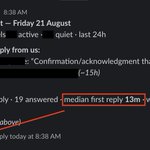
So I built a bot that monitors our customer Slack channels and sends a daily report to our account managers.
It tracks who's waiting on a reply, how long they've been waiting, and how quickly we're responding.
Here's an example from one of our reports:
20 conversations needed a reply.
19 were answered.
Median first response time was 13 minutes.
One was missed.
It's very easy for a message to get buried in Slack when you're juggling multiple accounts.
Now our account managers wake up to a report showing exactly what needs attention rather than having to go through every channel.
Pretty simple automation, but the sort of thing that makes a big difference as we scale 👍

4
3
689
From generating millions together in the info space to building a SaaS company that hit $1M ARR in just 12 months.
Now we're going for $3M.
A lot of people have seen what we're building with Kendo AI, but probably don't know the history behind it.
@Lukealexxander and I have been building businesses together for years.
And Kendo is far from our first rodeo.
It started with Closer Cartel.
Luke had built an incredible brand in the sales training space, and I came in as COO to help scale the business.
Together, we generated millions in revenue and trained over 5,000 salespeople.
My focus was largely behind the scenes. Building systems, automations, managing operations, and creating the infrastructure needed to scale.
From there, we moved into software.
Luke had acquired Closify, and we decided to rethink how the business operated.
We revamped the platform, changed the revenue model, restructured operations, and worked on turning it into a more scalable business.
Eventually, we decided to exit and put our focus into something much bigger.
That something was @Kendosalesai
After years in the sales training industry, we'd seen firsthand how broken traditional sales training was.
Managers don't have enough time to coach every rep, new hires take months to ramp, and most salespeople end up practising on real prospects.
We knew AI could change that.
So we went all in on building Kendo.
12 months later, we hit $1M ARR.
It's been a crazy journey.
We've experimented with different acquisition channels, rebuilt processes, hired people, made plenty of mistakes, and learned a ridiculous amount along the way.
My role has evolved from overseeing operations and building the systems behind the business to now leading our GTM efforts.
And one thing has become very clear.
What gets you to $1M ARR won't necessarily get you to $3M.
In the early days, you can brute-force growth.
Founders handle everything like onboarding, customer relationships, and whatever else needs doing.
But eventually, that becomes the bottleneck.
Our focus now is building a predictable, repeatable growth engine.
Better outbound. Stronger sales processes. More efficient onboarding. Better systems. And a team that can execute without everything relying on us.
Looking back, everything we've built together has led us here.
Closer Cartel taught us how to sell, train, and scale.
Closify taught us about software and recurring revenue.
And Kendo is where we're putting all those lessons together.
Proud of what we've accomplished so far, but I genuinely believe we're only getting started.
$0 → $1M ARR in 12 months.
Next stop: $3M.
Back to work ⚔️


Sales & AI Systems = $$$
@MaxBatess has done a serious job of executing from the moment he joined.
True killer 🚀
