

Twitter account of The Memorial Library at Marlborough College. Find us on Instagram: https://teapawt.org/t.co/iycAKMixLA
- Tweets902
- Following164
- Followers471
- Likes281





ALT Follow us on Instagram: https://instagram.com/mcol_library/

ALT Team Hufflepuff participating in the Harry Potter play-do challenge

ALT A tense moment as Team Ravenclaw struggle to win points in the Harry Potter play-do challenge

ALT Team Slytherin take a break from Lego-building to pose for a photograph

ALT Team Gryffindor celebrate their win with the Tri-Wizard Cup!

ALT Team Slytherin showing off a Harry Potter play-do creation

ALT The Library full of pupils taking part in the Harry Potter trivia quiz

ALT A Harry Potter themed buffet

ALT Head Librarian Mr B, emerging from Platform 9 and 3/4...

ALT Swindon Academy pupils taking part in an escape room activity

ALT Swindon Academy pupils taking part in an escape room activity

ALT Hagrid signs autographs for a crowd of St Mary's pupils

ALT A pupil holds up her autographed keyring

ALT St Mary's pupils participating in the Harry Potter quiz

ALT St Mary's pupils participating in the Harry Potter quiz

ALT St Mary's pupils building a spaghetti and marshmallow tower

ALT St Mary's pupils posing for a group photo with Hagrid outside the library


ALT Announcing the winners of our Hundred Research Prize 2022! We asked: “If you had a trillion dollars to fix the world’s problems, how would you spend it?” Find out more in the thread below.

ALT I see the correlation between the lack of education and addiction and conclude that addiction will exacerbate the chances of a substance abuser going into a living state of poverty, on varying extremities. To solve this problem, I think investment into rehabilitation programs is what’s needed. However, rehab treatment is expensive, with the average cost of rehabilitation in the UK being £7000-£10,000 a week, which will mean not everyone will have access to it, so my money can ensure that rehabilitation for serious addiction can be accessed by all.

ALT Africa has been caught in the vicious cycle of poverty peddled forward by the lack of basic human resources and infrastructure. So, how is it possible that the wealthiest continent with the largest cobalt and diamond reserves is still enslaved by poverty? Government corruption, nepotism, human rights abuse and war have certainly played a part in Africa’s long-standing history of poverty, however the newest danger to Africa’s suffering economy and living standards is neo-colonialism. Neo-colonialism is an extension of colonialism and can be defined as a foreign power indirectly controlling or influencing a state, which in theory has been given independence, usually through financial or political means. Instead of helping to develop the country, the foreign direct investment (FDI) instead exploits the country.

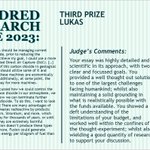
ALT The first area of focus should be managing current levels of Carbon Dioxide, prior to reducing the production of it. There have been numerous approaches to try deal with Carbon dioxide. One of which is carbon capture, where before carbon dioxide enters the atmosphere from a power plant, it is captured but isn’t 100% efficient. This potentially could be a viable method of preventing more carbon dioxide production, however, this doesn’t remove it from the atmosphere, which is what I’m looking to do. To achieve my goal, I could use a more recent technology called Direct Air Capture (DAC). […]Instead of storing all of this carbon dioxide in geological landforms, I think we should utilize some of it and generate a profit, so these machines are economically viable on their own. Additionally, at some point, the utilization may even pay for more machines.

ALT Creating an underwater city would not only save the people of Tuvalu and Kiribati from the devastating effects of climate change, but it could also have long-term economic and environmental benefits. If the city was a success, then people would want to visit it which would generate revenue from tourism. Some of this money could either be put into building defences against rising sea levels in low-income countries, such as mangrove forests or sea walls in Bangladesh, or it could be put towards expanding the city or building another one somewhere else. An underwater colony could also benefit the ocean’s ecosystem. I hope that building even one city for a small amount of people would inspire people and funding would be put into building more of them. This city would also provide scientists with a brilliant research base to discover more about the ocean and its species.

ALT What more worthy cause to gift one trillion dollars to? Investing in research to create technology to harness the most abundant material on earth, seawater, to regenerate supplies. Creating a governance model overseeing it that redistributes wealth more fairly from rich to poor nations, so that all nations can see their industries prosper through secure water supply. This will grow their economies, fertilise their lands using desalinated water yielding rich crops to become food self-sufficient. Research in technology, equitable distribution, and a long-term funding model to ensure water parity among rich and poor nations is a worthy recipient of one trillion dollars. There remains many unanswered questions, and hypotheses to test herein, but all great inventions and major global change start with the seed of an idea. Just maybe, if gently watered, this one can succeed.
ALT Announcing the winners of our Hundred Research Prize 2022! We asked: “If you had a trillion dollars to fix the world’s problems, how would you spend it?” Find out more in the thread below.

ALT A pupil carving a pumpkin

ALT A pumpkin carved with a scary face design and decorated with Halloween candy for eyeballs

ALT A pupil carving a pumpkin

ALT A pumpkin carved with a scary face design and decorated with Halloween candy

ALT The Library busy with pupils carving pumpkins

ALT The winning pupil receiving a bucket of Halloween candy

ALT A pupil holding a pumpkin carved with a cat-face design

ALT Pupils taking part in the pumpkin carving competition

ALT A pupil carving a pumpkin

ALT A pupil posing next to a carved pumpkin

ALT Head Librarian Mr B introduces Swindon Academy pupils to the Memorial Library

ALT Hundred Research Prize 2023: An essay competition for Hundred students. “If you had a trillion dollars to fix the world’s problems, how would you spend it?” Make a case for the best way to spend the money, with reference to expert opinion.