Father, Doctor, Geek, Gamer
Los Angeles, CA
Joined August 2010
- Tweets370
- Following192
- Followers47
- Likes253




The repeated caveat of "OF COURSE WORKING ALONGSIDE, NOT REPLACING doctors" is ubiquitous at #HLTHUSA
Why is everyone so scared to say AI might REPLACE MDs in some capacity? (see: Primary Care) Empowering midlevels to oversee care is already a great idea, AI can evolve to be a natural expansion.
#HLTH2026
50
Another interesting session titled "Can We Hack Our Way To Happiness?" with @calm, @neurable and @StanfordBrAIns Here's my takeaways:
@NinaVasan had the best overall advice saying "Exercise, Gratitude, and Social Connection" as things that are really important to happiness. Hard agree especially with social connection which I think is probably overlooked vs exercise which everyone knows (but no one does it).
The difference between the Neurable founder @RamsesAlcaide and and the Stanford Doc really reminded me of what Leon Eisenberg called the movement of psychiatry from “brainless” to “mindless”. It sounds like bashing but I’m not, let me explain:
Up until the 1970s, American psychiatry was dominated by psychoanalysis and mental illness was explained almost entirely through psychological theories of the mind (unconscious conflicts, early experiences, and defense mechanisms) while the brain as a biological organ received little attention. Biological research and physical treatments were sidelined, and the field operated as if the mind could be understood largely apart from its biological substrate (“brainless psychiatry”).
BUT from the 1980s on, the pendulum swung in the OPPOSITE direction toward “mindless” psychiatry. Mental disorders came to be framed primarily as brain diseases to be investigated through genetics, neuroscience, and psychopharmacology. While this brought greater scientific rigor and useful treatments for some conditions, it also downplayed the psychological, experiential, and social dimensions of mental illness.
The result (as seen in a microcosm on this stage) is an incomplete and discordant model that treats the brain as if it exists independently of the mind, relationships, and environments that shape both its development and its disorders.
It felt like Neurable was focused solely on the Brain, with cool headphones with silver brainwave(or some kind of brain thing) detectors, while Stanford is focused on a lot of therapy and social/emotional aspects.
Also important is the recent take by Actor @twhiddleston that chasing happiness is a mistake, because of its fleeting nature - it’s like trying to live in perpetual sunrise or sunset then upset that day and night still exist. He said people should focus on meaning, which is built through purpose, relationships, and endurance. Maybe he should be on stage at #HLTH2027!
#HLTHUSA #HLTH2026
13
Obviously the @OpenAI session was a big draw at @HLTHEVENT here's my takeaways:
A lot of it was framed as the "clinical side" but the demo was mostly prior auth, drafting notes, pulling eligibility (more admin stuff). The generated note also was the usual AI-style - wordy and even had something like "I'm sorry you're feeling..." As if the note was going to the patient.
The model can surface trends (A1c, etc.) but only if the agent actually HAS the data. In most hospital systems that access is still tightly controlled to not share to rival hospital systems (despite interoperability requirements, its a business decision).
They also talked about longitudinal medical records that can PREDICT future conditions based off of current issues. Reminds me of the work Cecil Lynch did a decade+ ago with predicting infant disease based on maternal health during pregnancy.
This is still a better "Band-Aid" for the paperwork monster we built to terrorize ourselves in America, but a long way to go
#HLTHUSA #HLTH2026


1
25
Menu at the Welcome Reception... You know Indians always representing at Health Conferences 😂
#HLTHUSA

1
30
So far my biggest takeaway from the opening remarks is that the founder pronounces this conference like "health" not like an initialism like H-L-T-H. I guess initialism is inaccurate too since it doesn't stand for anything - so ut would be... Disemvoweling?
Anyways I'm gonna keep calling it H-L-T-H, sorry Jon. The founder isnt always right: like the .gif guy saying its "Jiff".
So stay tuned for more "content" updates like this from HLTH~
#HLTHUSA


1
43

Whenever parents are concerned about their child's delay in speech development, my go-to citation is "@ColinJost didn't speak til he was 5, and now hes married to Scarlett Johansson"
71
Even in Med school I played DotA and @Warcraft , so multiple friends linked this study to me - but headlines are misleading, so I looked into what the ACTUAL study said:
The final study never says “your brain is 13.7 years younger.” (that's from a 2024 pre-print press release by @WesternU), but it does say frequent gamers scored better on short-term memory, reasoning, and processing speed.
But what is categorized as a gamer? To me, I think games have evolved into a more mainstream, easy to play (and win) format from when I was a kid. Early @NintendoAmerica (NES) games were damn near impossible to beat - the creators of the original Teenage Mutant Ninja Turtles should have an ICC warrant out for their arrest. Also the difference in focus and skill between RTS like @StarCraft or FPS like @CounterStrike vs like… Stardew Valley or Animal Crossing must have different cognitive benefits. This study just did a survey which I think can be stratified further.
"Frequent gamer" in the final paper is three or more hours a week, across any genre. "Infrequent" is any gaming under three hours. So what the paper actually reports is that frequent gamers scored higher than infrequent and non-gamers on a composite cognitive score, in a statistically significant way.
Reasoning showed the biggest gap between frequent and infrequent gamers. Processing speed also came in clearly ahead. But short-term memory improved with any gaming at all, but didn't keep improving with more hours. So some benefits look like a Threshold Effect (you get most of it just by playing regularly) and some look Dose-Dependent (more hours = more benefit… up to a point)
Also this was a cross-sectional, correlational study, meaning everyone was measured once. No random selection and signals to game more or less. Which makes it a chicken-and-egg problem: maybe gaming sharpens reasoning and processing speed, OR maybe people who already have sharp reasoning and fast processing speed are more drawn to gaming? The study can't tell you which direction the arrow points.
So I’d love it if @elonmusk was right and “play video games or be dumb” was a simple truth (because I play video games), but the nuances are in the actual paper. Exercise almost disappeared from the discourse around this study, but most people in the sample were already active adults (not the basement-dwelling gamer, South Park style stereotype of yore). Plus in this dataset, physical activity tracked with better mood, not necessarily cognitive scores.

1
115
Uncommon W for the little guy in a world dominated by Billionaires doing whatever they want – at Onion Creek, TX

Accountability for the wealthiest people on Earth is hard to come by.
Thank you for believing in the power of independent journalism to accomplish it.
(And, yes, more to come.)
pablo.show/p/it-happened

27
My first reaction was: good riddance! My second reaction was: wait, why are they doing this voluntarily?? Insurers don't hand out goodwill for free...This takes effect next month so I dug a little deeper...
reuters.com/legal/litigation…

1
1
40
Though one can argue the amount of PA attempts abandoned mid-stream due to Provider Office Rage Quitting is not properly tracked, or the amount of who “learned their lesson” in previous attempts and just gave up for future patients, still less prior auth is less prior auth.
1
5
Great talk by the first @neuralink "cyborg" @ModdedQuad here at @Ai4Conferences ! Too short though, he needs a longer session!! I've listened to @elonmusk @djseo and others before too so this was less technical and more personal but amazing! – at Winchester, NV


25
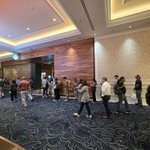
The classic super long @Starbucks line literally 100 feet away from free coffee at the conference. Never change, conference attendees. #ai4 – at Winchester, NV