

We are the Republican Caucus of the Montana House of Representatives, championing conservative values under the leadership of Speaker Brandon Ler 🏛️🐂🌾🏔️
Helena, MT
Joined January 2015
- Tweets1.3K
- Following43
- Followers3.5K
- Likes2.3K







Montana Republicans are moving to eliminate outdated restrictions and taxes on firearm suppressors, bringing state law in line with recent federal reforms.

Today, we remember the lives lost, the heroes who answered the call and the courage of a nation united. We will never forget.

Speaker Ler: "Last session, we delivered historic income tax relief and put Montana firmly on the path toward a flatter, fairer tax code. I support @GovGianforte's proposal to continue that work by bringing the rate down to 4.7%. House Republicans are ready to get it done."
montanafreepress.org/2026/09…

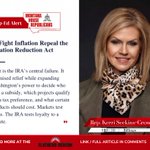
The Inflation Reduction Act didn't deliver affordability, it delivered more Washington control. Rep. Kerri Seekins-Crowe makes the case for repeal and a return to American energy independence.
Link and full article in comments.

flatheadbeacon.com/2026/08/3…
To Fight Inflation Repeal the Inflation Reduction Act
By Rep. Kerri Seekins-Crowe
President Biden sold the 2022 Inflation Reduction Act as a cure for inflation. Critics warned it would make life more expensive. They were right. Housing, energy, and healthcare costs kept climbing. The law never reduced inflation. It financed a political industrial policy and called the bill “affordability.”
Inflation is not defeated by subsidizing favored industries or letting Washington set selected prices. It is driven by debt-financed spending — exactly what the IRA delivered. Price controls do not create abundance. They create a talking point. Someone else still pays: the taxpayer, the ratepayer, or the patient waiting for a medicine that never gets developed.
That is the IRA’s central failure. It promised relief while expanding Washington’s power to decide who gets a subsidy, which projects qualify for a tax preference, and what certain products should cost. Markets test ideas. The IRA tests loyalty to a statute.
Nowhere is that clearer than energy. Tax credits for wind, solar, electric vehicles, and favored manufacturing do not create wealth. They redirect it. Taxpayers absorb risks the market would have rejected. Companies chase eligibility rules instead of customers. A few subsidized products may look cheaper on paper. The rest of the economy pays in higher prices, weaker grids, and delayed investment in the fuels and generation that actually keep the lights on.
Energy independence is not a slogan. It is the ability to produce reliable, affordable power at home — coal, oil, natural gas, hydro, nuclear, and whatever else can compete without a permanent federal crutch. A nation that cannot power its own homes, farms, factories, and military is not independent. It is exposed. The IRA treated energy as a social program. It should have treated it as a strategic asset.
When government picks winners, entrepreneurs get the message. Do not innovate where the credit does not apply. Do not invest where the next Congress might change the rules. Build to the statute, not to demand. That is a tax on growth. It is also a tax on energy security. Intermittent generation layered onto a grid that still needs dispatchable power does not make America stronger. It makes reliability a political afterthought.
The same logic applies to prescription drugs. Americans want lower costs. Seniors should not have to choose between medicine, food, and heat. The IRA’s Medicare price-setting regime confuses a government number with a real reduction in what patients and the system pay. The hidden bill shows up as higher premiums, narrower formularies, more prior authorization, thinner supply, and subsidies shifted onto taxpayers. Compress the return on a decade of research and capital risk, and the next treatment, the better formulation, and the new use never arrive.
Price controls offer the easy illusion: change the cell on the spreadsheet and declare victory. The costs do not vanish. They move — to premiums, to access barriers, to future patients, and to the products that never reach the market.
Congress has already begun scaling back the IRA’s energy tax machinery. It should finish the job. Repeal the remaining subsidies and price-setting apparatus. Stop mistaking central planning for affordability. Strengthen the dollar. Expand production. Let competition — not a credit schedule written in Washington — determine what gets built.
If the goal is lower prices and a country that can power itself, the remaining Inflation Reduction Act should go. Energy independence is not compatible with a statute designed to ration investment by political preference. Repeal it, and let American producers do what they do when they are allowed to: produce.
Republican Rep. Kerri Seekins-Crowe represents House District 39 in Billings. She is the Vice Chair of the House Business & Labor Committee.

As Montana considers the future of data center development, our priority is clear: Montana and our people come first.

Thank you, @GovGianforte!
Read more: helenair.com/opinion/column/…


Montana producers are facing serious drought conditions and getting hay where it is needed is critical. Sen. Wylie Galt, Speaker Brandon Ler and Rep. Randyn Gregg outline what an emergency declaration could mean for producers.
Full article and link in comments.

helenair.com/opinion/column/…
Get the Hay Moving
By Senator Wylie Galt, Representative Brandon Ler and Representative Randyn Gregg
Weather conditions across our great state have been quite inconsistent this year, with some areas of Montana receiving adequate precipitation while other localities seem to have gotten very little, leaving many cattle producers and farmers in a tough spot. While drought has not hit every corner of the state, it has hit some segments of cattle and farm country particularly hard.
So what actually is the official status on the ground?
According to Drought.gov, some of the hardest-hit areas include portions of southwestern, central, and eastern Montana. More than half of Montana is officially experiencing drought, nearly one-fifth of the state is experiencing severe or extreme drought, and roughly 94% of Montana is experiencing at least abnormally dry conditions.
By far, though, some of the most alarming numbers come from the USDA, with only 13% of Montana's topsoil moisture rated "adequate," the lowest in the nation.
Conditions such as these are extremely tough on cattle producers and farmers trying to grow and store adequate feed to sustain cattle herds through Montana's long winter months.
That is why we have been in communication with Gov. Greg Gianforte about these difficult conditions. It is our understanding that the governor’s office is working through an official State of Emergency declaration that could come as soon as Aug. 31.
Now, you might be wondering: What does that actually mean beyond more political talk and legal jargon?
In practical terms, an emergency declaration gives the state the ability to ease certain motor vehicle restrictions to help producers get hay, feed, livestock, and stock water where they need to go. Most importantly for producers trying to haul hay, this can mean relief from certain weight and other vehicle restrictions that would otherwise limit the size of loads moving down Montana highways.
That matters. When hay is scarce and producers may have to haul it hundreds of miles, being able to legally move heavier and larger loads can mean fewer trips, lower transportation costs, and getting more feed to drought-stricken operations faster.
Such a designation provides up to a 15-day period of automatic relief from certain federal hours-of-service requirements for commercial motor carriers providing direct assistance during a governor-declared emergency. The specific weight, size, permitting, and other transportation exemptions available will be determined by the terms of the governor's declaration and MDT requirements.
So, in plain terms: Know the effective dates, know what exemptions apply, and use the window while it is available. Get that hay bought and get it hauled.
For more information or questions, the appropriate contacts are below. In the meantime, stay safe, everyone, and let's get that hay where it needs to go.
God bless our producers, and God bless Montana.
Montana Hay Hauling/Emergency Information: Montana Department of Transportation — Motor Carrier Services, Permits, 406-444-7262
For oversize/overweight permits, hay-hauling restrictions, routes, and questions regarding emergency exemptions.: Montana Department of Transportation — Motor Carrier Services, 406-444-6130
America's family farms and ranches are built over generations. Rep. Randyn Gregg warns that wealth taxes and a growing push toward socialism could put that legacy at risk.
Link and full article in comments.


Taxpayer funded advertising should be based on reach, results, and value, not the judgments of private media gatekeepers.
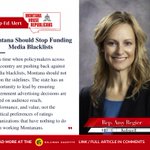
Rep. Amy Regier makes the case for why Montana should stop allowing media blacklists to influence where public advertising dollars are spent.
Link and full article in comments.

billingsgazette.com/opinion/…
Montana should stop funding media blacklists
By Representative Amy Regier
Montana prides itself on independence.
We value open spaces, open markets, and open minds. We are skeptical of distant institutions that presume they know what's best for our communities.
That is precisely why Montana lawmakers should take a hard look at how state advertising dollars are being spent.
Today, Montana state agencies hire advertising firms to place public service announcements, tourism campaigns, workforce recruitment ads and other taxpayer-funded messages. Many of those advertising firms rely on media monitoring companies like NewsGuard or the group Global Disinformation Index (GDI) when deciding where to place ads.
These media monitors assign ratings to news outlets and publishers, claiming to measure credibility and reliability. Advertisers frequently use those ratings to determine which media outlets are considered "safe" for advertising and which should be avoided.
In practice, that means a private ratings company can influence whether taxpayer-funded advertising appears on a particular website, podcast, newspaper, or news outlet. A low rating can result in fewer or no advertising dollars flowing to that outlet, even if it reaches exactly the audience a state agency is trying to reach.
Imagine Montana Fish, Wildlife & Parks wants to promote hunting opportunities, or the state's tourism office wants to attract visitors to Glacier National Park. These audiences, drawn to the rugged Montana lifestyle popularized by Yellowstone, often consume conservative and independent media.
Common sense would suggest placing ads in these outlets.
But if an advertising firm relies on a ratings system that disfavors certain media outlets, those ads may never appear there. Instead, taxpayer dollars can be steered elsewhere, regardless of whether those placements are the most effective way to reach Montanans or potential visitors considering a trip to Big Sky Country.
This is not a hypothetical problem. Montana already relies on outside firms to place taxpayer-funded advertising across digital platforms. Those firms often employ "brand safety" and media-suitability tools that can exclude entire categories of news outlets from advertising consideration. The result is that taxpayer advertising decisions are influenced by corporate gatekeepers who don’t know Montana rather than audience performance.
That's why a growing number of policymakers are questioning whether taxpayer-funded advertising should be filtered through these systems at all.
It's a problem for free speech.
But in Montana, it's also a problem for taxpayers.
Montana's economy depends heavily on tourism, ranching, agriculture, energy production, outdoor recreation, and rural workforce development. When state agencies use advertising firms that rely on media-monitoring services, Montana risks reducing the effectiveness of campaigns designed to reach these audiences.
That means fewer tourism dollars, weaker outreach, less effective recruitment efforts in rural communities, and diminished returns on taxpayer-funded communications.
The concerns extend beyond economics.
Studies show conservative outlets routinely receive substantially lower ratings than left-leaning outlets. Some studies have even found instances where Chinese state-controlled media outlets received higher credibility scores than certain American conservative publications.
Whether one agrees with those publications is beside the point.
Montanans should be concerned when media-rating organizations treat outlets controlled by authoritarian governments more favorably than independent American publishers.
Fortunately, policymakers across the country are beginning to address the problem.
Florida recently renewed anti-blacklisting protections through its state budget for a second consecutive year. West Virginia enacted similar safeguards through its First Amendment Preservation Act. South Carolina has included such protections through their state budget process. Congress included related language in the National Defense Authorization Act restricting the Pentagon from using advertising agencies that employ media-monitoring systems when placing military recruitment ads.
Federal regulators at the Federal Trade Commission have taken notice as well, enacting safeguards against exclusionary practices based on political ideology.
At a time when policymakers across the country are pushing back against media blacklists, Montana should not sit on the sidelines. The state has an opportunity to lead by ensuring government advertising decisions are based on audience reach, performance, and value, not the political preferences of ratings organizations that have nothing to do with working Montanans.
We have always believed in fair competition, individual liberty, and responsible stewardship of taxpayer dollars.
Our advertising policies should reflect those values.
Rep. Amy Regier represents House District 6 in the Flathead. She is the Chair of the House Judiciary Committee.

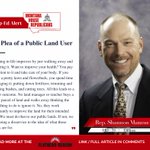
Montana's public lands deserve active stewardship, not neglect. Rep. Shannon Maness makes the case for healthier forests, stronger wildlife habitat, and responsible land management. Full article and link in comment section below.

flatheadbeacon.com/2026/07/2…
The Plea of a Public Land User
The case for active management – not hands-off neglect – on Montana’s public lands
Teddy Roosevelt is often known as one of the biggest supporters of conservation and protecting lands from overuse. During his presidency, he was able to protect many areas for future users. Since then, we as a country have done a fabulous job of setting aside lands for public use. I believe if President Roosevelt were to see our public lands today, he would have some harsh words of criticism for what has happened to our public lands and how we have stewarded what he left behind for us. I am an avid public land user, and the availability of public lands is one of the main reasons I live in Montana, but the way we are currently taking care of those lands is disheartening.
Our forests are in terrible shape; millions of acres are way overgrown, dead or dying, burned to the ground or filled with weeds. An ever-expanding forest in other areas is taking over our prairies, and our water supplies are being dried up by too many trees in some areas or filled with ash and dirt in other areas because of fire. Every summer our skies are filled with smoke from coast to coast. The amount of wildlife that uses these public lands compared to the number of acres available is abysmal. Between the quality of habitat and the number of apex predators, wildlife numbers have fallen greatly on public land.
Why has all of this happened in the last generation? I believe it is because of the lack of management. Nothing in life improves by just walking away and ignoring it. Want to improve your health? You pay attention to it and take care of your body. If you want a pretty lawn and flowerbeds, you spend time managing it: putting down fertilizer, trimming and pruning bushes, and cutting trees. All this leads to a better outcome. No land manager or rancher buys a large parcel of land and walks away thinking the best thing to do is ignore it. No, they work constantly to improve the land for their intended use. We must do that to our public lands. If not, we are doing a disservice to the idea of what those lands are for.
I have had the privilege of spending considerable time in several Wilderness Areas and a fair amount on National Forest and BLM lands over the years. I have seen firsthand how mismanagement has made these areas less desirable for wildlife and public use. Many acres of land are completely unusable and have been abandoned by both animals and humans. Currently in Montana, we are facing issues with more wildlife using private land as home instead of the public land it has used for decades. The public land is so undesirable to wildlife, with the lack of adequate food and shelter, and pressure from predators, that it has forced these animals into cohabitation with humans and cows. This is causing considerable issues with ranchers, hunters, and wildlife managers. Public land users such as I see a growing number of people crowded into fewer areas because of the unusable areas that people no longer bother to visit.
Why is this happening when we have very competent people whose job it is to manage landscapes? We have proven track records on private grounds where landscapes are thriving, and wildlife numbers far exceed those on non-managed lands. The answer is the fact that many Americans have been sold on the idea that the best thing to do to vast swaths of our public land is to walk away from it and keep the humans and their interference out of it. Unfortunately, this is a lie! People with no knowledge of these lands and who have not taken the time to learn about them have become very vocal on the idea of zero management of our valued lands. National environmental groups repeatedly file lawsuits to stop active management. Environmental organizations have created a fairy tale of these lands where wildlife abounds and lives out their lives in nature’s perfect balance. They have convinced too many people of this false reality. None of this is accurate. We must change course.
I encourage everyone who has an interest in this topic to do some research on land and wildlife management. It would be even better to come out and see it firsthand and talk to those working on the land daily. I want to see these lands alive with healthy forests, abundant wildlife, and flowing rivers. Just don’t fall for the narrative that it should all be ignored so that nature can take its own course. Active management must occur for these lands to reach their peak potential. Just like having a healthy body, we must take care of things and be proactive to achieve the best possible results.
Shannon Maness is a Republican state representative from Dillon.

Public trust in our courts must be earned, not assumed. Speaker Ler is raising serious questions about the Montana Supreme Court's appointment of former Court Administrator Beth McLaughlin to the Commission on Practice. Read the full statement below.

Rep. Greg Overstreet joins John R. Lott Jr. to examine the free speech implications they see in Initiative 194. Full article and link in comments section.

ravallirepublic.com/opinion/…
I-194 threatens free speech for citizen groups
You have the right to donate to the candidate you support. You can buy ads in your local newspaper. But what happens when you join your neighbors to advocate for an issue such as access to public lands or high property taxes and form an organization to amplify your voice? But if Montana Initiative 194 passes, the state could effectively prohibit your organization from participating in the political process.
Montana Initiative 194, which is set to appear on the November ballot, would ban so-called “artificial persons” — including nonprofits, trusts, partnerships, corporations, trade associations, unincorporated associations, and any entity doing business in Montana — from contributing to political campaigns, ballot measure elections, or political parties. Any entity that violates the initiative would lose the right to do business in Montana until it certifies that it has complied with the law.
The initiative does not treat all organizations equally. It expressly exempts companies that own newspapers, radio stations, and television stations. Those companies can continue publishing news stories and editorials that help one candidate or hurt another, and they can still endorse their preferred candidates—endorsements that candidates highly value. As a result, the initiative would increase the political influence of media companies while restricting the political participation of other organizations.
The initiative also quite noticeably does not mention labor unions by name. Although its broad definition of "artificial persons" may encompass unions, any dispute over whether the initiative applies to them would ultimately be decided by the Democrat-controlled Montana Supreme Court, so don’t bet on unions being covered.
Democrats have never accepted the Supreme Court’s 2010 ruling in Citizens United and some on the left have hit on the novel end-run around the First Amendment by redefining what is a corporation.
The left-wing Center for American Progress developed and popularized this specific legal strategy. It justifies the strategy this way: “When a state exercises its authority to define corporations as entities without the power to spend in politics, it will no longer be relevant to discuss whether the corporations have a right to spend in politics.”
The initiative would also drag Montana into costly legal battles. The U.S. Supreme Court has already rejected the argument that states can strip people of their First Amendment rights simply because they join together in corporations or other associations. Writing for the majority in Citizens United, Justice Anthony Kennedy explained: “The Court has thus rejected the argument that political speech of corporations or other associations should be treated differently under the First Amendment simply because such associations are not ‘natural persons.’”
But even many liberal Democrats believe these laws go too far. Hawaii recently enacted a similar law, but Hawaii's Democratic attorney general, Anne Lopez, opposed it, warning that it would be costly to defend and was unlikely to survive constitutional scrutiny.
Indeed, the Grassroot Institute of Hawaii, represented by the Institute for Free Speech, has already challenged Hawaii’s law in federal court. The lawsuit argues that citizens have a constitutional right to associate and "pool their resources" to make their speech more effective. It also points out that the First Amendment "guarantees that lawmakers cannot pick and choose who gets to speak. Nor can lawmakers condition access to any legal benefit on forfeiting the fundamental right of free political speech."
Montanans shouldn’t let the government decide which groups may speak and which must remain silent. Initiative 194 won’t get money out of politics; it would shift power to favored voices while silencing ordinary citizens who organize together. Free speech doesn’t disappear when people join with their neighbors to make themselves heard to survive a constitutional challenge.
Rep. Greg Overstreet and John R. Lott Jr
Rep. Greg Overstreet is the Republican state representative from House District 88 in Stevensville.

Parents, not the government, should have the final say in raising their children. Read Rep. Kerri Seekins-Crowe's latest op-ed. Full article and link in comments.

helenair.com/.../article_f4f…...
Parents, Not Government, Know Best for Their Children
There was a time in America when it was universally understood that parents, not bureaucrats, medical professionals, politicians, or activist educators, were the primary decision-makers in their children’s lives. That time is slipping away, and if we don’t fight back, we risk losing the most fundamental right we have: the right to raise our children according to our values, our faith, and our judgment.
Parental rights are under attack on multiple fronts. Schools are shutting parents out of curriculum decisions, keeping them in the dark about what is being taught, and dismissing their concerns about political agendas creeping into the classroom. Parents deserve full transparency. Every assignment, every book, every lesson plan. Teachers and administrators are there to educate, not indoctrinate, and no parent should be treated like an intruder for demanding accountability.
The assault on parental authority doesn’t stop at the classroom. Across the country, we’ve seen disturbing efforts to sideline parents in critical medical decisions, from gender transition procedures to mental health treatments. No doctor, school counselor, or government entity has the right to make life-altering choices for a child without parental involvement. Parents must have full access to their child’s medical records as state law already requires and have the final say in any treatments or interventions. Hospitals know what the law requires, yet they openly disregard it, hiding behind internal policy. In fact, some go so far as to admit, loudly and without apology, that they have no intention of following state law when it comes to a parent’s right to access their child’s medical records.
At its core, this fight is about a simple but profound question: Who raises children, their parents or the state? Every day, we see new policies designed to erode parental influence, pushing the idea that government knows best. Whether its activist educators encouraging secrecy, courts deciding they know better than families, or laws that place the power of parenting in the hands of bureaucrats, the message is clear: parents should sit down, shut up, and let the state take over. We must reject that entirely.
Montanans have always valued freedom, faith, and family. If we want to protect those values, we must stand up now and demand that parental rights be upheld at every level. The government has no business raising our children. That is a job for parents, and parents alone.
Contact me and let me know how I can help: [email protected]
Rep. Kerri Seekins-Crowe is the Republican state representative from House District 39 in Billings.