

Premier Financial Platform 📊Data & Charts | 📋Market Insights | 🧰Chart Tools | 📈Exclusive Indicators | 👥Community | Macro X Industry X Equities Databases👇
MacroMicro.me
Joined August 2020
- Tweets8.3K
- Following443
- Followers23.7K
- Likes4.4K





📆 After the Fed hold, eyes are now on these key dates:
📍 Oct 29: Q3 GDP & September PCE inflation, including core PCE, to gauge growth resilience and whether price pressures are broadening.
en.macromicro.me/collections…
en.macromicro.me/collections…
📍Nov 6: October payrolls. After just 29K jobs were added in September, another weak report would complicate the Fed’s inflation–employment tradeoff.
en.macromicro.me/collections…
📍Nov 10: October CPI. Another upside surprise in core inflation would strengthen the case for a December hike.
en.macromicro.me/collections…
📍Nov 13: October PPI, offering clues on whether producer-cost pressures are easing or feeding through to consumer prices.
en.macromicro.me/collections…
📍Nov 18: Fed meeting minutes, which could shed light on officials’ concerns about inflation, financial conditions and the case for waiting.
📍Dec 4: November payrolls, the final major jobs report before the next policy decision.
en.macromicro.me/collections…
📍Dec 8–9: FOMC meeting, with updated economic projections and the dot plot providing the latest signal on the rate path.
en.macromicro.me/central_ban…
Between now and December, inflation and employment data will help determine whether the Fed’s pause is likely to hold or whether another hike remains on the table.


🔥 October 2026 FOMC Meeting: Key Takeaways 🔎
📌 The Fed held rates steady at 3.75%–4.00% in a 10:2 vote, with Cook and Hammack dissenting in favor of a 25bp hike. The statement upgraded its assessment of economic activity from “solid” to “strong” while adding that more information is needed to determine the appropriate policy stance.
📌 Warsh rejected any soft or implicit inflation target, reaffirming 2% PCE, arguing that price stability can be achieved without damaging the labor market. However, he acknowledged that financial conditions have tightened since September, with businesses and households facing tighter credit and some AI-related credit spreads widening.
📌 On liquidity, the Fed maintains ample reserves. The NY Fed has paused reserve management purchases of T-bills since 8/13, yet reserves remain steady at $2.96T. TGA rebounded to $1.02T after mid-September corporate tax receipts, and with the Treasury’s end-Q4 cash target cut to $850B (from $950B), TGA could release $100B–$200B by year-end.
📌 Warsh announced changes to the FOMC calendar: starting in 2027, one of the eight annual meetings will focus on economic and monetary policy strategy without a rate vote or policy statement. In 2028, two meetings will be dedicated to strategy discussions. He also announced the Productivity and Employment working group hearing on 11/16.
📌 We still see a possible 25bp hike in December. FedWatch odds of a December hike rose from 78% to 87%, yet the 2-year yield fell below 4.73%, a neutral market read. Payrolls rose just 29K, unemployment edged up to 4.2%, and October gasoline prices turned lower. Q4 is likely the peak of inflation pressure, with the post-midterm US-Iran situation and oil the key swing factors.
📊 The MacroMicro AI FOMC Statement and Optimism Index (en.macromicro.me/collections…) shows the Fed’s optimism on the economy rising sharply and its hawkish tone picking up, though by less than last time.
📈 The Fed is balancing persistent inflation against signs that higher rates are already tightening credit conditions. With oil prices and the post-midterm US-Iran outlook key to the inflation path, will December bring another hike, or will tighter financial conditions give the Fed room to pause?
🇰🇷 SK Hynix $SKHY posted record Q3 revenue of KRW 104.6 trillion and operating profit of KRW 83.3 trillion, with operating margin reaching 79.7%. Profit beat market expectations as AI demand drove growth across HBM, server DRAM and enterprise SSDs.
Most importantly, SK Hynix expects memory shortages to persist through 2030. More than 50% of its production capacity for 2027–2028 is already covered by long-term contracts with 14 major customers, and some buyers are discussing agreements extending beyond the typical five-year term.
HBM4 is expected to surpass HBM3E in both shipments and revenue from Q4, while demand is spreading beyond major cloud providers to enterprises adopting AI. Autonomous driving and robotics could add further demand over time.
SK Hynix also plans around KRW 100 trillion in shareholder returns this year, reflecting the cash generation of the current memory cycle.
Record earnings, contracted capacity and exceptional pricing power suggest AI memory demand remains strong. The longer-term risk is familiar: if manufacturers expand capacity too aggressively, today’s shortage can become tomorrow’s glut.
The key question is how long tight supply can sustain current margins before new capacity catches up with demand.


🇺🇸 The Fed May Pause, but December Is Still in Play. Rates are largely expected to be held steady at this week's meeting, but a December hike remains a real possibility. Here are six things to watch in the Fed’s messaging:
1️⃣ Is the pause temporary? A hold while officials wait for more data leaves the door open to another hike. Saying policy is already sufficiently restrictive would point in a different direction.
2️⃣ Is energy inflation spreading? September CPI rose 3.7% YoY, with core CPI up 2.6%. The key question is whether higher energy prices are feeding into goods, services and inflation expectations, making the pressure harder to contain.
3️⃣ Can the Fed guide markets without making promises? Officials have resisted pre-committing to a policy path. Markets will look for clues about what would trigger another hike, even if policymakers refuse to signal a date.
4️⃣ Are bond yields doing some of the Fed’s work? Elevated long-term Treasury yields and higher borrowing costs are already weighing on housing and other rate-sensitive sectors. If financial conditions tighten enough on their own, the case for another hike may weaken.
5️⃣ How does the Fed weigh AI? AI investment is supporting near-term demand, while productivity gains may take longer to materialize. Whether the inflationary impulse comes first, and how much longer-term disinflation follows, could shape the rate outlook.
6️⃣ Will politics enter the conversation? With the November 3 midterms approaching, political pressure for rate cuts puts the Fed’s independence in focus. Whether officials address the pressure directly or sidestep it will be worth watching.
The decision to hold may be largely expected. The bigger market question is whether the Fed’s message keeps December firmly in play or signals that rates are already restrictive enough.

🧵 Anthropic filed its S-1 on Oct 26 and plans to list on Nasdaq as $ANT. 10 key takeaways 👇
1️⃣ First operating profit
Revenue went from $41M (2023) to $4.6B (2025) and $16.3B in 1H26 (+1,300% YoY). Q2 alone: $11.6B with ~$970M GAAP operating profit. 1H26 adjusted operating income: +$1.6B.
2️⃣ Usage-based model
80% of 1H26 revenue was consumption-based and 20% subscription. Revenue rises with token volume through the Claude Platform, Anthropic's own apps, and cloud marketplaces.
3️⃣ Enterprise engine
$100K+ customers grew from 950 to 11,900+, including more than half the Fortune 500. 250 customers pay over $10M a year.
4️⃣ Compute economics flipped
1H26 compute spend was $8.9B, more than all of 2025. But it fell to 55% of revenue, down from 1,056% in 2023. Inference margins now cover frontier training costs.
5️⃣ The $80.7B loss is mostly non-cash
$72.4B (~90%) came from fair-value marks on the Amazon convertible notes, SAFEs, and derivatives. Those marks were driven by the jump to a $965B valuation in the May Series H.
6️⃣ Huge cash pile
The company held $131.7B in cash and short-term investments at end-June. Pre-IPO raises funded most of it, including the $65B Series H (Altimeter, Dragoneer, Sequoia).
7️⃣ The real liability: compute commitments
~$266B in purchase commitments plus ~$321B in leases not yet started, some running to 2045. Key suppliers: Google $114.5B+, AWS $110B+, Azure $44.9B+, SpaceX up to $120.5B.
8️⃣ Founder-controlled governance
7 co-founders hold 50.1% of the vote through one Class F share. Public Class A holders have little say. A Long-Term Benefit Trust appoints a majority of the board to keep safety first.
9️⃣ Dilution for charity
5% of fully diluted equity (~847M shares) already goes to a public-benefit fund. Up to 2% more can be issued to the fund each time the stock climbs 50% from its last milestone.
🔟 Risks flagged
• Cloud suppliers are also rivals
• TSMC/Taiwan concentration
• Open-weight price wars
• AI misuse (Claude Code cyberattack; Mythos restricted)
• Top 5 customers = ~25% of revenue; 5–7% of revenue came from customers who violated policies


🇰🇷 Inflation remains above the BoK’s 2% target, with September headline CPI at 2.9% YoY and core at 2.8%. The BoK now expects growth this year and next to come in significantly above its August forecasts, and it sees inflation staying above target for a considerable time as accumulated cost pressures pass through and demand pressure builds.
That points to more tightening. A November hike is the base case among forecasts. Another 25bp in February 2027 would take the policy rate from 3.00% to a 3.50% terminal level. The BoK also continues to monitor financial imbalance risks from housing and household debt in Seoul and surrounding areas. The October hold came without explicit forward guidance, so November remains open.

🇰🇷 South Korea’s Q3 GDP grew 1.0% QoQ against a 0.7% consensus, and the Bank of Korea estimates about half of it came from semiconductors. Private consumption fell 0.2%, the first drop in nearly four years, as financial services contracted with the stock market.
The Kospi is down more than 35% from its June high while 12-month forward earnings estimates are up 22%, so the chip boom is showing up in exports and capex but not in household wealth. The BOK expects the pass-through to arrive from chip firms’ Q4 dividends and Q1 2027 bonuses, and SK Hynix $SKHY is reportedly preparing a special payout of about KRW 16 trillion from its Kioxia stake sale.
Output is running ahead of the households that have to spend those payouts, and the BOK held at 3.00% after two hikes with inflation seen staying above target for a considerable time.
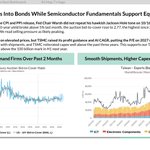
🔮 The SOX fell eight straight sessions last week, its longest losing streak since 2008, and sank more than 15% from its October 6 high through Friday. Hotter inflation started it, with September CPI at 3.7% and PPI at 6.4% YoY, but the move accelerated when CoreWeave’s 5-year CDS went above 1,100 bp, which implies a default probability above 60%, and Anthropic’s QoQ revenue growth slowed to 45% from 145%.
CoreWeave’s first half explains why credit investors are nervous. Operating cash flow of $3.66 billion ran against $14.1 billion of cash capex, which required $11.53 billion of net borrowing, and the CCC high-yield spread has broken above 12%, close to its October 2022 high.
At the same time, TSMC raised its 2026 revenue growth guidance to about 44%, and the companies supplying chips, packaging and power equipment are posting cash flow that looks nothing like the operators’. Our four-stage dot-com framework places the cycle between stages two and three, and it treats upstream cash flow as the test of whether stage three arrives.
This week's commentary compares 18 companies across five layers of the AI chain through eight financial metrics, then follows the cash into TSMC’s depreciation schedule and Meta’s and Tesla’s Q3 results.
🔗 Full report 👉 en.macromicro.me/blog/wefc-o…


MacroMicro retweeted

Kospi margin balance
Oct 2020: "There is no way this is sustainable"
Oct 2026: "There is no way this......."


📢 MacroMicro | Website Maintenance Notice (EDT, GMT−4)
Our website will be unavailable for a system update starting at 11:00 PM on 10/22 (Thu), with service expected to resume before 5:00 AM on 10/23 (Fri).
Thank you for your patience and understanding.

⏰ LAST 24 HOURS! Get the Global ETF AI Assistant FREE with Max AI.
Bring MacroMicro’s ETF research framework and market views to ChatGPT, Claude, Gemini, and more.
Subscribe Max AI and download from My Rewards by 10/23.
Once installed, keep using it after the offer ends. Claim yours before time runs out!
👉 mmgo.me/bx9jrh

$META Q3: AI Is Paying Off in Ads. Can Muse Do the Same?
Meta’s revenue rose 26% YoY to $64.6 billion, beating expectations, as AI-driven ad improvements lifted monetization. Ad prices climbed 14% and impressions grew 10%, while nearly 10 million advertisers used at least one generative AI creative tool. AI is already improving the core business, not just promising future growth.
Now Meta wants to turn that advantage into a new business. Its Muse personal AI agent attracted more than 10 million sign-ups in the US and Canada in roughly six weeks, with shopping emerging as a key use case. Transaction fees, subscriptions and enterprise services could open new revenue streams, but user adoption is only the first step toward proving the model.
The challenge is cost, with free cash flow swinging to negative $2.12 billion. Meta raised its 2026 capex outlook to $135 billion to $145 billion as AI infrastructure spending continues to climb. Management is targeting more than a tenfold improvement in compute cost efficiency over the next year, a key condition for scaling Muse beyond its initial user base.
Meta has shown that AI can improve the performance of its advertising business, but turning that advantage into a profitable consumer and enterprise AI platform is a much larger undertaking. With infrastructure spending still climbing and a 2027 budget not yet finalized, the key question is whether Muse can generate enough revenue to justify the cost of building it.


$TSLA Q3 results showed improving margins and a return to positive free cash flow, although its next growth drivers remain years away from full commercialization, leaving the company balancing better near-term financials against substantial investment needs.
Revenue fell 0.2% YoY to $28.05 billion, slightly below expectations, while GAAP gross margin rose to 19.6% from 16.8% last quarter and non-GAAP EPS of $0.48 beat forecasts. Free cash flow also turned positive at $1.53 billion, helped by lower capital expenditure, but operating income fell 56% YoY to $718 million and automotive revenue declined 3%, showing that stronger margins have yet to translate into broad-based earnings growth.
Energy storage offered a brighter spot, with deployments reaching 13.7 GWh and gross margin rising to 33.1%, although the improvement partly reflected one-off benefits from tariff refunds and battery warranty cost adjustments. Tesla also sees AI data center demand supporting further growth, with 2027 Megapack capacity nearly sold out.
In the automotive business, FSD adoption continues to expand, with active paid subscribers reaching 1.74 million, up 67% YoY. Meanwhile, Tesla expects Robotaxi to make a more meaningful revenue contribution from Q2 2027 and begin external Optimus deliveries by the end of 2027, while its in-house semiconductor program is targeting useful chip production from 2028. All three plans remain dependent on technical progress, regulatory approval and the ability to scale production.
Tesla lowered its 2026 capital expenditure guidance to around $20 billion from more than $25 billion, partly due to delays in new product timelines, but expects spending to accelerate again from 2027. Planned investments span Robotaxi fleets, humanoid robots, AI computing and semiconductor manufacturing, with Musk outlining potential long-term investment of more than $100 billion in chipmaking infrastructure.
The central question is whether these new businesses can generate returns that justify the investment required to bring them to scale. For now, Tesla’s core financials are showing signs of improvement, but much of its longer-term growth case rests on businesses that have yet to prove their economics at scale.


🌡️ CoreWeave $CRWV grew Q2 revenue 113% year over year to $2.58 billion, and after $640 million of net interest expense, only $130 million of operating profit remained.
Over the first half of 2026, operating cash flow of $3.66 billion covered about a quarter of its $14.1 billion in cash capex, and $11.53 billion of net new borrowing filled the gap. By October 16 the shares had fallen 25% in a week, and five-year CDS above 1,100 basis points was pricing a default probability over 60%. That was enough to drag Oracle and other leveraged technology names down with it.
Markets took this as the beginning of a broad retreat from AI financing. Credit spreads on the other AI data center bonds we track barely moved over the same period, which disagrees with that reading.
Our latest report compares neocloud providers with the large cloud providers on capex-to-revenue and free cash flow, goes through 24 US high-yield data center bonds backing more than 4.5 GW of computing capacity, and places the AI buildout on a four-stage framework drawn from the dot-com cycle. It also covers September’s inflation surprise and the slowdown in Anthropic’s revenue growth.
📥 Download the full PDF to see where we think the cycle stands and which segment of the supply chain would have to crack before the risk turns systemic 👇
🔗 en.macromicro.me/blog/is-a-5…


🚀 SpaceX revenue surged 161%. Here’s what stood out on its earnings call.
What’s next for Starlink and AI? How much will SpaceX spend to keep growing?
Get the highlights from SpaceX’s Q3 earnings call—from management’s outlook to analyst Q&A — with our AI summary and full transcript.
🔗 Read the earnings call highlights: mmgo.me/jyfgk3

