

A Digital Science Magazine! Trailblazing the Excellency in Science. Donate Us: https://xitter.cf/t.co/vQFREHp83I
Pakistan
Joined January 2019
- Tweets7K
- Following508
- Followers1.8K
- Likes1.7K



Pinned Tweet
Our latest edition's cover story is LIVE! 🌋 @FouzSiddiqui_ talks with Dr Joelle Buxmann (@metoffice) about aerosols, lidar, volcanic ash & why hunting a few molecules in a trillion teaches patience. Read it: scientiamag.org/the-science-… 🔗

Working as a disaster management practitioner in Khyber Pakhtunkhwa, I have witnessed how our mountain communities live with these risks every day. Many families build their houses near the streams and dry riverbeds due to flat and cheap land...
Read more: scientiamag.org/when-the-sky…

Pakistan has been blessed with lush green mountains and far dry deserts. From lakes to alpine valleys, glaciers, from some of the longest river trails to a large coastline, icy-capped mountains to beautiful beaches, Pakistan has it all.
Read more: scientiamag.org/glacial-graf…

West Antarctica from space 🛰️
This austral spring image from Copernicus Sentinel-3 shows the tip of the Antarctic Peninsula and the South Shetland Islands. Elephant Island stands out against the dark, ice-free ocean. (1/2)
Image Credits: @CopernicusEU @esa @eumetsat

Scientia retweeted

Europe is building its own capability to reach, land and operate on the Moon.
Bringing together expertise from across Europe, Argonaut will deliver cargo and technology to the lunar surface, starting with its first mission from 2030.
🔗esa.int/Science_Exploration/…

Scientia retweeted

HiPOD: A Flow Intersection
At this location, a portion of the Cerberus Fossae seems to intersect with the edge of a lava flow or other feature nearly perpendicular to the fossae. This could be a good location to investigate stratigraphic relationships.
uahirise.org/hipod/ESP_06963…


The floods will continue to come, as they are now inevitable due to accelerated climate change. The question is whether the water they leave behind will be a source of life or a vector of disease.
Read more: scientiamag.org/water-securi…

Sea otters hold hands while they sleep so they don’t drift apart. 🦦 Milo, one of the Vancouver Aquarium’s hand-holding otters, found comfort in Tanu’s company during a break from chemo for lymphoma.
Full video: youtu.be/zHIIzcWqsP0
Credit: Vancouver Aquarium
#SeaOtters
The team studied 455 satellite images, climate data and on-the-ground human responses during the period from 1990 to 2023, and found that at least 335 landslides took place...
Read more: scientiamag.org/climate-chan…

🐬 Why is this Omani dolphin pink? It’s biology, not pigment. Some dolphins have thin skin full of blood vessels and flush pink as they release heat. Others, like Risso’s, gain pale scars with age until they look almost white. 🌊 #PinkDolphin #Oman #MarineBiology
Scientia retweeted

Recently talked to Dr Joelle Buxmann at the Met Office about "Atmospheric Sciences: aerosols, volcanic ashes, lidars and much more." - An interesting read!

Our latest edition's cover story is LIVE! 🌋 @FouzSiddiqui_ talks with Dr Joelle Buxmann (@metoffice) about aerosols, lidar, volcanic ash & why hunting a few molecules in a trillion teaches patience. Read it: scientiamag.org/the-science-… 🔗
Two disasters, roughly two years and two thousand kilometres apart. Between them sits nearly everything researchers now understand about why early-warning systems succeed or fail.
Read more: scientiamag.org/zero-deaths-…

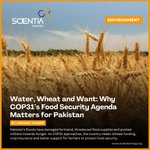
At the @COP31Agenda launch in NY on 21 Sep, Finance Min. Aurangzeb listed food security and climate-resilient agriculture among Pakistan’s priorities with the presidency. In Antalya, Pakistan should turn that alignment into four clear demands.
Read more: scientiamag.org/water-wheat-…

Close your eyes. Remember that earthy, comforting scent right after the first rain? 🌧️That’s petrichor: plant oils and soil bacteria compounds, released into the air the moment raindrops hit dry ground.
Can you smell it? 🌱
Source: Climate4Life


Mobula rays can leap over 2 meters out of the water and hang in the air for seconds.
Why? Science suggests mate signaling, shaking off parasites on impact, or long-distance communication through the splash. Maybe even just play. 🌊
Scientia retweeted

This gorgeous mosaic of images from the James Webb Space Telescope showcases the nearby star-forming cluster NGC 1333, located roughly 960 light-years away.
(Credit: ESA/Webb, NASA & CSA, A. Scholz, K. Muzic, A. Langeveld, R. Jayawardhana, N. Bartmann, ESA/Webb)
Senior Journalist Ms. Zofeen Ebrahim writes: MAZU offers faster forecasts and supports early warning systems. But its effectiveness depends on the quality of data and disaster response capacity, experts say. 🌍⚠️
Read more on: 🔗 scientiamag.org/can-a-chines…
Source: @DialogueEarth_

New Edition is LIVE! | Scientia Pakistan – September–October 2026
What happens when the sky above us turns against us? And how can science help us read the warning signs before it’s too late?
VISIT: scientiamag.org/
