

linux bitcoin UNIC 2020 ₿ node & miner; ∞/21M nostr: npub1278ptwa5y8hx28ye69xvj6cpcfx3q7wau72dufy52ny9w2hs45jqs9eq8w ⛳️
Utrecht
Joined December 2008
- Tweets35.9K
- Following6.2K
- Followers2.2K
- Likes75.4K







Pinned Tweet
If you really want to understand #Bitcoin start with reading these papers

Best #bitcoin papers everyone should read.
1. The Bitcoin Whitepaper
What started it all. Satoshi Nakamoto once said, "I had to write all the code before I could convince myself that I could solve every problem, then I wrote the paper"
[Read here: miami.gov/files/sharedassets…]

3
23
4,607
Marcel Smeets ₿ Powerlaw retweeted

in this AI math proof FUD blighted time, fanned by people who have no idea what non-deterministic polynonmial time even means, just remember Betteridge's law of headlines: any news headline ending in a question mark can be answered with the word "no"
Marcel Smeets ₿ Powerlaw retweeted

I interviewed a gold investor who called the 2008 crash a year early, and he says not one fiat currency of the last 300 years survived 100 years.
His name is Willem Middelkoop, and here are 7 lessons he learned about protecting your wealth:
1. Gold > real estate ?
Marcel Smeets ₿ Powerlaw retweeted

Bitcoin doesn't just cause a monetary revolution, it causes an energy revolution.
And the energy revolution it causes is arguably going at a much faster pace.
5 reasons why


Politiek (tegenwoordig) samengevat: ik heb jullie gehoord, zeg dat ik er van alles meedoe, doe er niets mee en ga gewoon door als altijd, F..K you En het klapvee vindt het prachtig

We zetten eens op een rij hoe vaak Yesilgöz al eerder de hand in eigen boezem stak @nynkedezoeten #Nieuwsuur
21
Mijn Engelse draad in het kort 🇳🇱
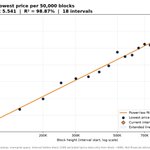
Ik bouwde de power law van @dotkrueger na: de laagste bitcoinkoers per 50K/100K blokken (R² ≈ 99%), doorgetrokken over 10 jaar.
Modelbodem op 1 januari:
2027: $84K–88K
2030: $193K–200K
2036: $747K–775K
Een model, geen voorspelling. Geen financieel advies.


Recreated @dotkrueger's Bitcoin block-low power law 📈
Take the lowest BTC price in every 100K-block interval, plot it on log-log axes:
R² = 99.46% (his: 99.49%)
50K blocks: R² = 98.87–99.01% (his: 99.00%)
Current low: $55,081 (21 Nov). The model line at block 1M is ~$92K.

19
Recreated @dotkrueger's Bitcoin block-low power law 📈
Take the lowest BTC price in every 100K-block interval, plot it on log-log axes:
R² = 99.46% (his: 99.49%)
50K blocks: R² = 98.87–99.01% (his: 99.00%)
Current low: $55,081 (21 Nov). The model line at block 1M is ~$92K.
The prediction that can't be made 🔮
Bitcoin's block-low power law, extended 10 years:
~1M blocks (Apr 2027): $93K–97K
Halving 6 (~2032): $335K–348K
~2036: $790K–910K
Same model, in block time and in years.
Model, not a prediction. Not financial advice.

1
7

These are approximate extrapolations of the free-exponent power-law fits to the 50k-block and 100k-block interval lows (exponents 5.7089 and 5.607).
They are calibrated near the charts’ latest assumed low of ~$55,000 around block ~950k and projected forward using ~52,560 blocks per year from the current height of ~978,000 (as of late November 2026).
The figures represent the modelled floor level (interval low trend) rather than a point price forecast. Actual yearly lows can deviate; historical scatter around these fits has been on the order of ±30 %
teapawt.org/dotkrueger/status/2126…
| Year | block height | 50k-block low | 100k-block low trend |
|------|----------------------|---------------------|-----------|
| 2027 | ~1.03M | ~$88,000 | ~$87,000 |
| 2028 | ~1.08M | ~$116,000 | ~$115,000 |
| 2029 | ~1.14M | ~$152,000 | ~$150,000 |
| 2030 | ~1.19M | ~$197,000 | ~$193,000 |
| 2031 | ~1.24M | ~$253,000 | ~$246,000 |
| 2032 | ~1.29M | ~$320,000 | ~$310,000 |
| 2033 | ~1.35M | ~$402,000 | ~$388,000 |
| 2034 | ~1.40M | ~$500,000 | ~$481,000 |
| 2035 | ~1.45M | ~$617,000 | ~$591,000 |
| 2036 | ~1.50M | ~$756,000 | ~$722,000 |
The two models track each other closely. These are pure mathematical extensions of the historical log-log fits on interval lows and are not predictions of future prices.
Realised lows depend on market conditions, and the power-law relationship itself is an empirical observation that could change.


44

Marcel Smeets ₿ Powerlaw retweeted
New research: I broke the Bitcoin History int 50K blocks and plotted the low of the block against price in log-log.
RSQ is 99%.

Marcel Smeets ₿ Powerlaw retweeted

Bitcoin has ~4.4% total supply left to be issued.
Total. Ever.
That’s not 4.4% per year.
That’s 4.4% from now until ~2140.
Gold, by contrast, grows its supply roughly 2% every year.
If that continued, by 2140:
Bitcoin supply: ~1.044x today
Gold supply: ~9.56x today
Critics talk about Bitcoin like it’s some fragile speculative toy but its monetary policy is one of the hardest economic facts in finance.
In fact, gold inflates more in about 26 months than Bitcoin will for the rest of its existence.
Bitcoin gives you a supply curve you can know in advance.
In the most uncertain time in human history, that's one hell of a product.
Choose your fighter:

Marcel Smeets ₿ Powerlaw retweeted
Assume you can save $100K a year. What are your chances of reaching $10M in 10 years?
Holding cash: Zero.
Day trading stonks: Near zero.
Trading memecoins: Near zero.
Investing in AI infrastructure plays: Near zero.
Investing in a 60/40 portfolio: Near zero.
Buying residential real estate : Near zero.
Following Peter Schiff: Near zero.
Stacking Bitcoin: A real shot.
Marcel Smeets ₿ Powerlaw retweeted
What the power law tells us and doesn't tell us.
1. Over its 17 year price history, Bitcoin has a statistical growth pattern that is up and to the right around a straight line in log-log space.
2. This is true versus USD, other currencies, Gold, SPX, M3 etc..
3. Versus the USD it is rarely below 0.5x of the power law trend. This is absolutely not the case for Gold, which has hit 0.25x of trend.
4. The statistical growth pattern is at least as good as Stocks, which tend to go up at a constant exponential growth > 10% (which is why people buy them).
5. Saying there is a demand for AI has zero impact on for example the power law versus Gold. AI investment takes money from both Gold and Bitcoin.
6. The Power Law really has one use: giving you conviction for a large allocation to Bitcoin. Not leveraged trading.
7. The Power law of Bitcoin Adoption / Addresses gives a very good narrative of why the Price law works. This is important. There is a reason why NGU. Its people buying the Bitcoin use case -- sovereign store of value that can be moved and liquidated at will.

