

News, research & analysis across global capital markets. Built by traders, for traders.
Joined July 2020
- Tweets2K
- Following80
- Followers19K
- Likes1.6K





Pinned Tweet
Join our community of traders, where we discuss trade strategies, price action and more! discord.gg/5JzMBb4zvP


Trading Terminal retweeted
AI’s suppliers are committing $26 billion to one of their own customers.
Alongside Anthropic’s proposed IPO, Nvidia, Microsoft, Google, AMD, Broadcom, Micron and TSMC Partners have agreed to invest $26B in a separate placement.
These companies benefit from the infrastructure spending that financing helps support.
Invest in the customer. Help fund its expansion. Compete to supply that expansion.
That can accelerate growth. It also ties their fortunes more closely together.
Meanwhile, Anthropic’s IPO reportedly reached 6x oversubscription by Thursday.
My concern: investors making room for the new AI stock could sell the AI stocks they already own.
A successful IPO doesn’t guarantee a rising tide for $NVDA, $AMD or $MU.
Watch what gets sold to fund the next big thing.
Trading Terminal retweeted
Semiconductors’ major corrections have followed a surprisingly consistent rhythm: roughly two years between peaks.
We tested 2,513 $SOXX trading sessions from November 2016 through November 12, 2026.
Using a fixed 20% correction threshold, with each episode ending only after the previous peak recovered, we identified:
• March 2018 peak: −26.1% maximum drawdown
• February 2020 peak: −34.3%
• December 2021 peak: −46.2%
• July 2024 peak: −41.7%
• June 2026 peak: −39.6% so far
The intervals between those peaks:
23.3 → 22.2 → 30.4 → 23.4 months
Average: 24.8 months.
Median: 23.3 months.
Three of four intervals fell within 18–30 months.
The pattern is stronger for MAJOR corrections. Raising the threshold to 30% produced median spacing of 23.4 months. Smaller 15% pullbacks occurred much more frequently, with median spacing of 13.4 months.
We also ran 30,000 block-bootstrap simulations. Among comparable simulated histories containing five qualifying episodes, roughly 7%–8% matched or exceeded the observed clustering.
After the initial 20% decline signal, subsequent 252-session returns averaged +36.5%, with three of four positive. But the dataset’s average overlapping 252-session return was already +33.1%.
And in 2022, $SOXX fell ANOTHER 30.0% after first crossing the 20% correction threshold.
The takeaway: the two-year rhythm has support in this sample.
Next week’s earnings will test AI demand, cybersecurity spending and the strength of the consumer.
NVIDIA $NVDA
EPS expected: $2.47
Revenue expected: $108.73B
Watch: Forward guidance, Data Center growth, gross margins, customer financing and management’s transition plans.
TARGET $TGT
EPS expected: $2.06
Revenue expected: $26.51B
Watch: Holiday guidance, comparable sales, customer traffic and discretionary spending. Separate underlying profitability from tariff-refund benefits.
PALO ALTO NETWORKS $PANW
EPS expected: $0.97
Revenue expected: $3.31B
Watch: Next-Generation Security ARR, remaining performance obligations and acquisition integration. Company guidance targets $9.54B–$9.56B ARR and $20.8B–$20.9B RPO.
WALMART $WMT
EPS expected: $0.63
Revenue expected: $187.19B
Watch: U.S. comparable sales, customer traffic, e-commerce profitability and holiday guidance. Are consumers buying more, or simply paying more?
ALIBABA $BABA
EPS expected: RMB11.03 per ADS
Revenue expected: RMB269.85B
Watch: AI/cloud growth, cloud margins, quick-commerce losses, capital spending and free cash flow. Revenue growth needs to translate into returns on investment.
GAP $GAP
EPS expected: $0.78
Revenue expected: $4.01B
Watch: Old Navy and Gap comparable sales, Athleta’s turnaround, promotional activity,


Trading Terminal retweeted
Softer inflation. Red tech. The market is trading more than the Fed
October PPI rose 0.3% versus 0.4% expected. That should provide some relief, but it doesn’t repair confidence in the AI trade
At 12:13 PM ET:
$NVDA: −4.%
$AMD: −10.0%
$AVGO: −6.81%
Nasdaq Composite: −1.8%
More S&P 500 stocks were actually advancing than declining. Heavyweight AI selling was dragging the index lower
An already-expected December hike isn’t a new bearish catalyst
The real question: Are investors changing their rate expectations, or changing what they’re willing to pay for AI earnings?
Watch whether semiconductor selling broadens or stabilizes. A better inflation print alone won’t answer that
Trading Terminal retweeted
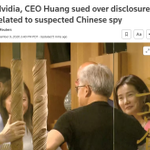
$NVDA’s CEO Jensen Huang just admitted to an affair and US officials reportedly believe the woman was working for Chinese intelligence!
Nvidia shares fell as much as 8% after the news broke. The board says there's no sign any secrets were leaked and China calls the spy claims slander.
@elonmusk : "If she's a 10, you're an asset" line isn't new, by the way. He tweeted it last October, when the honeypot reports first came out.
Nvidia spends billions keeping hackers out and now it's learning the cheapest way in was never code.
Keep that Huang to yourself!
Trading Terminal retweeted
🔴 trading in 2026: chart pattern recognition
🟢 trading in 2026: see where real orders are actually waiting to get filled
🔴 trading in 2026: chart pattern recognition
🟢 trading in 2026: see where real orders are actually waiting to get filled
