
This account has been archived. Follow @NASAMars to get the latest updates on the Curiosity rover’s mission.
- Tweets4.5K
- Following53
- Followers3.8M
- Likes3.3K
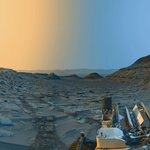





ALT Two panoramas taken in the morning and afternoon on Mars are combined to create a color-enhanced landscape image. Both panoramas of the area, known as "Marker Band Valley," were taken by the Curiosity Mars rover's navigation cameras. The detailed photo shows yellow coloring in the sky to mark the afternoon hours and it transitions to a blue color to indicate the morning color. The taupe-colored landscape shows a large, rocky hill to the right and smaller rocky hills in the distance toward the center and out into the horizon. To the left is a rocky outcrop and as we get closer to the foreground the area shows rover tracks along the sandy floor. To the bottom-right corner, the backend of the off-white, dusty rover is shown. Part of the rover's wheel can be seen as well as three of its antennas. The Radiation Assessment Detector, or RAD instrument, appears as a white circle in the lower right portion on the back of the rover.

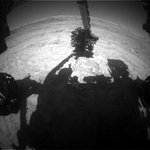
ALT A black-and-white image taken by the Curiosity rover shows its own shadow cast on the rocky Martian surface. The shadow clearly outlines the rover’s body, mast, and robotic arm, which is extended over the ground. The barren terrain stretches out to the horizon, with scattered rocks and a slightly elevated ridge in the distance.

ALT A black-and-white view from the Curiosity rover shows a rocky, textured Martian surface with scattered slabs and ridges. The rover’s mechanical components and wiring are visible in the foreground, along with its shadow stretching across the lower left of the frame. The horizon rises in the distance with layered terrain.


ALT A desert landscape with dunes of sand and dust in the foreground, and craggy sandstone hills on the horizon.

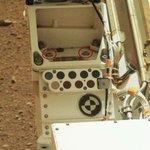
ALT A close-up view of the Curiosity rover on Mars shows a section of the rover’s body that contains its calibration targets and two microchips (circled in red) mounted above them. These microchips contain the names of more than 1.2 million people who signed up to send their names to Mars. The dusty Martian surface is visible in the background.


ALT A black-and-white image shows the Curiosity rovers shadow on the surface of Mars. The rover has its robotic arm and drill extended out and the outline of the arm and tools is clear along the rocky surface.

ALT This is a close-up image of a drill hole in a flat, dusty, light-brown rock surface on Mars. The hole, made by the Curiosity rover, is surrounded by scattered, fractured rock fragments. The terrain is cracked and finely textured, piling up around the hole.

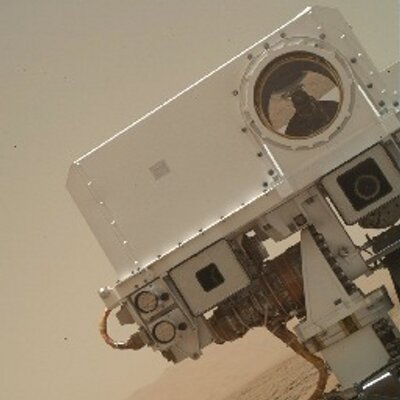
ALT A portion of a selfie is shown with the Curiosity Mars Rover angled to the side of the image. The head is coming in from the right and tilted toward the left with its rectangular head taking up most of the image.

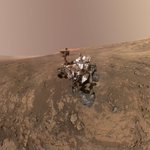
ALT The Curiosity rover sits on a rocky, sloped terrain on Mars, captured in a wide-angle selfie. The rover’s robotic arm is visible, and its body is covered in dust from years of exploration. The landscape stretches out behind it, featuring layered, reddish-brown rock formations, scattered boulders, and a soft, dusty sky. In the distance, gentle ridge lines and sedimentary slopes of Mount Sharp are visible under a pale Martian haze.

ALT Close-up of the Mars Hand Lens Imager (MAHLI) Calibration Target on the Curiosity rover. The target features a dark gray square with a rough texture, several tan and beige color swatches, and a white panel with black resolution patterns labeled with numbers. Fine reddish Martian dust lightly coats the surface, giving it a speckled appearance.

ALT A close-up color view shows an oval shape where the Curiosity rover's dust removal tool swiped away Martian grit. The beige-colored surface is smooth and shows ridges across the rock. Surrounding the clean spot is thick Martian dust along a pockmarked surface.

ALT A close-up view shows the Curiosity rover's Dust Removal Tool (DRT) on Mars. The image shows two metallic wire brushes extending from a rotating mechanism, lightly coated with Martian dust. The blurred background reveals the reddish, sandy Martian surface.

ALT A ribbed Martian landscape is shown in a black-and-white image taken by the Curiosity rover. The long fractures stretch out toward the horizon, appearing jagged and cracked.

ALT A black-and-white image taken by the Curiosity rover shows a rocky, uneven Martian landscape in Gale Crater. The rover's instrument deck is visible at the bottom of the frame. In the middle distance, rippled sand textures stretch across a small patch of terrain, with scattered rocks and ledges leading up to a gentle slope in the background. The scene is lit by soft sunlight, casting faint shadows across the surface.

ALT A black and white image taken by the Curiosity rover shows a rocky, desert-like landscape with wheel tracks in the foreground. A cylindrical instrument is mounted on the rover’s deck in the bottom right corner. In the distance, several rounded hills rise from the flat terrain, and layered rock formations line the right edge. The hazy Martian horizon stretches across the background.