
Perth, Western Australia
Joined August 2019
- Tweets55
- Following185
- Followers125
- Likes443
Matheus Daros Pinto retweeted

Our meta-analysis on sex differences in muscle strength in kids, which was published in April 2025, is now one of the top cited papers in the European Journal of Sport Science over the past two years. @MatheusdPinto

Matheus Daros Pinto retweeted
NEW: Pre-print of our new meta-analysis now available. Using data from 78 studies and over 120,000 males and females, we found that the muscle strength-to-body mass ratio is generally greater in males than females. Thus, dividing muscle strength by body mass does not mathematically eliminate the male strength advantage. This is likely because factors other than body mass contribute to the sex difference in muscle strength and because the relationship between muscle strength and body mass is not linear, which is what is assumed when dividing muscle strength by body mass (i.e., ratio scaling). Further, we found that the sex difference in the strength-to-body mass ratio is smallest in children and largest in adults, and it is greater in upper- than lower-limb muscles.
Note: This paper is currently undergoing peer review at a journal. Some contents of the pre-print will change after we receive feedback from reviewers.
How to Support Our Work:
This research was conducted independently, without institutional backing or external funding. If you value this work and would like to support it, please visit the GoFundMe link in the comments or in my pinned tweet. Thank you for your support.
Co-author: @MatheusdPinto

Matheus Daros Pinto retweeted
🧵NEW: Our latest paper is a meta-analysis of sex differences in upper- and lower-limb strength in kids aged 5-17 years old (3,497 boys; 3,137 girls).
Before, during, and after puberty, boys are stronger than girls on average. The sex difference in muscle strength is ~10% in 5–10-year-olds and increases to ∼40% in 14–17-year-olds. Throughout development, the sex difference in strength tends to be more pronounced in upper- than lower-limb muscles.
Co-author: @MatheusdPinto

Matheus Daros Pinto retweeted
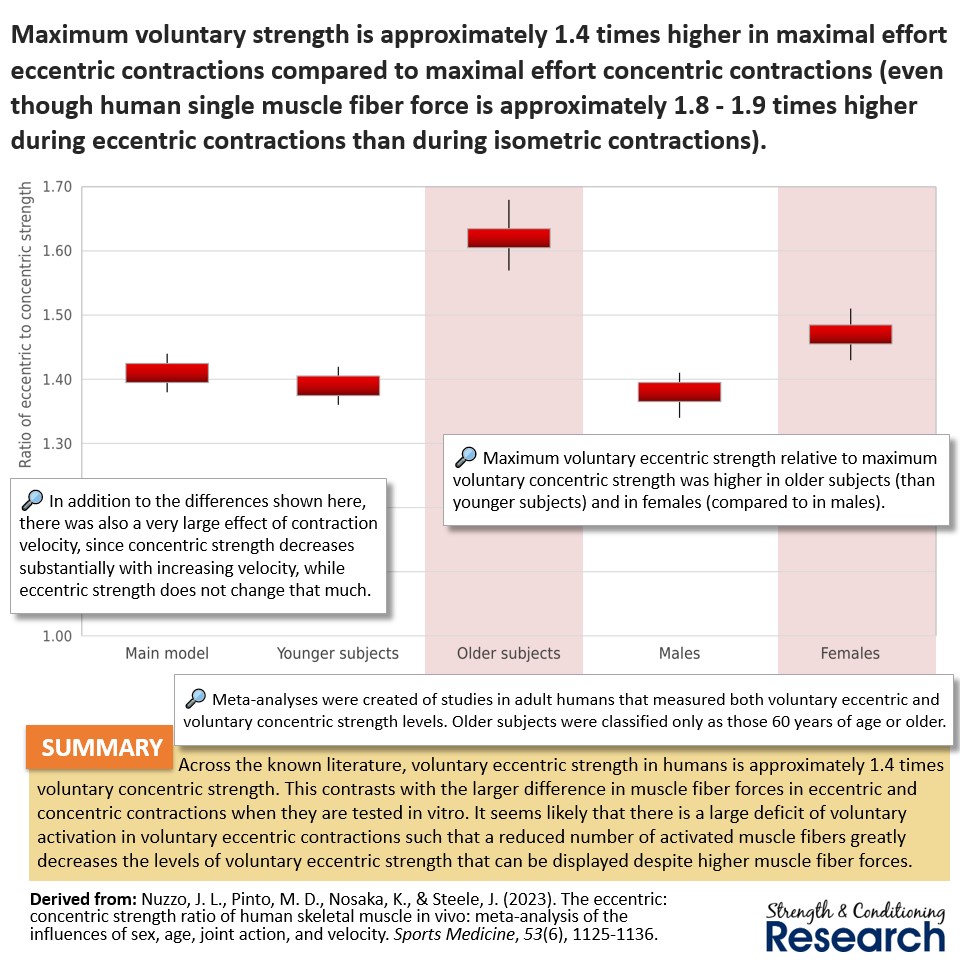
Nice to see people contemplating the results of our recent meta-analysis on eccentric vs concentric muscle strength. @JamesSteeleII @MatheusdPinto

Matheus Daros Pinto retweeted

Even small doses of resistance training can have big benefits.
Some updated evidence on minimal dose resistance training approaches, including:
“Weekend warrior”: a single weekly resistance training session
“Single-set resistance training”: one set of multiple exercises, multiple days per week
“Resistance exercise snacking”: brief bouts performed once or multiple times daily
“Practising the test”: one maximal repetition in one or more sets, multiple days per week
“Eccentric minimal dose”: low weekly volumes of submaximal or maximal eccentric-only repetitions
All can improve muscle strength - and at lower doses than current recommended guidelines.
Nice work from @JamesLNuzzo and co.
link.springer.com/article/10…

Matheus Daros Pinto retweeted
NEW: Our overview of minimal dose resistance exercise is now available @SportsMedicineJ #OpenAccess.
Co-author: @MatheusdPinto
link.springer.com/article/10…

On this day last year, I was awarded the 1st prize for my presentation at the @AusHumanBiology conference. Almost a year later, the paper is now published open access in the @JBiomech.
Thank you reviewers for valuable feedback.
Link: sciencedirect.com/science/ar…
@TonyBlazevich
This Post is from an account that no longer exists. Learn more
Matheus Daros Pinto retweeted
NEW: We updated the REPS-%1RM table that has been printed in the NSCA textbook for ~20 years
One table for leg press
One table for bench press
One table for all other exercises
Published #OpenAccess @SportsMedicineJ
Authors:@MatheusdPinto @JamesSteeleII
link.springer.com/article/10…

Matheus Daros Pinto retweeted
Now in-print: Our overview of muscle fatigue (acute strength loss) during max eccentric vs concentric resistance exercise.
The quadriceps appear more "protected" against muscle fatigue and damage from max eccentrics than arms muscles. @MatheusdPinto
onlinelibrary.wiley.com/doi/…

Matheus Daros Pinto retweeted

If you are interested in #postgraduate #research in human #neurophysiology @EdithCowanUni #Perth register for the below event and come speak to our team on the day. @TonyBlazevich @JamesLNuzzo @MatheusdPinto

➡ Are you a current #student, #alumni or never been to @EdithCowanUni and interested in #postgraduate #research opportunities? Register for our FREE HDR Information Symposium! Only 3 weeks to go!

Matheus Daros Pinto retweeted
NEW: Our latest review
Does acute strength loss (#fatigue) differ after MAX eccentric vs MAX concentric exercise?
Depends on the muscle
Lower-limb muscles appear more protected against acute strength loss & DOMS from eccentrics than upper-limb muscles
Co-author:@MatheusdPinto

Matheus Daros Pinto retweeted
New study on EMG during biceps curls with a dumbbell vs Tonal machine.
@MatheusdPinto & I published 2 similar studies on the Vitruvian machine
1.link.springer.com/article/10…
2.onlinelibrary.wiley.com/doi/…
And a review on CARE technology
link.springer.com/article/10…
nature.com/articles/s41598-0…

Matheus Daros Pinto retweeted
Now in issue
We used the Vitruvian machine and its automatic drop setting to study muscle fatigue during max eccentric, concentric, and eccentric-concentric curls
Men fatigued more w/concentrics
Women fatigued more w/eccentrics
Co-author @MatheusdPinto
onlinelibrary.wiley.com/doi/…


And pre-print access 👇

PRE-PRINT now @SportRxiv
We re-examined the reps-to-%1RM relationship by collating data from every reps-to-failure test we could find
952 tests by 7,270 individuals in 266 studies
Paper is currently under review
Co-authors @MatheusdPinto @JamesSteeleII
sportrxiv.org/index.php/serv…

Matheus Daros Pinto retweeted
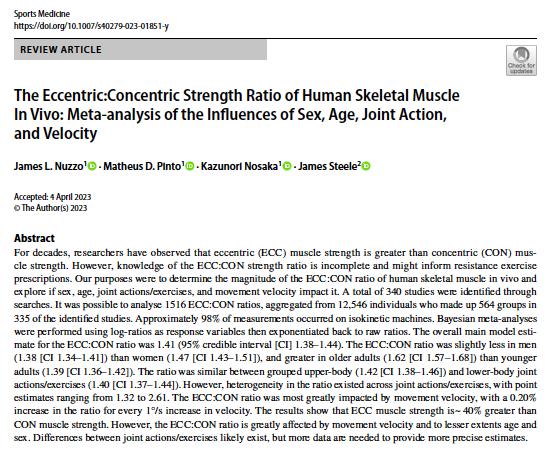
1. NEW: How much stronger are muscles eccentrically than concentrically?
Our meta-analysis of 1,516 ECC:CON strength ratios from 12,546 individuals provides the answer.
Published @SportsMedicineJ #OpenAccess
Data @OSFramework
Co-authors @MatheusdPinto @JamesSteeleII
📢If you are interested in resistance eccentric training, check our latest paper 👇
➡️overview equipment used to deliver eccentric load and their limitations
➡️explain how new technology can optimise delivery of eccentric
➡️Implications to research, S&C, and rehab discussed
NEW: Our overview of CARE technology for delivery of eccentric resistance exercise is now online and #OpenAccess @SportsMedicineJ.
Co-author: @MatheusdPinto
link.springer.com/article/10…

Matheus Daros Pinto retweeted

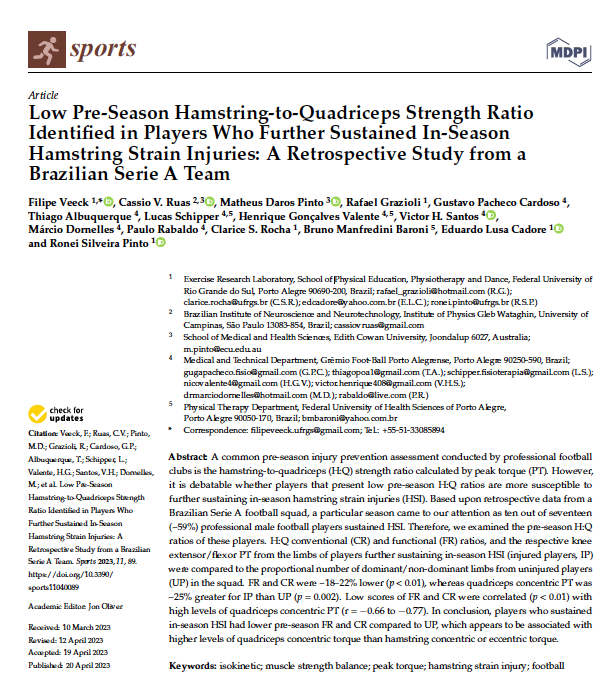
Great to see this paper come out, and to be a part of this amazing collaboration
@FilipeVeeck @MatheusdPinto @ufrgsnoticias @MHS_ECU @Sports_MDPI
Paper full-text: mdpi.com/2075-4663/11/4/89
@Brasileirao @geglobo

Matheus Daros Pinto retweeted
NEW PAPER: Based on my previous research on letters to the editor, I created an assignment intended to help students learn of the role of letters in science. I hope you will consider it for your research methods class.
#OpenAccess @AdvPhysiolEduc
journals.physiology.org/doi/…
