

Founder @ https://xitter.cf/t.co/DW2otSSnZ9 Tech investor & mouse jiggler. Co-founder at https://xitter.cf/t.co/j4B4ZfOaD9. INTJ with a Questioner tendency. 🇨🇦
Somewhere warm
Joined September 2008
- Tweets11.7K
- Following13.4K
- Followers19.8K
- Likes75.7K





Pinned Tweet
Been meaning to post this for quite a few years - mattmickiewicz.com/post/7468…
Google needs to spin-off YouTube as its own separate company and create $300-500b in shareholder value.
META is the cheapest MAG 7 stock right now, trading at 21X vs. 39x for Apple with faster growth, and an actual consumer A.I. strategy.
Wages should go up because employers are competing for workers, not because the government mandates a higher minimum.
Matt Mickiewicz retweeted

Great summary of 100+ rent control studies
tldr: rent control helps existing tenants, but at the expense of almost everyone else


Matt Mickiewicz retweeted

The beginning of Spellbook was also an oddly meditative and spiritual pursuit: Our hypothesis was that if we could access raw reality directly, and disconnect from the sort of "false reality" of popular stories, then we would find alpha in the world.
In some ways the company was a higher level experiment: if we can come to see raw reality with crystal clarity, then alpha should follow. Alpha exists in the gap between popular stories, and raw reality.
We saw business as competitive philosophy. Your score is a direct measure of how good you are at uncovering truth before others.
This continues to provide a great deal of meaning for me: investing and business are a gym that ultimately enable you to build radically clear thinking.
It worked: we raised money for a legaltech company long before it was fashionable (pre-Atrium), and were the first in the world to commercially launch and LLM-based tool for lawyers.
We were making a hard bet that legal AI was needed, based on raw first principles thinking, long before any story had taken hold.
The challenge, though, is that the "raw reality" view that uncovers alpha, is a completely different from the story-telling muscle that excites customers and your team.
The hardest part of business is that you must simultaneously be aware of stories as a pollutant, while still crafting the inspiring stories that ultimately drive most people to action.
Investors/hedge funds have the luxury of only needing to be good at seeing raw reality. They don't need to market their bets. Sales and marketing has the luxury of being able to focus on the stories.
There are very few people who can simultaneously wield the power of stories, while also piercing through the sea of stories, extracting alpha from the raw reality that eludes others.
The ultimate magic is being able to do both.

Realizing how incredibly autistic our early board meetings were for Spellbook:
1. I declared the meeting a “story free zone” because I was worried that stories were too psychologically persuasive, and that they would pull us away from hard data-driven reality
2. Meetings would largely consist of scrolling through like 40 slides of charts sifting for signal. I called this “soaking in the data”
3. In the search for PMF I wanted us to think like a hedge fund making many bets. While we knew the problem we were solving I didn’t want our team to get too tied to any single narrative because I thought it would reduce agility.
4. I never allowed us to think about us as “a company”, but instead as a SWAT team searching for a company to build
5. This approach enabled us to launch over 100 different landing pages with different angles on the way to PMF
Honestly, I think it’s a really good approach pre-PMF. Too many companies get attached to a singular story too early and quit when it doesn’t work out. Startups are 3D chess. There is always a move. Slack was a game company.
However, at Series B/Series C scale you really need stories to align both your team and customers, and you can think much more longterm after PMF.
But I still believe stories are a dangerous dark magic. You can craft an incredibly persuasive story for almost any position. They’re more of a marketing/comms tool than a reasoning/understanding reality tool.
Matt Mickiewicz retweeted

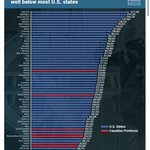
Info for Canadians Under 30
Combined ranking: median income after taxes:
1 Massachusetts $104,828
2 New Jersey $104,294
3 Maryland $102,905
4 Hawaii $100,745
5 California $100,149
6 New Hampshire $99,782
7 Washington $99,389
8 Colorado $97,113
9 Utah $96,658
10 Connecticut $96,049
11 Alaska $95,665
12 Virginia $92,090
13 Delaware $87,534
14 Minnesota $87,117
15 New York $85,820
16 Oregon $85,220
17 Rhode Island $83,504
18 Illinois $83,211
19 Vermont $82,730
20 Arizona $81,486
21 Idaho $81,166
22 Nevada $81,134
23 Georgia $79,991
24 Texas $79,721
25 North Dakota $77,871
26 Florida $77,735
27 Pennsylvania $77,545
28 Wisconsin $77,488
29 South Dakota $76,881
30 Maine $76,442
31 Nebraska $76,376
32 Wyoming $75,532
33 Kansas $75,514
34 Iowa $75,501
35 Montana $75,340
36 North Carolina $73,958
37 Michigan $72,389
38 South Carolina $72,350
39 Ohio $72,212
40 Tennessee $71,997
41 Indiana $71,959
42 Missouri $71,589
43 New Mexico $67,816
44 Alabama $66,659
45 Oklahoma $66,148
46 Kentucky $64,526
47 Arkansas $62,106
48 🇨🇦 Alberta $62,269
49 Louisiana $60,986
50 West Virginia $60,798
51 Mississippi $59,127
52 🇨🇦 Ontario $58,035
53 🇨🇦 British Columbia $55,334
54 🇨🇦 Saskatchewan $55,115
55 🇨🇦 Manitoba $52,560
56 🇨🇦 Quebec $50,224
57 🇨🇦 Newfoundland and Labrador $49,640
58 🇨🇦 Prince Edward Island $48,107
59 🇨🇦 New Brunswick $47,523
60 🇨🇦 Nova Scotia $46,866

This is pretty accurate, but 1*'s depending on the country can be pretty mid.
Most 1*'s I went to in Italy where underwhelming.
Spain and France on the other hand deliver the goods.

I have a completely unscientific theory about Michelin restaurants:
1 star: Fantastic. Great food, serious cooking, no nonsense.
2 stars: Often unbearable. Haute cuisine at its most self-conscious. 14 courses, tweezers, foam, and an elaborate philosophical explanation of a carrot.
3 stars: Somehow fantastic again. The absurdity becomes so extreme, the execution so extraordinary, that it transcends pretension and becomes art.
The Michelin paradox: 1 is great, 2 is terrible, 3 is sublime.
Muse and Instinct have gotten very lazy this week.
Tab continues to crush it on perseverance and task completeness.


Matt Mickiewicz retweeted

Once again the Canadian government FAILS to understand the problem
I would know, I founded and ran a tech company for a decade and raised MILLIONS from investors
And it was HORRIBLE doing business here
Let me explain
This isn't a "money issue"
This is a regulatory, economic and taxation issue combined with a deep cultural problem
Back in 2015 I founded a tech company, using my own money from working in the Alberta oil field
We developed our MVP in Montreal and launched our proof of concept right here in the West Island
Our first ever investors were our own first clients. We raised $150,000 from them
But things got harder when it came time to raise our seed round
I met with EVERY SINGLE VC in Montreal.
All told us NO
Why?
Too risky
lol... its the very definition of Venture Capital
They wanted a pitch deck, projections on 5 years, cashflow, business plan, go-to-market strategy, communication strategy, marketing strategy, Tech reviews, C.V. of founding team, financial disclosure etc
We spent more time preparing documents for them than we did scaling our business
Worse of all, they all wanted something different and would give contradicting requirements
I remember this interaction at the Espace CDPQ, the headquarter for all Venture firms in Montreal
ie:
Investor: How much do you need
Me: $1 Million
Investor: So if you only raise $750k what happens?
Me: Well we'll adapt XYZ
Investor: So then never EVER tell me a fix number. Give me a range. $750K-$1.5M or else you look foolish
I went home, reworked the pitch deck
The very next day:
New investor: How much you need
Me: $750K-$1.5M
New investor: What... you don't even know your number???
Me: well... yes but what if we raise less or more
New Investor: No, you look foolish
We said screw it. Approached American Investor
Our first was a VC firm out of Houston, Texas
Took less than 1 month from initial pitch, to closing.
In USD. For more money than what Canadians wanted to offer.
Best of all, they understood the fluid nature of a startup. No onerous and rigid plan. No overburdened documentation. Every second wasted on non-operating activities was sucking productive time away from scaling.
But Elliot... what about BDC and other AMAZING institutions in Canada
We did business with the BDC. a $250,000 loan. Which I had to personally guarantee.
Which 25 year old has assets and the balls to guarantee that amount? Very few. It's prohibitive. And reduces capital available to our homegrown companies
And this was AFTER MONTHS of explaining to them what we were doing. It was clear the BDC was setup to support traditional brick-and-mortar companies only.
Think Manufacturers or Commerces. But a tech startup? They could NOT wrap their heads around it.
Canadian banks? Forget it. Outright. Too risky
Then I watch fellow startups do the same. And move to the US.
Why wouldn't they?
In Quebec, I had to pay an extra 15% on top of my payroll as taxes. QPIP, QPP, FSS, CNESST... all to satisfy the government non-stop appetite.
Consequences: Well for a startup where every dollar counts, this means lower salaries thus harder to attract top talent (vs American competitors)
or
I simply hired less staff... thus slowly growth for both my company and the country's economy.
But wait it gets worse.
Revenue Quebec and CRA both required a plethora of compliance documents filled monthly or quarterly. GST and QST tax fillings, CNESST Salary equity (yes lol) documents, Source deduction documents, RL-1 fillings, Income tax (both QC and CAN), Workplace sexual harassment policy, OQLF policy, CNESST training and certification... the list goes on
At least 1 day a month was spent by me and some of my executives preparing and fulfilling these documents. This means we were't scaling our business and instead working for FREE for the government.
Then there is the tax burden.
Why would top talent want to come here and get taxed at up to 52% marginal rate?
While a Miami startup offers higher salary and the State taxes you 0%
Finally investor behaviour
In Canada... safe. steady return. Great for a Series C. Great for an established companies. No desire for risk. No understanding of the ecosystem.
HORRIBLE FOR VENTURE
Meanwhile the U.S. , they understand the ecosystem. 90% of their investment will go down to 0. But the few that survive will go on to earn them BILLIONS and change the world.
So this new announcement of $1.75Billion won't change the underlying issue that makes us uncompetitive.
At best, it will go to startups who will flee to the US the very second the money hits
At worse, it will just be another slush fund given to friends of the government
and I fear its the latter as usual

Ottawa kicks off process to give $1.75-billion boost to venture capital sector
theglobeandmail.com/business…

Agree 100%:

I’ve increasingly come to worry about the rise of “judicial nihilism” (for lack of a better term) in Canada.
We have a justice system that spends enormous energy considering the personal circumstances of offenders, their rights, identities, mental health, and prospects for rehabilitation. Yet it seems unconcerned with the victims whose lives have been destroyed, or the public that must live with the consequences when dangerous individuals repeatedly reoffend.
I think we need to take judicial reform more seriously, rather than dismissing concerns about overreach and malfeasance as conservative fearmongering.
The more I look at recent cases (many highlighted by @sarkonakj) the more concerned I become that our institutions are losing sight of some basic moral values in justice.
I’ve been thinking about the
principles that should guide us to a more liberal, rules-based approach to criminal justice (I’ll admit that this is hardly new thinking, but I can’t remember the last time I’ve seen them laid out):
1. Justice should begin with victims, whose suffering should never become secondary to the circumstances of offenders.
2. Protecting the public from dangerous individuals must be a central responsibility of sentencing, and we should lean towards caution.
3. Punishment must be a meaningful deterrent and reflect the gravity of crimes. Some crimes warrant permanent imprisonment (if not capital punishment). Some crimes are so heinous that the mere prospect of rehabilitation should not be considered.
4. Repeat offenders should face dramatically greater consequences, including long-term incarceration or asylum to protect society. Nobody with dozens of separate criminal convictions should be roaming freely.
5. Mental illness should determine treatment and facility type, not reduce punishment. The bar for criminal non-responsibility should also be much higher than it is today.
6. Sentencing must apply to those convicted equally, based on actions and responsibility, not race, religion, cultural identity, immigration status etc. The rule of law should be non-discriminatory, the right time to address the “root causes” of crime and pursue social justice is before crime is committed.
7. Parliament needs to figure out how to reclaim its authority, with courts exercising much greater restraint in constitutional interpretations.
8. Judicial “independence” must be balanced with meaningful accountability for serious failures and overreach. The judiciary is not supreme to legislature.
I worry that too many political leaders have become uncomfortable defending the very concepts of order, punishment and personal responsibility, as though doing so is somehow incompatible with liberal moral values.
They aren’t.
A liberal democracy has two fundamental obligations. To protect people from the arbitrary exercise of government power, and to protect them from the violence and predation of others.
We cannot fulfill one by neglecting the other. They are together the necessary preconditions for liberty.
When the public sees rulings that seem fundamentally disconnected from shared expectations of right and wrong, it erodes trust in the system.
Order and public safety are necessary conditions for freedom.
The freedom to walk down the street, take public transit, operate a business or simply live peacefully in your own home means little if the government cannot protect you from disorder, violence and criminality. It’s often those with the fewest resources who suffer most when that protection fails.
If we want Canadians to have faith in the rule of law, they need to believe that it applies equally, that serious wrongdoing carries serious consequences, that dangerous people will not repeatedly be allowed to victimize others, and that the system will not be careless with the lives and suffering of victims.


We need different judges.
Murder parole rules ‘unconstitutional’, B.C. judge rules
theglobeandmail.com/canada/a…

Matt Mickiewicz retweeted
Realizing how incredibly autistic our early board meetings were for Spellbook:
1. I declared the meeting a “story free zone” because I was worried that stories were too psychologically persuasive, and that they would pull us away from hard data-driven reality
2. Meetings would largely consist of scrolling through like 40 slides of charts sifting for signal. I called this “soaking in the data”
3. In the search for PMF I wanted us to think like a hedge fund making many bets. While we knew the problem we were solving I didn’t want our team to get too tied to any single narrative because I thought it would reduce agility.
4. I never allowed us to think about us as “a company”, but instead as a SWAT team searching for a company to build
5. This approach enabled us to launch over 100 different landing pages with different angles on the way to PMF
Honestly, I think it’s a really good approach pre-PMF. Too many companies get attached to a singular story too early and quit when it doesn’t work out. Startups are 3D chess. There is always a move. Slack was a game company.
However, at Series B/Series C scale you really need stories to align both your team and customers, and you can think much more longterm after PMF.
But I still believe stories are a dangerous dark magic. You can craft an incredibly persuasive story for almost any position. They’re more of a marketing/comms tool than a reasoning/understanding reality tool.
Matt Mickiewicz retweeted

In Canada, you can randomly kill a CBC journalist, and get out of prison to do more crime in just 1.5 years.
This is bullshit. Our criminal justice system is completely broken.
The Liberals who broke it aren’t going to fix it.
cp24.com/local/toronto/2026/…

Matt Mickiewicz retweeted

Bernie Sanders says the top 1% owns more than the bottom 93%, that fewer than a thousand billionaires got $2.2 trillion richer last year, and that it's "obscene."
It's the most seductive and most wrong economic argument of our time. Let me explain why.
First, wealth distribution follows a power law. Always. Everywhere. Books, music, startups, followers on X, goals in soccer. A small minority captures most of the value. That's not a bug of capitalism. It's the mathematical signature of every system where value gets created.
So the only question that matters isn't "how big is the rich's slice?" It's "is the cake growing, and is the slice of the poorest growing with it?"
And the answer is yes. In 1990, more than one human in three lived in extreme poverty. Today it's about one in ten. During exactly the period when billionaires multiplied.
Bernie shows you the slice. He never shows you the cake.
Second thing he won't tell you: past a certain level, wealth stops being consumption. It becomes capital allocation.
Elon Musk isn't sleeping on a pile of cash. He owns stakes in Tesla, SpaceX, xAI. Jeff Bezos owns Amazon stock. That "$2.2 trillion" isn't sitting in a checking account. It's factories, rockets, data centers, millions of jobs. Nobody can eat $100 billion. You can only decide where to invest it.
Once you understand that, the whole debate changes. The real question becomes: who allocates capital better?
The people who built Amazon, SpaceX and Nvidia? Or politicians?
A 5% wealth tax isn't "taking money from the rich." It's taking investment decisions away from people who proved they can create value and handing them to people who proved the opposite.
Because the fundamental difference between an entrepreneur and a politician is consequences.
The entrepreneur invests his own money. If he allocates badly, he loses everything. The market corrects him brutally, no appeal. That's why most startups die: the system kills bad decisions.
The politician invests other people's money. If he allocates badly, nothing happens. Worse, he gets a bigger budget to "fix the problem."
Milton Friedman put it better than anyone. There are four ways to spend money. Your money on yourself: you care about price and quality. Your money on others: you care about price. Others' money on yourself: you care about quality. Others' money on others: you care about nothing.
Government is the fourth box. By design.
Perfect example: California high-speed rail. Approved in 2008 for about $33 billion. Current estimated cost: over $100 billion. Passengers carried: zero. No entrepreneur would have survived that. The politicians who pushed it built careers on it.
And when allocation has no consequences, it eventually finds a buyer. A politician who controls billions without accountability becomes the most profitable target in the world for anyone who wants to steer that money.
The irony is that the left that rails against billionaires is itself funded by billionaires. George Soros is one of the biggest Democratic donors in history. The Gates Foundation shapes public health policy across the planet.
Politicians don't fight billionaires. They pick their own. The ones who fund the state over the ones who compete with it.
So if we actually want fewer poor people, we have to stop judging ideas by their intentions and start judging them by their results. And the results are brutally clear.
China, 1978: Deng Xiaoping opens the economy to markets. More than 800 million people escape extreme poverty. The largest retreat of misery in human history. Not through redistribution. Through the freedom to build.
India, 1991: liberalization. Same movie.
South Korea and North Korea: same people, same language, same starting point in 1953. One became one of the most advanced economies on earth. The other has famines.
Poland and Ukraine: comparable living standards in 1990. Today the average Pole is more than three times richer than the average Ukrainian.
Argentina: a year and a half of liberalization, and the poverty rate falls from over 50% to around 30%.
No country in history escaped poverty by punishing the people who build. Every single one did it by letting them build.
And if you want to see what Bernie's program looks like in real life, you don't have to imagine it. It exists. It's called France. We've been running it for 45 years.
Mass nationalizations in 1981. Two years later, Socialist president Mitterrand has to reverse course into austerity.
Retirement at 60. The 35-hour workweek.
A wealth tax for 35 years. Hundreds of wealthy households left every year for Belgium, Switzerland, London, taking their capital, their companies and their future taxes with them. Macron finally scrapped it in 2018.
Hollande's 75% tax: raised a few hundred million, drove talent out, abandoned after two years.
One of the highest tax burdens in the OECD. Public spending around 57% of GDP, a record in the developed world.
Last balanced budget: 1974. Public debt: over €3.4 trillion. Mass unemployment for four decades.
If taxing the rich and growing the state made people prosperous, France would be the richest country on the planet.
It isn't. GDP per capita in France is barely more than half of America's. It's lower than Mississippi, the poorest state in the US. Not a single global tech giant. Our best engineers build Silicon Valley instead. I've been going back and forth between Paris and San Francisco for years. I see it every week.
And California is about to replay the movie. Prop 40, on the ballot November 3rd, would take 5% of billionaires' net worth. Even Gavin Newsom, a Democratic governor, opposes it. The state's own nonpartisan budget analyst warns that income tax revenue could drop every year if the wealthy leave. Larry Page, Sergey Brin and Peter Thiel have reportedly already started moving their assets out.
You don't fight poverty by shrinking the top. You fight it by growing the cake.
Bernie wants a society where nobody has too much. I want a society where nobody has too little.
The first has been tried everywhere and produces equality in stagnation. The second lifted a billion people out of misery.
Choose.
