

10+ years of personal experience merged with scientific insights to empower your journey to better health and well-being. No medical advice!
Joined October 2023
- Tweets21.8K
- Following1.7K
- Followers22.4K
- Likes5.8K




Pinned Tweet
My message is pretty simple. No matter how weak you might feel, how unhappy you are about your body, your performance, your job, your financial status, or your relationship…
It is never too late to start having positive thoughts about yourself, a positive outlook, the will to change, and a goal that you set for yourself and follow no matter what.
Don’t underestimate how heavily your belief in yourself weighs on any outcome in your life.
If you can’t believe in yourself, nobody else will.
One of the many things that I learned during my own transformation:
You can dream big about your destination, but do not force yourself to get there with an unrealistic time goal. It will only set you up for failure, or it will force you to chase shortcuts.
Shortcuts usually lead to broken dreams.
Take your time with whatever goal you might set for yourself. Many little steps over a long period of time will carry you much farther than large and hasty steps.
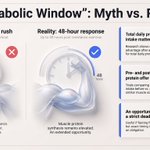
Ever heard of the anabolic window? It's the period after exercise when your muscles are especially responsive to nutrients that support repair and growth.
For years, fitness advice claimed you had just 30 to 60 minutes to consume protein before that opportunity disappeared. But how much does timing really matter?
Resistance exercise increases muscle protein synthesis. Your body uses amino acids from food to repair and build muscle.
Leucine is one of the key signals that activates this process. It's found in many protein sources and is particularly concentrated in whey. Other amino acids provide the building materials for muscle growth and countless functions throughout the body.
This is where protein timing comes in.
Whey and essential amino acid mixtures can raise blood amino acid levels quickly. A regular mixed meal digests more gradually and supplies amino acids over several hours.
The difference is how quickly those nutrients become available.
When amino acid availability is low, fast protein can stimulate muscle protein synthesis sooner. But once sufficient amino acids are available, delivering more or delivering them faster does not necessarily increase the muscle-building response.
Even a stronger short-term response does not automatically mean more muscle growth over time.
WHAT THE RESEARCH SHOWS
Human studies have found:
- Muscle protein synthesis can remain elevated for up to 48 hours after resistance exercise in the studied conditions.
- A 2013 meta-analysis found no significant independent timing advantage for muscle growth after accounting for daily protein intake.
- A trial comparing protein immediately before versus after training found similar gains in muscle size and strength.
- A 2025 meta-analysis found no clear difference in lean body mass between pre-workout and post-workout protein intake, although the evidence remains limited.
These findings support a wider recovery opportunity than the traditional 30- to 60-minute rule suggests.
Your previous meals also matter. If you ate a substantial protein-rich meal before training, amino acids may already be available when your workout ends.
A rapid protein shake may raise their concentration sooner. A slower meal can still support muscle protein synthesis across a longer period.
Neither approach has demonstrated a universal advantage for long-term muscle growth.
WHEN POST-WORKOUT PROTEIN MAKES SENSE
Eating protein soon after training is particularly useful when you haven't eaten for several hours. It supplies amino acids rather than extending a period of low availability.
A regular protein-rich meal can accomplish this. Whey or essential amino acid mixtures offer faster delivery and convenience, but aren't required.
Spreading protein across several meals may also improve repeated muscle protein synthesis responses. That can be worth considering when maximizing hypertrophy is the priority.
The overall nutritional picture matters too.
Whey and lean muscle meat provide abundant essential amino acids but relatively little glycine compared with collagen-rich foods. Gelatin and connective tissue can complement these sources. Adequate calcium also deserves attention, especially when a diet is dominated by meat and protein powders.
Recovery also requires energy. Carbohydrates support training performance and glycogen replenishment. They can help reduce reliance on amino acids for glucose production when carbohydrate availability is low.
WHAT MATTERS FOR YOU?
For most people, sufficient high-quality protein providing all essential amino acids, adequate energy and consistent training matter far more than the exact timing of a meal.
Eating after training is useful. So is spreading protein across several meals. Neither needs to become an obligation.
Professional bodybuilders optimize countless details because maximizing muscle growth is their primary goal.
If you're training to stay healthy, get stronger, build some muscle and remain physically capable, you don't need to copy every part of that routine.
Take advantage of convenient timing when it fits your day. If your next meal comes a few hours later, your workout hasn't been wasted.
The anabolic window is an opportunity, not a deadline.
General information, not medical advice.
See below more about protein quality, amino acid and mineral balance, carbohydrate fueling and situations where timing deserves more attention, with a practical checklist.


When colder days arrive, many people naturally replace cold drinks with large thermoses of hot tea. And while tea can offer plenty of benefits, there's something worth knowing: not all fluids hydrate equally, and drinking more doesn't necessarily mean retaining more.
WHY YOUR DRINK MATTERS
Your kidneys continuously regulate how much water your body keeps.
When you drink large amounts of plain water, your blood becomes temporarily more diluted. This reduces vasopressin, a hormone that helps your kidneys conserve water.
The result is increased urination.
Electrolytes and nutrients influence this process, helping explain why different drinks can produce surprisingly different results.
WHAT HUMAN STUDIES FOUND
In a study comparing 13 everyday beverages, researchers gave participants equal amounts of different drinks and measured how much fluid their bodies retained.
The results were surprisingly different:
- Whole and skimmed milk retained significantly more fluid than plain water.
- Skimmed milk ranked highest numerically, closely followed by oral rehydration solution and whole milk.
- Tea and coffee provided hydration comparable to plain water.
- Orange juice also showed an early fluid-retention advantage.
Another experiment found that milk helped people retain substantially more fluid after exercise-induced dehydration than plain water.
A more recent human study confirmed that milk could remain in the body longer than water, fruit juice and sports drinks in younger adults.
Milk's advantage makes physiological sense. It contains protein, carbohydrates and electrolytes that influence digestion and fluid regulation.
THE WINTER CONNECTION
Different teas offer useful plant compounds, from increased alertness to relaxation, depending on the variety.
But several large cups prepared with very-low-mineral water provide little calcium or magnesium.
Large fluid loads also increase urine production and can alter urinary electrolyte excretion. This makes mineral balance particularly relevant when your diet already supplies insufficient minerals.
And although you generally sweat less during winter, your nutritional needs remain.
Fortunately, some of the most enjoyable cold-weather options also provide substantial nourishment:
- Warm milk with honey combines fluid, protein, calcium, potassium and carbohydrates.
- Homemade broths and hearty stews provide water alongside sodium, protein and other nutrients.
- Mineral-rich spring water, including sparkling varieties, can contribute meaningful calcium and magnesium.
- Orange juice supplies water, potassium, natural sugars and vitamin C.
For people sensitive to conventional cow milk, A2 cow milk or goat milk may offer better digestive tolerance due to differences in their beta-casein proteins.
THE TAKEAWAY
Enjoy your tea. But when warm drinks start replacing most of your other beverages, it's worth paying attention to what those drinks actually provide.
Especially if your diet is already low in minerals, a little awareness of your fluid choices can make a meaningful nutritional difference.
Mineral-rich water, milk and nourishing warm meals can help maintain that balance throughout the colder months.
The composition of your drink matters, not just how much you consume.
General information, not medical advice.
More about fluid retention, mineral balance, milk and A2 alternatives, orange juice, nourishing winter drinks, and a practical checklist in the comments.


Have you heard that you should take a deload week every four weeks to keep building muscle? The idea is to deliberately train less so your body can recover. But does your body actually need a scheduled break, or could you be slowing your progress by resting when you don't need to?
WHAT DOES THE RESEARCH SHOW?
A deload is a temporary reduction in training stress. Usually, that means fewer sets, lighter weights, or fewer workouts.
The goal is to recover without losing the muscle and strength you've already built.
Human studies have found:
- Taking one full week off during a 9-week training program showed no clear difference in muscle growth, power, or muscular endurance compared with continuous training. But uninterrupted training produced greater strength gains.
- In a 2026 study, beginners who trained substantially less during scheduled deload weeks achieved similar muscle growth and strength-endurance improvements to those who continued training.
- Other research found that previously gained strength can be maintained for extended periods with much less training volume.
A lighter week does not necessarily erase your progress. But these results also do not show that automatically scheduling frequent deloads makes you build more muscle.
WHAT ABOUT RECOVERY?
Hard training creates fatigue that temporarily reduces your ability to perform.
In one experiment, central nervous system fatigue recovered sooner than some other aspects of fatigue, while overall neuromuscular performance took up to 72 hours to fully recover after demanding sessions.
These were short-term measurements, not proof that longer-term fatigue cannot accumulate.
Your recovery also depends on workload, sleep, and nutrition. Tendons adapt more slowly than muscles and may benefit from temporarily reducing repeated heavy loading.
Mental fatigue matters too. Prolonged concentration can make repeated exercise harder, even without reducing measured maximum muscular strength. A mentally exhausting day does not automatically mean your muscles need a week off.
WHEN SHOULD YOU DELOAD?
Your calendar cannot measure how recovered you are.
Instead, pay attention to patterns:
- Strength declining across several workouts
- Unusual fatigue that persists despite normal rest
- Joint or tendon discomfort that keeps returning
- Increasing difficulty recovering between sessions
These are reasons to reassess your training, not automatic proof that you need a full week off.
WHAT THIS MEANS FOR YOU
If you're getting stronger, recovering well, and your joints feel good, there is little reason to interrupt training just because four weeks have passed.
If fatigue is building, temporarily reducing your training volume can provide relief while keeping your muscles active.
Sometimes shorter sessions, familiar exercise variations, or less mentally demanding workouts can help you maintain consistency without forcing another exhausting session.
The goal is to train hard enough to make progress while recovering well enough to keep making it.
Let recovery guide your training, not an arbitrary calendar.
In the first comment, you can find more about practical workload adjustments, mental fatigue, training variety, and when complete rest makes sense... plus a quick checklist.


Two meals can contain the same calories, yet your body may burn different amounts of energy processing them. Protein requires considerably more work than carbohydrates or fat.
But how much energy does digestion actually consume, and does that difference meaningfully affect your metabolism?
WHY EATING INCREASES ENERGY EXPENDITURE
Food must be broken down, absorbed, transported, and processed for use or storage. All of this requires energy.
The temporary rise in expenditure after eating is called the thermic effect of food (TEF).
Typical estimates are:
- Protein: roughly 20-30% of its calories
- Carbohydrates: roughly 5-10%
- Fat: roughly 0-3%
For example, processing 100 calories of protein may expend around 20-30 calories. The same amount of carbohydrate or fat generally costs less. These are broad estimates, not exact values for individual meals.
WHY PROTEIN GENERATES MORE HEAT
After digestion, amino acids are used to build and replace proteins throughout your body. This continual work costs energy. When amino acids are broken down, the liver also processes their nitrogen for excretion.
These steps help explain why protein usually produces the largest thermic response. A systematic review of 52 studies found that higher-protein meals increased post-meal energy expenditure compared with lower-protein meals.
HOW MUCH DOES IT MATTER OVER A DAY?
TEF commonly accounts for about 5-15% of daily energy expenditure. It is a real part of metabolism, alongside the energy required for basic functions and physical activity.
But a single-meal response is not the same as a full-day result. Mixed meals, measurement duration, and the rest of the diet all affect what researchers observe. In the same 52-study review, longer-term higher-protein diets modestly increased total daily expenditure, but did not show a significant difference in measured TEF itself.
IS A HIGHER THERMIC EFFECT BETTER?
That depends on the goal. Extra expenditure may help someone trying to lose fat. Someone trying to gain weight must supply enough energy to cover it. Neither outcome follows predictably from TEF alone.
Appetite, spontaneous movement, and other metabolic processes also influence overall energy balance. A higher TEF does not guarantee more fat loss or better metabolic health. It also does not mean that replacing more and more carbohydrate with protein is necessarily a better diet.
If you track calories, do not subtract a theoretical 20-30% from protein in your food log. Digestion already contributes to total expenditure. Subtracting that cost again from an intake target based on your actual maintenance needs can double-count it.
The purpose of eating is to supply your body with energy and nutrients, not to make their processing as expensive as possible.
Protein's higher processing cost is worth understanding. But the value of a meal depends on what it supplies and how it fits your needs, not simply how much energy your body spends handling it.
General information, not medical advice.
Check the first comment for references and a publicly available cheat-sheet and action plan that explains how to interpret the percentages, food forms, and real-world energy balance.


Your brain can make your muscles give up earlier, even when they haven't lost their strength. Researchers have measured how prolonged mental effort reduces physical performance, from cycling endurance to repetitions in the gym. The surprising part is what changes, and what doesn't.
WHEN MENTAL FATIGUE BECOMES PHYSICAL
Physical performance depends on more than the energy available in your muscles. Your brain also helps regulate how demanding an activity feels and how long you can keep going.
After prolonged concentration, difficult decisions, or sustained attention, a familiar physical workload may feel harder. You can reach the point where you stop exercising earlier, even when your muscles remain capable of producing the same force.
Researchers have measured this difference in controlled experiments:
- After 90 minutes of demanding cognitive work, participants cycling at a fixed intensity lasted 640 seconds compared with 754 seconds after a mentally undemanding activity.
- In another experiment, sustained muscular endurance fell by 13%, despite no significant reduction in maximum voluntary strength or measured muscle function before exercise.
- A meta-analysis of 11 randomized studies found that demanding cognitive tasks reduced subsequent resistance-training volume, particularly in exercises involving multiple joints.
These findings reveal an important distinction: how much muscular force you can produce and how long you can sustain physical effort are not necessarily affected in the same way.
WHY SOME WORKOUTS ARE AFFECTED MORE
The effect appears particularly relevant for prolonged endurance exercise and repeated strength-training sets.
Brief maximal efforts, such as explosive movements, generally appear less affected. Mental fatigue may therefore influence how much work you can sustain more than the maximum force you can produce in a single effort.
One proposed explanation involves changes in brain signaling, including adenosine, a substance involved in regulating alertness and fatigue. Such changes could influence the perceived effort required to continue exercising, although this precise mechanism has not been directly demonstrated in humans.
There is still uncertainty about how large and consistent the performance effect is. Some analyses have identified possible publication bias, which can exaggerate average benefits or impairments when positive results are more likely to be published. The experiments also largely involve controlled mental tasks rather than ordinary working days.
Nevertheless, the findings illustrate a useful possibility: an unusually difficult workout does not automatically mean your muscles have become weaker or your fitness has declined.
MENTAL EXHAUSTION AND THE BENEFITS OF MOVEMENT
There is another interesting side to this relationship. Mental fatigue can make exercise harder to sustain, while exercise itself can improve mood and increase feelings of energy.
After a day spent sitting, concentrating, and looking at screens, physical activity can provide a welcome contrast. Walking through a forest, training outdoors in natural light, or simply moving away from a demanding indoor environment may feel restorative rather than exhausting.
How difficult an exercise session feels and how energized you feel afterward are different outcomes. Both matter when deciding what kind of activity is appropriate.
LEARNING TO LISTEN TO YOUR BODY
The answer is not to skip exercise whenever you feel tired. Mental exhaustion and physical exhaustion are different, and movement itself can sometimes leave you feeling more energized than before.
But neither is the answer to force every workout regardless of how you feel. Poor recovery, illness, and genuine exhaustion deserve attention, especially when your body is already dealing with substantial physical stress.
The useful skill is learning to recognize the difference. Sometimes a walk outdoors or a familiar warm-up reveals that you simply needed to get moving. Other times, unusually demanding exercise, persistent fatigue, or signs of illness suggest that additional recovery is the better choice.
And that judgment should not be completely dictated by a wearable score or a rigid schedule. Research has shown that negative sleep feedback can itself influence perceived fatigue and certain aspects of cognitive performance. Constantly chasing perfect recovery numbers can turn healthy routines into another source of pressure.
Your body provides information that no single score can capture. The goal is to understand its signals through experience, without confusing ordinary reluctance with genuine exhaustion or allowing expectations to determine how you feel.
Building strength, improving fitness, or changing your body also requires showing up on days when motivation is low. But showing up doesn't always have to mean repeating the same workout. When a routine starts feeling like a mental burden, changing exercises, training styles, or surroundings can help keep movement engaging while still working toward your goals.
Consistency builds progress. Flexibility helps you sustain it.
General information, not medical advice.
Check the first comment for references and a publicly available action plan that covers how to assess and adjust demanding workouts, use training variety and outdoor movement, manage pre-training mental load, and interpret recovery signals without overreacting.

