

https://xitter.cf/t.co/Szx8LdECse -Open-Source OpenClaw Voice App with live canvas generation | https://xitter.cf/t.co/O0Dc1Y4rak
Toronto, Ontario
Joined January 2022
- Tweets10.1K
- Following3.1K
- Followers3.8K
- Likes12.8K


Pinned Tweet
OpenVoiceUI -The first Open-Source Voice App that uses @openclaw and can create apps, websites, and anything you ask for like a hands free AI operated Computer.
Now with one click installer with pinokio.co by @cocktailpeanut


MetaMike retweeted

Higgsfield promised to open-source their entire platform. They didn’t.
Let's help them.
For the next two weeks, Comfy and our partners are putting up $25,000 in prizes for the best open-source builds on the Comfy Developer Platform.
Partners: @NVIDIAAI, @runpod, @MiniMax_AI, @ltx_io, @bfl_ai
→ $10K grand prize
→ RTX 5090: Most Innovative
→ RTX 5090: Most Viral
→ RTX 5090: Open Weights Only
→ 10 runners-up: $250 in Comfy credits

MetaMike retweeted
You’re using Jev wrong.
Without a decision graph, you pay a model call for every row, even the obvious ones.
rulesmith has DSPy write the graph over your fields, so Jev only judges the hard cases. Job fraud, fine-tuned 4B judge: +6.7 pts accuracy, 29% of the calls.


MetaMike retweeted

Stripe can shut down your business in one email and then refuse to tell you what you actually did wrong.
That’s exactly what happened to us.
MacWall had:
• thousands successful payments
• ONE $3.99 chargeback
• real software + real customers
Then @Stripe suddenly closed our account for vague “business model risk.”
Since then:
• 5 days waiting
• 10+ emails
• multiple support chats
• full compliance + policy cleanup
• documents offered
• formal complaint submitted
And still no specific violation. No actionable explanation. No real answer.
Meanwhile payouts are frozen and legitimate customers are being refunded i am not asking Stripe to expose some secret fraud algorithm.
Just tell us what MacWall actually did wrong.
If we violated a policy, name the policy.
If something needs fixing, tell us what to fix.
If the risk system made a mistake, have a human review it.
A payments company this important should not be able to destroy a small business relationship with a vague sentence and then disappear.
@stripesupport @Stripe we need an actual answer.
Indie founders deserve better than this.

MetaMike retweeted

Claude Opus 5.5 just took a big drop on NerfBench.
Yesterday it was scoring above launch. Today it's at 94.2%.
GPT 6 Astra: 98.0%
Sonnet 5.5: 100.9%
GPT 6.1 Sol: 106.7%
94.2% is still inside normal variance, so we can't call it a nerf yet.
But we're watching Opus 5.5 very closely.
MetaMike retweeted
I ran out of my entire weekly limit on the $500 ChatGPT Pro Max plan in under 30 minutes.
GPT 6 Astra Ultrafast.
0% left until October 6.
OpenAI just scammed everybody.

MetaMike retweeted

7-Zip has no company, no ads, and no donate button.
One Russian programmer has maintained it alone since 1999. He refuses money and almost never speaks.
Half the internet zips files through one hermit's hobby.

I asked my SMS Jam-bot agent to: make me a character intro (like actor intros at the start of a tv show) for all the characters in our character folder with some cool music and each of them introducing themselves
Here’s what I got first cut no edits….
I asked my Video Agent:
Make a cinematic emotional video to match this song using this character, truck and the shop, have him wearing a cowboy hat….
This is what I got no edits still rough draft no edits, whole video planed and rendered autonomously with @Hailuo_AI and @Grok
MetaMike retweeted

Ironed out the last performance issues with my full 2.5m line codebase explorer. 120hz awesomeness. Can only upload 60fps video tho. Much nicer uncompressed
MetaMike retweeted

Is OpenAI Mining Your Secrets? The Navier-Stokes Scandal is a warning to every CEO
Your proprietary IP is currently being used to train your biggest competitor.
The Navier-Stokes dispute isn't just about math. It is a terrifying preview of
how OpenAI and others can consume the value of the companies building on top of it.
This is the ultimate story of platform risk.
Two mathematicians spent a year putting unpublished, breakthrough work into Codex.
The moment rumors of their success reached OpenAI, the lab suddenly "discovered" a near-identical result.
Buckmaster and Alpöge followed a narrow, specialized path almost nobody else was on.
They used Lean-checking. They made real progress.
Then the other story arrived.
OpenAI privately claimed an internal model produced a Navier-Stokes proof using the same specialized route.
It happened in the same week they heard the rumors.
Buckmaster asked the question every customer should now be asking:
"We stored every draft in your tool. Did that data touch the model?"
On training, he got no clear answer.
Then authorship entered the room.
The suggestion: Drop the human co-author. Credit the model. Share the glow of a million-dollar prize.
OpenAI denies this. No public proof has been released.
But the mechanism is here. And it is bigger than mathematics.
If you are building software on OpenAI, you are doing a milder version of the
same thing.
You are uploading product specs, architecture, and the code that IS your
company.
Those drafts do not live in a private notebook.
They live inside a vendor that wants to own the next layer of software.
This is the existential threat boards must confront immediately.
A model subscription is not a moat. It is rented intelligence.
The moment the vendor can do the work itself, or train on your adjacent work, your "AI strategy" becomes an R&D donation.
Companies need to build moats the old way:
1. Own the workflow, not the prompt.
2. Own the proprietary data the model never keeps.
3. Own the distribution and customer context.
4. Put the crown jewels behind private inference paths you can audit.
Assume anything you paste into a frontier lab's product will one day inform a
competitor.
That includes the lab itself.
Software companies pretended the chat window was a private room.
It is not.
Expect more of these collisions. More rushed claims.
More "the model did it" stories that get messier under questioning.
The corporate lesson does not wait for the math to be settled.
If your only advantage is that you asked ChatGPT first, you do not have an
advantage.

You're missing the core drama of the story: Tristan is softly accusing OpenAI of having stolen their result from Codex chat logs.
Tristan then claims OpenAI tried to threaten him to not publicly disclose this, and that they'd give him the Clay Prize ($1M) as the "closest humans to the problem" if he'd agree to disavow his co-author, @__alpoge__ , who is at Anthropic.
This is HBO-level drama, but with math proofs.


MetaMike retweeted

🖥️ UPDATE: GMKtec released it!
Last week I said “fingers crossed they actually ship the EVO-X5 Pro with the full 192GB.”
Confirmed today at IFA: they are. 🔥
GMKtec just officially unveiled its new Local AI monster:
🧠 192GB unified memory
🎮 Up to 160GB GPU memory
⚡ Ryzen AI Max+ PRO 495
🧮 16 Zen 5 cores / 32 threads
🎮 Radeon 8065S / 40 CUs
🤖 55 TOPS NPU
💾 Up to 24TB storage
🔌 4× USB4 incl. USB4 v2
🎮 eGPU support
🔗 Multi-node clustering
And here’s the crazy part:
GMKtec says the EVO-X5 Pro can run 300B-parameter LLMs fully offline on ONE box.
AMD independently says the PRO 495’s 160GB graphics-memory allocation can support 300B+ models at 4-bit.
⚠️ No tps yet. GMKtec explicitly says the 300B claim is theoretical for now and real performance comes with the commercial launch.
📅 Ships October 2026
💰 Price: not announced
128GB Strix Halo changed Local AI. Now we’re getting 192GB.
The question is no longer “will GMKtec actually build it?”
How fast will a 300B GGUF run on it? 👀🔥

MetaMike retweeted

Someone built a workstation that needs 4.5 kilowatts.
That's more than any standard wall circuit can deliver.
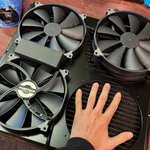
Renderboxes Molecule Air: eight RTX 6000 Ada, a Threadripper PRO 7975WX, 768GB of DDR5 ECC 5800, and three Corsair HX1500i supplies stacked together.
🔴 US 15A circuit → 1,800W
🔴 US 20A circuit → 2,400W
🔴 EU 16A circuit → 3,680W
🟢 This machine → 4,500W
The PSU rating isn't the draw, though. Eight cards at 300W plus the CPU lands near 3kW sustained.
That's three space heaters running in the room, and the cooling to remove that heat costs more power on top.
Note: 384GB of VRAM total, but it's eight separate
48GB pools talking over PCIe. Not one pool of 384.
This is what "local AI" looks like at the top end.
A datacenter rack that happens to be in a room.
So before the GPU budget — what does your
panel actually deliver?

