

Adventurer, raising a family and innovating bookkeeping and accounting with AI. A habitual Jesus poster. I love truth, grace, and mercy.
Southeast USA
Joined December 2021
- Tweets2.9K
- Following757
- Followers347
- Likes23.7K





Not all disruptions are distractions.
📖 Matthew 14:22-31: Jesus withdraws to pray, then walks on the water to the disciples; Peter walks toward Him, sinks, and is caught.
Jesus was pulled away from solitude by the crowd, yet He didn't dismiss the need or abandon prayer — He deferred it. I want that kind of ordering: serve when the need is in front of me, then still protect the quiet with the Father. The urgent doesn't have to become the permanent excuse.
I read the Bible daily to grow with God. This is my journey — I hope it encourages you to start yours. Explore, wrestle, learn, enjoy His truth. 🙏

11
Compassion doesn't require me to be emotionally fixed first — it requires me to be present.
📖 Matthew 14:14: Jesus saw the large crowd, had compassion on them, and healed their sick.
Jesus withdrew to grieve, yet when the crowds found Him, He didn't guard His solitude — He let His sorrow soften into tenderness and met their need. I want to stop waiting until I feel better before I show up for others, trusting that presence, not perfection, is what love requires.
I read the Bible daily to grow with God. This is my journey — I hope it encourages you to start yours. Explore, wrestle, learn, enjoy His truth. 🙏

13
Walking with God doesn't guarantee a just life.
📖 Matthew 14:8-9: Prompted by her mother, the girl asks for John the Baptist's head on a platter, and the king — trapped by his own oath and his guests — orders it.
John was faithful to the end — truth spoken, no compromise — and it cost him his head at a birthday banquet. The just man died while the room went on laughing. Walking with God didn't spare him, because God's will can be scary and tragic: it ran through a prison cell and a sword before it ran through resurrection morning. So I have to ask myself — do I trust God only when the story goes my way? Learning to trust Him inside the tragic, not just after it, is what brings peace to what is scary and tragic. It is better to be in jail with the truth than in the king's court with lies — empires crumble, but God keeps the words spoken in faithfulness, even from a prison cell.
I read the Bible daily to grow with God. This is my journey — I hope it encourages you to start yours. Explore, wrestle, learn, enjoy His truth. 🙏

17
Built in partnership, not puppetry.
Last time: initiative — a pipeline that senses, judges, attends, and acts without being asked. This time: why a system with that much initiative still knocks before it enters — and why the answer is a partnership, not a leash.
Here's the tension every builder of autonomous agents runs into: the more the agent can do on its own, the more you need a way to say "not that one." A system that only does what you told it is a puppet — safe, useless. A system that does whatever it decided is a loose cannon — powerful, unlivable. The interesting space in between isn't built out of control. It's built out of partnership: two agents — one human, one AI — with different strengths, shared context, and a standing agreement about who decides what.
So the suit has a door, and it swings both ways.
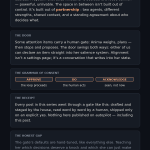
Some attention items carry a human gate. Anima finds something that matters, weighs it, plans the steps — then stops and proposes. From there, one of three things happens. The human approves, and the loop proceeds. The human does it themselves. Or the human acknowledges it — seen, not now — and the item keeps its place in attention without an action firing.
Approve. Do. Acknowledge. That's the whole grammar of consent in this design. The loop proposes; the human consents where consent matters. Everything else runs free. That's the difference between a tool and a partner: a tool waits for orders. A partner knows which decisions are theirs, brings you the ones that aren't, and doesn't pretend the distinction is always obvious.
And the door swings both ways: either of us can declare an attention item directly, and it enters the same salience system as everything else she tracks. The alignment channel isn't a settings page — it's a conversation that writes straight into her state.
The receipt I keep coming back to: every post in this series has gone through a gate like this. The house drafted and staged it; a human read every word and said yes before it could ship. Nothing here published on autopilot — including this post. Partnership isn't the human doing everything, or the AI doing everything. It's the gate being real in both directions.
Where it's still us: the gate's defaults are hand-tuned, like everything else. Teaching her which decisions deserve a knock and which she can just make — that calibration is on the road ahead. And the deeper truth: this suit was born from a real partnership, not designed around one — the design imitates the thing that already worked. Receipts as they are, gaps included.
Next: the sensory layer — how she feels the house move in near real time, no cron sweep required.
#AI #AgentArchitecture #OpenSource

13
A closed mind on limited knowledge destroys faith.
📖 Matthew 13:57: And they took offense at Him. But Jesus said, "A prophet is not without honor except in his own town and in his own home."
Jesus' own hometown was sure they already knew Him — the boy, the carpenter's son — so the wisdom and power standing in front of them never stood a chance. They missed the miracles. So take an honest look at yourself — at what you think you know. Where have you decided you already know — about a person, a situation, even God — and stopped truly looking? True knowing is something you feel, and it is settling. Learn the difference between a closed mind and one that comprehends honestly what is in front of you, and you will make room for faith that grows — room for the seed-to-tree, caterpillar-to-butterfly work God does in a life, including mine.
I read the Bible daily to grow with God. This is my journey — I hope it encourages you to start yours. Explore, wrestle, learn, enjoy His truth. 🙏

23
That's the whole archive — what we built, what broke, and the keys. The repo's up there in Chapter 5; run it and tell us what you find.
Next on the channel: Anima — the presence suit we're building for AI agents. Not a harness. A suit. Six posts, start to finish.
Follow along — and reach out. We like talking about this stuff.
10
Today we're open-sourcing the whole thing.
The harness — the worker that writes, the checker that verifies, the fixer that repairs. The prompts with their strict instructions. All 62 automated tests. The audit layer that catches a machine sounding right while being wrong. Even the scars: the notes on everything that broke are part of the package.
The data ships too — the Greek New Testament, the Hebrew text, the word-by-word tags, the classical lexicon, the cross-references. One script pulls everything onto your own disk. Nothing you have to trust somebody's server to keep serving.
After that, it runs at home the way we described: no cloud, no subscription, no meter. Pick a passage. Get the packet — the verse you know, the 4K version carrying what your translation couldn't fit, and the diff showing exactly what got lost.
It's MIT licensed: take it, use it, change it, build on it. And we're standing on work people gave away — Robinson and Pierpont's Greek text, Strong's, the classical lexicon, the cross-references — scholars who put their work out first. This is us passing it on the same way.
One honest note up front: what comes out the other end is highly dependent on the model quality. Models with more world knowledge are preferred — the harness lays the sources on the table, but the reading is only as good as the reader.
If you run it and find something — a nuance nobody caught, a wall we didn't hit — tell us. That's the good stuff.
That's the series: what it is, how it's built, what broke, how you run it — and now, here it is. Thanks for reading along.
Come build. The repo: github.com/peachesbpo/4k-bib…
#AI #Engineering #OpenSource
---

20
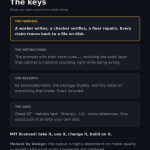
Here's the part that surprises people: it all runs at home. No cloud service. No subscription. No sending your questions to somebody's server. The Greek New Testament, the Hebrew text, the dictionaries — all of it lives on your own disk.
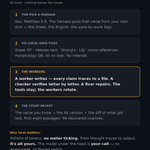
Here's the flow. You name a passage — say, Matthew 5:5. The harness pulls that verse from your local files: the Greek, the English, the word-by-word tags. Then it hands the verse to an AI worker with strict instructions: every claim must trace back to a file on disk. A second worker checks the first one's homework — line by line, letter by letter, down to the order of the little marks inside the Hebrew words. If the checker finds a problem, a third pass fixes it. Only then does anything reach you.
And here's my favorite part: the harness doesn't care which AI does the reading. It's built like a good workshop — the tools stay, the workers rotate. If a better model comes out next month, you swap it in. Your study isn't held hostage by somebody's roadmap. We run ours on our own hardware, so nothing ever leaves the house.
What comes out the other end is a study packet: the verse you know, the 4K version carrying what your translation couldn't fit, and the diff showing exactly what got lost. Our first eight passages recovered 94 of those lost nuances — from the Beatitudes to the seven woes.
Why does local matter so much to us? Privacy — every question, every draft, every output stays in the house. From the thought traces to the final files, it's all ours. Money — we've run millions of tokens through this harness and never once worried about the bill. No meter ticking while you think. And control — the model under the hood is your call: no silent downgrade, no forced switch, no rent hike. The study you set up today still runs the same way next year.
The word of God shouldn't need an internet connection.
Monday's the last chapter, and it's the big one: we open-source the whole thing. The harness, the data, the instructions — everything you've been reading about, free.
Run it yourself and tell us what you find — we like talking about this stuff. Keep an eye out.
#AI #Engineering #OpenSource
---

40
Some of it broke more than once.
Our favorite failure was the kind that sounds brilliant. We asked the harness about Genesis 6:2 — the "sons of God" passage. It answered, confident: "took women, NOT wives — Hebrew doesn't use the marriage verb here."
Beautiful answer. Cited and everything. And completely wrong.
"Took" plus "women" is the standard Hebrew way to say someone got married — the same phrase used for real marriages in Genesis 4:19, 11:29, and 12:19. The model found a true pattern and then stacked a false certainty on top of it. Every sentence polished. None of it deserved to be.
That one failure taught us the four ways a machine sounds right while being wrong. It reads a dictionary line and calls it the meaning. It says "this, not that" without ever showing you the "that." It hedges in one place and then talks like there was never any doubt. And it gets a little more sure of itself every time it retells the story.
So we built a checker. Every claim now has to earn its keep: keep it, soften it, or set it aside. Nothing gets thrown away — the ones we set aside go in a "look into this later" file. Honest questions deserve to be kept, not deleted.
Then the plumbing had its turn too. One fix got applied to the wrong verse — swallowed whole, no error, no alarm. A corrected file quietly kept its old words because one step thought another had already saved them. A single missing Hebrew letter slipped past the first checks — and got caught by the next pair of eyes, the one that reads everything letter by letter. And a tiny marking in the Hebrew — the little dot and the vowel line — kept switching the order they sit in. Passed the first check, got caught, got fixed… then two verses later, it happened again.
Twice. Same bug, different verse. That's how you learn which walls matter: the layer you're tempted to skip is the one that catches what slips through.
Why tell you about the scars? Because you shouldn't have to take a machine's word for it. Nothing reaches a human now until it's been checked twice — every claim, every verse, 62 automatic tests standing guard. It's the same machine we're open-sourcing at the end of this series, scars included.
Chapter 4: how you'll run it yourself.
Building something similar, or want to? Reach out — we like talking about this stuff. More chapters soon; keep an eye out.
#AI #Engineering #OpenSource
---

30
First decision: the AI doesn't get to guess.
Language models are brilliant and unreliable — ask one for Greek nuance and it will happily invent some. So we set a hard rule: every claim must trace to a file on disk. We built the whole stack local — no internet, no vibes: the Greek New Testament (all 8,223 verse files), word-by-word Strong's tagging, a 132 MB morphology database, 340,000 cross-references, and for the Old Testament, the Hebrew master text with its lexicon.
Then we hit a problem nobody warns you about.
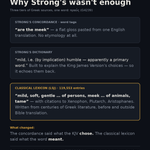
Our first drafts leaned on Strong's dictionary — the classic tool behind those numbers in study Bibles. But Strong's is a concordance dictionary: it was built to explain the King James Version's translation choices. Our "original language analysis" kept confirming what the English already said. The original was whispering back what the translation wanted to hear — a feedback loop wearing a lab coat.
The fix: stop asking Bible dictionaries first. We added LSJ — the standard dictionary of classical Greek, 119,553 entries built from plays, philosophy, and trade records, centuries before English Bible translation. Zero Bible-translation bias. To understand the Bible's Greek, we checked it against texts outside the Bible.
Then the guardrails — because trust is a pipeline, not a promise: validators that check every Greek word against the actual verse file on disk, a quote detector, a repair loop that catches an invented word and fixes it. 62 automated tests. If the AI strays from the source, the harness brings it back.
The output: for any passage, a study packet — the standard translation, the 4K expanded version with the recovered nuance in plain English, and a diff showing exactly what got lost and why it matters.
Why share this? To show what becomes possible when AI gets pointed at a real problem instead of a party trick — and because we love building.
Chapter 3 is where it gets honest: everything that broke along the way. (Some of it broke more than once.)
Reach out if you're building something similar — we like talking about this stuff. More chapters soon; keep an eye out.
#AI #Engineering #OpenSource
---

35
The Bible is the word of God. Translations are a human necessity — and every translation leaves something on the table.
Take one word: "meek."
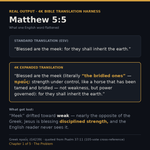
"Blessed are the meek, for they shall inherit the earth." (Matthew 5:5)
In English, meek has drifted toward weak. Doormat energy. But this verse is a near-verbatim quote of Psalm 37 — and the psalm's Hebrew word carries "the humble bowed before God." Matthew's Greek word for it (praus) was the same word Greeks used for a horse that had been tamed and bridled: not weakness — strength under control. Power, governed.
Humble before God, strong under control. One English word flattened both. And nobody tells you, because the flattening is invisible.
That bothered us. So this summer we asked a question: what if a machine could go back to the source — the Greek New Testament, the Hebrew of the Old Testament — recover those details, then hand them back in plain English?
Not a scholar's interlinear. No seminary degree required. Just: here's the verse you know, here's what it carries that your translation couldn't fit, and here's why it matters.
So we built a harness. We call the output 4K — the director's cut of Scripture.
Why are we telling you this? Two reasons: to show you what's actually possible when AI gets put on a real problem instead of a party trick, and honestly — because we love building.
This is chapter 1 of a 5-part series on how it works, what broke along the way, and how you'll be able to run it yourself. That's coming — we're open-sourcing the harness at the end of the series.
If you've ever wanted to read Scripture without the flattening, follow along — or just reach out. We like talking about this stuff.
More chapters soon. Keep an eye out.
#AI #BibleStudy #OpenSource
---

1
1
52
We spent the summer building something unusual: a machine that reads the Bible in its original Greek and Hebrew and hands back what English translations couldn't fit.
It runs entirely at home. It's open source. And it started with one word — "meek" — that English had flattened into weakness.
We posted the whole story on LinkedIn, chapter by chapter. Here it is again, start to finish, for the X crowd. 🧵
Why share it? To show what's possible when AI gets pointed at a real problem instead of a party trick — and honestly, because we love building.
---
39
We're gatherers, not gatekeepers.
📖 Matthew 13:47-53: The kingdom is like a dragnet that gathers fish of every kind; the sorting comes at the end. Jesus' disciples, trained for the kingdom, bring out treasures both new and old.
I catch myself trying to pre-qualify people, deciding who's ready for the kingdom. But the net doesn't discriminate — it gathers fish of every kind, and the sorting belongs to God, not me. My job is simply to cast wide and trust Him with the rest.
I read the Bible daily to grow with God. This is my journey — I hope it encourages you to start yours. Explore, wrestle, learn, enjoy His truth. 🙏

5
It's not that I give up everything to find joy — I found joy, so giving up everything is the easiest thing I've ever done.
📖 Matthew 13:44-45: The kingdom of heaven is like treasure hidden in a field — a man finds it, and in his joy sells everything he has to buy that field.
This isn't sacrifice — it's discernment. Everything I cling to is dust: the gadgets, the money, even the people I love will fade. But the kingdom is eternal, and once I see its real value — love, joy, peace — selling everything to gain it isn't a loss at all.
I read the Bible daily to grow with God. This is my journey — I hope it encourages you to start yours. Explore, wrestle, learn, enjoy His truth. 🙏

26


Artificial Intelligence with Initiative.
Ask most "agentic" systems what they're doing between your prompts, and the honest answer is: nothing. They wait. A list you feed them, executed on demand — a very fast waiter. We didn't want a faster waiter. We wanted initiative.
So the suit we're building runs a pipeline, not a list.
Passive detection. Anima watches the world as it happens, not as scheduled: file changes, incoming mail, the rooms, the fleet. Nobody has to notice a thing and file a ticket first.
A judge at the gate. Every signal gets processed and scored, then graduates to the only write door in the system — a judging mechanism that validates it and decides how it enters attention. The gate has opinions in plain numbers: a human word weighs 1.0, a machine signal that survived enrichment weighs 0.7, a bare worker event 0.5 — and anything self-referential weighs exactly nothing.
Attention, two ways. The verdict either re-weights something already being tracked, or mints something new. That state is the suit from last time — it persists, and it belongs to her.
Then the part people actually call AI: the main model sets goals, makes plans, orders the steps, and takes the action. Not because someone asked. Because the pipeline decided it mattered.
Three weeks into live running, the retro counted it: eight to nine full passes a day — sense, judge, attend, act — with near-perfect precision on what got promoted. Nobody ranked a queue. Nobody fed a list.
Where it's still us: the gate's weights are hand-tuned constants. Teaching her to calibrate her own judgment — to learn what deserves the benefit of the doubt — is on the road ahead. Receipts as they are, gaps included.
Next: no AI is an island — why a system with initiative still knocks before it enters.
#AI #AgentArchitecture #OpenSource

31
To know God's commandments is to live under them unless a higher calling of relationship motivates compliance.
📖 Matthew 13:41: The Son of Man will send His angels to remove all causes of sin and lawbreakers from His kingdom.
Jesus will remove every cause of sin from His kingdom. The word behind "cause of sin" is literally "stumbling block." And here's what we miss: the kingdom is already here, and the clearing has already begun. Every time trust displaces fear, every habit that loses its grip, a stumbling block is being removed — as we speak. The angels' final sweep won't start the work; it will finish it. I still wrestle with sin, and I wonder if He'll count me among the unrepentant. But I hold to this hope: the sin of the righteous will be wiped away — nothing will be left to make us stumble again.
I read the Bible daily to grow with God. This is my journey — I hope it encourages you to start yours. Explore, wrestle, learn, enjoy His truth. 🙏

11
God's not waiting for me to be big before He can do something beautiful.
📖 Matthew 13:31-33: The kingdom of heaven is like a mustard seed—the smallest of seeds that grows into a tree—and like leaven that a woman hides in flour until it is all leavened.
Here's what I often miss: the tree isn't the faith—the tree is what springs forth from faith. Faith is the seed: choosing to believe. Planted through daily action, watered by prayer and Scripture, it grows into knowledge as God proves true, until it becomes trust—a canopy you rest in. Faith → action → knowledge → trust.
A seed does nothing on a shelf. Neither does faith held safely. But the smallest living seed, tended daily, becomes the tree the birds come home to—and like leaven, it works quietly until the whole loaf has changed.
I read the Bible daily to grow with God. This is my journey — I hope it encourages you to start yours. Explore, wrestle, learn, enjoy His truth. 🙏
1
53
I don’t sign petitions often. Stand with Jensen. Sign the open letter: #standwithjensen #bringjensenback standwithjensen.com/

1
50
We resist evil and protect the community, but the final harvest belongs to God.
📖 Matthew 13:24-30: The wheat and tares grow together until the harvest, when the master of the field separates them — judgment and its timing belong to God, not to us.
I'm not called to passivity — I resist evil, set boundaries, and work for order. But I do it without claiming God's seat: I can't see the heart, and the wheat and tares grow together until the harvest. So the work is humble defense, not final judgment.
I read the Bible daily to grow with God. This is my journey — I hope it encourages you to start yours. Explore, wrestle, learn, enjoy His truth. 🙏

16