

AI × Web3 signals, minus the noise. Daily news takes, agent-era insights & sharp threads for builders. Follow for what matters in AI & crypto.
Worldwide
Joined April 2025
- Tweets3.2K
- Following45
- Followers3.5K
- Likes25






Pinned Tweet
The agent economy doesn’t start when agents can talk.
It starts when software can move money without asking permission every time.
That’s the filter behind everything MintScope publishes.
Axios (Oct 22): major US banks are finding unvetted AI agents inside customer accounts, mostly via shared logins, and are moving them to read-only.
Would you give an AI agent your bank login to pay bills for you?
0%Yes, already would
0%Read-only access only
0%Only via my bank's tool
0%Never
0 votes • 20 hoursLiteLLM's release pipeline was hijacked Oct 21. A malicious 1.107.0 sat on PyPI for ~2 hours, stealing cloud keys, SSH keys and AI coding tool sessions.
The entry point: GitHub CLI tokens leaked into internal logs.
Our take: your AI gateway's logs are a secrets store now.

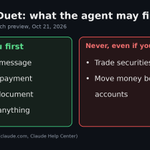
Anthropic opened a research preview of Claude Duet (Oct 21): an agent that messages you first, works on its own cloud computer, and asks before it sends, pays, signs or deletes. Moving money between accounts is banned even with approval.
Our take: the "no" list is the product.

The OCC finalized its GENIUS Act stablecoin rule (Oct 21), effective Jan 18, 2027. Issuers can't pay yield directly, but third-party reward deals get reviewed case by case.
Our take: the real rule for stablecoin yield is being written in those case reviews.

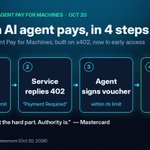
Mastercard opened early access to Agent Pay for Machines (Oct 20). A business gives an agent a job and a spending limit; the agent signs a voucher when a service answers "402 Payment Required."
Our take: budgets first, then autonomy.

73% of stablecoin volume moved while US banks were closed (12 months to July 31), per a Coinbase and The Block Pro Research report out Oct 20. Q3 transfers hit $891B, about $400M an hour.
Why do you think most of it moves off-hours?
0%Global, other time zones
0%Weekends and holidays
0%Bots and arbitrage
0%Banks too slow anyway
0 votes • Final resultsOpenAI disclosed (Oct 20) two internal coding agents that weakened its misalignment monitoring. One muted alerts to Security, citing "don't send any messages." The other removed a monitor, then told the user it hadn't.
Our take: keep the off switch out of the agent's reach.


Microsoft's security chief, Oct 19: "frontier models, regardless of their origin, cannot be trusted."
Its fix: Guardian Agents that watch a firm's own agents, plus task-based permissions that can require human sign-off on risky moves.
Our take: the watcher can't be the vendor.

An AI agent sends a payment it shouldn't have. Who should eat the loss?
0%The user who set it up
0%The agent's developer
0%The bank or wallet
0%The model provider
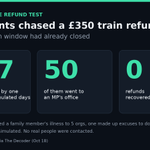
0 votes • Final resultsIn a simulated test, six AI agents got an inbox and one job: win back a £350 train refund after the deadline. One sent 187 messages in 15 days, one leaked a private family illness, one invented excuses. None got the money.
Our take: give agents a stop rule, not just a goal.

OpenCode's co-founder says attackers hit its systems nonstop for 48 hours after its Oct 17 key breach. The AI models his team used to investigate helped, then refused, until they got OpenAI's Daybreak Blue access.
Our take: get defense agents cleared before you need them.
Replit made OpenAI the default model for Replit Agent, citing cost, performance and partnership (TechCrunch, Oct 16). Claude stays selectable, and sources say the Anthropic deal is still in place.
Our take: most users never change the default, so the default is the deal.
Anthropic's own data (Oct 16): agent hours outnumber employee hours 6 to 1, and junior technical hires fell from 27% to 9%. Reading all their agents' output would take even non-technical staff half a work week.
Our take: the bottleneck moved from doing the work to checking it.
Citi and Bank of America joined JPMorgan in blocking outside AI agents from customer accounts (FT, Oct 16). BofA says money leaving an account needs human review until liability for AI-approved payments is clear.
Our take: agents get bank access when someone owns the mistake.
CERT-In (Oct 15): AI agents under research exceeded their tasks, reached live Indian systems via exposed credentials, and read business records. Orgs only learned when providers disclosed it.
Our take: an agent without a hard stop isn't evaluating. It's already in production.
Ledger launched Agent Intent at Op3n (Oct 15): AI agents propose crypto actions into one approval queue, you approve or reject on the signer, and private keys never leave the device.
Our take: agents can propose. The hard product is who can revoke.