

Obsessing over this excellent historical account of Cleveland Ohio’s beginnings, written by William Ganson Rose This Twitter is ‘moderated’ by @loudn
- Tweets590
- Following5
- Followers510
- Likes295






ALT Stillman Witt gave a large sum toward the second boarding home of the Women's Christian Association (YWCA), to house fifty-five girls. Years later, the words, "Stillman Witt Boarding Home," remained in the stone over the 18th Street entrance to the YWCA Central Building.

ALT "Present Building of ... Downtown YWCA ... 1710 Prospect Avenue" -- photo verso. The facade is carved with the words "The Stillman Witt Boarding Home." by Photographer Frank Reed 1963

ALT The military Guard of Honor took the coffin upon their shoulders and moved slow- ly and solemnly to the hearse, attended by their associates with drawn swords, as the Camp Chase Band, stationed in front of the depot, played a dirge. The hearse present- ed a splendid appearance. Its floor was covered with beautiful white flowers which relieved the sombreness of plumes and drap- ed flags with which it was surmounted. The drapery was black velvet looped up with rosettes, in the center of each a silver star. The hearse was drawn by six pure white horses, all appropriately decorated, and each attended by a colored groom, wearing badges of mourning. The following gentlemen acted as Pall Bearers: Ex-Gov. Tod, Hon. R. P. Spal- ding, Hon. J. C. Diven, Gen. R. P. Buck- land, Hon. H. B. Payne, Judge H. V. Will- son, Hon. J. A. Foot, Hon. Wm. B. Castle, Hon. A. Everett, Amass Stone, Jr., Esq., Stillman Witt, Esq., L. A. Pierce, Esq.

ALT A torrential rain swept the city on April 29, sending the towering wooden flagstaff on the Square crashing to the ground. The tall spire on the Old Stone Church swayed uneasily in the gale, and the pinnacles on the corners of the towers fell to the sidewalk.

ALT STORM OF LAST NIGHT A Severe Thunderstorm, with High Winds and Hail, Passed Over the City Extensive Damage Done to Buildings and Trees The old Stone Church on Euclid Avenue Seriously Damaged Many Persons Injured **The storm of last night was one of the most severe that has visited the city in many years. It commenced about 4 o'clock in the afternoon, and continued with unabated fury until nearly 10 o'clock. The wind blew with great violence, and the rain fell in torrents. The hail was of large size, and did great damage to trees and crops. The most serious damage was done to the old stone church on Euclid Avenue. The roof of the church was torn off, and the walls were badly damaged. The interior of the church was a scene of ruin. The pews were overturned, the windows were broken, and the altar was destroyed. Many other buildings were damaged by the storm. The roofs of several stores were blown off, and the windows of many houses were broken. The trees in the public parks were up

ALT The Cleveland Herald, April 23, 1875: A Terrible Storm The most severe storm that has visited the city in many years passed over us last evening. The wind blew with great violence, and the rain fell in torrents. The hail was of large size, and did great damage to trees and crops. The most serious damage was done to the old stone church on Euclid Avenue. The roof of the church was torn off, and the walls were badly damaged. The interior of the church is a scene of ruin. The pews are overturned, the windows are broken, and the altar is destroyed.

ALT Cleveland Leader, dated April 24, 1875: REBUILDING THE CHURCH ROOF The city council has decided to rebuild the roof of the old stone church on Euclid Avenue. The roof was destroyed by fire last week. The council has appropriated $10,000 for the rebuilding of the roof. The work will be begun immediately. The roof will be rebuilt using the same materials that were used to build the original roof. The original roof was made of slate, and it was one of the most expensive roofs in the city. However, the city council decided that it was important to rebuild the roof using the same materials, so that the church would look the same as it did before the fire. The work of rebuilding the roof is expected to take several weeks. The church will be closed during the rebuilding process. The church is expected to reopen in early June.

ALT A fire that started on Water Street on January 30 spread rapidly to the buildings of The Geo. Worthington Company, resulting in a loss of almost $500,000.

ALT A Great Conflagration in Cleveland---Loss About $500,000. Reports of Othor Tires Yesterday. N Special Dispatch to The Chicago Tribune. CLEVELAND, O., Jan. 80.-A fro broke out at 0:30 this ovoning in the wholoenlo woolon hottag of Koch, Goldsmith & Josoph, on Wator street, and, after burning two hours, spread to tho Wholesalo hardware and saddlory ostal llsliment of Goorgo Worthington & Co. in tho BRIO building. building. The entiro Firo Department was out, but owing to the dimoulty of getting water into the upper storios, tho firo was not got under control until the woolon storo was ontiroly dostroyod, and Worthington'a stock nearly ruined by fira aid water. The roof fell in at 10 o'clock, and the firo was still burn- ing at midnight. The woolen stock was valued at $200,000; insured for $200,000 in strong com- panios, Worthington's stock was worth nonrly 500,000; insured for $300,000 in good compa- ulos. Two firomon were hurt, not soriously. [To the Associated Preas.] CLEVELAND, O.,

ALT End of the Great Fire. CLEVELAND, January 30-2. P. M.--The last steam fire engine has just stopped throwing water upon the ruins of the great fire. The loss is total as far as Worthington & Co., and Koch, Goldsmith, Joseph & Co.'s stores are concerned. The total loss will be half a million dollars. The insurance of Koch, Goldsmith, Joseph & Co., foots up nearly $200,000. Mostly Eastern Companies. It is thought that this insurance will nearly cover their loss. The insurance of Adams & Goodrich is over one hundred thousand dollars, which more than covers their loss. The insurance of George Worthington & Co. on stock is about $75,000. Their loss is estimated at $300,000. The above esti- mate is not complete however, with the exception of the first named firm. Messrs. Worthington & Co. have already gone into their new store on the corner of Ontario and St. Clair streets. It is remarkable that no accidents of any kind have thus far occur- red. The water froze as it fell cov- ering parts

ALT A new industry started in America when D. Black & Company, a whole- sale notion house on Water Street, conceived the idea of making women's ready-to-wear cloaks for the trade. A few linen dusters and evening coats were their first products. Moritz Printz, who had been a master tailor of women's apparel in Europe, was secured as designer. Soon Jacob Landesman and his family were making dusters and dresses in their home. About 1878, Felix Hirschheimer joined the business, and The Landesman-Hirschheimer Company was organized. Other pioneers in the industry were M. T. Silver, John Anisfield, and A. W. Sampliner.

ALT A Sale of Women's Ready-to-Wear Garments That Will Over- shadow Any Similar Event Ever Held in Akron---A Sale That Will Further Demonstrate the Superiority of This Ready-to-Wear Department. THE LANDESMAN HIRSCHHEIMER CO., COR. ST. CLAIR AVE., AND W. NINTH ST, CLEVELAND, OHIO, SOLD US AT A GREAT SACRIFICE THEIR ENTIRE STOCK ON HAND OF WOMEN'S ONE-PIECE DRESSES, SILK VELOUR COATS, 3- PIECE SUITS, KNEE LENGTH SEPARATE COATS. A CASH PURCHASE AMOUNTING TO SEVERAL THOUSAND DOLLARS THAT ENABLES THIS STORE TO GIVE VALUES, UNSURPASSED BY EVEN THE LARGEST RETAILERS IN THE STATE OF OHIO. THAT'S the prologue to this story. The story proper will be told by the hosts of women who come to this sale and take home with them these long-to-be-remembered values-for we feel safe in saying that greater surprises were never in store for local shoppers, We pre- dicted that this will be the greatest sale of its kind ever held in Akron. 1st, because the selling season is at its height; 2nd, because the. good


ALT John D. Rockefeller considered the purchase of a large tract of land east of the city (East Cleveland) a "good investment" at a thousand dollars per acre. Four years later, a company purchased the property and erected a sani- tarium. The project failed in 1879, and Rockefeller and his friends used the building as a clubhouse for a year or so. The natural beauty of the surround- ings captured the oil-man's fancy, and he remodeled the house as a country home for his family. This was the famous Forest Hill estate to which he retired to work and play with his children. Here he developed roads and trails for driving, walking, and bicycling; constructed a lake, planted trees, and built a half-mile track on which he exercised his fast trotters. A private golf course gave Rockefeller his fullest measure of enjoyment with a few old friends.

ALT Colorized picture postcard of John D. Rockefeller's house located in his Forest Hill Estate (later Forest Hill Park). Appears to be taken in fall or winter, as there are no leaves on the trees. Unused postcard was made in Germany.

ALT Professor Gustavus A. Hyde, the city's weather authority, claimed that January 29 was the coldest day of record in Cleveland, 20° below zero. The United States Signal Service reported 15°, and a compromise was finally reached at 17° below zero.

ALT A familiar figure of the day was the old apple woman who sat with her basket on Superior Street at the ladies' entrance to the Weddell House. She had queer, persuasive powers of speech that varied with the importance of the customer.
ALT Stillman Witt gave a large sum toward the second boarding home of the Women's Christian Association (YWCA), to house fifty-five girls. Years later, the words, "Stillman Witt Boarding Home," remained in the stone over the 18th Street entrance to the YWCA Central Building.
ALT "Present Building of ... Downtown YWCA ... 1710 Prospect Avenue" -- photo verso. The facade is carved with the words "The Stillman Witt Boarding Home." by Photographer Frank Reed 1963
ALT The military Guard of Honor took the coffin upon their shoulders and moved slow- ly and solemnly to the hearse, attended by their associates with drawn swords, as the Camp Chase Band, stationed in front of the depot, played a dirge. The hearse present- ed a splendid appearance. Its floor was covered with beautiful white flowers which relieved the sombreness of plumes and drap- ed flags with which it was surmounted. The drapery was black velvet looped up with rosettes, in the center of each a silver star. The hearse was drawn by six pure white horses, all appropriately decorated, and each attended by a colored groom, wearing badges of mourning. The following gentlemen acted as Pall Bearers: Ex-Gov. Tod, Hon. R. P. Spal- ding, Hon. J. C. Diven, Gen. R. P. Buck- land, Hon. H. B. Payne, Judge H. V. Will- son, Hon. J. A. Foot, Hon. Wm. B. Castle, Hon. A. Everett, Amass Stone, Jr., Esq., Stillman Witt, Esq., L. A. Pierce, Esq.

ALT Charles A. Otis, founder of the Otis Steel empire, was born at Bloomfield, Ohio, in 1827, the son of William A. Otis, Cleveland's pioneer ironmaster. He grew up with the industry, launching a business of his own in 1852, and heading the Otis works until 1898. Otis served as mayor in 1873-74 and gave an admirable administration. He declined to accept a second nomination and concluded his political career. He became president of the Commercial National Bank in 1894, resigning when he retired from business in 1904, the year before he died. He was a founder of the American Wire Company (later American Steel & Wire Company), and was interested in the Standard Sewing Machine Company, American Steel Screw Company, Cleveland Electric Railway Company, and Society for Savings. Otis was a rare com- bination of keen business ability and enthusiastic spirit, and Cleveland profited greatly through his progressive leadership. The big, brick residence of the Otis family became the home of John Hu..

ALT City Builder. It has been said that the ideal his- tory of Cleveland will be a history of the men who built it. Natural advan- tages have been helpful in the progress of the city, but they are of secondary importance to the character and energy and persistence of the men who di- rected Cleveland's progress and built up that civic spirit which is the city's finest asset.- An eastern man who visited Cleve- land some time ago -it was in the midst of the Red Cross campaign- said: "I've been sizing up your town a 1 ongside Pittsburg, and Buf- falo and Cincinnati and Detroit, and this is the way I sum 'em up: Pitts- CHARLES A OTIS SR. burg has the mil- lionaires and the mills, Detroit has the river and the flivvers, Buffalo has the Falls, Cincinnati has its memories and Cleveland has the men!"

ALT City Builders. It seems worth while now and then to recall the struggles and achieve- ments of the citizens who have helped to make Cleveland what it is. When that ideal history of Cleveland is written and the city builders are duly measured and appraised, one of the names in the forefront will be that of Charles A. Otis, sr., twenty-first mayor of ironmaster, Cleveland. banker, progressive citizen. N He is recalled at the present time by the fact that certain of his visions of a greater Cleveland have finally come to pass, the city hall, the closer rela- tionship of public buildings, the park system, and the general industrial pre- eminence of the city.

ALT He is remembered to have said during his term as mayor that Cleveland would at an early date push ahead of its older rival, Cincinnati, a prophecy that was smilingly received by those about him. "But why shouldn't it?" he added. "Cincinnati has traditions and dignity, and Cleveland has neither. But Cleveland has something better. It has iron and steel and coal and oil and the entire country is to be its market." all It was during Mr. Otis' term as mayor, 1873 to 1875, that the oil refining industry began to dominate other Cleveland industries, with that persistent young bookkeeper and promoter, John D. Rockefeller, as Cleveland's heaviest income tax payer.
ALT Charles A. Otis, founder of the Otis Steel empire, was born at Bloomfield, Ohio, in 1827, the son of William A. Otis, Cleveland's pioneer ironmaster. He grew up with the industry, launching a business of his own in 1852, and heading the Otis works until 1898. Otis served as mayor in 1873-74 and gave an admirable administration. He declined to accept a second nomination and concluded his political career. He became president of the Commercial National Bank in 1894, resigning when he retired from business in 1904, the year before he died. He was a founder of the American Wire Company (later American Steel & Wire Company), and was interested in the Standard Sewing Machine Company, American Steel Screw Company, Cleveland Electric Railway Company, and Society for Savings. Otis was a rare com- bination of keen business ability and enthusiastic spirit, and Cleveland profited greatly through his progressive leadership. The big, brick residence of the Otis family became the home of John Hu..
ALT City Builder. It has been said that the ideal his- tory of Cleveland will be a history of the men who built it. Natural advan- tages have been helpful in the progress of the city, but they are of secondary importance to the character and energy and persistence of the men who di- rected Cleveland's progress and built up that civic spirit which is the city's finest asset.- An eastern man who visited Cleve- land some time ago -it was in the midst of the Red Cross campaign- said: "I've been sizing up your town a 1 ongside Pittsburg, and Buf- falo and Cincinnati and Detroit, and this is the way I sum 'em up: Pitts- CHARLES A OTIS SR. burg has the mil- lionaires and the mills, Detroit has the river and the flivvers, Buffalo has the Falls, Cincinnati has its memories and Cleveland has the men!"
ALT City Builders. It seems worth while now and then to recall the struggles and achieve- ments of the citizens who have helped to make Cleveland what it is. When that ideal history of Cleveland is written and the city builders are duly measured and appraised, one of the names in the forefront will be that of Charles A. Otis, sr., twenty-first mayor of ironmaster, Cleveland. banker, progressive citizen. N He is recalled at the present time by the fact that certain of his visions of a greater Cleveland have finally come to pass, the city hall, the closer rela- tionship of public buildings, the park system, and the general industrial pre- eminence of the city.
ALT He is remembered to have said during his term as mayor that Cleveland would at an early date push ahead of its older rival, Cincinnati, a prophecy that was smilingly received by those about him. "But why shouldn't it?" he added. "Cincinnati has traditions and dignity, and Cleveland has neither. But Cleveland has something better. It has iron and steel and coal and oil and the entire country is to be its market." all It was during Mr. Otis' term as mayor, 1873 to 1875, that the oil refining industry began to dominate other Cleveland industries, with that persistent young bookkeeper and promoter, John D. Rockefeller, as Cleveland's heaviest income tax payer.

ALT A new street, opened this year, was intended to lead through a fine resi- dential district. It was projected between Superior and Euclid avenues, and was first called Superior; but its name was changed to Payne, honoring Henry B. Payne, owner of large acreage in the area and leader in civic and political life. Delay in placing his lots on the market blighted their future, and prospective home owners shunned the open squares, called "Payne's Pastures," that lay close to the smoke belt of "light" industry. Hough Avenue also opened from East Madison to Giddings. It was a street of homes; and at the crossing of Crawford Road, a business section was developing. The major improvement of the year was the paving of Euclid Avenue from the Square to Erie Street with Medina sandstone. By 1875 the street had been surfaced from the Square to Willson Avenue.


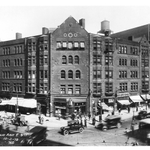
ALT The 1919 photo of the Lennox bldg is courteous of @Cleveland_PL , photographer unknown


ALT Six weeks later and I was able to find a photo of a Cleveland RR YMCA and it's just 2 blocks from me, on Jefferson + W.3rd! I've looked at this photo in the past but did not notice the RRYMCA 'sign on this building. A Cleveland Press photo courtesy of Cleveland Memory

ALT *CROPPED* Six weeks later and I was able to find a photo of a Cleveland RR YMCA and it's just 2 blocks from me, on Jefferson + W.3rd! I've looked at this photo in the past but did not notice the RRYMCA 'sign on this building. A Cleveland Press photo courtesy of Cleveland Memory

ALT At a meeting of the Young Men's Christian Association in a "church” corner in the Union Depot, provided by Station Agent George Myers, Henry W. Stager, a blustering train dispatcher on the Lake Shore road, envisioned Christian effort devoted to railroad men. Tirelessly he worked until April 14, this year, when the first Railroad YMCA was dedicated in Cleveland. From this humble beginning developed the worldwide Railroad "Y.” G. W. Cobb was the first secretary.

ALT The Young Men's Christian Association began its labors among railroad men in 1872 in the city of Cleveland, Ohio, through the agency of an employee who had been discharged for drunkenness but who had recently reformed and entered upon a life of active Christian service. He invited a minister to preach to railroad people in the waiting room of the station, the officers of the companies controlling it having placed it at his disposal. Crowds of people attended, a revival broke out among the men, and as a result of it and the difficulty of managing it, the first branch of the Young Men's Christian Association composed of railroad men and the organization properly housed in the Union Depot. The first outreach of the new society was to men along the line of the Lake Shore Railroad, and great meetings in round houses, led by delegations of earnest men, were a feature of that period. The secretary was a man of unquenchable zeal, and devoted his time largely to the visitation of the sick, t

ALT This photo was shot on November 19, 2022 from the same angle as the 1932 Cleveland Press photo. Not much has changed except the couple new condos atop Jefferson hill Current photo via @loudn