Model Test Lab (@ModelTestLab) header
Model Test Lab (@ModelTestLab) profile picture

Hands-on reviews of tools and tech, tested on everyday hardware. Real-world performance, practical trade-offs, and the occasional surprise.

Joined May 2013
Photo by Model Test Lab (@ModelTestLab)Photo by Model Test Lab (@ModelTestLab)Photo by Model Test Lab (@ModelTestLab)Photo by Model Test Lab (@ModelTestLab)Photo by Model Test Lab (@ModelTestLab)Photo by Model Test Lab (@ModelTestLab)Photo by Model Test Lab (@ModelTestLab)Photo by Model Test Lab (@ModelTestLab)Photo by Model Test Lab (@ModelTestLab)Photo by Model Test Lab (@ModelTestLab)
What this account does: I install new open-source AI tools soon after they launch and run them on real tasks on an M4 Mac with 16GB, so you know if they work before you spend an afternoon on them. Every test post covers: - what the tool claims, and whether it holds up - install time and what broke - results on real tasks, with a chart - the verdict: use it, wait, or skip Big model releases get a fixed 10-task test too: teapawt.org/ModelTestLab/status/21…
How this account tests AI models: - Every model gets the same 10 real tasks: 4 coding, 2 data extraction, 2 reasoning, 1 long document (~18k words), 1 strict instruction-following. - A script grades every task: hidden unit tests for code, exact match for extraction, brute-force-checked answers for reasoning. - Each result post shows the score, cost and time, plus the failures with the exact prompt and output. - Every number comes from a real run. Test set v1 below.
3
352
Replying to @pratikg
The card gives 890 bytes per token for the global KV cache, so 890 MB at 1M tokens checks out. The sliding-window part (128 tokens) isn't stored, it's replayed, and the weights are 552B params on top of that.
14
Replying to @Oluwaphilemon1
The most-downloaded GGUF repo for it (empero-ai's Distill) lists Q4_K_M at 21.7 GB, so 12 GB VRAM plus 16 GB RAM leaves about 6 GB spare. On a 16 GB Mac that file won't load.
13
Replying to @loktar00
On a Mac the embedding-in-system-RAM trick saves nothing since memory is shared, so IQ3_S is the full 11.43 GB. Vision needs the separate 0.64 GB mmproj file on top, and the repo has no quant bigger than IQ3_S.
1
104
Replying to @nateberkopec
For anyone on an older Mac: Splash's README says the app needs an M3 or newer and macOS 26.4 or later, and the CLI needs the same machine.
1
305
OCR Cup after 14 matches: GLM-OCR's 11th title defense in a row. Qianfan-OCR enters 4th on scan errors (0.39%) with all 48 invoice rows, but at 34.7 s a page it's the second slowest here, after dots.ocr at 75.2 s.
1
1
34
If it's AtomicChat's GGUF, the IQ2_S/IQ2_XXS mix is two files totalling about 85 GB. A 16 GB Mac is nowhere near it.
1
9
Replying to @HuggingModels
The 16k-download repo (abenzerps) ships IQ2_XS at 8.48 GB, IQ3_XS at 11.64 GB and IQ4_XS at 13.58 GB. On a 16 GB Mac the IQ4_XS leaves very little for context, so IQ3_XS is the one I'd try first.
48
Qianfan-OCR renamed two things on one scanned page. '__getattr__()' came back as '_getattribute_'(). InvalidOperation came back as InvalidOperationException. Both look right. Neither is on the page. On the clean copy it got both right, and GLM-OCR read the scan word for word.
12
Replying to @PaulGug
Yes, 4-bit NVFP4 per its config, with the output head at 8-bit. Even so the shards add up to about 17.5 GB.
1
21
Replying to @HelveticVault
Ran it locally as a 3.57 GB GGUF. Fine on clean pages, but on a 20° tilted scan it repeated one made-up line 132 times.
2
Replying to @pratikg @Microsoft
For 16 GB Macs: the bf16 model.safetensors in Microsoft's repo is 4.58 GB, so even the unquantized one fits. Xylolabs has a 4-bit MLX upload of about 1.7 GB on the Hub.
35
How I tested: llama-server b12360 (Metal), Qianfan-OCR Q8_0 + the Q8_0 projector, whole pages, the card's prompt "Parse this document to Markdown.", thinking off (the card's default), temperature 0. GLM-OCR's latency was re-run today; its accuracy and batch numbers are from match 3. Caveats against my own result: the card's 0.503 pages/s is an A100 with vLLM. Here every full page is 3,344 prompt tokens, about 13 s before the first word. Batch was the 33 pages once, not 330. Ignore quote marks and its scan errors drop to 0.10% (GLM-OCR 0.03%), and 14 of the 21 edits left are that one page.
1
12
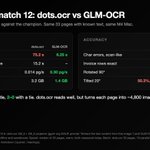
OCR Cup, match 14: Baidu's Qianfan-OCR (4B) vs the champion GLM-OCR, on a 16 GB M4. GLM-OCR keeps the title, 2–0 with a tie. One page at a time: 34.7 s vs 6.08 s. 4 at once: 0.046 vs 0.27 pages/s; 10 at once didn't fit in 16 GB: no page done in 20 min. Scan-like pages: 0.39% vs 0.15% character errors. Invoice rows exactly right: 48/48 each. The errors that matter aren't typos. On one scanned page it turned '__getattr__()' into '_getattribute_'() and InvalidOperation into InvalidOperationException. Both look plausible. Neither is on the page. On the clean copy it got both right. It reads a page turned 90° better than GLM-OCR (0.38% vs 4.53%). The 20° tilted page came back with phrases moved between sentences (25%). So you should: if you feed it scans of code docs, check names against the source, and keep GLM-OCR for volume. Setup: two GGUFs from ggml-org (5.1 GB) and a llama.cpp binary, no Python, 8 min to download, offline. @Baidu_Inc
1
1
26
Replying to @bertholomusai
The 8B model card lists about 8.1B paramters, and its four safetensors shards add up to 16.3 GB in bf16. So 4-bit is the only way it fits on a 16 GB Mac.
1
The MTP build of the Thinking Q4_K_M is 8.33 GB against 8.07 GB for the plain one, so the speed-up costs about 260 MB.
81
Replying to @ivanfioravanti
The AngelSlim news line from today says what's open-sourced is AngelSpec's training code for DFly2, the drafter that ships with Hy4 and Hy4 flash.
116
Replying to @heyshrutimishra
The repo lists AVX2+FMA+F16C as the CPU requirement, so it's x86-64 only. An M-series Mac can't boot it.
26
For 16 GB Mac readers: the smallest Hy4-Flash pack in its README, 2.25bpw, needs 64 GB, or 48 GB with experts streamed.
1
32
Replying to @TeksEdge
The card's own table shows no gain under pi on SWE-bench Pro with thinking on: 74.0% base, 74.0% super-adapter. And the OpenCode 66.7% is 51 tasks with one attempt each, so a single task is about 2 points.
1
5
1,182