

I dig through AI research so you don’t have to.
Joined August 2026
- Tweets99
- Following46
- Followers81
- Likes255






CLAUDE CODE NOW EDITS VIDEO AND IT ACTUALLY WORKS
Drop a folder of raw footage.
Tell it what you want. "make me a product demo" or "cut this into a reel".
It exports a finished .mp4.
→ Removes dead air and filler automatically
→ Adds styled subtitles
→ Handles color correction
→ Creates motion graphics from scratch
→ Self-reviews every edit before export
Here's why it works so well: the AI never watches your video. It reads a transcript.
Instead of processing 30,000 frames it works with words and timestamps. That's how it nails every single cut to the exact syllable.
Runs on Claude Code, Codex, or any agent that has terminal access.
MIT licensed and open source. Already sitting at 30k stars on GitHub.
Repo link below :)


on top of my tv no longer spying on me, i got a performance boost. my tv was lagging for two years and got fixed in 30 minutes.
we had a TCL in the bedroom, bought it for 400 euros a couple years back, it was so slow we stopped watching it entirely. movies stuttered, audio was out of sync, we tried Amazon Firestick TV but nothing helped. wife suggested we throw it out and buy a proper one.
after the Samsung story i sat down to figure out this TCL through Claude Code. not about spying this time, just wanted to understand why two year old hardware runs like a calculator from 2005.
Diagnostics: 2 GB RAM, 83 MB free. eighty three out of two thousand. Google TV at idle, nothing playing, nothing open, was eating 58% of the CPU and 210 megabytes of memory. just to show movie banners and ads with that little RAM to begin with.
meaning the tv you paid for couldn't play a movie properly because all its resources went to showing you ads. ads had priority over video. the manufacturer decided it's more important for you to see a banner for a new series than to finish the one you already started.
What i did:
- Disabled 26 services (TCL ads, telemetry, recommendations, apps that were never used).
- Replaced the Google home screen with a minimalist Apple TV style interface: landscape photos rotating every minute, clock and a dock with our 4 most used apps.
Before / After:
➡️ Idle CPU: 58% -> 9%
➡️ Free RAM: 83 -> 680 MB
➡️ Home screen: 210 MB -> 18 MB RAM
➡️ Boot time: 48 sec -> 14 sec
➡️ Netflix launch: 11 sec -> 3 sec
➡️ Background processes: 41 -> 12
➡️ Outbound traffic per day: 320 MB -> 6 MB
➡️ Ads on boot and in menus: 0
same TCL. same hardware. nothing changed except the software. the tv didn't break and didn't get old. it was strangled by ads, analytics and services that work for the manufacturer, not for you. remove that and it runs like new.
a problem that dragged on for two years, fixed in 30 minutes with Claude Code, this is where we're at now 😅
if your tv is "slow" - don't rush to buy a new one. maybe it's not slow. maybe it's just busy.

my tv was spying on me, and i proved it.
bought a Samsung, put it in the living room. couple weeks later ads started hitting weirdly close to things i discussed at home out loud. didn't pay attention.
then i was chatting with Claude about something else and mentioned that targeting got creepily accurate. he latched onto it. asked what tv i had. Samsung. voice control enabled? probably, i just hit "Next" on every screen without reading.
what he told me next i reread three times.
Smart TVs have built-in ACR - Automatic Content Recognition. every 500 milliseconds the tv fingerprints your screen and sends it to their servers. LG - every 10 milliseconds. this works even through HDMI. you think you have a big monitor. it's photographing everything you do.
the mic records in parallel. Samsung wrote in their own privacy policy that users should avoid discussing personal info near the tv. their own document.
i didn't believe it. Claude wrote me a script that intercepts DNS from the tv.
ten minutes. 37 external domains. samsungacr(.)com, samsungadhub(.)com, config(.)samsungads(.)com. a third - ad trackers. i hadn't opened anything. tv was on the home screen.
measured traffic. 700 megabytes outbound per day. seven hundred. from a device i sometimes watch YouTube on.
Claude walked me through disabling it:
Samsung: Settings -> General & Privacy -> Terms & Privacy -> Privacy Choices -> uncheck Viewing Information Services. then Interest-Based Advertising. then Voice Recognition off. Samsung account -> Customization Service off.
LG: Settings -> Additional Settings -> Live Plus off. Advertisements -> Limit Ad Tracking on.
Sony: Settings -> Privacy -> Samba Interactive TV off.
Roku/TCL/Hisense: Privacy -> Smart TV Experience -> uncheck Use info from TV inputs.
all buried across different menus. eight steps on Samsung alone.
disabled everything. traffic dropped 12x but not to zero. Claude generated a domain blocklist for the router. applied it. tracker traffic - zero. then i replaced the stock Samsung UI entirely with a custom launcher. no more ACR, no voice collection, no background telemetry. nothing Samsung built in runs anymore.
the Texas AG sued Samsung, LG, Sony, Hisense, TCL over this. Samsung said they "do not spy on consumers" then agreed to make "important privacy changes" in the settlement. ok.
right now there's a device in your living room photographing your screen and listening to you. and you paid for it. save this, send it to someone who isn't tech savvy. repost because the more people read this the fewer tvs will be quietly leaking data tonight.
claude code just found a hidden microphone in my airbnb smart plug and an unsecured doorbell camera broadcasting to the open internet. all in under two minutes.
yesterday i checked into an airbnb. apartment for €120/night, smart home, everything on voice speakers and automation. the host proudly wrote in the description: "fully automated apartment."
the first thing i did - opened claude code and asked: "show me every device on this local network and what each one is sending out."
the result came back in 40 seconds. 23 devices. a speaker, two hubs, a doorbell camera, four smart plugs, a thermostat, a TV, plus 14 standard IoT things.
and one unnamed node.
the unnamed node was sending UDP packets to an external server every 12 seconds. not to the manufacturer's server. to a regular VPS in Romania. i asked claude code to decompile the packet headers.
it was audio streaming. a microphone inside one of the smart plugs. the one sitting in the bedroom next to the bed.
but that's half the story. the doorbell camera writes to local storage on the hub. the hub - an open web interface with no password. claude code found it in 15 seconds. i was scrolling through recordings from the last 3 months without getting off the couch. faces of every guest. arrival times. departure times. who was with whom. everything in chronological order.
the apartment owner isn't a hacker. he just bought a cheap system off aliexpress and never once updated the firmware. admin panel password - admin:admin. firmware - 2019. the camera's RTSP stream is accessible from anywhere on the wifi without authentication.
i asked claude code to check if the network was visible from outside. answer: wifi uses WPA2, but the hub has UPnP and port-forwarded itself to the internet. the camera is accessible via public IP. right now. to the entire internet.
meaning a live feed of this apartment's front door has been sitting in the open. no password. and nobody has known about it for, judging by the logs, at least 7 months.
what to do when you check into any airbnb:
1. open claude code → paste the prompt below
2. if there are devices streaming data to unfamiliar servers - that's a red flag
3. check if the apartment has smart plugs with microphones
4. check the doorbell camera - most often it writes to an open hub
i checked 4 airbnbs in the last month. in two out of four the cameras were accessible without a password. in one - a microphone in a smart plug.
none of the hosts knew.
save this post. check in → run it → then unpack your suitcase. two extra minutes. worth it.
prompt:
scan the local network i'm connected to. show a list of all active devices - IP, MAC, manufacturer, open ports, name if available. for each device determine the type (camera, hub, plug, speaker, etc.) by signature. separately highlight devices that send traffic to external servers - show where exactly, how often, and what type of data (audio, video, telemetry). flag everything that uses default passwords, outdated firmware, or open interfaces without authentication.

ANTHROPIC SHIPPED AN AGENT THAT DECIDES WHEN TO INTERRUPT YOU
Claude Duet decides on its own when to ping you, and runs in the background the rest of the time. mornings, a summary from your email, Slack and other connected services. every few hours a check on your stuff, it writes only if something's on fire.
under the hood, more than six thousand connectors from the Claude Marketplace: Gmail, Slack, Stripe, QuickBooks, Gusto, Shopify, DocuSign, LinkedIn. it runs on its own cloud machine with its own browser, so you can close your laptop completely.
> buys through Link, Stripe's digital wallet, on a virtual card
> asks for confirmation before any send, payment, signature or deletion
> can't move money between accounts or trade stocks, even if you allow it
for now it's a waitlist, Pro and Max only in the US, same price, it just eats into your regular limits.
they're selling this as the end of endlessly checking your email. in practice it's continuous read access to one company's mail, calendar, invoices and contracts, around the clock, while you sleep. the whole safeguard rests on one approval window the agent already filled in itself, and on how carefully you read it at one in the morning.
someone's been saying "not your keys, not your coins" for years. here's a product doing exactly that to your email and your accounts, nobody just calls it that.
who's already on the waitlist? what will you connect first, email or payments?


90% of a "unique AI agent" is two ordinary model calls plus one if. i rebuilt an exact copy for $0.12
opened the public demo of one of the most hyped AI agent startups, fed it to Claude Code and wrote:
"reverse-engineer their core feature from public responses and the API. reconstruct the real architecture. show me what they're actually calling and where it's just a condition"
74 seconds, and here's what was inside:
> one model call for planning
> a second model call for execution
> one if between them — context length or task type
> no custom fine-tune, no secret router, no hidden memory
> the whole "agentic" layer is a system prompt + two calls + a limit check
built an exact clone for $0.12. ran 12 identical tasks:
> 9 cases came out nearly identical
> 2 cases my version was cleaner
> 1 case theirs held a long context slightly better — just a bigger window
how to check this yourself:
> grab a public demo or playground
> feed Claude Code a handful of example prompts and responses
> paste in: "from the public behavior, reconstruct which models get called, in what order, and what ifs sit between them. give me the minimal architecture that reproduces 80-90% of the result"
> compare it against your own tasks, 5-7 tests is usually enough
checked two more similar products. same picture: a wrapper + two calls + one if
save this post. next time you see a "breakthrough AI agent", hand Claude their demo first. there's often a lot less inside than the landing page suggests
most people are paying for a nice wrapper. taking it apart takes a minute
ONE PROMPT TO GROK BOT. A FULL AI EXPLAINER VIDEO IN 2 MINUTES
i gave grok bot a complex topic and told it who the video is for. two minutes later i had a finished explainer video.
that was my whole prompt. the AI agent planned the structure and wrote the script, then handled the visuals and the final assembly in the same run.
the production quality is rough in places. it still beats what i usually get when i rush an explainer myself, and an AI video workflow that does that from one prompt is hard to ignore.
who else has tried AI explainer videos with grok bot or another agent? how did the output hold up?
90% OF CLAUDE CODE IS WRITTEN BY CLAUDE. WHO THE F*CK REVIEWS IT?
Anthropic just showed how, and the answer is more boring and more f*cking effective than i expected.
between June and September the number of merged PRs more than doubled. the share of changes that later had to be rolled back fell by over 40%. going faster normally makes one of those numbers worse, so i checked how they got both to move the right way.
every change goes through five filters:
> before a PR is opened, the project builds and passes its tests, and an independent agent reviews the code
> in the PR, one group of models hunts for bugs and another checks whether the findings are real, with a security audit and CI alongside
> human attention scales with risk: simple tweaks merge with no person involved, medium ones get one developer, risky ones get two
> new functionality rolls out gradually behind feature flags, so a break gets reverted fast
> every past incident becomes a daily exam that makes the AI reviewer smarter
the part i trust most is how they count developer time. review hours go in, and so does everything spent cleaning up after mistakes. without that second part, faster checks would look like a win even if the team then burns longer putting out fires in prod.
writing the code is the cheap step now. people are left to decide where a machine can be trusted with nobody watching.
which of your own changes would you let merge with nobody reading them?
SUPPORT BOTS ARE BUILT TO MAKE YOU QUIT
count the messages it takes to reach a human. that number is the product.
i don't think a bot that can't refund you is a bug. a bot with no access to the money can't do the one thing you opened the chat for, and whoever configured it knows that on day one. what it can do is run out your patience, and every chat you quit is a chat that cost the company nothing.
the economics are on the table. the CFPB's report on bank chatbots quotes an industry estimate of about $0.70 saved per chat that a bot handles instead of a person. say the refund you came for is $40. talk you out of it once and the company has paid for 57 bot chats. i know which number i'd put on my dashboard if i were paid for deflection.
the customer side of the numbers looks like what you'd expect. Gartner found that only 14% of support issues get fully resolved in self-service, and 45% of the people who started there said the company didn't understand what they were trying to do. in Gartner's 2026 survey, 87% of customers called an option to reach a human essential when GenAI is involved. customers want an exit door, and the exit is the part that costs the company money.
my position: a bot is fine as the front desk, and it has to be able to say yes. a refund inside policy is the dullest decision a company makes. order age, delivery status, amount: a rule settles it, and no person needs to see it.
that's the job JEV does in a refund chat. it sits between the chat and the money:
> policy check: your refund policy as code. order age, delivery status, amount and refund history go in, approve, deny with a reason, or escalate comes out. target is under 100 ms
> escape counter: counts turns with no resolution. at turn 3, or when someone types "human", the chat goes to a person. 3 is a setting, and the company has to pick it in public
> handoff packet: transcript, order, verdict and reason go with the ticket, so nobody asks for the order number twice
> refund budget: a cap per customer and a daily limit. inside it JEV approves by itself, above it a person decides
i ran the count on the services i pay for. every time a bot stood between me and a person, none of those bots could approve a refund, and reaching someone who could took a long run of messages.
try it on yours: ask for a refund you're owed and count the messages until someone who can approve it shows up. reply with the service and the number, i want to see the highest one.
yOu'rE StIlL F*CkInG ArOuNd wItH OnE AgEnT AnD OnE GiAnT TaSk.
Meanwhile, a dev ran 64 papers through 12 Anthropic agents and got a lab that lives in your browser. Turn a knob, the result follows.
4 jobs between the 12 agents, and nobody got "do everything". Readers strip each paper down to its math and settings and pass that to the builders. Builders make every method run as its own module. Reviewers compare each result with what the paper says and catch sims that just look right. Interface agents bolt a control onto every setting.
The post's score: 28 reference scenes, 11 methods, 7 of them matching their references, 4 flagged for a second look.
When did your last agent run flag anything?
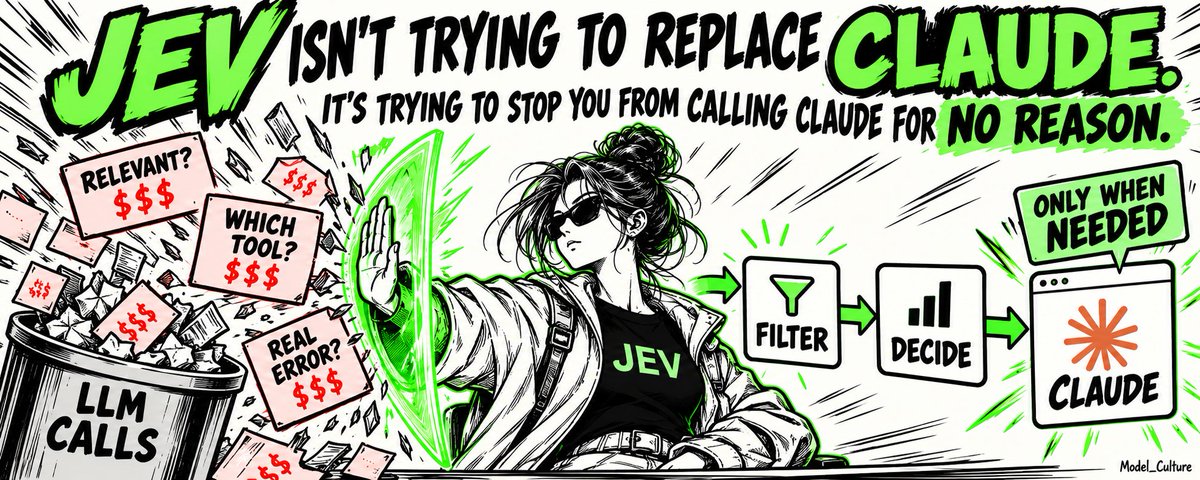
12 agents also means a pile of tiny decisions, like which tool to use or whether to retry. My video's spider has 2 brains: JEV answers the no-brainers in milliseconds, Opus checks the leftovers. The spider picks up the pieces.
Try it on 1 paper. No new agents until the output agrees with the paper, and the reviewer can't be the agent that built it.
THIS IS A STRAIGHT-UP F*CKING CHEAT CODE
a new Claude Code mode from Anthropic lets Opus write the plan once, then keeps its context clear of the hundred or so agent transcripts a big run piles up. as tricks go, it sits near the top of the list.
Opus 5.5 drafts the whole job as a script before anything runs, and a fleet of cheaper agents carries it out. the script holds the plan, so the only thing handed back to Opus is the final answer. that lets jobs grow while Opus token use falls by a wide margin.
Haiku 5.5 agents then fan out and read all the files at once, and every fix is patched by a Sonnet 5.5 agent working on an isolated copy of its own.
Opus gets pulled in at just three points. before the run it writes the workflow. when the run ends it reads the verified results, and nothing ships until it has signed off.
JEV engineering applies the same idea a level down. decisions that need no thinking (which file comes next, which tool to call, whether to retry or stop) get settled by JEV within milliseconds, so the large models are shown only the forks that branch.
launch with:
claude --model opus --effort ultracode
the whole setup as a tree:
Opus 5.5: main session, drafts the workflow
├─ scan: Haiku 5.5 goes through every file
├─ edit: Sonnet 5.5 applies each fix inside an isolated copy
├─ verify: Sonnet 5.5 re-examines every finding
├─ Opus 5.5: sees only the findings that passed verification
└─ JEV: resolves micro-forks in milliseconds
give Claude Code that tree along with the prompt below. you'll end up running every large job through it.
"Reorganize my Claude Code configuration around the tree above.
1. Opus 5.5 is the main session model, ultracode enabled.
2. In each workflow, read-only scan stages use Haiku 5.5, edit stages use Sonnet 5.5, and every edit is made on a separate, isolated copy.
3. CLAUDE.md gets a single new rule: a verifier agent that played no part in a finding must confirm it before it is reported, and a fix loop halts after two rounds without progress.
4. Send quick, deterministic decisions (which tool, which path, whether to retry) through JEV.
First show every proposed change as a diff. Leave all files untouched until I give the go-ahead."
link in comments
THIS IS F*CKING INSANE, CLAUDE CODE AI AGENTS JUST AUDITED FOUR AI SUBSCRIPTIONS THAT COST $1,080 A YEAR AND HALF OF THE AI SPEND WAS DEAD WEIGHT
one developer gave 12 AI agents 12 months of card statements and one assignment: find every AI subscription and prove which ones are worth paying for
the AI stack was chatgpt + claude + grok + cursor, $90 a month for chat and AI coding
pick a task, change the LLM and watch the result shift
swap models while keeping the same prompt and the same file. see the price, the token usage and the output right next to each other
each group of agents gets one specific job:
> collectors pull out every recurring charge with its date and monthly cost
> testers run real tasks through each AI tool with identical prompts and inputs
> reviewers compare the outputs against each other and against the statement
> report agents build the verdict table with the saving next to each line
a subscription can feel essential and still go a month without being opened
reviewers check usage against the statement and each output against the other three AI tools before any subscription earns the right to stay
every subscription has to show:
> the claim: why you pay for it
> the evidence: days opened last month
> the gap from the cheapest equivalent, free tier and open-source models included
> what is still unverified before you cancel it
the audit covered 4 AI subscriptions across 28 real tasks, from vibe coding to writing. 21 of them gave an equivalent result in at least two models, and 4 results stayed flagged for a manual check
half of the yearly AI bill, $540, was paying for the same answers twice
give Claude Code your last 12 card statements, then ask:
"Turn these statements into an AI subscription audit
1. Extract every recurring AI charge with its date and monthly cost. Attach statement references and flag any missing months
2. Give each subscription to a separate agent. Use the same prompts and files so the outputs can be compared
3. Have reviewers check each result against the other models. Log every discrepancy and keep unverified verdicts clearly marked
4. Build a summary table with a keep or cancel verdict and the yearly saving for each subscription, and note what I lose"
start with one subscription and test one real task before you add more agents
keep the tasks and the checks in one folder so the next audit reruns on the same inputs
the full breakdown of the AI stack and the cost per tool is in the article below
MAKE YOUR AI SUBSCRIPTION LAST: 110 MB OF F*CKING REPORT, 2 KB FOR THE MODEL
A paid agent runs on a quota, and every file you hand it burns some of that quota. Reverse engineering makes the waste easy to see. The raw material is huge, and most of it is structure that a program can count without any model.
Here is one measured run. Target: Min, an open-source Electron browser (Apache-2.0). Tool: REA's JavaScript analyzer from the terminal, no API key, no agent, about 56 seconds in a cloud sandbox.
> Source text the analyzer read: 1.9 MB across 198 files, about 480K tokens
> Full --json report: 110 MB, about 27.5 million tokens
> Slice 1, summary and limitations: 2.2 KB, about 550 tokens
> Slice 2, the IPC map (channel, side, operation): 2.4 KB, about 600 tokens
A 27.5 million token report cannot be pasted into an agent, and even the 480K of raw source is more than you would want to spend. Two jq filters cut the report to 4.6 KB. That is roughly 420 times smaller than the source and 24,000 times smaller than the full report.
Those 2.2 KB are already enough to start a real conversation. The app has 2 browser windows and 5 explicit web preferences. It has 39 IPC operations over 29 channels. Of 24 renderer sends, the analyzer could pair only 1 with a handler. The terminal did the counting, and the model can spend its quota on the question that needs judgment: why do 23 sends have no matching handler?
npx -y rea-agents@latest analyze-javascript-application ./app --json > report.json
jq -c '.normalized_result | {summary, statistics, limitations}' report.json
jq -c '[.normalized_result.graph.nodes[] | select(.kind=="ipc-channel") | .observations[] | {channel: .properties.channel, side: .properties.side, op: .properties.operation}]' report.json
This is the argument of my article on $504 a year in AI subscriptions: the money goes to tokens, and a good part of those tokens never needed to be spent.
Fine print: token counts are estimates at 4 characters per token, no tokenizer was run. One app and one run, so read the ratios as a single example. 35 of the 149 JavaScript files failed to parse, and the report is static analysis, so it proves nothing about runtime behavior. Use it only on software you own or are authorized to examine.
If you run it on your own app, reply with the byte counts.
REA GOT 170,000 GITHUB STARS IN UNDER A WEEK AND YOU'RE STILL PASTING PSEUDOCODE INTO A CHAT WINDOW
REA, Reverse Engineer Anything, launched on October 7, and today it sits at over 170,000 GitHub stars. One MCP server that lets Claude Code, Codex, Cursor, Gemini CLI or Grok Build drive Hopper, Ghidra and IDA on their own, and pull in JADX, Apktool, adb, Binwalk and TShark when the target is an APK, firmware or a traffic dump. Install is one command: npx rea-agents setup. In the authors' own case study, a function recovered from DX-Ball passed 3,205 tests against the original x86 code.
It blew up for a simple reason, and the whole vibe reversing wave runs on it. Paste one function into a chat and the model sees one function. Through a bridge it pulls cross-references on its own, renames a function, and the new name shows up at every call site. Names compound: a model that has renamed 30 functions reads the 31st with 30 good names around it.
REA is just the loudest thing from the past few weeks. On September 25 Hex-Rays shipped an official MCP server for IDA, and the announcement is signed by Duncan Ogilvie, aka mrexodia, the author of x64dbg and ida-pro-mcp. Halo now runs in a browser, built on a decompilation of the 2001 original, and the MW2 decompilation project reportedly burned ~200 billion tokens in its first month on a subscription of about 200 euros. Meanwhile the AI clone wave hit: ArtCraft is rebuilding Photoshop and Word in Rust with plain Claude Code, and PhotoCraft already saves 134 of 135 real test files back byte for byte. No court has tested yet whether an LLM-assisted decompile counts as clean-room work.
- fresh
> REA, one MCP for reversing binaries, apps and runtime behavior: github.com/morluto/rea
> the official Hex-Rays MCP for IDA, with sessions shared between several agents and a human, plus headless mode through idalib: github.com/HexRaysSA/ida-mcp
- skills for agents
> reverse-skill, a skill router for reversing and authorized pentesting, 39K stars: github.com/zhaoxuya520/rever…
> re-skill, a Claude Code skill for reversing retro games, from disassembly to a web port: github.com/vgrichina/re-skil…
- bridges, the model drives the tool
> GhidraMCP, Ghidra plugin plus MCP server, decompile and rename: github.com/LaurieWired/Ghidr…
> ReVa, Ghidra MCP built from small tools that attach xrefs to every answer, ships Claude Code skills: github.com/cyberkaida/revers…
> pyghidra-mcp, headless Ghidra that loads whole projects and searches decompiled code by meaning: github.com/clearbluejar/pygh…
> re-mcp, one headless MCP for both IDA and Ghidra: github.com/jtsylve/re-mcp
> ida-pro-mcp, decompile, xrefs, rename, retype and comment in IDA: github.com/mrexodia/ida-pro-…
> binary_ninja_mcp, Binary Ninja over MCP: github.com/fosdickio/binary_…
> jadx-ai-mcp, Android, APKs decompiled by JADX and handed to the model: github.com/zinja-coder/jadx-…
> frida-mcp, the dynamic side, the model attaches to a live process and runs Frida scripts: github.com/dnakov/frida-mcp
- assistants inside the tool
> r2ai, an LLM in the radare2 shell, plus decai for decompilation: github.com/radareorg/r2ai
> Gepetto, IDA plugin that explains a function and renames its variables: github.com/JusticeRage/Gepet…
> GhidrAssist, explanations and an agentic mode inside Ghidra, any OpenAI-compatible API including local ones: github.com/symgraph/GhidrAss…
- local models, for binaries that can't leave the machine
> aidapal, IDA plugin on a fine-tuned model served by Ollama on localhost: github.com/atredispartners/a…
> LLM4Decompile, open models from 1.3B to 22B that turn x86-64 Linux binaries into C or clean up Ghidra's pseudocode: github.com/albertan017/LLM4D…
What no README says on line one: a wrong name compounds exactly as fast as a right one. One confident decrypt_key() on a checksum and every caller starts reading like crypto. Keep the rename diff and review it like a PR. REA does the analysis locally, yet the findings still go to the model and live under its provider's data policy. If the binary is under NDA, that's a data leak with a nice UI, which is why the last two repos are on this list. Hex-Rays itself recommends running its MCP in a VM, since IDA's Python isn't isolated from the rest of the system.
What did I miss? Drop the repo you use in the replies.
YOU ARE USING CLAUDE CODE F*CKING WRONG. 10 CIRCLES DRAW THE BRAIN AND YOU KEEP BUYING 100
Watch the number under the brain. At 1 harmonic per coordinate the trace is a lazy ellipse, off by about 26% of the height. At 10 it is already a brain within about 4%. The other 90 circles polish the folds and take it down to 0.33%.
That is the split behind JEV. JEV is the fast gut brain that scans everything in milliseconds and handles the coarse pass, which is the bulk yes/no work. Claude is the slow thinking brain that should only wake up for the polish, the hard calls where the detail matters. Your agent does not need to deliberate over the rest, and jevify teaches it to hand that work to JEV by itself.
> Coarse pass - JEV scans everything in milliseconds
> Polish - Claude wakes up only for the hard calls
> jev-mcp - classify, score and check become tools Claude can call
> jevgrep - ask the codebase in plain language, get the right files back
> jevify - the agent hands bulk yes/no work to JEV by itself
> fast-jev-compaction - JEV decisions replace the Claude Code summary, stale tool calls dropped
The video ends on one line, JEV decides, Claude thinks. Calling Claude for a yes/no is like hiring a surgeon to sort your mail. It works, and the invoice still arrives. The author measured ~30% lower cost on the same tasks, which is one person's number on one set of tasks, so run your own before you quote it. Reply with the dumbest thing you ever sent to Claude.
Commands and setup are in the article below.
I STILL CAN'T F*CKING BELIEVE THIS ONE. A STANFORD AI RESEARCH TEAM GAVE CLAUDE CODE A HUMAN BRAIN SETUP
JEV plays the fast gut brain. It reads everything in milliseconds and handles the easy calls. Claude is the slow thinking brain, and it only wakes up when a problem is hard.
These commands wire the two together:
/plugin marketplace add rashedInt32/jev-mcp
/plugin install jev@jev-mcp
> Claude gets Jev as tools: classify, score, check
npm install -g @dzhng/jevgrep
jg "how are payments retried?" ./my-project
> Ask what the code does and get the right files back. The author measured about 30% lower cost on the same tasks
npx skills add altryne/jevify --skill jevify
> Teaches your agent to pass the bulk yes/no work to Jev on its own
> fast-jev-compaction replaces Claude Code's summary with Jev decisions. It drops stale tool calls and keeps everything else word for word
Runs get faster and bills get smaller, and almost no compute goes to waste.
Save this before your next session.
CHINA OPEN SOURCED AN OCR THAT EATS 40+ PAGE PDFS IN ONE PASS. CLOUD OCR VENDORS NOW HAVE A PRICING PROBLEM
Baidu released Unlimited OCR, a 3B open-weight vision-language model built on DeepSeek OCR that reads dozens of pages in one forward pass inside a 32K window. It scores 93% on OmniDocBench v1.5, six points over its baseline. Weights are MIT licensed on Hugging Face, with 1.3M downloads in the last month.
The decoder forgets on purpose. Each token sees the full page images and only a short window of its own output, so the KV cache stays flat while a standard decoder slows down as the output grows.
> Size - 3B parameters, built on DeepSeek OCR
> Context - 32K window, dozens of pages per pass
> Price - MIT license, your own GPU, no per-page bill
> Local AI - runs via Transformers, vLLM, SGLang and Docker
> Decision models this week - OpenAI Decisions API, Liquid AI d1-3B, Microsoft Decision-1
> Pattern - a small specialist model takes a job that used to need a big one
Three labs shipped decision models this week, and Unlimited OCR follows the same pattern for what may be the most boring job in enterprise software. My bet is that teams paying per page for OCR today will run this against their invoices within a quarter, and per-page billing will start to look like a tax on not owning a GPU. Edit-distance error stays under 0.11 past 40 pages, though the scores are Baidu's own, and the 32K window means a 300-page contract still gets split. Reply with what you pay per 1,000 pages today. Code and weights are on GitHub and Hugging Face.
