

Software Developer | Writer on https://teapawt.org/t.co/l0zfJRNVGr | Entrepreneur
Berlin Germany
Joined May 2020
- Tweets20.7K
- Following111
- Followers597
- Likes125




Moises Gamio retweeted

They built an AI agent in 20 minutes and sold it to Anthropic for $100k - and at Stanford showed how to repeat it from scratch:
02:00 - how to build your first agent with Opus 5 in 20 minutes
22:34 - one agent replaces an Anthropic engineering team worth $200k a year
49:47 - how to make $1.2M a year selling agents to Anthropic and Google
after watching I spent 20 minutes in Claude Code - the agent replaced 10 Anthropic engineers and they paid $100k and asked for more.
save & watch - the article below shows how to build an agent in Claude Code in 20 minutes and reach $1.2M a year.
Moises Gamio retweeted

Sam Altman (CEO of OpenAI):
"You no longer need to write prompts."
In just 38 minutes, he explains how to use ChatGPT at a level that most people can't even imagine.
It's a talk he gave to Stanford students. A friend sent me the recording last night.
After watching it, I realized I was only taking advantage of about 15% of what this tool can really do.
Watch it in full and then follow me for more such insightful content
Moises Gamio retweeted

AI System Design - A complete guide to learn AI System Design step by step - from LLM inference, GPUs, KV Cache, and caching to RAG, Vector Databases, AI Agents, MCP, Multi-Agent Systems, Voice AI, Guardrails, Evaluation, Observability, Cost Optimization, and a step-by-step framework to crack any AI System Design interview.
Everything in one place, explained in simple words, with detailed blogs for every deep dive.
Start here: github.com/amitshekhariitbhu…

Moises Gamio retweeted

Andrew Ng just dropped the best 2-hour course on Graph Engineering: from a single agent to full automation
9:14 - your first agent
33:11 - loop engineering
1:02:46 - graph engineering
1:24:10 - agents that rewrite themselves
1:38:20 - the full graph system
free, and the best thing on graph engineering I have come across
Prompts → Agents → Loops → Graphs
most people will stop after the first two timestamps and call it a system
he spends the last forty minutes on the part that is still true next year
same model, same tokens, completely different week
watch it today
the full guide is below, save it while it is still early ↓


Moises Gamio retweeted

This is f*cking gold..
Chinese researchers just published a paper with a brutal title: "The End of Prompt Engineering".
The argument is simple: telling agents what to do is finished as a skill.
A prompt is a wish, and a wish repeated three hundred times is still a wish.
Boundaries written in a file are law -- read by every agent before every action, versioned, owned by you.
At swarm scale nothing else composes.
Three hundred agents cannot share a vibe, they can share a file.
So the person stops being the one writing instructions. You turn into the boundary architect -- you define what never happens and audit the asks.
Prompts turn disposable, the constraint file turns into the job.
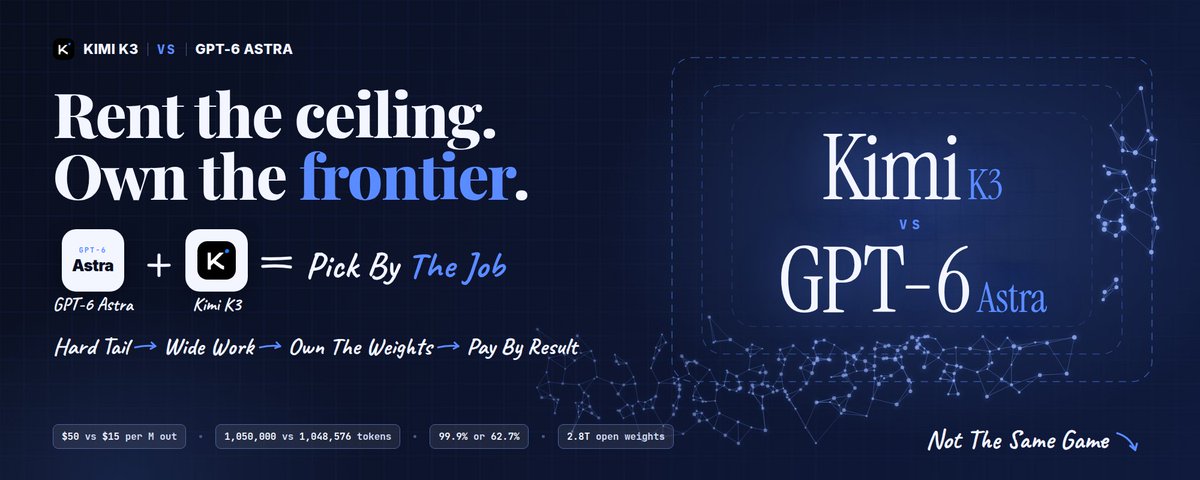
That is exactly the system I built and documented below: one AGENTS.md, three hundred Kimi K3 readers, zero escapes in 41 days.
The paper's whole thesis in one line: write the fence before the keys ↓

Moises Gamio retweeted

this is pure f*cking treasure
these 10 agent skills have 3.49M combined downloads and form a complete working stack
planning. react performance. databases. ideation. interface systems. branding. visual polish. search. browser work. production UI
01 grill-with-docs
▸ github.com/mattpocock/skills
02 vercel-react-best-practices
▸ github.com/vercel-labs/agent…
03 supabase-postgres-best-practices
▸ github.com/supabase/agent-sk…
04 brainstorming
▸ github.com/obra/superpowers
05 ui-ux-pro-max
▸ github.com/nextlevelbuilder/…
06 brandkit
▸ github.com/leonxlnx/taste-sk…
07 impeccable
▸ github.com/pbakaus/impeccabl…
08 seo-audit
▸ github.com/coreyhaines31/mar…
09 browser-use
▸ github.com/browser-use/brows…
10 shadcn
▸ github.com/shadcn-ui/ui
the stack covers the full product loop:
pressure-test the plan ⮕ shape the system ⮕ build the interface ⮕ harden the database ⮕ polish the experience ⮕ audit discovery ⮕ run the workflow in a real browser
save this, then select your gpt-6 astra use case ⭣


Moises Gamio retweeted

Chinese researchers published a paper with a devastating title: "The End of Software Engineering”
it argues software engineering is finished.
In traditional software, code is the carrier of pre-written human logic.
In agentic software, the AI agent is the software.
Code is no longer a permanent monument built by human hands. It is completely ephemeral, dynamically generated, executed, and discarded on the fly by an LLM-driven reasoning loop.
Think about how software delivery has evolved:
• Era 1: On-premise licensed software (you installed it locally)
• Era 2: SaaS (hosted in the cloud, managed by vendors)
• Era 3: Agent-as-a-Service (AaaS)
Each historical shift transferred complexity away from the user. But this latest shift transfers something entirely different.
It transfers decision-making complexity itself.
The paper argues that traditional engineering is hitting a hard complexity wall. Human brains can only hold so much state, manage so many dependencies, and debug so many lines at once.
LLM-based agents scale non-linearly.
They don't just write functions faster. They navigate architectural complexity by outsourcing reasoning to models that improve every single month.
Which means the role of the developer is permanently changing.
You are no longer a code author typing syntax line by line.
You are an intent architect.
Your job is no longer writing the implementation. It is specifying goals, designing multi-agent coordination loops, and auditing outcomes.

Moises Gamio retweeted

100 Coding Best Practices
--------------------
Inspired by @EOEboh, Written by @grok, Prompted by me
Contributions (auto collected by Grok, not specifically asked):
@iamatifriaz, @isMusembi, @distractedIq69, @gusniawan, @MakadiaHarsh, @PythonPr, @clcoding, @LaboratorioRafa, @DataScienceDojo, @milan_milanovic, @lemiorhan, @mgechev, @engineers_feed, @MoisesGamio, @freeCodeCamp, @sahnlam, @mjovanovictech, @czarify, @RemeJuan, @FlowHaa, @denilgabani, @uTombou, @bahdcoder, @opdroid1234, @Prathkum, @Franc0Fernand0, @OfficialSamAyo, @EngrIsaacAbby
--------------------
1. Declare and initialize variables upfront: Always define your variables at the beginning of functions or scopes to avoid hoisting surprises and improve readability.
2. Create modular, specialized functions: Break down large functions into smaller, single-purpose ones that handle one task well, promoting reusability.
3. Eliminate duplicate code: Refactor repeated logic into shared functions or utilities to reduce maintenance overhead and bugs.
4. Be efficient with DOM manipulations: Batch updates (e.g., using DocumentFragment) to minimize reflows and repaints for better performance.
5. Minimize global variables: Scope variables locally whenever possible to prevent namespace pollution and unexpected side effects.
6. Embrace shorthand notation: Use object literals, arrow functions, and destructuring for concise, expressive code without sacrificing clarity.
7. Utilize arrow functions for clean syntax: Prefer arrows for callbacks and non-method functions to reduce boilerplate and lexical 'this' issues.
8. Destructure objects and arrays: Extract values directly into variables for easier access and more readable parameter handling.
9. Master async/await over callbacks: Use async/await for cleaner asynchronous flow, reducing nesting and improving error handling.
10. Embrace template literals: Use backticks for dynamic strings to avoid concatenation mess and enable embedded expressions.
11. Opt for 'const' and 'let' over 'var': Leverage block scoping for better predictability and to prevent accidental redeclarations.
12. Use Promises to avoid callback hell: Chain promises for sequential async operations, making code linear and easier to debug.
13. Modularize long async chains: Split complex promise chains into smaller functions for better testability and flow control.
14. Object destructuring with defaults: Provide fallback values in destructuring to handle missing properties gracefully.
15. Double bang for boolean conversion: Use !! to coerce values to true booleans, ensuring consistent type handling.
16. Template literal conditionals: Embed ternary operators in templates for inline logic without extra variables.
17. Validate inputs in JS and backend: Always sanitize on client-side for UX, but re-validate server-side for security.
18. Use strict mode everywhere: Add 'use strict' to catch common errors early and enforce better practices.
19. Prefer map/filter/reduce over loops: Functional methods reduce imperative code and improve immutability.
20. Handle errors with try-catch in async: Wrap async blocks in try-catch for robust error propagation and logging.
-------------------
Python Best Practices
-------------------
21. Iterate with enumerate() over range(len()): Pair indices and values cleanly without manual indexing errors.
22. Use list comprehensions instead of for-loops: Concise, readable creation of lists from iterables.
23. Sort with built-in sorted() for flexibility: Handles any iterable and supports key functions for custom sorting.
24. Store unique values in sets: Automatic deduplication and O(1) lookups for efficient membership testing.
25. Save memory with generators: Yield values lazily to avoid loading large datasets into memory.
26. Use .get() and .setdefault() for dict defaults: Avoid KeyError and nested ifs for missing keys.
27. Count with collections.Counter: Efficiently tally hashable items without manual loops.
28. Format with f-strings: Embed expressions directly for readable, performant string interpolation.
29. Concatenate with .join(): Build strings from lists efficiently, avoiding quadratic time in + ops.
30. Merge dicts with ** unpacking: Combine dictionaries cleanly in Python 3.5+ for config overrides.
31. Simplify ifs with 'in' checks: Test membership directly instead of iterating manually.
32. Use docstrings for self-documenting functions: Explain purpose, params, and returns for IDE hints and help().
33. Early return for flatter logic: Exit functions on invalid conditions to avoid deep nesting.
34. Catch specific exceptions: Use targeted except blocks over bare Exception for precise error handling.
35. Prefer context managers for resources: Use 'with' for files/DBs to ensure auto-cleanup.
36. Type hints for clarity: Annotate functions with -> and : for better IDE support and contracts.
37. Use pathlib over os.path: Modern, object-oriented path handling for cross-platform ease.
38. Validate inputs early: Check args at function start to fail fast on bad data.
39. Immutable defaults in functions: Use None or sets() to avoid mutable default pitfalls.
40. Unpack iterables wisely: Use * for variable args to handle dynamic lengths safely.
-------------------
General Coding Best Practices
-------------------
41. Follow SOLID principles: Single responsibility, open/closed, etc., for extensible designs.
42. DRY: Don't Repeat Yourself: Extract common code into functions or classes to minimize duplication.
43. YAGNI: Avoid premature features: Build only what's needed now to prevent over-engineering.
44. KISS: Keep It Simple: Favor straightforward solutions over complex ones for easier maintenance.
45. Write unit tests first (TDD): Define behavior via tests before implementation for robust coverage.
46. Refactor regularly: Improve code structure without changing behavior to curb tech debt.
47. Use version control religiously: Commit often with meaningful messages for traceability.
48. Master algorithms and data structures: Choose optimal ones (e.g., hash maps for lookups) for efficiency.
49. Optimize database queries: Index frequently accessed columns and avoid N+1 problems.
50. Design for scalability: Use microservices or event-driven patterns for growth-ready systems.
51. Pair program for knowledge sharing: Collaborate in real-time to catch issues early and learn faster.
52. Conduct thorough code reviews: Focus on logic, style, and edge cases for quality gates.
53. Write descriptive commit messages: Explain what and why, not just how, for historical context.
54. Handle pushback gracefully in reviews: Respond constructively to foster team growth.
55. Design before coding: Sketch architecture and interfaces to avoid integration pitfalls.
56. Test everything exhaustively: Cover edge cases to catch issues before production.
57. Use inspections over manual checks: Formal reviews find more defects early.
58. Anticipate requirements changes: Build flexible architectures with loose coupling.
59. Defensive programming: Validate assumptions and inputs to prevent crashes.
60. Configuration management: Track all env-specific settings for reproducible builds.
-------------------
Clean Code Best Practices
-------------------
61. Use intention-revealing names: Choose variables/functions that describe their purpose clearly.
62. Keep functions small and focused: One function, one job—aim for <20 lines max.
63. Comment the 'why', not the 'what': Code should be self-explanatory; explain rationale only.
64. Avoid magic numbers/strings: Define constants or enums for hardcoded values.
65. Early returns for guards: Flatten conditionals by exiting on failures first.
66. Merge nested ifs: Combine conditions into single expressions where logical.
67. Extract booleans to methods: Turn complex conditions into named functions.
68. Prefer custom exceptions: Raise specific errors over generic ones for better debugging.
69. Use result objects over exceptions: Return structured outcomes for expected failures.
70. Abstraction hides complexity: Layer code to expose simple interfaces.
71. Separation of concerns: Divide code into distinct modules by responsibility.
72. Consistent formatting: Adhere to style guides (e.g., PEP8) for team readability.
73. Immutable data where possible: Prevent side effects by avoiding mutations.
74. Single responsibility per class: One class handles one cohesive set of behaviors.
75. Open/closed principle: Extend behavior via inheritance/composition, not modification.
76. Liskov substitution: Subtypes must be interchangeable without breaking clients.
77. Interface segregation: Small, specific interfaces over fat ones.
78. Dependency inversion: Depend on abstractions, not concretions.
79. Refactor toward simplicity: Ruthlessly simplify as you go, deleting unused code.
80. Make code easy to delete: Design loosely coupled so changes remove rather than rewrite.
-------------------
Software Engineering Best Practices
-------------------
81. Audit dependencies regularly: Scan for vulnerabilities and remove unused packages monthly.
82. Use private registries for prod: Proxy external deps to control access and caching.
83. Monitor package maintainers: Track changes in critical libs for security risks.
84. Sandbox builds: Isolate CI with no outbound net to prevent supply-chain attacks.
85. Implement CI/CD pipelines: Automate tests/deployments for faster, safer releases.
86. Track PR throughput: Measure cycle time to identify bottlenecks, not lines of code.
87. Prioritize security from day one: Follow OWASP for auth, input validation, and encryption.
88. Mentor juniors intentionally: Pair with seniors for 2x faster onboarding and skill transfer.
89. Use feature flags: Toggle deployments safely without full rollbacks.
90. Document APIs thoroughly: Use OpenAPI/Swagger for self-describing endpoints.
91. Prototype without discarding: Keep early mocks as testbeds for iterations.
92. Assert invariants at entry: Validate function preconditions for defensive coding.
93. Embed state verifiers: Call checks from anywhere to monitor assumptions.
94. Fuzz test with randomness: Generate inputs to uncover edge cases automatically.
95. Leverage complementary libs: Integrate high-quality tools to offload complexity.
96. Serialize all data structures: Enable easy persistence and debugging.
97. Break problems into sub-tasks: Solve in plain English first, then code.
98. Read others' code daily: Study open-source for style and patterns to evolve yours.
99. Debug systematically: Use breakpoints and logs over print-debugging.
100. Practice daily, even briefly: Consistency compounds—20 mins beats sporadic marathons.
Moises Gamio retweeted

MIT's "Mathematics for Computer Science".
PDF available at: courses.csail.mit.edu/6.042/…

Moises Gamio retweeted

"With the addition of these new software libraries from @IBMResearch new and existing partners can embed the same Watson #AI with the flexibility to build and deploy on any cloud in their containerized environment of choice.” - ibm.biz/BdPSas
----
#IBM #MachineLearning

Moises Gamio retweeted

We build analytics widgets to quickly help merchants understand how they’re doing and gain insights. After our third iteration of this work, we’re sharing the challenges and lessons we’ve learned along the way.
iOS ▶️ https://teapawt.org/t.co/tpGRA4sAaG
Android ▶️ https://teapawt.org/t.co/ZsFCHnxDEI

Moises Gamio retweeted

How do you make good decisions?
1. Think before you act.
2. Understand the true objective.
3. Defer everything not tied to that.
4. Believe no marketing promises.
5. Consult with your elders.
6. Correct mistakes before they fester.
7. …


Moises Gamio retweeted

We are very excited to announce our latest project, Peercoder AI!
Peercoder AI Is able to generate code based on basic guidelines passed along by the user.
Peercoder AI is launching mid November, and you can join the waiting list below! peercoder.io

Moises Gamio retweeted

Ever wanted to know more about Search Console performance data? 🧐 Here's a deep dive into the data available and how Google processes it
developers.google.com/search…


