

North American Defense Area|Protects free societies, sounds the alarm against tyranny, and advances freedom and democracy world
Joined January 2023
- Tweets11
- Following565
- Followers813
- Likes28



Taiwan's Pride Turned Weapon? Jensen Huang's "Spy Affair": Did Nvidia's Top AI Chips Reach a PLA "Taiwan Invasion Lab"?
NYT's Paul Mozur on CNN: "You see these chips going to a lab that's studying how basically to take Taiwan."
Made in Taiwan. Possibly aimed at Taiwan.
Connect the dots. Jensen Huang admitted an affair with Alice Huang and resigned as Nvidia CEO on Nov. 12. Alice Huang once ran Megaspeed, a Singapore cloud company, and US officials say she's an asset for Chinese intelligence. Beijing denies it. According to the NYT, when she and her husband pitched investors in Shanghai in 2023, the selling point was her relationship with Jensen Huang, which they said would guarantee chip supply. Megaspeed went on to buy more than $4 billion in Nvidia chips. Its biggest customer and financial backer: Alibaba.
This isn't classic smuggling. It's harder to catch: the chips never enter China, but the computing power does. The hardware sits in Southeast Asian data centers, and Chinese customers tap it remotely. Washington built a wall around the hardware. The other side just went around it through the cloud.
Go one layer deeper. Alibaba co-founded Zhejiang Lab in Hangzhou. Its director, Wang Jian, is Alibaba's former CTO and a longtime friend of Jensen Huang. Researchers there have worked on drone swarms and automated cyberattacks, and co-wrote war-game papers with PLA Air Force scientists on fighting off a carrier strike group coming to defend a "self-declared independent island."
To be clear, the NYT says it's still unclear whether Megaspeed's chips actually went from Alibaba to the lab. This isn't a conviction. It's a chain with one link still missing.
And that uncertainty is the scariest part. Export controls can track where chips are shipped. They can't track who's using the computing power. After enough layers of resellers and contractors, even Nvidia can't say for sure where its chips end up.
Taiwan's "silicon shield" rests on making the best chips in the world. But if no one can control where the most powerful computing power goes, even the best chips can end up as a knife in someone else's hand.
Was Jensen Huang played, or did he look the other way for the China market?
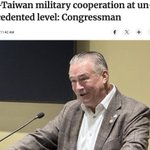
Unprecedented US-Taiwan Military Ties! US Lawmaker: Joint War Planning Already Underway! If China Attacks, Will the US Step In?
Rep. Don Bacon: INDOPACOM and Taiwan's military are coordinating at an "unprecedented" level.
The big word isn't "unprecedented." It's "planning."
Bacon says INDOPACOM chief Adm. Paparo is actively working with Taiwan's government and military, and US defense plans have been significantly adjusted as a result.
For years, the deal was simple: we sell you weapons, you train on your own. Now one of the US military's top combat commands is sitting down with Taiwan's forces to plan and coordinate. That's not a sales relationship anymore. That's a partnership.
Then look at the paperwork. Through the NDAA, Congress has been writing Taiwan training and contingency stockpiles into law, step by step. Washington and Taipei also signed an MOU on a "Taiwan Fellowship" program that sends US federal employees to work in Taiwan. Democratic Rep. Ami Bera nailed the point: this cooperation no longer hinges on one president's mood. It's locked in through legislation and signed agreements, across parties and across administrations.
Here's the logic people miss: no military reworks its plans and pours this much effort into coordination for a fight it has zero intention of joining. A plan isn't a promise to send troops. But it means the Pentagon has already war-gamed the Taiwan Strait.
Deterrence only works if the other side believes it. By going deeper on coordination and dialing up its posture, Washington has put its own credibility on the line. Back down in a Taiwan crisis, and it's not just Taiwan that pays. Japan, the Philippines, every ally under the US umbrella starts asking whether that umbrella is real.
Strategic ambiguity hasn't gone anywhere. But the ambiguity is shrinking, inch by inch. For Beijing, the toughest math isn't whether the US will show up. It's how much is already in place.
With war plans already in sync and the framework written into law, does America even have an exit left?
Is Japan Openly Snubbing Beijing? Days After Trump, Xi, and Putin Shared a Stage in Shenzhen, Tokyo Fires Back: China Is NOT Asia's Hegemon!
Asked if China is now Asia's top dog, Japan's FM Motegi didn't blink: "I don't believe China has become a regional hegemon in Asia."
Beijing went all-in on that photo op. Xi front and center, the American and Russian presidents flanking him. The message was clear: Asia runs through Beijing now. Tokyo picked that exact moment to pop the balloon.
Rewind. When PM Sanae Takaichi landed in Shenzhen, she was met by a retired former ambassador. At the summit, she reached out to Xi and got only a brief handshake. No bilateral meeting either. Plenty of people called it a humiliation. But Takaichi turned around and sat down with Putin for about 30 minutes, the first face-to-face between Japanese and Russian leaders since 2019, and since the war in Ukraine began. She put the emphasis on Quad solidarity with the U.S., Australia, and India. The next day, her foreign minister dropped the "not a hegemon" line.
That's not a tantrum. That's a calculated counterpunch.
You don't become a hegemon by throwing a summit and inviting VIPs. There are two real tests: Can you write the region's rules on your own? And does the region's No. 2 power accept you as the boss? In Asia, No. 2 is Japan. As long as Tokyo refuses to nod along, Beijing's photo is just that: a photo.
Japan sees it clearly. Trump came to Shenzhen to talk nukes, Iran, Ukraine, and trade commitments, and Washington reaffirmed its Taiwan policy hasn't changed. Sitting at the same table is dealmaking and risk management. It's not handing over the Indo-Pacific. U.S. forces are still in Yokosuka. The Quad is still running.
The real knife twist was Motegi's next line: China is an "important neighbor," and precisely because there are so many unresolved issues, the two sides need more dialogue. First he knocks Beijing off the hegemon pedestal, then he redefines it as a neighbor. Neighbors are equals. Accept China as a hegemon, and every future talk on the East China Sea, Taiwan, or investment becomes a small power petitioning a big one. Call it a neighbor, and it's a negotiation between equals.
Beijing tried to pressure Tokyo with airport protocol and a cold shoulder. Tokyo answered with something more powerful: the right to define the relationship.
Beijing saw that summit photo as a coronation. Tokyo doesn't even see a hegemon.
So what's Beijing's next move? Turn up the pressure, or realize that freezing out a neighbor who won't bow is harder to walk back than being told you're "not a hegemon"?