

Infosec | Activism | Freedom | Politics "Every living being is an engine geared to the wheelwork of the universe"
Joined November 2016
- Tweets70.9K
- Following4.9K
- Followers918
- Likes119K





Pinned Tweet
WANTED FOR GENOCIDE, TYRANNY, AGGRESSION & BIO-TERRORISM
For crimes against humanity, crimes of aggression, genocide against Uyghurs, Tibetans, and Hongkongers, for corruption, bribery, theft and fraud on industrial scale, for every fentanyl death & 30 million pandemic deaths.🗞️

Free Jimmy Lai.
Free them all.

Jimmy Lai could have stayed a clothing tycoon and kept quiet about Beijing. He started a newspaper instead.
By the early 1990s, his Giordano stores stretched across Asia. In 1994, after Chinese Premier Li Peng defended the Tiananmen crackdown, Jimmy wrote an open letter condemning him. Beijing went after his business and forced him to sell his stake.
In 1995, he launched Apple Daily. Hong Kong’s handover to China was two years away. He did it anyway.
For 26 years, Apple Daily printed the news Beijing didn’t want Hong Kong to read. It ran until 2021, when Hong Kong authorities used Beijing’s national security law to shut it down.
#FreeJimmyLai #BringHimHome

Free Jimmy Lai.

Champagne with Xi. Solitary confinement for Jimmy.
Trump and Xi are getting the VIP treatment in Shenzhen.
30 miles away, Jimmy Lai is locked up.
Trump promised: “100%... I'll get him out.”
So what's he waiting for? Why isn't he demanding
Jimmy's freedom?
#FreeJimmyLai
youtu.be/hv206L1w83Q?si=aU8U…

12
Phoenix Analytica🍎🌻🕸️ retweeted

Ukrainian forces attacked the Kerch Bridge last night, sparking debate over their objectives and whether an aerial strike can inflict serious structural damage. I tend to agree that even without severe damage, regular attacks could still force the bridge to close.

Phoenix Analytica🍎🌻🕸️ retweeted

This is what the British gave Hong Kong and this is what Jimmy Lai fought for.
#FreeJimmyLai #BringHimHome
Pres. Trump will visit APEC in Shenzhen, China. Right next to Hong Kong.
Where Jimmy Lai, Joshua Wong, Gwyneth Ho, Benny Tai, Claudia Mo, countless others are held as political prisoners: 1951 people as of now.
Please follow @SupportJimmyLai
Trump has to demand their release!


Champagne with Xi. Solitary confinement for Jimmy.
Trump and Xi are getting the VIP treatment in Shenzhen.
30 miles away, Jimmy Lai is locked up.
Trump promised: “100%... I'll get him out.”
So what's he waiting for? Why isn't he demanding
Jimmy's freedom?
#FreeJimmyLai
youtu.be/hv206L1w83Q?si=aU8U…
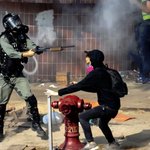
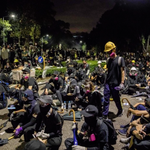
Hong Kong #OTD 7 years ago: Mass protests build and engulf the city as anger erupts over brutality by authorities, while riot police's militarized siege on CUHK reaches a climax.
Protests and road blocks ask for the Five Demands, the release and amnesty of detained protesters.

November saw the most violent clashes of 2019 following months of escalation by the government's forces.
Several shooting incidents miraculously have all protesters survive but countless "made suicides" raise suspicion people are covertly being murdered.
youtube.com/watch?v=M48LPYnV…


Phoenix Analytica🍎🌻🕸️ retweeted

Twelve years in detention. Now facing possible return to China.
Thailand can still choose protection. Canada can help make that possible.
These two Uyghur men deserve a future beyond prison walls.
#Uyghurs #HumanRights
hrw.org/news/2026/11/03/thai…


Phoenix Analytica🍎🌻🕸️ retweeted

This is external propaganda in the genre of "telling China's story well" (讲好中国故事), and promoting "whole-process people's democracy" (全过程人民民主). It's a narratively persuasive piece of discourse-power work (话语权) and de facto propaganda.
It answers "do Chinese citizens vote?" (yes) so that nobody asks "can they choose who governs them?" (no).
The column below is a useful example of whitewashing the fact that we are talking about One-party dictatorship and of how Beijing is pitching its idea of democracy to Western readers who have very little knowledge of China 🇨🇳.

Americans have just cast their ballots, and now voters in Beijing are heading to the polls today. How do two very different political systems approach elections, political representation, and democratic participation?
Many years ago, when I was studying at Cornell, I had a roommate for one semester who was an exchange student from the Netherlands.
His uncle was the deputy prime minister of the Netherlands at the time.
So, naturally, our dorm room had no shortage of political discussions. Unfortunately, neither of us had the authority to settle any of them at the beginning.
He knew relatively little about China, yet he had quite a few preconceived notions about the country, particularly its political system. And he's passionate.
On Friday and Saturday nights, after the lights went out in our dorm, we would often lie in our beds and engage in heated but friendly debates that sometimes lasted late into the late night.
While other college students spent their Friday nights partying, we spent ours debating in the dark. Not exactly the typical college experience, I know.
Like many others, he was skeptical about how elections worked in China.
I explained to him that deputies to the people's congresses at the county, county-level city, municipal district, township, are directly elected by citizens aged 18 and above who are entitled to vote. Representatives at higher levels are also elected, through an indirect electoral process.
I also pointed out something about China's political representation that he hadn't realized: all 55 ethnic minority groups have representatives in the National People's Congress, with special arrangements to ensure representation even for groups with very small populations.
I asked him: "Can the US Congress guarantee that every ethnic minority group has a voice of its own in the national legislature?"
Silence fell over his bed. And if you knew how much we loved arguing, you'd understand how unusual that was.
I continued:
If, under one political system, everyone formally has an equal vote, yet certain groups consistently struggle to achieve adequate representation, while another system specifically guarantees political participation for smaller ethnic groups through its allocation of seats and institutional arrangements, how should we understand what democratic representation truly means?
Through our countless late-night debates, some of his assumptions about China gradually began to shift.
Years later, our friendship had outlasted our disagreements-and his connection to China had taken a turn neither of us could have imagined. Two years ago, he married a Chinese woman.
And he invited me to their wedding! I guess China had found a more persuasive ambassador than me.
Of course, marrying a Chinese woman does not mean that he has to agree with everything about China. But I firmly believe that when someone truly gets to know China and its people, the China they come to see is often very different from the China they once imagined.
Today, I found myself thinking once again about my former Dutch roommate.
Because it is election day in Beijing for a new term of deputies to the people's congresses at the district and township levels.
Well before election day, both my local community and my workplace had both contacted me to ask where I intended to register and cast my ballot.
I could also clearly sense that Beijing has placed considerable emphasis this year on encouraging and organizing voter participation.
According to figures released by the Beijing municipal authorities, by late October 9.57 million voters have registered and been confirmed as eligible to vote in this round of elections.
More than 13,000 polling stations have been established across the city. Voters will elect 4,898 deputies to the new district-level people's congresses and 11,137 deputies to the township-level people's congresses.
On this very day, one polling station in particular attracted considerable public attention: the Huairentang (Hall of Cherished Benevolence/怀仁堂) polling station in the Zhongnanhai (中南海) electoral constituency of Beijing's Xicheng District.
Huairentang was once the residence and office of the Empress Dowager Cixi, who wielded the real power in China during the final years of the Qing Dynasty (1644-1911).
In 1900, when the Eight-Nation Alliance occupied Beijing, Marshal Alfred von Waldersee, the commander of the allied forces, unceremoniously chose Huairentang as his residence. The building was subsequently destroyed in a mysterious fire. Some accounts suggest that the blaze was accidentally started by Waldersee's cook.
During the Republican era, Huairentang became a venue for presidential receptions and official ceremonies. In 1949, it hosted the First Plenary Session of the Chinese People's Political Consultative Conference, a landmark gathering that helped lay the groundwork for the founding of the PRC. It subsequently became an important venue for meetings of senior CPC leaders.
Chinese President Xi cast his ballot at the Huairentang polling station in Beijing's Zhongnanhai leadership compound. Xi presented his voter registration card and was handed a ballot after officials verified his eligibility. He then marked his choice and dropped the ballot into a box.
Xi said electing deputies to people's congresses was essential to the functioning of China's people's congress system and a major event in the country's political life. He added voters should be ensured to elect representatives they are satisfied with.
All of this brought back memories of the many debates I used to have with my Dutch roommate. In fact, China's electoral system has a number of features that deserve closer examination.
The first is a basic question: How are deputies to China's people's congresses actually elected?
China uses a combination of direct and indirect elections. Deputies to people's congresses at the county level, including those in urban districts, counties, autonomous counties and cities without districts, as well as deputies at the township level, are directly elected by voters.
Deputies to people's congresses at higher levels, including cities, provincial regions and the NPC, are elected indirectly through people's congresses at the next lower level.
The second concerns political representation: China's electoral law explicitly seeks to ensure that deputies do not come exclusively from a narrow political or social elite. China's Electoral Law of the National People's Congress and Local People's Congresses stipulates an appropriate number of deputies from females, the grassroots, particularly workers, farmers and intellectuals.
It even provides for representation of returned overseas Chinese in the congresses in areas with significant populations of returned overseas Chinese.
In direct elections, the number of candidates must exceed the number of seats by between one-third and 100%. For example, if three seats are available, there must be between four and six candidates.
In indirect elections, where deputies are elected to the next higher level of people's congress, the number of candidates must exceed the number of seats by between 20% and 50%. Thus, an election for 10 seats would require between 12 and 15 candidates.
Looking back, the question my Dutch roommate and I debated most fiercely was not really whether China's political system was better or worse than those of Western countries.
It was something more fundamental:
Is there only one legitimate model of democracy, or can democratic participation and representation take different institutional forms?


Phoenix Analytica🍎🌻🕸️ retweeted

This is utterly heartbreaking, totally tragic, and absolutely illustrative of the inhumanity and barbarity of the Chinese Communist Party's genocide of the Uyghurs
My prayers, condolences and solidarity are with the Uyghur community at this tragic time of grief
Stop #UyghurGenocide
Rahile Omer, the youngest Uyghur detainee in Chinese prisons, has died asianews.it/en/east-asia/chi…

China murdered Rahile Omer, who committed no crime and was detained alongside her parents when she was just 14 year old. Her father was a government official.
She spent the next 9 years arbitrarily imprisoned. Now she died in detention due to abuse and deplorable conditions.
🕯️

Rahile Omer, the youngest detainee photographed in the Xinjiang Police Files, has died in a Chinese prison at 23.
RFA Uyghur Service reports that officials in Konasheher County, Kashgar, had confirmed by phone that she died one to two months earlier.
Her case is documented in my 2022 study of the Xinjiang Police Files. She was the youngest of the 2,884 photographed persons confirmed as detained.
Xinjiang’s mass surveillance platform flagged her as a “Type 12 person,” meaning someone connected to an existing police case. Both of her parents had been detained on July 3, 2017. Her father was a government official. The records note that she was first spared because she was “14 years old, a non-adult student.” Police detained her on September 28, less than three months after her parents.
RFA has now reported what followed. A judicial official said that in 2019 she was moved from the camp to a detention center because the “education” had not taken effect, she had given no information about others in her case, and she had prayed through gestures in her dormitory. In October 2021, after she turned 18, she was sentenced to 12 years in prison. An officer said she died of a heart condition but gave no further details. These statements cannot be independently verified.
Rahile spent more than a third of her life in custody because of her family. Beijing should release her medical and prison records and disclose what has happened to her parents.
Report links below.

Hong Kong #OTD 7 years ago: Protests met by arbitrary mass arrests across HK. Police continues its siege on the CUHK where protesting students gather to seek refuge and support.
Battles are marked by endless volleys of aggressive MIC-produced tear gas as people barricade inside.
Hong Kong #OTD 7 years ago: Arbitrary mass arrests of protesters across HK. Police continue their siege on the CUHK where protesting students gather to seek refuge and support.
Battles are marked by endless volleys of aggressive MIC-produced tear gas as people barricade inside.

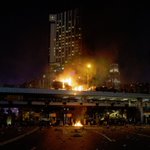
On fire: Here’s how clashes between protesters and police escalated on Tuesday night at the Chinese University of Hong Kong.
More @business: bloom.bg/2Qd0uVb #HongKongProtests #香港 #CUHK
Phoenix Analytica🍎🌻🕸️ retweeted

"He realized that if he surrendered his dignity, his captors wouldn't stop at a confession — they'd empty his very soul."
In 2015, Hong Kong bookseller Lam Wing-kee was abducted and disappeared across the border into a black jail, where Chinese Communist Party uniforms subjected him to psychological torture for unspecified crimes.
The CCP wanted to know who was buying “forbidden books” revealing the secret lives of its officials. Lacking leverage, they abducted Lam’s girlfriend, too.
But the Causeway Bay Books manager wouldn’t buckle. Returning to Hong Kong, he risked oblivion to tell the world about his secret capture.
His decision shook the world and inspired many to prepare for the fight against repression that was to come.
Lam passed away in exile in Taipei on July 2, 2026.
In this deeply moving tribute, @ChinaChange_org Editor-in-Chief @YaxueCao writes about Lam’s writing, dignity, and the love for Hong Kongers that motivated his decision-making. 👇
🔥thecfhk.org/the-last-hong-ko…