

Cisco’s largest Indiana-based reseller, NSI brings exceptional, complete solutions to the mid-level and enterprise markets of Indiana and the surrounding states
Indiana
Joined July 2008
- Tweets12K
- Following463
- Followers506
- Likes192



What if AI could prevent your next network outage instead of just helping fix it?
That's one of the goals Cisco's Liz Centoni is pursuing as she transforms Cisco's $15 billion services business with agentic AI.
Her four lessons are refreshingly practical:
- Redesign workflows instead of simply adding AI.
- Predict and prevent problems before customers notice.
- Choose AI tools based on the job, not the hype.
- Measure actual business results, not AI adoption.
The most interesting takeaway? Cisco is moving beyond faster troubleshooting toward preventing problems altogether.
For IT leaders, that's a compelling vision of intelligent, proactive infrastructure.
A great look inside Cisco's AI transformation from CIO Magazine:
hubs.ly/Q04FmPXL0
#Cisco #AgenticAI #ITOperations

12
What happens when the firewall becomes the attacker's front door?
That's exactly what happened to several Check Point customers in a troubling new cyberattack.
Attackers chained critical PHP vulnerabilities with a privilege escalation flaw to gain root access to security gateways.
Once inside, they could steal network configurations, conceal their activity, establish persistent access, and even deploy destructive malware.
The uncomfortable lesson? Your security infrastructure needs protecting, too.
And this isn't just a Check Point problem. Firewalls and management interfaces across multiple vendors have become attractive targets because of the privileged access they provide.
Patching is essential. But so are continuous monitoring, restricted management access, and investigating whether attackers have already established a foothold.
Who's watching the technology that's supposed to be watching everything else?
Read the Network World article:
hubs.ly/Q04FmbM10
#CyberSecurity #NetworkSecurity #VulnerabilityManagement

30
Two Forrester Waves. Two Leader recognitions. One important message about the future of cybersecurity.
Cisco has been named a Leader in both the Forrester Wave for Enterprise Firewall Solutions and the Forrester Wave for Microsegmentation Solutions.
And according to Cisco, it's the only vendor to earn Leader recognition in both evaluations.
Why does that matter?
Because protecting the perimeter is no longer enough. Today's threats move across applications, workloads, data centers, and cloud environments.
Firewalls help control traffic entering and leaving network segments.
Microsegmentation helps prevent attackers from moving freely once they're inside.
The real advantage comes when those defenses work together.
Cisco's Hybrid Mesh Firewall strategy connects these capabilities with unified policy management, including support for third-party firewalls.
At Network Solutions, we see tremendous value in this kind of integrated security architecture.
Fewer security silos. Better visibility. More control over where threats can go.
Read Cisco's perspective:
hubs.ly/Q04F336Y0
#CiscoSecurity #ZeroTrust #CyberSecurity

13
AI agents could break your network. And Cisco thinks it's time to rethink everything.
Here's a number that should get IT leaders' attention: Only 9% of organizations in the Asia-Pacific region believe their networks are fully ready for AI.
At Cisco Live Melbourne, Cisco made a provocative argument: Enterprise networks designed around human activity weren't built for thousands of autonomous AI agents communicating around the clock.
More traffic. New security risks. Machine-speed operations. And infrastructure that may not be ready.
Cisco's response involves some significant changes to networking, security, and automation.
The bigger question: Is your network ready for the AI you're planning to deploy?
Take a fascinating look at what's coming.
hubs.ly/Q04DZPFt0
#Cisco #AgenticAI #EnterpriseNetworking

14
AI agents are getting smarter. But who's making sure they're behaving?
Cisco just announced some fascinating new capabilities designed to tackle one of the biggest challenges of enterprise AI: keeping autonomous agents secure, accountable, and worth the investment.
Three developments caught our attention:
- Cisco AI Defense + Claude Mythos: Advanced AI red teaming to uncover vulnerabilities before attackers do.
- Splunk Agent Observability: Better visibility into what AI agents are doing, how well they're performing, and what they're costing.
- Cisco IQ: Connecting real-time threat intelligence with infrastructure vulnerabilities to help IT teams prioritize remediation.
Here's what makes this interesting: Cisco is connecting AI security, operational visibility, and infrastructure intelligence rather than treating them as separate problems.
At Network Solutions, we see this as an important evolution in how organizations will manage and secure increasingly intelligent infrastructure.
Because giving AI more autonomy shouldn't mean giving IT less control.
Read Cisco's announcement:
hubs.ly/Q04DXmQp0
#Cisco #AISecurity #AgenticAI

30
Full Wi-Fi bars. Terrible connection. Sound familiar?
We've all seen it. Someone wandering the hallway holding their device in the air, hoping to find that magical spot where the Wi-Fi actually works.
Here's the funny thing: Signal strength might not be the problem at all.
Interference, overcrowded channels, poorly placed access points, and even problems elsewhere in the network can turn a perfectly good signal into a frustrating experience.
And sometimes adding MORE access points actually makes things worse!
In our latest NSI blog, we explore five reasons wireless networks underperform and what organizations can do about them.
Because nobody should have to perform the laptop-in-the-air dance to get connected.
hubs.ly/Q04DSCw50
#WirelessNetworking #WiFiPerformance #CiscoNetworking

9
AI just found 81 Firefox vulnerabilities and developed exploits for 948 Linux kernel flaws. Let that sink in.
OpenAI's new GPT-6 Cyber model is demonstrating just how dramatically artificial intelligence could change cybersecurity.
The good news? AI can help security researchers discover vulnerabilities, validate threats, and develop patches faster than ever.
The concerning news? These same capabilities could eventually give attackers an extraordinary advantage.
We're entering an era where the speed of cybersecurity may matter as much as the strength of our defenses.
For IT leaders, this raises an important question: Are your security operations evolving quickly enough to keep pace?
An eye-opening article from BleepingComputer:
hubs.ly/Q04DPBXR0
#CyberSecurity #ArtificialIntelligence #ThreatDetection

17
Your Cisco partner should bring more to the table than a quote.
That's one of the biggest takeaways from Cisco Partner Summit 2026, and Zeus Kerravala makes a compelling case for it in this Network World article.
With innovations like Cisco IQ, Cloud Control, and AI-powered operations, Cisco partners have new opportunities to help customers:
- Identify vulnerabilities and infrastructure risks before they become problems.
- Make smarter, data-driven technology investments.
- Move from reactive support to proactive network management.
- Prepare their infrastructure for the demands of AI.
At Network Solutions, we've always believed the best partnerships are built on expertise, trust, and helping customers make better decisions.
The technology is changing. Customer expectations should be rising right along with it.
An excellent perspective on what IT leaders should expect from their Cisco partners.
hubs.ly/Q04DPxBq0
#Cisco #ITLeadership #NetworkModernization

1
23
Data center networks are evolving in more than one direction. Spine and core links may move to 400G or 800G, while many server-facing connections remain at 10G, 25G, 50G, or 100G. That leaves a clear design challenge at the leaf: add more 100G capacity while making efficient use of rack space. AI, high-performance computing (HPC), and hyperscale cloud environments are increasing demand for high-throughput connections. For many deployments, 100G remains a cost-efficient workhorse, and the move to faster spine links can increase the need for dense 100G leaf capacity.
hubs.ly/Q04DFQwn0

7
The FBI and CISA warn that hackers are actively targeting industrial refrigeration and cold-chain monitoring systems worldwide, potentially causing food spoilage, equipment damage, and fire hazards.
The warning was issued jointly with the U.S. Departments of Health and Human Services (HHS), Agriculture (USDA), and Transportation (DOT), urging critical infrastructure operators to secure vulnerable refrigeration controllers used in healthcare, food production, chemical facilities, and transportation.
hubs.ly/Q04DFQtH0

6
As a lifelong Patriots fan, I’ve spent plenty of Sundays at Gillette Stadium feeling the electric energy that defines New England Patriots football. But what fans see on the field is only part of the story.
Behind the scenes, the Patriots and The Kraft Group are transforming the technology that powers their organization—and I’m proud that Cisco is the critical infrastructure partner making it happen.
hubs.ly/Q04DFMKs0

15
D-Link shared mitigation measures for multiple unpatched security flaws affecting DGS-3130 series managed Gigabit stackable switches.
These switch models provide multi-gigabit uplinks, allowing enterprise network administrators to eliminate data bottlenecks, and are designed primarily for small-to-medium businesses (SMBs) and metro Ethernet deployments.
hubs.ly/Q04DFPcl0

10
Greetings Indiana #EdTech Tune in to see how we're celebrating HECC's 40th anniversary at #HECC2026 next week! Stay to the end for a quick #timelapse of Steve preparing for the show! @hecc_conference
5
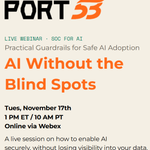
AI is moving fast. But can your security keep up?
AI is creating tremendous opportunities for businesses. It's also introducing new security challenges that many organizations aren't fully prepared to address.
Shadow AI. Sensitive data exposure. Limited visibility. New threats that traditional security tools weren't designed to handle.
Our cybersecurity partner, @Port53, is hosting an upcoming webinar, “AI Without the Blind Spots,” exploring the importance of securing AI adoption without sacrificing innovation.
If your organization is embracing AI, this is a conversation worth joining.
Register here:
hubs.ly/Q04DvC2G0
#AISecurity #CyberSecurity #ArtificialIntelligence

14
Great engineers build remarkable things. Great leaders build remarkable people.
At Network Solutions, we believe engineering excellence is about more than technical expertise. It's about integrity, leadership, dedication, and an unwavering commitment to the people we serve.
That's why we're proud to announce the creation of the Tommy Whatley Engineering Excellence Award, an annual recognition honoring an exceptional individual and the standards he has represented throughout his career.
With more than 25 years of technology and engineering leadership, including executive roles at Converge, Pivot, ProSys, and Cisco, Tommy has built an extraordinary professional legacy.
But this award is also deeply personal.
Our Managing Director, Victor Martino, worked alongside Tommy for many years, developing a friendship that grew into a bond of brotherhood. Victor created this award to honor not only Tommy's professional accomplishments, but also his character, friendship, and lasting influence.
Each year, the award will recognize an NSI engineering professional who exemplifies technical excellence, outstanding service, leadership, and dedication to others.
Tommy, your legacy will continue to inspire excellence at Network Solutions for years to come.
Please join us in celebrating Tommy Whatley and the values that make exceptional engineers even more exceptional people.
Congratulations to our two 2026 Tommy Whatley Engineering Excellence Award today presented with the award by Tommy himseslf!
#EngineeringExcellence #Leadership #TommyWhatleyAward

11
When users report a slow page or failed action, traditional tracing can leave teams stitching together client analytics and backend telemetry.
InfoQ’s look at LinkedIn’s OpenTelemetry platform shows a practical way to connect a user journey across mobile and web clients, backend services, and data stores. The takeaway for IT leaders: observability is most valuable when it starts with user impact and leads directly to the technical cause.
hubs.ly/Q04DmyQN0
#Observability #OpenTelemetry #ITOperations #DigitalExperience

1
55
A Google Calendar invitation could be all it takes to hijack your account. Even with MFA enabled.
Security researchers uncovered a sophisticated phishing campaign that uses legitimate Google links and convincing login pages to steal active user sessions.
The disturbing part? Victims can complete their normal MFA authentication while attackers capture the authenticated session.
Researchers blocked more than 68,000 malicious messages and helped take down nearly 900 attacker-controlled domains.
It's a reminder that MFA is essential, but not foolproof. Organizations also need phishing-resistant authentication, session monitoring, and rapid response capabilities.
Would your security team recognize a hijacked session before the damage is done?
Read the full story:
hubs.ly/Q04DkNhM0
#CyberSecurity #Phishing #IdentitySecurity

21
2027 is approaching. Are CIOs asking the right questions?
From proving AI ROI and managing autonomous agents to strengthening cybersecurity and developing IT talent, next year's technology priorities are taking shape.
CIO Magazine asked IT leaders to share the 13 questions driving their 2027 strategies.
One theme stands out: Technology investments must deliver measurable business value while keeping risk under control.
For IT leaders planning next year's budgets and priorities, this is an excellent conversation starter.
Which question is at the top of your 2027 agenda?
hubs.ly/Q04D9Rwq0
#ITStrategy #CIOLeadership #ArtificialIntelligence
4
On October 27, 2026, the Center for Internet Security (CIS), Multi-State Information Sharing and Analysis Center (MS-ISAC), and Consortium for School Networking (CoSN) released The State of K–12 Cybersecurity 2026.
Half of K–12 schools reported a cybersecurity incident in the past year. Yet two-thirds have just one or two people responsible for cybersecurity.
Think about that for a moment.
Thousands of devices. Hundreds of applications. Sensitive student data. Increasingly sophisticated cyber threats.
And often, just one or two IT professionals trying to protect it all.
The problem isn't a lack of effort. It's a lack of capacity.
School IT teams are being asked to defend increasingly complex environments with limited resources, shrinking budgets, and threats that don't stop at 5 PM.
The answer isn't necessarily more security tools. It's smarter security.
We've identified five critical questions every school district should be asking about its cybersecurity readiness.
If you're responsible for keeping a school district connected, secure, and operational, this one's for you.
Read the article: hubs.ly/Q04D9db40
#K12Cybersecurity #EdTech #SchoolCybersecurity #MAEDS #HECC2026

18