

Pioneering molecular quantum systems for quantum-enhanced metabolic MRI and scalable quantum computing
Ulm, Germany
Joined May 2026
- Tweets28
- Following23
- Followers56
- Likes19





What if researchers could see whether a cancer treatment is working much sooner than they can today?
In an interview with @focusonline, our CEO Sella Brosh speaks about the potential of quantum-enhanced MRI for human health, how it works, and why giving researchers access to better tools matters.
Read the full interview (German, paywalled): focusplus.de/wissen/in-tumor…

QuE-MRT is entering its next phase 🚀 The BMFTR-funded project has been extended through August 2028, bringing the total project volume to ~€20M.
Together with our partners, we're advancing quantum-enhanced metabolic MRI toward clinical translation.
📽️ Hear from the consortium about what's next.
Learn more about QuE-MRT: nvision-quantum.com/news/que…
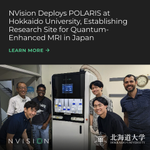
NVision’s quantum technology has arrived in Japan. 🇯🇵 Our first POLARIS deployment in the country is now live at @HokkaidoUni, where Prof. Shingo Matsumoto and his team will use quantum-enhanced MRI to study brain metabolism and disease response.
Learn more: nvision-quantum.com/news/nvi…

Excited to see our story featured on SWR Aktuell Baden-Württemberg!
What started with developing a molecule to make cancer cell metabolism visible with MRI led to an unexpected discovery: the molecule has unique quantum properties and could serve as a new type of qubit.
Molecular qubits could potentially be produced stably and at scale, opening up a new path towards scalable quantum computing and entirely new possibilities for solving complex problems.
From cancer research to quantum computing. Sometimes the most exciting technologies emerge from the discoveries you don’t set out to make.
Thank you SWR and Tina Fuchs for telling our story!
🎥 Watch the feature from 15:35: ardmediathek.de/video/swr-ak…?
🤖 Made with AI

NVision’s quantum technology is taking on a new healthcare challenge in South Korea. 🇰🇷
Backed by €2.5M in Horizon Europe funding, RESQ will bring POLARIS to @yonsei_u and advance metabolic imaging for brain metastases.
Learn more: nvision-quantum.com/news/res…

Is the disease active? Is treatment working?
Conventional MRI can miss important information in multiple sclerosis (MS) because it shows indirect consequences of inflammation, not the inflammation itself.
NVision’s quantum-enhanced metabolic MRI, POLARIS, aims to change that.
@Guglielmetti_C and her team at @WashU are using POLARIS to explore its potential in MS. Their work shows that metabolic imaging can reveal both chronic disease activity and treatment effects that may be missed by conventional MRI.
NVision Quantum Technologies retweeted

Quantum computers encode info in the quantum states of qubits, which can exist in combinations of 0 and 1 simultaneously. This quantum info can't simply be copied or transmitted in the same way as classical bits: when a qubit is measured, its quantum state is disturbed, making it impossible to transmit its info directly. To tackle this problem, qubits must be connected to photons, which can transmit their quantum info between distant parts of a network.
THE QUBIT-PHOTON INTERFACE
This connection relies on what physicists call a "spin-photon interface": a structure in which the quantum state of an electron or nucleus can be reliably written, read, and communicated via light.
Currently, the leading candidates for this role are atomic-scale defects in crystals, such as those found in diamond. However, these structures are notoriously difficult to position precisely, making it hard to build larger, more complex systems.
TRAPPING A PROGRAMMABLE MOLECULE
To overcome this limitation, the NVision team turned to synthetic chemistry. To start, they embedded a precursor molecule inside a host crystal of ketone, then exposed it to light, triggering a chemical reaction that produced a carbene—a molecule containing a carbon atom w/ two unshared electrons.
By carefully matching the molecular structure of the carbene to that of the surrounding crystal, the team created a stable environment in which they could address and control the quantum info encoded within the spin states of individual carbene molecules.
CARBENE— ATOM-IN-CRYSTAL QUBIT-PHOTON INTERFACE SYSTEM
The confined Carbene emitted bright light at a precise, stable frequency for over an hour: a level of consistency that is critical for reliably reading out quantum info.
Its quantum state, known as spin, also persisted for tens of milliseconds at a temperature of 4.5 Kelvin, comfortably exceeding the lifetimes reached by some competing platforms. Even further, Schwartz's team demonstrated coherent control of the spin, meaning they could manipulate the qubit state in a controlled way using carefully timed pulses of light.
T centers, a specific luminescent defect in silicon, can provide a "photonic link" between qubits. "An emitter like the T center that combines high-performance spin qubits and optical photon generation is ideal to make scalable, distributed, quantum computers, because they can handle the processing and the communications together, rather than needing to interface two different quantum technologies, one for processing and one for communications," Simmons says.
phys.org/news/2022-07-photon…
Optical observation of single spins in silicon
In this work, we integrate individually addressable ‘T centre’ photon–spin qubits in silicon photonic structures and characterize their spin-dependent telecommunications-band optical transitions. These results unlock immediate opportunities to construct silicon-integrated, telecommunications-band quantum information networks.
nature.com/articles/s41586-0…
Single-Molecule Spin-Photon Interface
A molecular color-center with a triplet ground state doped into a crystalline matrix
arxiv.org/html/2605.10077v1

NVision has been named to the 2026 @FastCompany World Changing Ideas list for POLARIS, our quantum-enabled platform designed to make metabolic MRI scalable.
Standard MRI shows anatomy. POLARIS is designed to help make metabolism visible.
See the full list of organizations changing the 🌍: fastcompany.com/world-changi…

What will it take for Europe to remain competitive in quantum?
Next week, our CEO @SellaBrosh joins Jason Palmer from @TheEconomist to discuss the future of Europe's quantum ecosystem and the role of pioneering quantum computing architectures.

The biggest challenge in quantum computing? Moving from fragile, complex lab systems to qubits that can be manufactured, integrated, and scaled.
Peter Barrett (@Playground_VC) explains why he believes NVision's PIQC molecular qubits could open a new path to scalable quantum computing.
Watch the full conversation: xitter.cf/NVisionQuantum/status/…

Learn what Peter Barrett of @Playground_VC means when he says that “NVision is globally unique in their talent for manipulating quantum spins” in this 3-minute video.
As one of NVision’s earliest investors shortly after the company was founded in 2015, Peter has had a front-row seat to our evolution from quantum sensing to quantum computing and to the broader development of the quantum industry.
We recently sat down with Peter at Playground’s headquarters in Palo Alto to discuss NVision’s evolution, the broader quantum landscape, and where the field is headed next.
In the last few years we are seeing monolithic quantum chips hitting a scaling wall. To reach utility-scale Fault-Tolerant Quantum Computing (FTQC), our hypothesis is that we must network chips together using photons.
However the hardware for a scalable Qubit-Photon Interface hasn’t existed.
Until now.
Today, we unveil the full architecture behind PIQC (Photonic Integrated Quantum Circuits).
Instead of relying on what we find in nature, we built the ideal quantum node from the ground up. By rationally designing our molecule’s quantum properties, we’ve created a system that acts as both a robust memory qubit and a native photonic interface.
To scale this to 100,000-qubit QPUs, our new whitepaper outlines how these molecular quantum systems can be integrated directly onto photonic integrated circuits (PICs). To make the full stack work, the PIQC architecture further includes:
- Deterministic nuclear-spin registers engineered at the molecular level
- Photon-loss-tolerant entanglement protocols
- New fault-tolerant error correction approaches optimized for networked quantum systems
Read our accompanying blog post at nvision-quantum.com/news/piq….
Or for a more technical overview, read our whitepaper at arxiv.org/abs/2605.21204.
Learn what Peter Barrett of @Playground_VC means when he says that “NVision is globally unique in their talent for manipulating quantum spins” in this 3-minute video.
As one of NVision’s earliest investors shortly after the company was founded in 2015, Peter has had a front-row seat to our evolution from quantum sensing to quantum computing and to the broader development of the quantum industry.
We recently sat down with Peter at Playground’s headquarters in Palo Alto to discuss NVision’s evolution, the broader quantum landscape, and where the field is headed next.
Another exciting week ahead! 🚀
Our CEO, @SellaBrosh, will be speaking this week at both Q-EXPO and DTM.
The talks will focus on taking quantum hardware out of the lab and into the real world at scale, from quantum sensing today to quantum computing tomorrow, and on how Europe can win the quantum race.
Looking forward to seeing many of you there.
#QuantumTechnology #QuantumComputing #QEXPO #DTM26 #DeepTech

NVision Quantum Technologies retweeted

A single molecule can now function as an individually controllable qubit with a native photonic interface
For years we've asked how quantum computers might help chemistry.
@NVisionQuantum flips it: chemistry helps build quantum computers
@ScienceMagazine science.org/content/article/…


NVision Quantum Technologies retweeted

NVision ist eines von rund 50 deutschen Start-ups, die sich der Quantentechnik verschrieben haben. Die Ulmer setzen auf die Medizin der Zukunft – und haben eine unerwartete Entdeckung gemacht. faz.net/aktuell/wirtschaft/u…
