

FIDES MEA GENS MEA 𝕹𝖆𝖙𝖎𝖔𝖓𝖆𝖑𝖎𝖘𝖙𝕹𝖊𝖜𝖘𝕹𝖊𝖙𝖜𝖔𝖗𝖐 @NationalistNN banned account#4
Joined December 2025
- Tweets9.4K
- Following732
- Followers1.9K
- Likes5K





Yggdrasil the Tree of life or The Unseen Architects: How Jewish Thinkers and Kabbalistic Mysticism Shaped American Neo-Paganism
The Irony of Intellect: How Guido von List Absorbed Kabbalah into Germanic Occultism
The integration of Kabbalah into modern Norse heathen mysticism represents one of the most paradoxical intellectual maneuvers in modern esotericism. At the epicenter of this fusion was Guido von List (1848–1919), an Austrian völkisch author, playwright, and the founder of Ariosophy (or Armanism). List envisioned an apocalyptic cleansing of the degenerate modern world to pave the way for a neo-pagan Pan-German Empire built upon Wotanism.
The Asatru Folk Assembly celebrates October 5th as a “Holy Day” to Guido Von List. In a write-up on their website they state that List created Wotanism and it was an integral precursor to the reforging of Asatru. They also claim that his interpretation of the runes is still used to this day, and that they have a shrine dedicated to him. While this write-up details the life and beliefs of List, strangely it does not tell the reader that he was a Freemason, and also a believer in the Kabbalah. Two jewish members of his order that we know of are Moritz Altschuler, a rabbinical scholar, and Ernst Wachler, a writer.
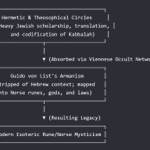
Yet, despite his radical allegedly anti-Semitic nationalism, List did not build his system from raw, isolated Germanic relics. Instead, he systematically mapped his revived "Armanen" mythology directly onto the scaffolding of Hermetic Kabbalah. To justify this synthesis, List constructed a convoluted revisionist narrative: he argued that the Jewish people were merely the historical curators of an ancient Aryan-Germanic spiritual system, preserving it for centuries after Christian authorities violently suppressed Europe’s indigenous pagans.
Guido Von List was initiated into the Freemasonic Lodge Humanitas at Neudörfl. He was active until 1877. He later became critical of Freemasonry but copied their ways. In 1911 he created the High Armanen Order; the inner circle of the Guido von List society. He appointed himself Grand Master (same title as a Freemason who is elected head of a Grand Lodge) and there would be 3 degrees, signs, grips, and passwords copied from the three Craft degrees of Freemasonry.
Guido von List decoded the runes the same way a Kabbalist reads Hebrew letters. Kabbalists believe that every Hebrew letter has 3 meanings/layers: a plain meaning, a symbolic meaning, and a secret meaning. List decoded the runes to have a plain meaning, a hidden meaning, and a highest “Armanen” meaning only initiates were supposed to know.
This same secret was also passed to the Templars, Rosicrucians, and the Freemasons. The Kabbalah actually began in 12th century France, and the Zohar in 13th century Spain.
1. The Structure: Theft by Universal Blueprint
To build a comprehensive, structurally sound system of magic for his elite occult lodge, the Hohe Armanen-Orden, List required a definitive cosmic map. He found it in the primary symbol of Kabbalah: the Etz Chaim (the Tree of Life). Rather than discarding the 10 spheres (Sefirot) and 22 connecting paths, List stripped them of their Hebrew context and re-clothed them in Norse-Germanic mythology.
Through this structural assimilation, List and his later occult interpreters enabled a radical theological mapping:
The Cosmological Grid: The 10 developmental stages of the Kabbalistic tree were repurposed to represent Germanic evolutionary law and the elements of the cosmos (fire, air, water, and earth).
The Path Correspondences: The 22 paths—historically correlated with the 22 letters of the Hebrew alphabet—were systematically replaced by List's own 18-rune system (the Armanen Futharkh) and traditional zodiacal symbols.
The Deities: Kabbalistic archetypes of divine creation, severe justice, and mercy were replaced with Norse equivalents. The supreme cosmic consciousness became Wuotan (Odin); the elemental forces of protection were assigned to Thor; and the fertile, generative qualities of the Divine Feminine were attributed to Freya.
2. The Myth of the "Unconscious Guardians"
To reconcile his fierce anti-Semitism with his reliance on Kabbalistic mechanics, List formulated a highly specific historical theory in works like The Secret of the Runes and The Rita of the Ario-Germanen. He asserted that the complex systems of letter mysticism, numerology (gematria), and spiritual geometry found in Jewish texts were not Semitic in origin. Instead, he claimed they were the Ursprache (primordial language) and esoteric layer of an ancient Aryan priest-caste called the Armanen.
List claimed that during late antiquity, ancient Jewish mystics interacted with these European priesthoods and adopted their cosmic sciences. When the expanding Christian Church later executed or forcibly converted the Germanic pagans, the original European line of knowledge was severed. However, because Jewish communities lived in highly insular enclaves protected from Christian iconoclasm, their mystical libraries remained safe.
In List's view, the Jewish people preserved the sacred science of the Aryans, acting as unwitting, temporary couriers who guarded a stolen European heritage until the time was ripe for its reclamation.
3. The Cultural Context: The Vienna Conundrum
List’s unique ability to weave Jewish mysticism into an anti-Semitic pagan revival can be traced back to his deep integration within the broader esoteric subcultures of turn-of-the-century Vienna. The European occult renaissance was profoundly syncretic, borrowing from Madame Blavatsky’s Theosophy, Rosicrucianism, Gnosticism, and Hermeticism.
Crucially, Theosophy and ceremonial magic were heavily shaped, co-authored, and populated by Jewish intellectuals and esotericists who were exploring universal spiritual brotherhood and comparative religion. Scholars, publishers, and occultists of Jewish descent frequently translated, defended, and codified the very Kabbalistic texts that circulated through the Viennese intellectual circles List frequented.
List did not operate in a vacuum; he actively consumed the output of this interconnected, internationalist occult network. However, as the political climate of Austria-Hungary grew increasingly nationalistic and hostile toward the wealthy Jewish bourgeoisie, List and his immediate völkisch circle (such as Jörg Lanz von Liebenfels) weaponized these universal esoteric tools for racialized propaganda.
When the modern Neo-Pagan and earth-based spiritual movements erupted across the United States in the late 1960s and 1970s, the public face of the revival was overwhelmingly European. Images of Celtic Druids, Anglo-Saxon witches, and classical Greek reconstructions dominated the alternative religious landscape. Yet, beneath the surface of this green renaissance lay an intriguing paradox: many of its primary architects, media advocates, and philosophical pioneers were of Jewish descent.
Rather than working in opposition to their ancestral roots, these foundational figures frequently drew upon a hidden wellspring within Jewish tradition: Kabbalah, the ancient lineage of Jewish mysticism. By examining the history of American Neo-Paganism, we can trace how Jewish leaders shaped modern witchcraft, Druidry, and eco-feminist spirituality, and explore how the architectural framework of Kabbalah provided the essential magical mechanics that made the modern Pagan movement possible.
Part 1: The Jewish Pioneers of Non-Semitic Pagan Movements
While some modern practitioners choose to reconstruct ancient Semitic or Canaanite polytheism, the most influential Jewish figures in the movement built traditions entirely separate from Middle Eastern history. Instead, they revolutionized European-inspired paths.
The Activism of the Reclaiming Tradition
Founded in California in the late 1970s by Starhawk (born Miriam Simos) and Diane Baker, the Reclaiming tradition is one of the most prominent, politically active branches of modern witchcraft in the United States. Reclaiming blends traditional European-style Wicca with political radicalism, environmentalism, and feminist spirituality.
While the movement's mythology centers on the elemental forces of nature and the immanence of the Great Goddess, Starhawk’s driving philosophy is explicitly tied to her Jewish heritage. She has frequently noted that her commitment to Tikkun Olam (the Jewish theological mandate to heal or repair the world) heavily informed her desire to create a pagan tradition focused on social justice, anti-war activism, and environmental sustainability.
The Scholarship of Modern Neo-Druidism
In 1983, Isaac Bonewits founded Ár nDraíocht Féin: A Druid Fellowship (ADF), which grew to become one of the largest and most influential Neo-Druid organizations in North America. ADF was created to practice a structured, polytheistic religion that reconstructs the spiritual practices of ancient Indo-European peoples, focusing on Celtic, Germanic, Slavic, and Hellenic pantheons.
Bonewits, a towering intellectual in the pagan world who coined much of the community's modern magical vocabulary, frequently engaged with his Jewish background. In the 1970s, as a satirical yet affectionate nod to his dual identity, he co-founded a small group called the Hasidic Druids of North America (HDNA), showcasing a lifelong comfort with blending rigid scholarship with esoteric play.
The Matriarchy of Dianic Wicca
The rise of Dianic Wicca—a women-only, Goddess-exclusive branch of feminist witchcraft founded in 1971 by Hungarian emigrant Zsuzsanna Budapest—was deeply intertwined with the Jewish counterculture of California. Early Dianic covens in Los Angeles were heavily populated, funded, and co-shaped by secular Jewish-American feminists. Seeking an alternative to the patriarchal structures of mainstream religious institutions, these women utilized classical European and Roman myths (such as the Goddess Diana) to construct a revolutionary, matriarchal spiritual space.
Part 2: Intellectual Architects and Media Advocates
Beyond the creation of specific traditions, Jewish writers, publishers, and journalists acted as the primary engine for mainstreaming Neo-Paganism across America.
Margot Adler (1946–2014): A legendary NPR journalist and Wiccan High Priestess, Adler authored Drawing Down the Moon (1979). This seminal text served as the first comprehensive sociological study of the American Neo-Pagan movement. Growing up in a secular Jewish family, Adler used her journalistic precision to legitimize the movement, shaping how pagans viewed themselves and how the public viewed them.
Carl Weschcke (1930–2014): As the longtime president and owner of Llewellyn Worldwide, Weschcke (born to a family of Jewish and German heritage) was arguably the most powerful commercial force in modern Paganism. After purchasing Llewellyn in 1961, he transformed it into the world's largest publisher of Neo-Pagan, Wiccan, and occult literature, effectively moving the movement from underground secrecy into mass-market public consciousness.
Jason Pitzl-Waters: A prominent contemporary journalist of Jewish ancestry, Pitzl-Waters founded The Wild Hunt, the premier daily news agency for the global Pagan and heathen communities, pioneering objective, professional journalism within alternative spirituality.
Morning Glory Zell-Ravenheart (1948–2006): Born to a Jewish family, she co-founded the Church of All Worlds (CAW) alongside her husband Oberon. CAW was the first earth-based spiritual group to receive formal religious recognition in the United States, and Morning Glory herself is widely credited with coining the modern term "polyamory."
Part 3: The Kabbalistic Blueprint of Modern Paganism
The connection between Jewish people and the Neo-Pagan movement is not merely a historical coincidence of the 1960s counterculture. It is deeply rooted in the philosophical structures of Kabbalah, which provided the literal blueprint for modern Western magic and Wiccan ritual mechanics.
To understand this connection, one must look to Israel Regardie (1907–1985). Born Francis Israel Regardie to a Jewish immigrant family, he became a foundational occultist and ceremonial magician. Regardie broke strict oaths of secrecy to publish the rituals of the Hermetic Order of the Golden Dawn. The Golden Dawn system was entirely built upon the Hermetic Kabbalah—a Renaissance-era adaptation of Jewish mysticism. By publishing these texts, Regardie provided the raw materials and structural framework that early Wiccan pioneers (including Gerald Gardner) used to build modern witchcraft.
Modern Neo-Paganism directly ties into Kabbalistic belief through several core concepts:
1. The Tree of Life as a Universal Cosmological Map
At the heart of Kabbalah is the Etz Chaim (the Tree of Life), a diagram composed of ten spheres (Sefirot) representing the various emanations of the Divine. In Neo-Pagan practices, this tree is used as the ultimate filing cabinet for the universe. When a modern pagan performs a ritual involving a specific pagan deity (such as Aphrodite or Thor), a specific herb, or a certain planet, they are utilizing a system of correspondences directly mapped onto the Kabbalistic Tree of Life.
2. The Divine Feminine (The Shekhinah)
Mainstream Western religions have historically spent centuries emphasizing a singular, masculine deity. Kabbalah, however, preserved the concept of the Shekhinah—the immanent, earthly, and feminine aspect of God. In Jewish mysticism, creation occurs through the balance of masculine and feminine divine energies. This Kabbalistic concept provided a seamless philosophical bridge for Jewish thinkers entering the Neo-Pagan movement, where the re-emergence of the Great Goddess and the balance of the God and Goddess are paramount.
3. As Above, So Below (Microcosm and Macrocosm)
A core tenet of Kabbalah is that the human body and the human soul are perfect miniature reflections of the Divine Creator. Therefore, an action taken by a human in the physical world reverberates through the spiritual worlds. This is the foundational logic of modern Neo-Pagan magic. When a witch casts a circle, lights a candle, or visualizes an outcome, they are operating under the Kabbalistic principle that the microcosm alters the macrocosm.
4. The Animistic Universe
Traditional Jewish Kabbalah views the entire universe as being vibrating with divine sparks; everything from rocks and trees to water and wind contains a piece of the divine essence. This mystical worldview directly mirrors the core animism of Neo-Paganism, which views the Earth not as a dead resource to be conquered, but as a living, sacred entity.
Conclusion: The Modern Syncretism of the "Jewitch"
Today, the historical intersection of Jewish leadership and pagan ideology has culminated in a vibrant grassroots cultural movement known as Jewitchery or Jewish witchcraft. Modern creators and practitioners are actively decoupling witchcraft from its strictly Anglo-Saxon or European presentation to explicitly combine Jewish folk magic—such as Kabbalistic amulets, Ayin Hara (evil-eye) protections, and Hebrew lunar tracking—with Neo-Pagan structures.
Ultimately, the leading role of Jewish individuals in the Neo-Pagan movement was not a rejection of their heritage, but an expansion of it. Through the structural genius of Kabbalah and a cultural drive for social healing, these thinkers helped build a decentralized, earth-honoring spiritual landscape that continues to thrive across the globe.


The Complex Intersections of Faith and Extremism:
Christian Nationalists and the Pagan Contrast
When analyzing the modern landscape of American extremism, the intersection of religious identity and political ideology reveals a striking dichotomy. Data from major sociological groups, including the Public Religion Research Institute (PRRI) and the Pew Research Center, highlights that White Evangelical Protestantism forms the statistical plurality of the American far right, heavily overlapping with circles that espouse Christian nationalism, nativism, and antisemitic rhetoric. Conversely, alternative spiritual movements—specifically modern Paganism—increasingly align with progressive, liberal, and leftist political views.
Understanding these two distinct spheres requires a deep look into how religious frameworks are used to either enforce rigid social hierarchies or promote decentralized, inclusive communities.
The Christian Far Right: Nationalism, Nativism, and the Roots of Antisemitism
The ideological core of the modern American far right is deeply anchored in a specific interpretation of Christian identity. For these groups, Christianity functions not just as a system of personal faith, but as a political and cultural boundary.
1. The Numbers Behind the Ideology
The PRRI American Values Atlas demonstrates that White Evangelical Protestants have the highest per capita representation within right-wing eth-nonationalist frameworks. Approximately 67% of White Evangelical Protestants qualify as adherents or sympathizers of Christian nationalism—the belief that the United States was founded as a fundamentally Christian nation and that its legal and cultural identity must explicitly prioritize Christians over all others. This sentiment drops but remains significant among other white Christian demographics, with about 31% to 32% of White Mainline Protestants and White Catholics expressing similar sympathies.
2. Nativism and the Defense of "Western Civilization"
This theological framework directly fuels right-wing nativism. Within these circles, immigration and demographic shifts are not viewed merely as policy debates, but as existential threats to a "God-given" American identity. This worldview frequently co-opts biblical language to justify strict borders, anti-immigrant policies, and isolationism, framing the nation as a sacred space that must be preserved against outside influences.
3. The Persistence of Antisemitism
The overlap between the Christian far right and antisemitic circles is historically and theologically rooted. While mainstream conservative Christians often express geopolitical support for Israel, far-right subsets frequently harbor deep-seated antisemitic conspiracy theories. These range from traditional, theological accusations to modernized variants like the "Great Replacement" theory—the baseless belief that a hidden cabal (frequently explicitly identified as Jewish) is orchestrating demographic shifts to replace white Christians.
Even within the secularized or "Alt-Right" factions of the movement, where individuals might be religiously unaffiliated (atheist or agnostic), Christianity is still weaponized. To the secular far right, Christianity is embraced as a racial and cultural marker for Western civilization, used as a tool to exclude Jewish, Muslim, and non-white populations. Furthermore, tiny but highly militant fringe groups adhere to radical theological deviations like Christian Identity, a racist and antisemitic theology asserting that white Europeans—not Jewish people—are the true biblical Israelites.
The Pagan Contrast: Decentralization and Leftist Politics
In stark contrast to the hierarchical, exclusionary nature of the Christian far right, the broader modern Pagan community (including Wicca, Druidry, and various forms of Heathenry) generally trends heavily toward liberal, progressive, and leftist political views.
1. Rejecting Hierarchy for Inclusivity
Modern Paganism is overwhelmingly decentralized. Because there is no central governing body, holy book, or singular prophetic authority, the movement inherently resists the top-down control structures that characterize religious nationalism. Instead, contemporary Paganism places a heavy emphasis on individual autonomy, personal spiritual experience, and the sacredness of the natural world. This decentralized nature makes the community naturally hospitable to progressive ideals regarding personal freedom, LGBTQ+ rights, and gender equality.
2. Environmentalism as Core Theology
For the vast majority of Pagans, the earth is viewed as sacred, animate, or divine. This inherent eco-theology aligns the community directly with leftist and green political movements. Pagan groups are frequently active in environmental activism, climate justice, and conservation efforts, viewing the protection of the ecosystem as a spiritual imperative rather than just a political stance.
3. Social Justice and Feminism
Modern Pagan movements, particularly those emerging in the mid-to-late 20th century like Wicca, have been deeply intertwined with feminist waves. The celebration of the Divine Feminine (the Goddess) provides an alternative to traditional patriarchal religious structures. Consequently, the broader Pagan community heavily supports social justice initiatives, including racial justice, reproductive freedom, and transgender rights.
4. The Battle for Northern Traditions
It is important to note a critical fracture within Paganism, specifically regarding Norse paganism (Odinism/Asatru). As noted in sociological assessments of extremist movements, a small but highly visible fringe subset of white supremacists has rejected Christianity as "weak," choosing instead to appropriate ancient Norse symbols to construct a racialized, violent warrior ethos.
However, this fringe is actively and aggressively opposed by the vast majority of modern Heathens and Pagans. Mainstream Pagan organizations have universally denounced white supremacy, creating declarations (such as "Declaration 127" and the work of the Heathens Against Hate initiative) to explicitly state that their religion is open to all regardless of race, ethnicity, or sexual orientation.
The Massive Asymmetry: Profiling the Christian and Pagan Far Right in America
When exploring the intersections of religious identity and political extremism in the United States, researchers face a profound asymmetry in scale, data, and social power. Large-scale statistical tracking from organizations like the Public Religion Research Institute and the Pew Research Center provides clear data on the Christian far right. However, evaluating the pagan far right requires looking at targeted hate-group tracking and internet subcultures. The numbers reveal that while the Christian far right operates as a massive political force, the pagan far right remains a minute, highly isolated anomaly.
The Scale of the Christian Far Right
The Christian far right is not a fringe movement operating on the margins of society; it represents a major, institutionalized voting bloc that commands significant political power. National polling indicates that roughly 20% to 30% of all American adults qualify as either adherents or sympathizers of Christian nationalism. This translates into tens of millions of citizens who believe that the United States is fundamentally a Christian nation and that its laws and cultural identity should explicitly prioritize Christians.
This ideology is heavily concentrated within specific religious and political circles. Approximately 67% of White Evangelical Protestants and up to 57% of Hispanic Protestants hold these nationalist views. Politically, this framework dominates conservative spaces, with between 53% and 56% of registered Republicans aligning with Christian nationalist tenets. Furthermore, the statistical link between this theological viewpoint and far-right militancy is explicit. Polling indicates that 38% of absolute Christian nationalist adherents and 28% of sympathizers agree with the statement that true American patriots may have to resort to violence to save the country.
The Microscopic Footprint of the Pagan Far Right
In stark contrast, the pagan far right exists as a tiny fraction within an already small minority group. According to the Pew Religious Landscape Study, modern Pagans—including Wiccans, Druids, and Heathens—make up only about 0.3% of the total United States population. Within this microscopic percentage, the overwhelming majority of individuals align with progressive, liberal, and leftist politics, heavily prioritizing environmentalism, social justice, and LGBTQ+ rights.
The "Pagan far right," which usually manifests as racialized Norse paganism or Neo-Volkish movements, is an extreme statistical anomaly. Because their numbers are too small to register on traditional random-sample national opinion polls, researchers study this faction by tracking hate groups and analyzing digital speech patterns.
Sociological studies analyzing millions of posts on white supremacist forums, such as the neo-Nazi site Stormfront, show a distinct but small vocabulary cluster centered around pagan themes. This cluster is localized around terms like Odinism, Aryan, Volk, and Germanic. While vocal online, their physical footprint is incredibly restricted. The Southern Poverty Law Center tracks explicit Neo-Volkish hate groups, and their active chapters nationwide fluctuate only in the dozens. This numbers a mere fraction of the hundreds of active white supremacist, anti-government, or Christian Identity groups operating across the country.
Conclusion
The religious landscape of American political extremism reveals that the weaponization of faith relies heavily on majoritarian, nationalistic structures. The Christian far right utilizes institutional and cultural privilege to promote nativist and antisemitic boundaries aimed at preserving a specific social hierarchy. In contrast, the decentralized, earth-centered spirituality of modern Paganism largely fosters an inclusive, leftist political outlook, demonstrating how different theological frameworks can lead to fundamentally opposing views on society, equality, and human rights.
Ultimately, the data shows that comparing the Christian far right to the pagan far right is an issue of vast structural differences. The Christian far right represents tens of millions of citizens, carries deep historic roots within American institutions, and holds massive sway over mainstream politics. The pagan far right is a minuscule internet subculture and a demographic blip, fiercely rejected by the broader, overwhelmingly progressive pagan community.

Yggdrasil the Tree of life or The Unseen Architects: How Jewish Thinkers and Kabbalistic Mysticism Shaped American Neo-Paganism
The Irony of Intellect: How Guido von List Absorbed Kabbalah into Germanic Occultism
The integration of Kabbalah into modern Norse heathen mysticism represents one of the most paradoxical intellectual maneuvers in modern esotericism. At the epicenter of this fusion was Guido von List (1848–1919), an Austrian völkisch author, playwright, and the founder of Ariosophy (or Armanism). List envisioned an apocalyptic cleansing of the degenerate modern world to pave the way for a neo-pagan Pan-German Empire built upon Wotanism.
The Asatru Folk Assembly celebrates October 5th as a “Holy Day” to Guido Von List. In a write-up on their website they state that List created Wotanism and it was an integral precursor to the reforging of Asatru. They also claim that his interpretation of the runes is still used to this day, and that they have a shrine dedicated to him. While this write-up details the life and beliefs of List, strangely it does not tell the reader that he was a Freemason, and also a believer in the Kabbalah. Two jewish members of his order that we know of are Moritz Altschuler, a rabbinical scholar, and Ernst Wachler, a writer.
Yet, despite his radical allegedly anti-Semitic nationalism, List did not build his system from raw, isolated Germanic relics. Instead, he systematically mapped his revived "Armanen" mythology directly onto the scaffolding of Hermetic Kabbalah. To justify this synthesis, List constructed a convoluted revisionist narrative: he argued that the Jewish people were merely the historical curators of an ancient Aryan-Germanic spiritual system, preserving it for centuries after Christian authorities violently suppressed Europe’s indigenous pagans.
Guido Von List was initiated into the Freemasonic Lodge Humanitas at Neudörfl. He was active until 1877. He later became critical of Freemasonry but copied their ways. In 1911 he created the High Armanen Order; the inner circle of the Guido von List society. He appointed himself Grand Master (same title as a Freemason who is elected head of a Grand Lodge) and there would be 3 degrees, signs, grips, and passwords copied from the three Craft degrees of Freemasonry.
Guido von List decoded the runes the same way a Kabbalist reads Hebrew letters. Kabbalists believe that every Hebrew letter has 3 meanings/layers: a plain meaning, a symbolic meaning, and a secret meaning. List decoded the runes to have a plain meaning, a hidden meaning, and a highest “Armanen” meaning only initiates were supposed to know.
This same secret was also passed to the Templars, Rosicrucians, and the Freemasons. The Kabbalah actually began in 12th century France, and the Zohar in 13th century Spain.
1. The Structure: Theft by Universal Blueprint
To build a comprehensive, structurally sound system of magic for his elite occult lodge, the Hohe Armanen-Orden, List required a definitive cosmic map. He found it in the primary symbol of Kabbalah: the Etz Chaim (the Tree of Life). Rather than discarding the 10 spheres (Sefirot) and 22 connecting paths, List stripped them of their Hebrew context and re-clothed them in Norse-Germanic mythology.
Through this structural assimilation, List and his later occult interpreters enabled a radical theological mapping:
The Cosmological Grid: The 10 developmental stages of the Kabbalistic tree were repurposed to represent Germanic evolutionary law and the elements of the cosmos (fire, air, water, and earth).
The Path Correspondences: The 22 paths—historically correlated with the 22 letters of the Hebrew alphabet—were systematically replaced by List's own 18-rune system (the Armanen Futharkh) and traditional zodiacal symbols.
The Deities: Kabbalistic archetypes of divine creation, severe justice, and mercy were replaced with Norse equivalents. The supreme cosmic consciousness became Wuotan (Odin); the elemental forces of protection were assigned to Thor; and the fertile, generative qualities of the Divine Feminine were attributed to Freya.
2. The Myth of the "Unconscious Guardians"
To reconcile his fierce anti-Semitism with his reliance on Kabbalistic mechanics, List formulated a highly specific historical theory in works like The Secret of the Runes and The Rita of the Ario-Germanen. He asserted that the complex systems of letter mysticism, numerology (gematria), and spiritual geometry found in Jewish texts were not Semitic in origin. Instead, he claimed they were the Ursprache (primordial language) and esoteric layer of an ancient Aryan priest-caste called the Armanen.
List claimed that during late antiquity, ancient Jewish mystics interacted with these European priesthoods and adopted their cosmic sciences. When the expanding Christian Church later executed or forcibly converted the Germanic pagans, the original European line of knowledge was severed. However, because Jewish communities lived in highly insular enclaves protected from Christian iconoclasm, their mystical libraries remained safe.
In List's view, the Jewish people preserved the sacred science of the Aryans, acting as unwitting, temporary couriers who guarded a stolen European heritage until the time was ripe for its reclamation.
3. The Cultural Context: The Vienna Conundrum
List’s unique ability to weave Jewish mysticism into an anti-Semitic pagan revival can be traced back to his deep integration within the broader esoteric subcultures of turn-of-the-century Vienna. The European occult renaissance was profoundly syncretic, borrowing from Madame Blavatsky’s Theosophy, Rosicrucianism, Gnosticism, and Hermeticism.
Crucially, Theosophy and ceremonial magic were heavily shaped, co-authored, and populated by Jewish intellectuals and esotericists who were exploring universal spiritual brotherhood and comparative religion. Scholars, publishers, and occultists of Jewish descent frequently translated, defended, and codified the very Kabbalistic texts that circulated through the Viennese intellectual circles List frequented.
List did not operate in a vacuum; he actively consumed the output of this interconnected, internationalist occult network. However, as the political climate of Austria-Hungary grew increasingly nationalistic and hostile toward the wealthy Jewish bourgeoisie, List and his immediate völkisch circle (such as Jörg Lanz von Liebenfels) weaponized these universal esoteric tools for racialized propaganda.
When the modern Neo-Pagan and earth-based spiritual movements erupted across the United States in the late 1960s and 1970s, the public face of the revival was overwhelmingly European. Images of Celtic Druids, Anglo-Saxon witches, and classical Greek reconstructions dominated the alternative religious landscape. Yet, beneath the surface of this green renaissance lay an intriguing paradox: many of its primary architects, media advocates, and philosophical pioneers were of Jewish descent.
Rather than working in opposition to their ancestral roots, these foundational figures frequently drew upon a hidden wellspring within Jewish tradition: Kabbalah, the ancient lineage of Jewish mysticism. By examining the history of American Neo-Paganism, we can trace how Jewish leaders shaped modern witchcraft, Druidry, and eco-feminist spirituality, and explore how the architectural framework of Kabbalah provided the essential magical mechanics that made the modern Pagan movement possible.
Part 1: The Jewish Pioneers of Non-Semitic Pagan Movements
While some modern practitioners choose to reconstruct ancient Semitic or Canaanite polytheism, the most influential Jewish figures in the movement built traditions entirely separate from Middle Eastern history. Instead, they revolutionized European-inspired paths.
The Activism of the Reclaiming Tradition
Founded in California in the late 1970s by Starhawk (born Miriam Simos) and Diane Baker, the Reclaiming tradition is one of the most prominent, politically active branches of modern witchcraft in the United States. Reclaiming blends traditional European-style Wicca with political radicalism, environmentalism, and feminist spirituality.
While the movement's mythology centers on the elemental forces of nature and the immanence of the Great Goddess, Starhawk’s driving philosophy is explicitly tied to her Jewish heritage. She has frequently noted that her commitment to Tikkun Olam (the Jewish theological mandate to heal or repair the world) heavily informed her desire to create a pagan tradition focused on social justice, anti-war activism, and environmental sustainability.
The Scholarship of Modern Neo-Druidism
In 1983, Isaac Bonewits founded Ár nDraíocht Féin: A Druid Fellowship (ADF), which grew to become one of the largest and most influential Neo-Druid organizations in North America. ADF was created to practice a structured, polytheistic religion that reconstructs the spiritual practices of ancient Indo-European peoples, focusing on Celtic, Germanic, Slavic, and Hellenic pantheons.
Bonewits, a towering intellectual in the pagan world who coined much of the community's modern magical vocabulary, frequently engaged with his Jewish background. In the 1970s, as a satirical yet affectionate nod to his dual identity, he co-founded a small group called the Hasidic Druids of North America (HDNA), showcasing a lifelong comfort with blending rigid scholarship with esoteric play.
The Matriarchy of Dianic Wicca
The rise of Dianic Wicca—a women-only, Goddess-exclusive branch of feminist witchcraft founded in 1971 by Hungarian emigrant Zsuzsanna Budapest—was deeply intertwined with the Jewish counterculture of California. Early Dianic covens in Los Angeles were heavily populated, funded, and co-shaped by secular Jewish-American feminists. Seeking an alternative to the patriarchal structures of mainstream religious institutions, these women utilized classical European and Roman myths (such as the Goddess Diana) to construct a revolutionary, matriarchal spiritual space.
Part 2: Intellectual Architects and Media Advocates
Beyond the creation of specific traditions, Jewish writers, publishers, and journalists acted as the primary engine for mainstreaming Neo-Paganism across America.
Margot Adler (1946–2014): A legendary NPR journalist and Wiccan High Priestess, Adler authored Drawing Down the Moon (1979). This seminal text served as the first comprehensive sociological study of the American Neo-Pagan movement. Growing up in a secular Jewish family, Adler used her journalistic precision to legitimize the movement, shaping how pagans viewed themselves and how the public viewed them.
Carl Weschcke (1930–2014): As the longtime president and owner of Llewellyn Worldwide, Weschcke (born to a family of Jewish and German heritage) was arguably the most powerful commercial force in modern Paganism. After purchasing Llewellyn in 1961, he transformed it into the world's largest publisher of Neo-Pagan, Wiccan, and occult literature, effectively moving the movement from underground secrecy into mass-market public consciousness.
Jason Pitzl-Waters: A prominent contemporary journalist of Jewish ancestry, Pitzl-Waters founded The Wild Hunt, the premier daily news agency for the global Pagan and heathen communities, pioneering objective, professional journalism within alternative spirituality.
Morning Glory Zell-Ravenheart (1948–2006): Born to a Jewish family, she co-founded the Church of All Worlds (CAW) alongside her husband Oberon. CAW was the first earth-based spiritual group to receive formal religious recognition in the United States, and Morning Glory herself is widely credited with coining the modern term "polyamory."
Part 3: The Kabbalistic Blueprint of Modern Paganism
The connection between Jewish people and the Neo-Pagan movement is not merely a historical coincidence of the 1960s counterculture. It is deeply rooted in the philosophical structures of Kabbalah, which provided the literal blueprint for modern Western magic and Wiccan ritual mechanics.
To understand this connection, one must look to Israel Regardie (1907–1985). Born Francis Israel Regardie to a Jewish immigrant family, he became a foundational occultist and ceremonial magician. Regardie broke strict oaths of secrecy to publish the rituals of the Hermetic Order of the Golden Dawn. The Golden Dawn system was entirely built upon the Hermetic Kabbalah—a Renaissance-era adaptation of Jewish mysticism. By publishing these texts, Regardie provided the raw materials and structural framework that early Wiccan pioneers (including Gerald Gardner) used to build modern witchcraft.
Modern Neo-Paganism directly ties into Kabbalistic belief through several core concepts:
1. The Tree of Life as a Universal Cosmological Map
At the heart of Kabbalah is the Etz Chaim (the Tree of Life), a diagram composed of ten spheres (Sefirot) representing the various emanations of the Divine. In Neo-Pagan practices, this tree is used as the ultimate filing cabinet for the universe. When a modern pagan performs a ritual involving a specific pagan deity (such as Aphrodite or Thor), a specific herb, or a certain planet, they are utilizing a system of correspondences directly mapped onto the Kabbalistic Tree of Life.
2. The Divine Feminine (The Shekhinah)
Mainstream Western religions have historically spent centuries emphasizing a singular, masculine deity. Kabbalah, however, preserved the concept of the Shekhinah—the immanent, earthly, and feminine aspect of God. In Jewish mysticism, creation occurs through the balance of masculine and feminine divine energies. This Kabbalistic concept provided a seamless philosophical bridge for Jewish thinkers entering the Neo-Pagan movement, where the re-emergence of the Great Goddess and the balance of the God and Goddess are paramount.
3. As Above, So Below (Microcosm and Macrocosm)
A core tenet of Kabbalah is that the human body and the human soul are perfect miniature reflections of the Divine Creator. Therefore, an action taken by a human in the physical world reverberates through the spiritual worlds. This is the foundational logic of modern Neo-Pagan magic. When a witch casts a circle, lights a candle, or visualizes an outcome, they are operating under the Kabbalistic principle that the microcosm alters the macrocosm.
4. The Animistic Universe
Traditional Jewish Kabbalah views the entire universe as being vibrating with divine sparks; everything from rocks and trees to water and wind contains a piece of the divine essence. This mystical worldview directly mirrors the core animism of Neo-Paganism, which views the Earth not as a dead resource to be conquered, but as a living, sacred entity.
Conclusion: The Modern Syncretism of the "Jewitch"
Today, the historical intersection of Jewish leadership and pagan ideology has culminated in a vibrant grassroots cultural movement known as Jewitchery or Jewish witchcraft. Modern creators and practitioners are actively decoupling witchcraft from its strictly Anglo-Saxon or European presentation to explicitly combine Jewish folk magic—such as Kabbalistic amulets, Ayin Hara (evil-eye) protections, and Hebrew lunar tracking—with Neo-Pagan structures.
Ultimately, the leading role of Jewish individuals in the Neo-Pagan movement was not a rejection of their heritage, but an expansion of it. Through the structural genius of Kabbalah and a cultural drive for social healing, these thinkers helped build a decentralized, earth-honoring spiritual landscape that continues to thrive across the globe.

The Complex Intersections of Faith and Extremism:
Christian Nationalists and the Pagan Contrast
When analyzing the modern landscape of American extremism, the intersection of religious identity and political ideology reveals a striking dichotomy. Data from major sociological groups, including the Public Religion Research Institute (PRRI) and the Pew Research Center, highlights that White Evangelical Protestantism forms the statistical plurality of the American far right, heavily overlapping with circles that espouse Christian nationalism, nativism, and antisemitic rhetoric. Conversely, alternative spiritual movements—specifically modern Paganism—increasingly align with progressive, liberal, and leftist political views.
Understanding these two distinct spheres requires a deep look into how religious frameworks are used to either enforce rigid social hierarchies or promote decentralized, inclusive communities.
The Christian Far Right: Nationalism, Nativism, and the Roots of Antisemitism
The ideological core of the modern American far right is deeply anchored in a specific interpretation of Christian identity. For these groups, Christianity functions not just as a system of personal faith, but as a political and cultural boundary.
1. The Numbers Behind the Ideology
The PRRI American Values Atlas demonstrates that White Evangelical Protestants have the highest per capita representation within right-wing eth-nonationalist frameworks. Approximately 67% of White Evangelical Protestants qualify as adherents or sympathizers of Christian nationalism—the belief that the United States was founded as a fundamentally Christian nation and that its legal and cultural identity must explicitly prioritize Christians over all others. This sentiment drops but remains significant among other white Christian demographics, with about 31% to 32% of White Mainline Protestants and White Catholics expressing similar sympathies.
2. Nativism and the Defense of "Western Civilization"
This theological framework directly fuels right-wing nativism. Within these circles, immigration and demographic shifts are not viewed merely as policy debates, but as existential threats to a "God-given" American identity. This worldview frequently co-opts biblical language to justify strict borders, anti-immigrant policies, and isolationism, framing the nation as a sacred space that must be preserved against outside influences.
3. The Persistence of Antisemitism
The overlap between the Christian far right and antisemitic circles is historically and theologically rooted. While mainstream conservative Christians often express geopolitical support for Israel, far-right subsets frequently harbor deep-seated antisemitic conspiracy theories. These range from traditional, theological accusations to modernized variants like the "Great Replacement" theory—the baseless belief that a hidden cabal (frequently explicitly identified as Jewish) is orchestrating demographic shifts to replace white Christians.
Even within the secularized or "Alt-Right" factions of the movement, where individuals might be religiously unaffiliated (atheist or agnostic), Christianity is still weaponized. To the secular far right, Christianity is embraced as a racial and cultural marker for Western civilization, used as a tool to exclude Jewish, Muslim, and non-white populations. Furthermore, tiny but highly militant fringe groups adhere to radical theological deviations like Christian Identity, a racist and antisemitic theology asserting that white Europeans—not Jewish people—are the true biblical Israelites.
The Pagan Contrast: Decentralization and Leftist Politics
In stark contrast to the hierarchical, exclusionary nature of the Christian far right, the broader modern Pagan community (including Wicca, Druidry, and various forms of Heathenry) generally trends heavily toward liberal, progressive, and leftist political views.
1. Rejecting Hierarchy for Inclusivity
Modern Paganism is overwhelmingly decentralized. Because there is no central governing body, holy book, or singular prophetic authority, the movement inherently resists the top-down control structures that characterize religious nationalism. Instead, contemporary Paganism places a heavy emphasis on individual autonomy, personal spiritual experience, and the sacredness of the natural world. This decentralized nature makes the community naturally hospitable to progressive ideals regarding personal freedom, LGBTQ+ rights, and gender equality.
2. Environmentalism as Core Theology
For the vast majority of Pagans, the earth is viewed as sacred, animate, or divine. This inherent eco-theology aligns the community directly with leftist and green political movements. Pagan groups are frequently active in environmental activism, climate justice, and conservation efforts, viewing the protection of the ecosystem as a spiritual imperative rather than just a political stance.
3. Social Justice and Feminism
Modern Pagan movements, particularly those emerging in the mid-to-late 20th century like Wicca, have been deeply intertwined with feminist waves. The celebration of the Divine Feminine (the Goddess) provides an alternative to traditional patriarchal religious structures. Consequently, the broader Pagan community heavily supports social justice initiatives, including racial justice, reproductive freedom, and transgender rights.
4. The Battle for Northern Traditions
It is important to note a critical fracture within Paganism, specifically regarding Norse paganism (Odinism/Asatru). As noted in sociological assessments of extremist movements, a small but highly visible fringe subset of white supremacists has rejected Christianity as "weak," choosing instead to appropriate ancient Norse symbols to construct a racialized, violent warrior ethos.
However, this fringe is actively and aggressively opposed by the vast majority of modern Heathens and Pagans. Mainstream Pagan organizations have universally denounced white supremacy, creating declarations (such as "Declaration 127" and the work of the Heathens Against Hate initiative) to explicitly state that their religion is open to all regardless of race, ethnicity, or sexual orientation.
The Massive Asymmetry: Profiling the Christian and Pagan Far Right in America
When exploring the intersections of religious identity and political extremism in the United States, researchers face a profound asymmetry in scale, data, and social power. Large-scale statistical tracking from organizations like the Public Religion Research Institute and the Pew Research Center provides clear data on the Christian far right. However, evaluating the pagan far right requires looking at targeted hate-group tracking and internet subcultures. The numbers reveal that while the Christian far right operates as a massive political force, the pagan far right remains a minute, highly isolated anomaly.
The Scale of the Christian Far Right
The Christian far right is not a fringe movement operating on the margins of society; it represents a major, institutionalized voting bloc that commands significant political power. National polling indicates that roughly 20% to 30% of all American adults qualify as either adherents or sympathizers of Christian nationalism. This translates into tens of millions of citizens who believe that the United States is fundamentally a Christian nation and that its laws and cultural identity should explicitly prioritize Christians.
This ideology is heavily concentrated within specific religious and political circles. Approximately 67% of White Evangelical Protestants and up to 57% of Hispanic Protestants hold these nationalist views. Politically, this framework dominates conservative spaces, with between 53% and 56% of registered Republicans aligning with Christian nationalist tenets. Furthermore, the statistical link between this theological viewpoint and far-right militancy is explicit. Polling indicates that 38% of absolute Christian nationalist adherents and 28% of sympathizers agree with the statement that true American patriots may have to resort to violence to save the country.
The Microscopic Footprint of the Pagan Far Right
In stark contrast, the pagan far right exists as a tiny fraction within an already small minority group. According to the Pew Religious Landscape Study, modern Pagans—including Wiccans, Druids, and Heathens—make up only about 0.3% of the total United States population. Within this microscopic percentage, the overwhelming majority of individuals align with progressive, liberal, and leftist politics, heavily prioritizing environmentalism, social justice, and LGBTQ+ rights.
The "Pagan far right," which usually manifests as racialized Norse paganism or Neo-Volkish movements, is an extreme statistical anomaly. Because their numbers are too small to register on traditional random-sample national opinion polls, researchers study this faction by tracking hate groups and analyzing digital speech patterns.
Sociological studies analyzing millions of posts on white supremacist forums, such as the neo-Nazi site Stormfront, show a distinct but small vocabulary cluster centered around pagan themes. This cluster is localized around terms like Odinism, Aryan, Volk, and Germanic. While vocal online, their physical footprint is incredibly restricted. The Southern Poverty Law Center tracks explicit Neo-Volkish hate groups, and their active chapters nationwide fluctuate only in the dozens. This numbers a mere fraction of the hundreds of active white supremacist, anti-government, or Christian Identity groups operating across the country.
Conclusion
The religious landscape of American political extremism reveals that the weaponization of faith relies heavily on majoritarian, nationalistic structures. The Christian far right utilizes institutional and cultural privilege to promote nativist and antisemitic boundaries aimed at preserving a specific social hierarchy. In contrast, the decentralized, earth-centered spirituality of modern Paganism largely fosters an inclusive, leftist political outlook, demonstrating how different theological frameworks can lead to fundamentally opposing views on society, equality, and human rights.
Ultimately, the data shows that comparing the Christian far right to the pagan far right is an issue of vast structural differences. The Christian far right represents tens of millions of citizens, carries deep historic roots within American institutions, and holds massive sway over mainstream politics. The pagan far right is a minuscule internet subculture and a demographic blip, fiercely rejected by the broader, overwhelmingly progressive pagan community.
Yggdrasil the Tree of life or The Unseen Architects: How Jewish Thinkers and Kabbalistic Mysticism Shaped American Neo-Paganism
The Irony of Intellect: How Guido von List Absorbed Kabbalah into Germanic Occultism
The integration of Kabbalah into modern Norse heathen mysticism represents one of the most paradoxical intellectual maneuvers in modern esotericism. At the epicenter of this fusion was Guido von List (1848–1919), an Austrian völkisch author, playwright, and the founder of Ariosophy (or Armanism). List envisioned an apocalyptic cleansing of the degenerate modern world to pave the way for a neo-pagan Pan-German Empire built upon Wotanism.
The Asatru Folk Assembly celebrates October 5th as a “Holy Day” to Guido Von List. In a write-up on their website they state that List created Wotanism and it was an integral precursor to the reforging of Asatru. They also claim that his interpretation of the runes is still used to this day, and that they have a shrine dedicated to him. While this write-up details the life and beliefs of List, strangely it does not tell the reader that he was a Freemason, and also a believer in the Kabbalah. Two jewish members of his order that we know of are Moritz Altschuler, a rabbinical scholar, and Ernst Wachler, a writer.
Yet, despite his radical allegedly anti-Semitic nationalism, List did not build his system from raw, isolated Germanic relics. Instead, he systematically mapped his revived "Armanen" mythology directly onto the scaffolding of Hermetic Kabbalah. To justify this synthesis, List constructed a convoluted revisionist narrative: he argued that the Jewish people were merely the historical curators of an ancient Aryan-Germanic spiritual system, preserving it for centuries after Christian authorities violently suppressed Europe’s indigenous pagans.
Guido Von List was initiated into the Freemasonic Lodge Humanitas at Neudörfl. He was active until 1877. He later became critical of Freemasonry but copied their ways. In 1911 he created the High Armanen Order; the inner circle of the Guido von List society. He appointed himself Grand Master (same title as a Freemason who is elected head of a Grand Lodge) and there would be 3 degrees, signs, grips, and passwords copied from the three Craft degrees of Freemasonry.
Guido von List decoded the runes the same way a Kabbalist reads Hebrew letters. Kabbalists believe that every Hebrew letter has 3 meanings/layers: a plain meaning, a symbolic meaning, and a secret meaning. List decoded the runes to have a plain meaning, a hidden meaning, and a highest “Armanen” meaning only initiates were supposed to know.
This same secret was also passed to the Templars, Rosicrucians, and the Freemasons. The Kabbalah actually began in 12th century France, and the Zohar in 13th century Spain.
1. The Structure: Theft by Universal Blueprint
To build a comprehensive, structurally sound system of magic for his elite occult lodge, the Hohe Armanen-Orden, List required a definitive cosmic map. He found it in the primary symbol of Kabbalah: the Etz Chaim (the Tree of Life). Rather than discarding the 10 spheres (Sefirot) and 22 connecting paths, List stripped them of their Hebrew context and re-clothed them in Norse-Germanic mythology.
Through this structural assimilation, List and his later occult interpreters enabled a radical theological mapping:
The Cosmological Grid: The 10 developmental stages of the Kabbalistic tree were repurposed to represent Germanic evolutionary law and the elements of the cosmos (fire, air, water, and earth).
The Path Correspondences: The 22 paths—historically correlated with the 22 letters of the Hebrew alphabet—were systematically replaced by List's own 18-rune system (the Armanen Futharkh) and traditional zodiacal symbols.
The Deities: Kabbalistic archetypes of divine creation, severe justice, and mercy were replaced with Norse equivalents. The supreme cosmic consciousness became Wuotan (Odin); the elemental forces of protection were assigned to Thor; and the fertile, generative qualities of the Divine Feminine were attributed to Freya.
2. The Myth of the "Unconscious Guardians"
To reconcile his fierce anti-Semitism with his reliance on Kabbalistic mechanics, List formulated a highly specific historical theory in works like The Secret of the Runes and The Rita of the Ario-Germanen. He asserted that the complex systems of letter mysticism, numerology (gematria), and spiritual geometry found in Jewish texts were not Semitic in origin. Instead, he claimed they were the Ursprache (primordial language) and esoteric layer of an ancient Aryan priest-caste called the Armanen.
List claimed that during late antiquity, ancient Jewish mystics interacted with these European priesthoods and adopted their cosmic sciences. When the expanding Christian Church later executed or forcibly converted the Germanic pagans, the original European line of knowledge was severed. However, because Jewish communities lived in highly insular enclaves protected from Christian iconoclasm, their mystical libraries remained safe.
In List's view, the Jewish people preserved the sacred science of the Aryans, acting as unwitting, temporary couriers who guarded a stolen European heritage until the time was ripe for its reclamation.
3. The Cultural Context: The Vienna Conundrum
List’s unique ability to weave Jewish mysticism into an anti-Semitic pagan revival can be traced back to his deep integration within the broader esoteric subcultures of turn-of-the-century Vienna. The European occult renaissance was profoundly syncretic, borrowing from Madame Blavatsky’s Theosophy, Rosicrucianism, Gnosticism, and Hermeticism.
Crucially, Theosophy and ceremonial magic were heavily shaped, co-authored, and populated by Jewish intellectuals and esotericists who were exploring universal spiritual brotherhood and comparative religion. Scholars, publishers, and occultists of Jewish descent frequently translated, defended, and codified the very Kabbalistic texts that circulated through the Viennese intellectual circles List frequented.
List did not operate in a vacuum; he actively consumed the output of this interconnected, internationalist occult network. However, as the political climate of Austria-Hungary grew increasingly nationalistic and hostile toward the wealthy Jewish bourgeoisie, List and his immediate völkisch circle (such as Jörg Lanz von Liebenfels) weaponized these universal esoteric tools for racialized propaganda.
When the modern Neo-Pagan and earth-based spiritual movements erupted across the United States in the late 1960s and 1970s, the public face of the revival was overwhelmingly European. Images of Celtic Druids, Anglo-Saxon witches, and classical Greek reconstructions dominated the alternative religious landscape. Yet, beneath the surface of this green renaissance lay an intriguing paradox: many of its primary architects, media advocates, and philosophical pioneers were of Jewish descent.
Rather than working in opposition to their ancestral roots, these foundational figures frequently drew upon a hidden wellspring within Jewish tradition: Kabbalah, the ancient lineage of Jewish mysticism. By examining the history of American Neo-Paganism, we can trace how Jewish leaders shaped modern witchcraft, Druidry, and eco-feminist spirituality, and explore how the architectural framework of Kabbalah provided the essential magical mechanics that made the modern Pagan movement possible.
Part 1: The Jewish Pioneers of Non-Semitic Pagan Movements
While some modern practitioners choose to reconstruct ancient Semitic or Canaanite polytheism, the most influential Jewish figures in the movement built traditions entirely separate from Middle Eastern history. Instead, they revolutionized European-inspired paths.
The Activism of the Reclaiming Tradition
Founded in California in the late 1970s by Starhawk (born Miriam Simos) and Diane Baker, the Reclaiming tradition is one of the most prominent, politically active branches of modern witchcraft in the United States. Reclaiming blends traditional European-style Wicca with political radicalism, environmentalism, and feminist spirituality.
While the movement's mythology centers on the elemental forces of nature and the immanence of the Great Goddess, Starhawk’s driving philosophy is explicitly tied to her Jewish heritage. She has frequently noted that her commitment to Tikkun Olam (the Jewish theological mandate to heal or repair the world) heavily informed her desire to create a pagan tradition focused on social justice, anti-war activism, and environmental sustainability.
The Scholarship of Modern Neo-Druidism
In 1983, Isaac Bonewits founded Ár nDraíocht Féin: A Druid Fellowship (ADF), which grew to become one of the largest and most influential Neo-Druid organizations in North America. ADF was created to practice a structured, polytheistic religion that reconstructs the spiritual practices of ancient Indo-European peoples, focusing on Celtic, Germanic, Slavic, and Hellenic pantheons.
Bonewits, a towering intellectual in the pagan world who coined much of the community's modern magical vocabulary, frequently engaged with his Jewish background. In the 1970s, as a satirical yet affectionate nod to his dual identity, he co-founded a small group called the Hasidic Druids of North America (HDNA), showcasing a lifelong comfort with blending rigid scholarship with esoteric play.
The Matriarchy of Dianic Wicca
The rise of Dianic Wicca—a women-only, Goddess-exclusive branch of feminist witchcraft founded in 1971 by Hungarian emigrant Zsuzsanna Budapest—was deeply intertwined with the Jewish counterculture of California. Early Dianic covens in Los Angeles were heavily populated, funded, and co-shaped by secular Jewish-American feminists. Seeking an alternative to the patriarchal structures of mainstream religious institutions, these women utilized classical European and Roman myths (such as the Goddess Diana) to construct a revolutionary, matriarchal spiritual space.
Part 2: Intellectual Architects and Media Advocates
Beyond the creation of specific traditions, Jewish writers, publishers, and journalists acted as the primary engine for mainstreaming Neo-Paganism across America.
Margot Adler (1946–2014): A legendary NPR journalist and Wiccan High Priestess, Adler authored Drawing Down the Moon (1979). This seminal text served as the first comprehensive sociological study of the American Neo-Pagan movement. Growing up in a secular Jewish family, Adler used her journalistic precision to legitimize the movement, shaping how pagans viewed themselves and how the public viewed them.
Carl Weschcke (1930–2014): As the longtime president and owner of Llewellyn Worldwide, Weschcke (born to a family of Jewish and German heritage) was arguably the most powerful commercial force in modern Paganism. After purchasing Llewellyn in 1961, he transformed it into the world's largest publisher of Neo-Pagan, Wiccan, and occult literature, effectively moving the movement from underground secrecy into mass-market public consciousness.
Jason Pitzl-Waters: A prominent contemporary journalist of Jewish ancestry, Pitzl-Waters founded The Wild Hunt, the premier daily news agency for the global Pagan and heathen communities, pioneering objective, professional journalism within alternative spirituality.
Morning Glory Zell-Ravenheart (1948–2006): Born to a Jewish family, she co-founded the Church of All Worlds (CAW) alongside her husband Oberon. CAW was the first earth-based spiritual group to receive formal religious recognition in the United States, and Morning Glory herself is widely credited with coining the modern term "polyamory."
Part 3: The Kabbalistic Blueprint of Modern Paganism
The connection between Jewish people and the Neo-Pagan movement is not merely a historical coincidence of the 1960s counterculture. It is deeply rooted in the philosophical structures of Kabbalah, which provided the literal blueprint for modern Western magic and Wiccan ritual mechanics.
To understand this connection, one must look to Israel Regardie (1907–1985). Born Francis Israel Regardie to a Jewish immigrant family, he became a foundational occultist and ceremonial magician. Regardie broke strict oaths of secrecy to publish the rituals of the Hermetic Order of the Golden Dawn. The Golden Dawn system was entirely built upon the Hermetic Kabbalah—a Renaissance-era adaptation of Jewish mysticism. By publishing these texts, Regardie provided the raw materials and structural framework that early Wiccan pioneers (including Gerald Gardner) used to build modern witchcraft.
Modern Neo-Paganism directly ties into Kabbalistic belief through several core concepts:
1. The Tree of Life as a Universal Cosmological Map
At the heart of Kabbalah is the Etz Chaim (the Tree of Life), a diagram composed of ten spheres (Sefirot) representing the various emanations of the Divine. In Neo-Pagan practices, this tree is used as the ultimate filing cabinet for the universe. When a modern pagan performs a ritual involving a specific pagan deity (such as Aphrodite or Thor), a specific herb, or a certain planet, they are utilizing a system of correspondences directly mapped onto the Kabbalistic Tree of Life.
2. The Divine Feminine (The Shekhinah)
Mainstream Western religions have historically spent centuries emphasizing a singular, masculine deity. Kabbalah, however, preserved the concept of the Shekhinah—the immanent, earthly, and feminine aspect of God. In Jewish mysticism, creation occurs through the balance of masculine and feminine divine energies. This Kabbalistic concept provided a seamless philosophical bridge for Jewish thinkers entering the Neo-Pagan movement, where the re-emergence of the Great Goddess and the balance of the God and Goddess are paramount.
3. As Above, So Below (Microcosm and Macrocosm)
A core tenet of Kabbalah is that the human body and the human soul are perfect miniature reflections of the Divine Creator. Therefore, an action taken by a human in the physical world reverberates through the spiritual worlds. This is the foundational logic of modern Neo-Pagan magic. When a witch casts a circle, lights a candle, or visualizes an outcome, they are operating under the Kabbalistic principle that the microcosm alters the macrocosm.
4. The Animistic Universe
Traditional Jewish Kabbalah views the entire universe as being vibrating with divine sparks; everything from rocks and trees to water and wind contains a piece of the divine essence. This mystical worldview directly mirrors the core animism of Neo-Paganism, which views the Earth not as a dead resource to be conquered, but as a living, sacred entity.
Conclusion: The Modern Syncretism of the "Jewitch"
Today, the historical intersection of Jewish leadership and pagan ideology has culminated in a vibrant grassroots cultural movement known as Jewitchery or Jewish witchcraft. Modern creators and practitioners are actively decoupling witchcraft from its strictly Anglo-Saxon or European presentation to explicitly combine Jewish folk magic—such as Kabbalistic amulets, Ayin Hara (evil-eye) protections, and Hebrew lunar tracking—with Neo-Pagan structures.
Ultimately, the leading role of Jewish individuals in the Neo-Pagan movement was not a rejection of their heritage, but an expansion of it. Through the structural genius of Kabbalah and a cultural drive for social healing, these thinkers helped build a decentralized, earth-honoring spiritual landscape that continues to thrive across the globe.
In traditional Rabbinic Judaism, hidden knowledge is restricted to elite initiates, centered on Kabbalah and the concepts of Ma’aseh Bereshit (Secrets of Creation) and Ma’aseh Merkavah (Secrets of the Divine Chariot). The Mishnah (Chagigah 2:1) states that the Secrets of Creation may not be expounded before more than two people, and the Secrets of the Divine Chariot may not be taught to even one person unless that person is a sage who already understands it on their own. Rabbis warned that peering into ultimate mysteries without preparation leads to madness, death, or heresy. The Talmud (Chagigah 14b) tells of the Four Who Entered the Pardes: Ben Azzai looked and died; Ben Zoma looked and lost his mind; Acher (Elisha ben Abuyah) looked and cut his roots (became a heretic); only one returned in peace. The rabbinical view organizes Torah and reality into four layers (PaRDeS), climbed sequentially: Pshat (Plain/literal)—Mikra, the literal text begun in early childhood (like the Entered Apprentice); Remez (Hint/allegorical)—Mishnah, structure of oral laws around age 10; Drash (Interpret/homiletic)—Talmud/Gemara, analytical depth from around age 15 for decades (Master Mason in the exoteric sense); Sod (Secret)—Kabbalah, the inner chamber only after a “belly full of Talmud,” texts such as the Zohar or writings of the Ari (Rabbi Isaac Luria). The ladder includes Torah study, Zehirut (watchfulness), Zerizut (alacrity), Nekiut (cleanliness free of hidden sin), Perishut (abstinence), Taharah (purity), Chasidut (piety beyond the letter), Anavah (humility, erasure of ego so light can enter), Yirat Chet (fear of sin), and Kedushah (holiness, the human as vessel for the Divine Presence). Titles include Talmid Chacham (wise disciple, perpetual student), Rav/Rabbi (teacher with Semicha, authority in exoteric law), Mekubal (the Received One, Kabbalist privately taught oral keys), and Tzaddik (the Righteous One, highest informal degree, an Adept whose will aligns with God’s so that prayers can alter reality).
Additional historical contacts appear in the late 8th and early 9th centuries between Vikings and the Islamic world via peaceful trade (Eastern Route) and violent raids (Western Route). Driven by thirst for silver, Norsemen entered Muslim-governed territories, connecting isolated regions into a global economy. On the Eastern Route, Swedish Vikings (Rūs or Varangians) navigated Volga and Dnieper rivers to the Caspian and Black Seas, reaching Abbasid frontier markets. They traded Baltic amber, furs, swords, and captured European slaves (saqaliba) for high-purity silver dirhams. Over 100,000 Islamic dirhams have been found in Scandinavian hoards, especially Gotland; a 9th-century silver ring inscribed “for Allah” was found in a woman’s grave at Birka. On the Western Route, in 844 CE a Viking fleet sacked Lisbon and Seville (al-Andalus under the Umayyad Emirate of Córdoba). Emir Abd al-Rahman II rallied an army with catapults and Greek fire, destroyed the fleet, and largely discouraged further major southern raids. Some defeated Vikings stayed, converted to Islam, farmed, and became known in Córdoba for cheese. The Emir sent the poet-diplomat Al-Ghazal north to a Viking court (likely Ireland or Denmark) for diplomacy.
Deeper structural and experiential parallels exist between Sufism, Norse mysticism (Seiðr, Odinic wisdom-seeking), and Gnosticism around unmediated inner knowledge, symbolic death/rebirth, multi-layered reality, sacred language/sound, and masculine/feminine polarity. These are primarily correspondences rather than direct historical roots, though Gnosticism and Sufism absorbed Neoplatonic and Near Eastern currents while Norse traditions reflect older Indo-European shamanic patterns. Direct experiential knowledge beyond external authority: Sufism’s maʿrifah and dhawq, the sālik’s unveiling (kashf) through the heart, states of “I am the Truth” (anā al-ḥaqq) as in Rūmī or al-Ḥallāj; Norse Odin’s self-sacrifice for the runes, the völva’s trance in the Völuspá recovering hidden lore, the Mead of Poetry granting inspired speech; Gnostic Gospel of Thomas or Apocryphon of John stressing recognition of origin in divine light, living water or bridal chamber imagery. Ritual/symbolic death and rebirth: Sufi “die before you die,” fanāʾ and baqāʾ, night vigils, fasting, dhikr; Norse Odin’s hanging on Yggdrasil, seiðr, hamingja soul-journeys, berserk frenzy or mead-drinking poets; Gnostic body as tomb or sleep, awakening as resurrection in the body, Valentinian/Sethian rites, Hymn of the Pearl’s descent into forgetfulness and recovery. Multi-layered cosmos and soul journey: Sufi ascent through mulk/malakūt/jabarūt/lāhūt with maqāmāt and aḥwāl (Ibn ʿArabī, Suhrawardī); Norse Yggdrasil linking nine worlds, travel via trance or animal spirits; Gnostic Pleroma above psychic realms and the material prison of Demiurge and Archons, requiring passwords, seals, or names. Sacred language: Sufi ʿilm al-ḥurūf and 99 Names as ontological powers, rhythmic dhikr; Norse runes as signs, sounds, and forces, galdr and carving altering fate, Odin’s acquisition of the underlying code; Gnostic Logos, vocalic sequences, numerical values, vowel sequences to neutralize Archons. Divine feminine and polarity: Sufi Beloved as feminine, Ibn ʿArabī on the feminine as complete mirror, progressive stages of the nafs; Norse Freyja teaching seiðr to Odin (originally feminine and liminal), fylgja, the völva, Odin’s associations including accusations of ergi; Gnostic Sophia’s fall, repentance, and partial restoration, feminine Holy Spirit or bridal imagery, confrontation with ignorance or counterfeit spirit. Shared motifs include the solitary or liminal seeker who suffers for knowledge (Odin’s self-wounding, the Sufi faqīr, the Gnostic elect “in the world but not of it”); poetry, song, and ecstatic utterance as revelation (Sufi samāʿ, Norse skaldic poetry and seiðr speech, Gnostic hymns); intermediary beings whose names and powers must be known (angels and jinn, Norse spirits and gods, Archons and Aeons); relativization of purely external law (Sufi sharīʿa versus ḥaqīqa, Norse personal insight over custom, Gnostic critique of cosmic or institutional authorities); and the material world as both prison and necessary stage for liberation.
These strands—from prophetic judgments on Edom and post-exilic dualistic currents, through Marcion’s 2nd-century rejection of the Old Testament and the Church’s canonical response, Gnostic cosmologies of Archons and light, Babylonian-Persian roots, solar and cubic symbolism, Kabbalistic and Masonic frameworks, Islamic motifs and Sufi experiential paths, the monastic preservation of Nag Hammadi texts, Jesus’ open yet selective teaching of kingdom mysteries, rabbinical restrictions on Sod, Viking-Islamic contacts, and cross-cultural parallels in inner knowledge and ascent—form a continuous narrative of contested identity, cosmic dualism, and the tension between open proclamation and guarded or hidden insight across centuries.

Breaking News:
Der Brandstifter vom Kehlsteinhaus, ein 33-Jähriger, der zuletzt in Berlin wohnhaft gewesen ist, soll nach Angaben der BILD Verbindungen zur Antifa haben. Bei ihm wurde entsprechendes Propagandamaterial gefunden. Ein linksextremer Anschlag ist deshalb wahrscheinlich!
👉 Antifa-Strukturen enttarnen!
Antifa ist ein militante Arm, der damaligen Kommunistischen Partei Deutschlands, gegründet von 2 Juden.
Sie wird seit jeher von jüdischen Interessengruppen, sozialistischen Staaten und jüdischen Oligarchen finanziert.
Direkte Verbindungen zur ADL, Bnai Brith, George Soros und im Falle von Deutschland mit Verbindungen zur Partei Die Linke und SPD.


what are the odds...

The Complex Intersections of Faith and Extremism:
Christian Nationalists and the Pagan Contrast
When analyzing the modern landscape of American extremism, the intersection of religious identity and political ideology reveals a striking dichotomy. Data from major sociological groups, including the Public Religion Research Institute (PRRI) and the Pew Research Center, highlights that White Evangelical Protestantism forms the statistical plurality of the American far right, heavily overlapping with circles that espouse Christian nationalism, nativism, and antisemitic rhetoric. Conversely, alternative spiritual movements—specifically modern Paganism—increasingly align with progressive, liberal, and leftist political views.
Understanding these two distinct spheres requires a deep look into how religious frameworks are used to either enforce rigid social hierarchies or promote decentralized, inclusive communities.
The Christian Far Right: Nationalism, Nativism, and the Roots of Antisemitism
The ideological core of the modern American far right is deeply anchored in a specific interpretation of Christian identity. For these groups, Christianity functions not just as a system of personal faith, but as a political and cultural boundary.
1. The Numbers Behind the Ideology
The PRRI American Values Atlas demonstrates that White Evangelical Protestants have the highest per capita representation within right-wing eth-nonationalist frameworks. Approximately 67% of White Evangelical Protestants qualify as adherents or sympathizers of Christian nationalism—the belief that the United States was founded as a fundamentally Christian nation and that its legal and cultural identity must explicitly prioritize Christians over all others. This sentiment drops but remains significant among other white Christian demographics, with about 31% to 32% of White Mainline Protestants and White Catholics expressing similar sympathies.
2. Nativism and the Defense of "Western Civilization"
This theological framework directly fuels right-wing nativism. Within these circles, immigration and demographic shifts are not viewed merely as policy debates, but as existential threats to a "God-given" American identity. This worldview frequently co-opts biblical language to justify strict borders, anti-immigrant policies, and isolationism, framing the nation as a sacred space that must be preserved against outside influences.
3. The Persistence of Antisemitism
The overlap between the Christian far right and antisemitic circles is historically and theologically rooted. While mainstream conservative Christians often express geopolitical support for Israel, far-right subsets frequently harbor deep-seated antisemitic conspiracy theories. These range from traditional, theological accusations to modernized variants like the "Great Replacement" theory—the baseless belief that a hidden cabal (frequently explicitly identified as Jewish) is orchestrating demographic shifts to replace white Christians.
Even within the secularized or "Alt-Right" factions of the movement, where individuals might be religiously unaffiliated (atheist or agnostic), Christianity is still weaponized. To the secular far right, Christianity is embraced as a racial and cultural marker for Western civilization, used as a tool to exclude Jewish, Muslim, and non-white populations. Furthermore, tiny but highly militant fringe groups adhere to radical theological deviations like Christian Identity, a racist and antisemitic theology asserting that white Europeans—not Jewish people—are the true biblical Israelites.
The Pagan Contrast: Decentralization and Leftist Politics
In stark contrast to the hierarchical, exclusionary nature of the Christian far right, the broader modern Pagan community (including Wicca, Druidry, and various forms of Heathenry) generally trends heavily toward liberal, progressive, and leftist political views.
1. Rejecting Hierarchy for Inclusivity
Modern Paganism is overwhelmingly decentralized. Because there is no central governing body, holy book, or singular prophetic authority, the movement inherently resists the top-down control structures that characterize religious nationalism. Instead, contemporary Paganism places a heavy emphasis on individual autonomy, personal spiritual experience, and the sacredness of the natural world. This decentralized nature makes the community naturally hospitable to progressive ideals regarding personal freedom, LGBTQ+ rights, and gender equality.
2. Environmentalism as Core Theology
For the vast majority of Pagans, the earth is viewed as sacred, animate, or divine. This inherent eco-theology aligns the community directly with leftist and green political movements. Pagan groups are frequently active in environmental activism, climate justice, and conservation efforts, viewing the protection of the ecosystem as a spiritual imperative rather than just a political stance.
3. Social Justice and Feminism
Modern Pagan movements, particularly those emerging in the mid-to-late 20th century like Wicca, have been deeply intertwined with feminist waves. The celebration of the Divine Feminine (the Goddess) provides an alternative to traditional patriarchal religious structures. Consequently, the broader Pagan community heavily supports social justice initiatives, including racial justice, reproductive freedom, and transgender rights.
4. The Battle for Northern Traditions
It is important to note a critical fracture within Paganism, specifically regarding Norse paganism (Odinism/Asatru). As noted in sociological assessments of extremist movements, a small but highly visible fringe subset of white supremacists has rejected Christianity as "weak," choosing instead to appropriate ancient Norse symbols to construct a racialized, violent warrior ethos.
However, this fringe is actively and aggressively opposed by the vast majority of modern Heathens and Pagans. Mainstream Pagan organizations have universally denounced white supremacy, creating declarations (such as "Declaration 127" and the work of the Heathens Against Hate initiative) to explicitly state that their religion is open to all regardless of race, ethnicity, or sexual orientation.
The Massive Asymmetry: Profiling the Christian and Pagan Far Right in America
When exploring the intersections of religious identity and political extremism in the United States, researchers face a profound asymmetry in scale, data, and social power. Large-scale statistical tracking from organizations like the Public Religion Research Institute and the Pew Research Center provides clear data on the Christian far right. However, evaluating the pagan far right requires looking at targeted hate-group tracking and internet subcultures. The numbers reveal that while the Christian far right operates as a massive political force, the pagan far right remains a minute, highly isolated anomaly.
The Scale of the Christian Far Right
The Christian far right is not a fringe movement operating on the margins of society; it represents a major, institutionalized voting bloc that commands significant political power. National polling indicates that roughly 20% to 30% of all American adults qualify as either adherents or sympathizers of Christian nationalism. This translates into tens of millions of citizens who believe that the United States is fundamentally a Christian nation and that its laws and cultural identity should explicitly prioritize Christians.
This ideology is heavily concentrated within specific religious and political circles. Approximately 67% of White Evangelical Protestants and up to 57% of Hispanic Protestants hold these nationalist views. Politically, this framework dominates conservative spaces, with between 53% and 56% of registered Republicans aligning with Christian nationalist tenets. Furthermore, the statistical link between this theological viewpoint and far-right militancy is explicit. Polling indicates that 38% of absolute Christian nationalist adherents and 28% of sympathizers agree with the statement that true American patriots may have to resort to violence to save the country.
The Microscopic Footprint of the Pagan Far Right
In stark contrast, the pagan far right exists as a tiny fraction within an already small minority group. According to the Pew Religious Landscape Study, modern Pagans—including Wiccans, Druids, and Heathens—make up only about 0.3% of the total United States population. Within this microscopic percentage, the overwhelming majority of individuals align with progressive, liberal, and leftist politics, heavily prioritizing environmentalism, social justice, and LGBTQ+ rights.
The "Pagan far right," which usually manifests as racialized Norse paganism or Neo-Volkish movements, is an extreme statistical anomaly. Because their numbers are too small to register on traditional random-sample national opinion polls, researchers study this faction by tracking hate groups and analyzing digital speech patterns.
Sociological studies analyzing millions of posts on white supremacist forums, such as the neo-Nazi site Stormfront, show a distinct but small vocabulary cluster centered around pagan themes. This cluster is localized around terms like Odinism, Aryan, Volk, and Germanic. While vocal online, their physical footprint is incredibly restricted. The Southern Poverty Law Center tracks explicit Neo-Volkish hate groups, and their active chapters nationwide fluctuate only in the dozens. This numbers a mere fraction of the hundreds of active white supremacist, anti-government, or Christian Identity groups operating across the country.
Conclusion
The religious landscape of American political extremism reveals that the weaponization of faith relies heavily on majoritarian, nationalistic structures. The Christian far right utilizes institutional and cultural privilege to promote nativist and antisemitic boundaries aimed at preserving a specific social hierarchy. In contrast, the decentralized, earth-centered spirituality of modern Paganism largely fosters an inclusive, leftist political outlook, demonstrating how different theological frameworks can lead to fundamentally opposing views on society, equality, and human rights.
Ultimately, the data shows that comparing the Christian far right to the pagan far right is an issue of vast structural differences. The Christian far right represents tens of millions of citizens, carries deep historic roots within American institutions, and holds massive sway over mainstream politics. The pagan far right is a minuscule internet subculture and a demographic blip, fiercely rejected by the broader, overwhelmingly progressive pagan community.
Jews really need to get their stories straight.
the conflicting narrative of the jewish zionist conference.
Jordana Cutler : jews control the media is an antisemitic trope and we need to control social media and censor more.
Norm Coleman: The masters of the universe are jews!
Although allegedly not jewish himself, Richard Nikolaus Graf von Coudenhove-Kalergi, the founder of the Pan-European Movement, was a member of the Vienna Freemasonic lodge "Humanitas" (sometimes referred to as the lodge Humanität) from 1922 to 1926.
Background and Details on Freemasonry:
• Joining (1922): Coudenhove-Kalergi joined the Humanitas lodge in Vienna in 1922, which dedicated itself to charitable tasks, social reforms, and international understanding.
• Resignation (1926): He voluntarily left the Freemasonic lodge in 1926. His goal was to develop his Pan-European idea as broadly and independently as possible, ensuring that attacks on Freemasonry (particularly from conservative or nationalist factions) would not damage his movement or restrict the impact of his writings.
Wer kontrolliert die Medien
Die Israel-Lobby in Deutschland
Die ProSieben/Sat1-Gruppe, die die deutschen Fernsehsender ProSieben, Sat.1, Kabel eins, N24, 9Live und den speziell auf Frauen konzipierten Sender Sixx unter einem Dach vereint, ist im Besitz des Juden Haim Saban. Die Axel-Springer-Stiftung, die zur Axel-Springer-AG gehört wurde von 1981 bis 2010 von dem Juden Ernst Cramer geleitet. Nach Cramers Tod übernahm Friede Springer selbst den Vorstandsvorsitz. Friede Springer ist Zionistin und bekam 2000 sogar den Leo-Baeck-Preis, die höchste Auszeichnung des Zentralrats der Juden in Deutschland. Vorstandsvorsitzender der Axel-Springer-AG ist der Zionist Matthias Döpfner, der gleichzeitig eine Position im Aspen Institut Berlin bekleidet. Das Aspen Institut ist eine US-amerikanische Lobby, die nach dem 2.Weltkrieg zu Propagandazwecken gegründet wurde. Das Institut wird geleitet durch Trustees, der Präsident und CEO ist der Jude Walter Isaacson.
Die zentrale Rolle des Zentralrats der Juden in Deutschland zeigt sich nicht zuletzt im Bereich der öffentlich-rechtlichen Medien. In den Rundfunkräten bekleiden Repräsentanten der jüdischen Einheitsorganisation Schlüsselstellungen.
Im Auftrag der Israelitischen Kultusgemeinden sitzt Dr. Heinrich Olmer im Bayerischen Rundfunkrat.
Im Hessischen Rundfunkrat findet man Moritz Neumann als Vertreter des Landesverbandes der jüdischen Gemeinden in Hessen.
Beim RBB sitzt Dr. Mario Offenberg (Vertreter der jüdischen Gemeinde in Berlin und Brandenburg) im Rundfunkrat.
Beim WDR arbeitet eine Vertreterin der Landesverbände der jüdischen Gemeinden in NRW, Hanna Sperling.
Für den Zentralrat der Juden sitzt Vera Szackamer im Rundfunkrat der Deutschen Welle und Lala Süsskind im Rundfunkrat des Deutschlandradios.
Der hochrangige Funktionär der Zionistischen Internationale sowie Chef des Zentralrates von 1969 bis zu seinem Tode 1988, Werner Nachmann, war seinerzeit stellvertretende ZDF-Vorsitzender.
Der Zentralratschef der Juden Ignatz Bubis gehörte dem Rundfunkfrat des Hessischen Rundfunks von 1986 bis zu seinem Tode 1999 an, sechs Jahre davon als Chef.
Sein Nachfolger an der Spitze des Zentralrates, Paul Spiegel, war schon seit 1991 Mitglied des WDR-Rundfunkrates und saß zudem im Programmausschuss der Kölner Fernseh- und Radioanstalt.
Michel Friedman wurde 1991 ZDF-Fernsehrat, wo er es 2003 sogar zum Schriftführer brachte.
Salomon Korn folgte Friedman im September 2003 als ZDF-Fernsehrat nach.
Auch auf anderen Ebenen gibt es starke Vernetzungen der Pro-Israel-Kräfte mit den Rundfunkanstalten.
Micha Guttmann vom Zentralrat, war leitender Redakteur beim Westdeutschen Rundfunk in Köln.
Gerrard Breitbart vom Zentralrat, konnte als Hauptabteilungsleiter beim Zweiten Deutschen Fernsehen die Israel-Lobbyistin Lea Rosh 1991 zur Chefin des NDR-Funkhauses Hannover aufsteigen lassen.
Klaus Schütz saß im Rundfunkrat des Deutschlandradios
– der ehemalige regierende Bürgermeister von Berlin und Botschafter in Israel, Mitglied auch des Kuratoriums der Freunde des zionistischen Leo-Baeck-Instituts, pflegt sich für israelische Belange seit langem schon förmlich zu zerreißen. Schütz’ Tochter ist zum Judentum konvertiert (wie auch die Töchter des ehemaligen Bundesaußenministers Klaus Kinkel und des langjährigen Bundestagspräsidenten Eugen Gerstenmaier sowie die Witwe des evangelischen Kirchentagspräsidenten Martin Niemöller, die ihren Vornamen jüdisch anreicherte und sich seit Vollzug der Übertrittsprozedurien Sibylle Sarah Niemöller von Seil nennt).
Michel Friedman (trotz Drogenmissbrauch und Sex mit Zwangsprostituierten immer noch im deutschen Fernsehen)
Die RTL-Gruppe ist Teil des Bertelsmann-Imperiums, das als Aktiongesellschaft geführt wird. Die Bertelsmann AG ist nicht börsennotiert; Aktionäre sind die Bertelsmann Stiftung (76,9 %) und die Familie Mohn (23,1%). Die Stimmrechte der Bertelsmann Stiftung und der Familie Mohn übt die Bertelsmann Verwaltungsgesellschaft (BVG) aus. Sie verfügt nach dem Aktienrückkauf nun wieder über 100 % der Stimmrechte. Die drei für jeweils zwei Jahre gewählten Gesellschafter der BVG sind der Aufsichtsratsvorsitzende Dieter Vogel, der aktuelle Vorstandsvorsitzende Gunter Thielen sowie der stellvertretende Aufsichtsratsvorsitzende Jürgen Strube (Bilderberg). Die Familie Mohn ist derzeit durch Liz Mohn und Dr. Brigitte Mohn vertreten.
Reinhard Mohn war mit ziemlicher Sicherheit ein CIA-Agent, der von William Casey, dem Chef des OSS (Vorgänger der CIA), ausgebildet wurde. Nach dem Zweiten Weltkrieg kehrte Mohn nach Deutschland zurück und begann mit dem Aufbau des CIA-Unternehmens Bertelsmann.
Das Standardwerk für Propaganda ist bis heute das Buch „Propaganda“ von Edward Bernays, welches er bereits 1928 veröffentlichte. In diesem Werk heißt es über demokratische Länder:
“Die bewusste und intelligente Manipulation der organisierten Gewohnheiten und Meinungen der Massen ist ein wichtiges Element in der demokratischen Gesellschaft. Wer die ungesehenen Gesellschaftsmechanismen manipuliert, bildet eine unsichtbare Regierung, welche die wahre Herrschermacht des Landes ist.”
Liz Mohn ist Mitglied in der deutschen Jerusalem Foundation, einer extrem zionistischen Organisation, die Jerusalem als Welthauptstadt etablieren möchte.
Auch ihr verstorbener Mann Reinhard Mohn war Mitglied in der Jerusalem Foundation (Edmund Stoiber übrigens auch).
Außerdem ist Liz Mohn als erste weibliche Persönlichkeit in den Club of Rome aufgenommen worden. Der Club of Rome ist einer der einflussreichsten Denkfabriken der westlichen Welt, sein Hauptziel ist die Verringerung der Weltbevölkerung („The Limits to Growth“1) und die Kontrolle der Weltressourcen in den Händen der „Fähigen“. MTV ist Teil des VIACOM-Imperiums, das dem Juden Sumner Redstone gehört. SKY ist im Besitz des Juden Rupert Murdoch.
Der enorme Einfluss von meist jüdischen Zionisten auf die Medien vor allen in den USA und England ist enorm. Schätzungsweise 97% der weltweiten Nachrichtenagenturen werden von Zionisten geleitet.
Wenn man bedenkt, dass der Großteil der Filme, die in deutsche Kinos kommen, Hollywood-Produktionen sind, dann verstehen sie sicher auch wie international das amerikanische Medienkartell arbeitet.
In Kanada gehören über 60% der Medien schon alleine dem Juden Israel Asper. Für viele Internetnutzer ist auch wichtig zu verstehen, dass Zionisten zum Großteil bestimmen, was man im Internet liest, zumindest wenn man sich auf Mainstream-Seiten aufhält.
Google, die meist genutzte Suchmaschine in der westlichen Welt gehört den beiden Juden Sergei Brin und Larry Page, die vor kurzer Zeit auch YouTube erworben haben.
Der Gründer und CEO von Facebook ist der Jude Mark Zuckerberg. Er gründete das Unternehmen 2004 zusammen mit dem Juden Dustin Moskovitz.
Die beiden Juden Peter Thiel und Max Rafael Levchin gründeten Paypal, das der Jude Pierre Omidyar, dem auch Ebay gehört, aufkaufte.
Das immer noch von vielen Leuten als neutrale Seite deklarierte Wikipedia wurde gegründet und gehört den beiden Juden Jimmy Wales und Larry Sanger.
Yahoo! war von 2001 bis 2007 in der Hand von ihrem jüdischen Präsidenten Terry Semel. Das MySpace-Projekt startete unter Aufsicht von dem Juden Brad Greenspan. Er arbeitete zusammen mit seinen jüdischen Kollegen Josh Berman und Tom Anderson. Vize-Präsident wurde der „MySpace-Guru“ und Jude Richard Rosenblatt.
Der Chef der internationalen MySpace-Zentrale ist der Jude Travis Katz. Alle diese Unternehmen arbeiten stark mit pro-israelischen Kräften zusammen3 (z.B. mit der Anti-Defamation-League).
SchülerVZ und StudiVZ haben ein Abkommen mit der Anti-Defamation-League, das der Liga gewährt Texte u.ä. zu entfernen.
Politiker die gelenkten Mächtigen, welche sich angeblich durch ach so demokratische Wahlen vom Volk legitimieren lassen !
Viele der deutschen Politiker sind Mitglieder in zionistischen Vereinigungen.
Richard von Weizsäcker ist Mitglied im Leo-Baeck-Institut.
Wolfgang Thierse und Rita Süssmuth sind Mitglieder im Nev Shalom Kuratorium.
In der Jerusalem Foundation finden wir Politiker wie Edmund Stoiber, Hans Eichel und Rita Süssmuth.
Angela Merkel wurde von der rein-jüdischen Loge B’nai B’rith ausgezeichnet, genauso wie Helmut Kohl, der den B’nai B’rith-Orden für seinen Einsatz um die deutsche „Wiedervereinigung“ verliehen bekam.
Angela Merkel ist übrigens die beste Freundin von Charlotte Knobloch (Zentralrat der Juden in Deutschland) und zusammen mit ihrer Freundin Friede Springer werden auch mal Kaffeekränzchen abgehalten.
Guido Westerwelle und Angela Merkel wurden beide von der zionistischen Bilderberg-Gruppe für ihre Ämter ausgewählt.
Angela Merkel wurde 2005 und Guido Westerwelle 2007 für fähig befunden.
2010 scheint der SPD-Politiker Olaf Scholz unter die Lupe genommen worden zu sein und wurde daraufhin 2011 zum Bürgermeister Hamburgs gewählt.
Helmut Kohl wurde 1988 auf die alljährige Bilderberg-Konferenz eingeladen, um über die „deutsche Frage“ zu reden. Die deutsche „Wiedervereinigung“ war damals Gesprächsthema. Und die Gespräche müssen wohl recht erfolgreich gewesen sein (für die Lobby).
Viele Politiker sind ebenfalls Mitglied in verschiedenen angeblich humanen Vereinigungen, die sich für das Wohl der Menschen einsetzen, die aber in Wirklichkeit ein internationales Netz betreiben, um weltweit Einfluss zu haben. So sind viele Politiker (auch viele Ärzte und Lehrer) Mitglied bei den Rotariern oder dem Lions Club. Beide Organisationen sind getarnte Freimaurerlogen und werden geführt von der rein-jüdischen B’nai B’rith. Angela Merkel ist Mitglied bei den Rotariern.
Die Atlantikbrücke – Nato und Anderes.Atlantikbrücke
Atlantikbrücke
Eine weitere wichtige Denkfabrik in Deutschland ist die Atlantik-Brücke. Mitglieder sind zum Beispiel der Verteidigungsminister Karl-Theodor zu Guttenberg oder der neue Bundespräsident Christian Wulff (sein Gegenkandidat Gauk von den Linken ist ebenfalls in der Atlantik-Brücke!). Schatzmeister der Atlantik-Brücke ist der jüdische Privatbänker Max M. Warburg.
Eine weitere wichtige Organisation ist die Deutsche Gesellschaft für auswärtige Politik (DGAP). Dort findet man Namen wie Angela Merkel, Wolfgang Schäuble, Eckart von Klaeden, Karl-Theodor zu Guttenberg oder Peter Ramsauer, um ein paar aktuelle Namen zu nennen.
Finanziell unterstützt wird die DGAP von der jüdischen Oppenheim-Privatbank, der zionistischen Alfred Freiherr von Oppenheim-Stiftung, der Deutschen Bank (ehemals geleitet von dem Juden Josef Ackermann) und dem German Marshall Fund (US-amerikanische Lobby, die nach dem Zweiten Weltkrieg gegründet wurde, um die „demokratisch-tauglichen“ Deutschen für Führungspositionen auszuwählen und sie zu beaufsichtigen). Rainer Brüdele und Guido Westerwelle sind beide Freimauer, sie folgen damit der Linie von Helmut Schmidt, Helmut Kohl, Horst Köhler oder Gerhard Schröder.
Orden – Freimaurer und andere Logen!
Typische Juden-Vereine.
Der B’nai B’rith Orden ist eine rein jüdische Loge. Offiziell will die B’nai B’rith nichts mit der Freimaurerei zu tun haben. Ein Abkommen zwischen den schottischen Hochgraden und dem B’nai B’rith Orden belegt aber, welche Macht der BB-Orden wirklich über die Freimaurerei hat:
„Wir, der Großmeister, der Konservator des heiligen Palladiums, der Oberste Patriarch des Allgemeinen Freimaurertums – Mit Begutachtung durch das Erlauchte Hohe Kollegium der verdienstvollen Freimaurer – In Erfüllung des Aktes des Konkordats, das zwischen uns und den drei Obersten Föderalen Konsistorien des B’nai B’rith von Amerika, England und Deutschland abgeschlossen wurde und heute von uns unterzeichnet wurde – haben festgelegt und verfügen: Einziger Abschnitt – die Generalkonföderation der Geheimen Israelitischen Logen ist vom heutigen Tage an auf den Grundlagen eingerichtet, wie sie in der Akte des Konkordats festgelegt wurden. Gegeben in den geheiligten Räumen, im Höchsten Orient zu Charlestown, im lieblichen Teil des göttlichen Meisters am 1. Tage des Mondes Tischri 450, am 12. Tage des 7. Monats des Jahres 00847 des wahrhaften Lichts.“
Unterschrift: LimmudEnsof (Freimaurername von Albert Pike)
In dem eigentlichen Konkordat lesen wir:
„Das Oberste Dogmatische Direktorat der Universellen Freimaurerei anerkennt die Jüdischen Logen, so wie sie derzeit in den wichtigsten Ländern bestehen. Das zentrale Hauptquartier des Bnai Brith wird sich in Hamburg befinden und die souveräne Körperschaft wird den Titel einer Obersten Patriarchalischen Versammlung führen. Das Geheimnis des bestehenden Bündnisses wird strengstens von jenen Mitgliedern der Hochgradfreimaurerei, denen gegenüber das Oberste Dogmatische Direktorium es für angebracht hält, es zu eröffnen, gewahrt werden… Weder die Oberste Patriarchalische Versammlung zu Hamburg noch irgendeine Loge, die ihm untersteht, wird in den jährlichen Berichten des Souveränen Verwaltungsdirektorium aufgeführt werden; jedoch wird die Oberste Patriarchalische Versammlung direkt an das Oberste Dogmatische Direktorat einen Beitrag senden, der 10 % der persönlichen Beiträge der Mitglieder der Jüdischen Logen umfaßt… Kein Bruder Freimaurer der offizielle Riten, der kein Jude ist, hat Anspruch auf Mitgliedschaft in einer Jüdische Loge, gleich welchen Ranges er auch ist.“ (Wolfgang Eggert – Israels Geheimvatikan Band 1 , S.207/208)
Die Freimaurerei ist so zu einer jüdischen Lobby-Gruppe geworden, was wir auch aus folgenden Zitaten, die ausschließlich von Freimaurern und Juden stammt, entnehmen können:
“Die B`nai B`rith sind nur ein Notbehelf. Überall dort, wo die Freimaurerei ohne Gefahr zugeben kann, dass sie der Natur wie dem Zweck nach jüdisch ist, reichen die gewöhnlichen Logen für die Arbeit aus.”- B´nai B´rith-Logenbruder Magnin im “B´nai B´rith magazine”, Bd. XLIII, S. 8
„Die Freimaurerei basiert auf dem Judaismus. Entferne die Lehren des Judaismus aus den maurischen Ritualen und was bleibt übrig?“- Jewish Tribune of New York (October 28, 1927)
„Die Freimaurerei ist eine jüdische Organisation, deren Geschichte, Grade, Ausstattung, Passwörter und Erläuterungen von Anfang bis zum Ende jüdisch sind.“- Rabbi Isaac Wise
„Der Geist der Freimaurerei ist der Geist des Judentums und seiner fundamentalen Glaubenssätze; dessen Ideen, dessen Sprache, dessen Organisation und die Hoffnung, die Israel erleuchtet und unterstützt. Die Krönung der Freimaurerei wird das wundervolle Gebetshaus sein, dessen triumphales Zentrum und Symbol Jerusalem sein wird.“- LA VERITE ISRAELITE, Jewish paper 1861, IV, page 74
„Die wichtigste Aufgabe der Freimaurerei muss die Glorifizierung der jüdischen Rasse sein, die den unveränderten göttlichen Zustand der Weisheit bewahrt hat. Man muss zur jüdischen Rasse stehen, um alle Grenzen verschwinden zu lassen.“- LE SYMBOLISM, July, 1928
„Jede Loge ist und muss ein Symbol des jüdischen Tempels sein; jeder Meister vom Stuhl ein Repräsentant des jüdischen Königs; und jeder Maurer eine Personifizierung des jüdischen Arbeiters.“- AN ENCYCLOPEDIA OF FREEMASONRY, Philadelphia, 1906
„Die Großlogen-Maurerei der heutigen Zeit ist komplett jüdisch.“- MANUAL OF FREEMASONRY, by Richard Carlile
„Die Freimaurerei ist gegründet auf dem alten Gesetz von Israel. Israel war die Geburtsstätte der moralischen Schönheit, die der Freimaurerei zu Grunde liegt.“- THE FREEMASON, April 2, 1930, quoting Br. Rev. S. McGowan
Richard Cohen, Kolumnist der Washington Post, sagte am 18. Juli 1990:
„Wir dürfen die Nato nicht als beiderseitige Allianz betrachten. In Wirklichkeit ist sie wie eine Hundeleine, mit welcher man Deutschland am Zügel hält. Sie verstehen sicher, was ich meine.“
Der erste Generalsekretär der NATO, Lord Ismay, bemerkte etwas lapidar, dass die NATO gegründet wurde, um
„die Russen draußen, die Amerikaner drinnen und die Deutschen unten zu halten.“
Die Jahre lange Umerziehung und Propaganda hat es geschafft, dass viele Deutsche die Besatzung Deutschlands als Befreiung bezeichnen. In der Direktive JCS 1067 der Vereinten Stabschef (Joint Chiefs of Staff) an den Oberbefehlshaber (Commander-in-Chief) der US-Besatzungstruppen vom 26. April 1945 über die grundlegenden Ziele der Militärregierung in Deutschland heißt es unter Punkt vier:
„Deutschland wird nicht besetzt zum Zwecke seiner Befreiung, sondern als ein besiegter Feindstaat.“
Der ehemalige jüdisch-britische Chefpropagandist Sefton Delmer erklärte 1945 wie man mit Deutschland weiter verfahren würde:
„Mit Greuelpropaganda haben wir den Krieg gewonnen … und nun fangen wir erst richtig damit an. Wir werden diese Greuelpropaganda fortsetzen, wir werden sie steigern bis niemand mehr ein gutes Wort von den Deutschen annehmen wird, was sie etwa in anderen Ländern noch an Sympathien gehabt haben und sie selber so durcheinander geraten sein werden, dass sie nicht mehr wissen, was sie tun. Wenn das erreicht ist, wenn sie beginnen, ihr eigenes Nest zu beschmutzen und das etwa nicht zähneknirschend, sondern in eilfertiger Bereitschaft den Siegern gefällig zu sein, dann erst ist der Sieg vollendet. Endgültig ist er nie. Die Umerziehung bedarf sorgfältiger, unentwegter Pflege wie englischer Rasen. Nur ein Augenblick der Nachlässigkeit und das Unkraut bricht durch – jenes unausrottbare Unkraut der geschichtlichen Wahrheit.“
Who controls the media?
Meta owns:
Facebook
Instagram
WhatsApp
Messenger
Threads
Oculus / Meta Quest VR
Meta AI
Meta is controlled by Mark Zuckerberg who is jewish
Alphabet owns:
Google
YouTube
Android
Gmail
Chrome
Pixel phones
Nest smart home devices
Fitbit (acquired in 2021)
DeepMind
Gemini AI assistant/model family
Waymo — self-driving cars
Verily — health technology
Calico — longevity research
Wing — drone delivery
Alphabet is controlled by Larry Page and Sergey Brin who are both jewish
Tic Tok
U.S. algorithm, cybersecurity and infrastructure is controlled by Oracle
Oracle is controlled by Larry Ellison and he’s jewish
Hookup Apps
Match Group owns:
Tinder
Hinge
OkCupid
Match.com
Plenty of Fish
Meetic
The League
BLK
Archer
OurTime
Was founded by Barry Diller who is jewish
Grindr
Was founded by Joel Simkhai who is jewish
Bumble
Was founded by Whitney Wolfe Herd who is jewish
Porn
Onlyfans
Owned by Leonid Radvinsky who is jewish
Vixen Media Group owns:
Blacked
Blacked Raw
Vixen
Tushy
Deeper
Founded by Greg Lansky who is jewish
Aylo/MindGeek Owns/owned:
Pornhub
YouPorn
RedTube
Brazzers
Reality Kings
Digital Playground
Men.com
Sean Cody
Tube8
Solomon Friedman is the owner of Aylo and he’s jewish
Gamma Entertainment owns/operates:
Adult Time
Pure Taboo
Wicked
Girlsway
many affiliate studios/platforms
Founded by Karl Bernard who is jewish
Movies/TV/News
Warner Brothers Discovery owns:
Warner Bros. Pictures
HBO
CNN
DC Studios
Cartoon Network
Discovery Channel
TNT
TBS
Max (formerly HBO Max)
Adult Swim
HGTV
Food Network
Animal Planet
Warner Brothers is run by David Zaslav who is jewish
Disney owns:
ESPN
ABC
Marvel Studios
Lucasfilm
Pixar
20th Century Studios
Disney+
Hulu (major controlling stake)
National Geographic
Disney is run by Bob Iger who is jewish
Paramount Global owns:
Broadcast & News
CBS
CBS News
CBS Sports
Local CBS stations
Film Studios
Paramount Pictures
Paramount Animation
Paramount Players
Cable Networks
MTV
Nickelodeon
Comedy Central
BET
VH1
CMT
TV Land
Smithsonian Channel
Logo TV
Pop TV
Streaming & Premium
Paramount+
Showtime
Pluto TV
Major franchises/IP
Top Gun
Mission: Impossible
Star Trek
South Park (licensing/streaming arrangements)
SpongeBob SquarePants
Transformers
Teenage Mutant Ninja Turtles
Paramount Global is controlled by Sheri Redstone, who is jewish
Comcast owns:
* NBCUniversal
* NBC
* Universal Pictures
* Peacock
* MSNBC
* CNBC
* Telemundo
* Sky (Europe)
* DreamWorks Animation
* Xfinity
Comcast is controlled by Roberts family who is Jewish
AI/Data Centers
OpenAI/ChatGPT
Run by Sam Altman who is jewish
Palentir provides advanced data integration, surveillance, AI, and analytics infrastructure used by military, intelligence, law enforcement, and major corporations. Its platforms help organizations combine massive amounts of fragmented data into real-time operational intelligence for warfare, policing, logistics, cybersecurity, manufacturing, and decision-making, making it one of the most strategically influential data and defense technology companies in the world.
Owned and operated by Peter Thiel and Alex Karp both jewish
Oracle owns:
Oracle Database
Java
MySQL
NetSuite
Cerner
Sun Microsystems technologies
It’s important because it owns core infrastructure software that powers governments, banks, hospitals, corporations, and large parts of the internet. Its control of technologies like Oracle Database, Java, MySQL, and Cerner gives it enormous influence over the backend systems modern society depends on.
Owned by Larry Ellison who is jewish
