


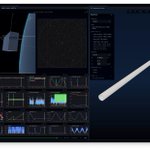


Our team gave our engineering agent in Prism a grid fin case to work through. It set up the compressible simulation in OpenFOAM, ran it, and validated it. The shock angle landed within 0.04° of oblique-shock theory.
The Navier agent continues to hold up on different types of physics as we test it on more cases!
Navier AI retweeted

generic 8 m patrol hull, 22 kn into 1.83 m head seas, free to heave and pitch
in calm water it lands within 6% of savitsky on trim and 3% on resistance. in the waves it heaves 2.09 m peak to peak and pitches from −3 to +13 deg
single mesh, and slamming isn't resolved yet. towing tank comparison is next
done with @NavierAI with our GPU solver
Yesterday, our agent in Prism generated CAD for 12 skived heat sink designs, ran the CFD simulations in OpenFOAM, and compared their performance.
Less manual work means engineers can test ideas they might otherwise skip, explore more of the design space, and find better designs. That's agent driven engineering.
Navier AI retweeted
stoke's 2nd stage is one of the most interesting designs for reusability
ran some reentry and landing sims with @NavierAI. this is a powered landing flown by a closed-loop gnc controller coupled to the cfd, simulated with ventus, our gpu cfd solver
*representative geometry from public info, not affiliated with stoke*
Navier AI retweeted
agree with most of this. models will get good at design fast. but most of the time on a real program goes to building the thing, measuring it, and figuring out why it didn't work as expected
more sims won't remove that, but they can cut how many times you have to loop. @NavierAI

AI is on track to become a superhuman hardware designer, but design is only the beginning. The interface between bits and atoms is lossy, and turning designs into real hardware gets harder at every level:
1. Sourcing off-the-shelf parts that work together (a 2006 Falcon 1 engine test was delayed by one capacitor, in stock 6,000 miles away)
2. Custom parts, where a master machinist translates CAD into machine instructions
3. Assemblies, where every part can meet its drawing and still not fit
4. Outside vendors (even SpaceX has 591 employees with supply chain titles)
5. Doing all of it at a scale of 1,000,000
"Superhuman AI might be great at pure design, meaning at defining the platonically ideal part for a particular job, but struggle with 'design for manufacturing,' or finding a point design that meets the requirements while remaining easy to build/procure and inexpensive."
Full piece from a16z's Christian Keil on what it takes to turn AI-designed hardware into the real thing: a16z.news/p/superhuman-hardw…

You can just simulate things.

has @Tesla tested a backflip yet?
the inertia about the pitch axis is ~3-4x that of the roll axis so rotational energy increases by ~3-4x
however, the majority of the energy required still comes from the initial jump, so this should theoretically be possible
Something fun our team ran this morning: an engine firing into supersonic flow, the same problem a booster solves when it slows down to land.
One prompt to our agent. It set up the case, ran it on the GPU solver we’ve been building in house, and rendered the start-up.
This sort of sim used to be reserved for a CFD specialist. Now, these sorts of complex cases are becoming more accessible to everyday engineers.
More updates to come soon! 👀
Navier AI retweeted
the bots are grinding on this one.
immersed boundary layer solved on gpu with @NavierAI agents

This morning, the team ran a robot gripper and arm through FEA and Project Chrono, all inside Prism.
Structural analysis and multibody dynamics, one agent, one session.
Prism acts as one interface across every domain, with every file staying in context. When you move from stress to motion, the agent doesn’t start from scratch. It already has the geometry, the setup, and the results from the previous step. That is what makes multiphysics design loops practical.
More on Prism soon 👀
Over the weekend, we ran some 2D tank sloshing simulations with Basilisk in Prism, our agentic engineering platform.
Basilisk, one of Prism's pre-bundled solvers for free-surface flows, paired with our agent, allows for rapid experimentation.

Navier AI retweeted
Supersonic retropropulsion temperature field. Different angle on the same case run with @NavierAI's solver.
Heat comes from the hot nozzle exit gas + shock compression.
What fields or post-processing would you add here?


