

Professor and Lab Director at UWM | Memory and concept learning | fMRI + computational modeling | he/him | 🇺🇸🧠🖥 | @nealmorton@fediscience.org
- Tweets124
- Following233
- Followers385
- Likes250






ALT Human and Machine Learning Lab logo, with three converging boxes around a gear. The gear represents learning mechanisms, and the boxes represent a process of converging on common understanding of human learning and high-performance machine learning.


ALT We examined distinct strategies for storing initial (AB) and overlapping (BC) memories, and how they impact people’s ability to infer indirect associations (AC) between items. We predicted that reactivation of initial memories during encoding of overlapping memories would lead to integrated memories combining information from both memories, while suppression of initial memories during encoding would result in differentiated memories. We used fMRI to measure reactivation and suppression of memories during encoding and found that when there was more reactivation/less suppression of initial memories in prefrontal cortex, participants were better able to infer connections between memories. Finally, we used a model of semantic similarity to measure reactivation and integration of semantic knowledge related to the initial and overlapping memories. We found evidence of semantic reactivation in medial prefrontal cortex, and semantic integration in the medial temporal lobe.


ALT An overview of my recent research, which I will continue at UWM. I use fMRI to study how representational geometry, i.e., the relationship of neural patterns of different events to one another, reflects structure in the world (Morton et al. 2020, PNAS). I also use representational similarity methods to examine how semantic knowledge about real-world people and places is represented in the brain and how knowledge about different events becomes integrated in the medial temporal lobe (Morton et al. in press, Cerebral Cortex). Finally, I examine how statistical learning about regularities in when events occur provides clues about underlying structure in the world, which is represented in human hippocampus (Pudhiyidath & Morton et al. 2022, JOCN).

ALT Schematic illustrating study where paintings are either presented in blocked order, with one artist at a time, or interleaved order, with multiple artists in a given learning block. On each trial, participants are shown a painting and asked to guess the artist, and are then shown the correct artist.


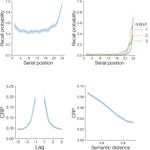
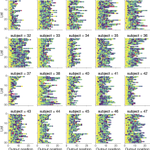
ALT Examples of plots generated by Psifr, including a plot with tiles indicating the input position of all recalls for a participant, recall probability as a function of input position, and a lag-conditional response probability (CRP) analysis split by whether the transition was within-category or across-category.

ALT Logo for the {psifrr} package in R.