

NephU is an engaged community of health care professionals and advocates collaborating to improve kidney health. https://xitter.cf/t.co/NUGlmYfKTT
Joined August 2019
- Tweets1.4K
- Following259
- Followers1.8K
- Likes19


Be sure to join us on August 12, 2026, 12PM EDT for our webinar featuring Dr. Ann Childress and Amaka Onyereri PharmD, BCPS who will discuss Executive dysfunction and emotional dysregulation are common major contributors to ADHD impairment, yet these features are often overlooked during clinical assessments 1-3. Dr. Childress will discuss how to understand and recognize features of executive dysfunction and emotional dysregulation in individuals with attention-deficit/hyperactivity disorder (ADHD). Register Now! go.psychu.org/zUBt #PsychU #ADHD #Webinar
Be sure to join us on August 8, 2026, 12PM EDT for our webinar featuring Dr. Ann Childress and Amaka Onyereri PharmD, BCPS who will discuss Executive dysfunction and emotional dysregulation are common major contributors to ADHD impairment, yet these features are often overlooked during clinical assessments 1-3. Dr. Childress will discuss how to understand and recognize features of executive dysfunction and emotional dysregulation in individuals with attention-deficit/hyperactivity disorder (ADHD). Register Now! go.psychu.org/zUBt
#PsychU #ADHD #Webinar
Attend live and virtual events that provide a platform for education and collaborative discussion about the management of kidney disease and strategies to improve kidney health. Join health care professionals from around the world to advance your knowledge and connect with peers in nephrology. Explore upcoming events and register today! go.nephu.org/hX9z

Listen to a recent episode of our Hot Topics In Nephrology podcast!
The Kidney Care Choices (KCC) Model aims to reduce the cost and improve the quality of care for patients with chronic kidney disease. It is focused on improving care throughout the kidney disease life cycle, from advanced chronic kidney disease (CKD) care to successful transplantation. Join Mark Neumann and Geoffrey Lockwood, PharmD, BCPS, MBA as they discuss this important topic. go.nephu.org/hX9n

ADPKD can negatively affect many aspects of patients' lives including physical symptoms and limitations, psychological burden, medical costs, and work limitations.
Patients with both early and late stage ADPKD experience a significant disease burden, and this is often underestimated, especially in younger patients.
Watch our on-demand webinar: Patient-Reported Outcome Measures, Polycystic Kidney Disease Burden, & Outcomes In Autosomal Dominant Polycystic Kidney Disease (ADPKD) to better understand the patient burden and learn how patient reported outcomes predict risks of future adverse ADPKD related outcomes. go.nephu.org/hX9K

Request free educational presentations for your organization! NephU offers several ADPKD-focused programs, including Autosomal Dominant Polycystic Kidney Disease: The Role Of Imaging In Diagnosis & Prognosis, Mental Health In Autosomal Dominant Polycystic Kidney Disease (ADPKD), and Genetic Testing In Autosomal Dominant Polycystic Kidney Disease (ADPKD).
These live presentations (online or in-person) are available for free for NephU members. Request a program today: go.nephu.org/hX8g

Identifying patients with rapidly progressing ADPKD can help optimize treatment strategies to help slow progression. However, due to genetic heterogeneity and other lifestyle and clinical factors, rapid progression may manifest differently in the ADPKD patient population. Learn about validated predictors including early manifestations, kidney size, comorbidities, and more. go.nephu.org/hX4U

ADPKD affects more than just the kidneys. The recent KDIGO ADPKD guidelines comprehensively address extrarenal complications, pregnancy considerations, pediatric issues, and crucial lifestyle adaptations. Explore these vital resources to provide holistic care for people living with ADPKD across their lifespan. go.nephu.org/hX3v
Understanding ADPKD starts with proper diagnosis and prognosis. The KDIGO ADPKD guidelines provide critical information on nomenclature, diagnosis, prognosis, prevalence, the complexities of kidney manifestations, and management of ADPKD and CKD. Access these valuable resources to enhance your approach to ADPKD care. go.nephu.org/hX3a
BREAKING: KDIGO releases its first-ever guidelines on ADPKD! This comprehensive resource provides health professionals like you with the tools to improve diagnosis, treatment, and management of this genetic kidney disorder. The KDIGO experts cover everything from diagnosis to pregnancy considerations and even pediatric issues. Explore the video series featuring Dr Peter Harris, Dr Arlene Chapman, and Dr Vicente Torres. go.nephu.org/hX3S
Join Drs. Joshi and Shah for an on-demand webinar exploring nutritional considerations for peritoneal dialysis patients.
In this session, learn about the key differences between peritoneal dialysis and hemodialysis, dietary macronutrients and electrolytes in PD, and evidence-based nutritional recommendations for patients receiving peritoneal dialysis. Watch now: go.nephu.org/h4AF

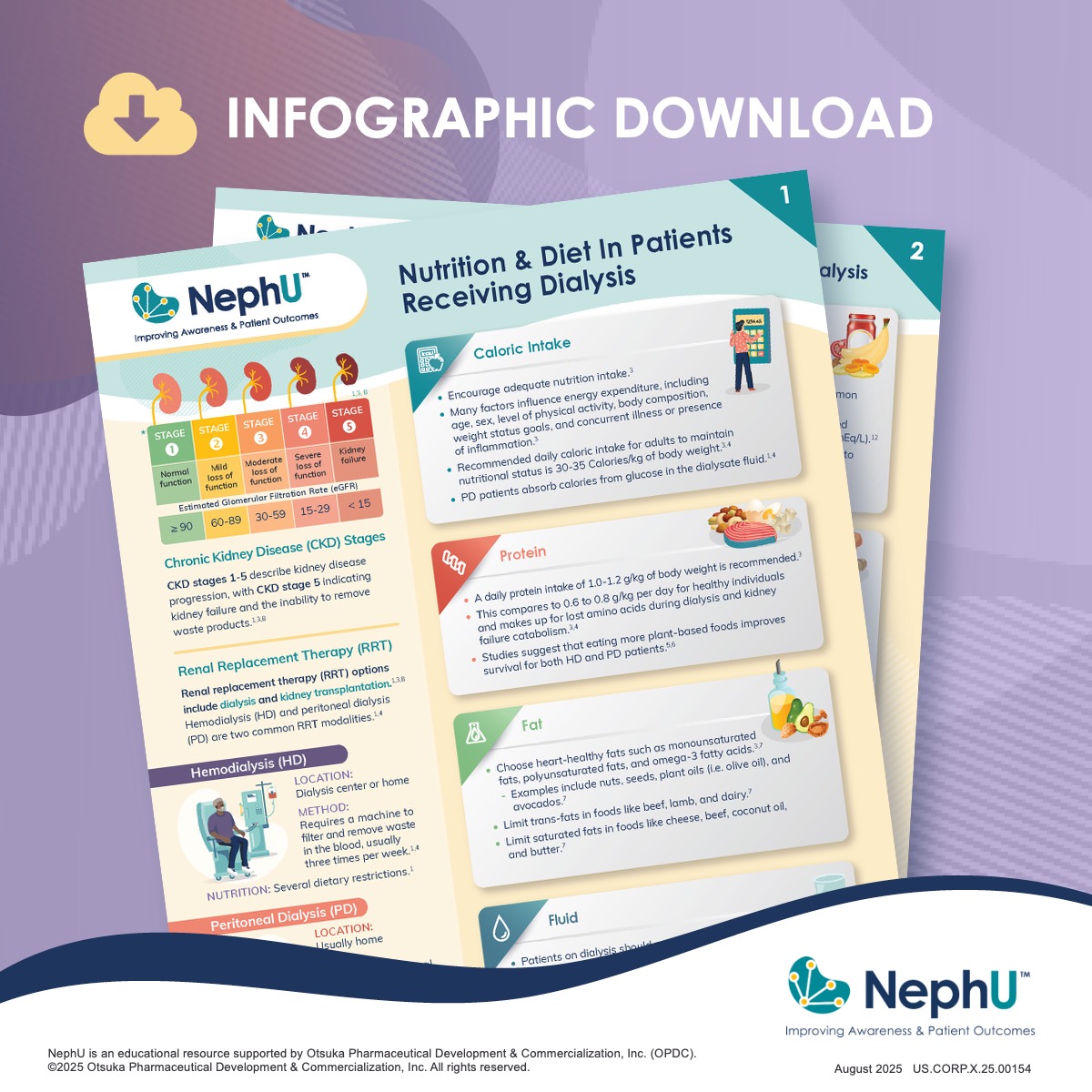
Understanding nutrition considerations for dialysis patients is essential for optimal care.
Our infographic provides a breakdown of nutritional information to consider for patients receiving dialysis, covering key dietary factors that health care providers should keep in mind. Download your free copy today: go.nephu.org/h4A2
As we wrap up our five-year anniversary celebration, we can't forget about those who have joined us on this journey.
Our supporting organizations, community advisors, speakers, and every single member who joined us on this journey: You didn't just witness these 5 milestones, you MADE them possible.
From our PKD foundation in 2020 to the innovation revolution happening today, your dedication and expertise transformed NephU from an idea into a trusted global resource for nephrology education.
Here's to the next five years of collaboration! 🥂

These past few days, we’ve reviewed an incredible journey: 5 years, 5 groundbreaking milestones that shaped both NephU and nephrology itself.
But here's the thing: we're not just looking back, we're also looking ahead with more excitement than ever.
With IgA nephropathy treatments evolving rapidly, PKD research advancing at break-neck speeds, and new technologies emerging daily, the next five years promise opportunities we can barely imagine.
The question is: Will you join us for what comes next? The next chapter of our mission starts now. Join the NephU community today: go.nephu.org/gqR5

We've reached our final milestone in this incredible 5-year journey.
From breakthroughs like xenotransplantation moving closer to clinical reality, to SGLT2 inhibitors becoming integral to chronic kidney disease management, nephrology has seen a wave of unprecedented innovation.
But among the most transformative is the rise of genetic testing—redefining how we diagnose, understand, and manage kidney conditions and opening the door to truly personalized medicine. Learn more: go.nephu.org/gqQh

Our journey through 5 years brings us to one of the most exciting developments in IgAN treatment—APRIL.
NephU developed comprehensive resources exploring this evolving science and what it means for the future of IgAN care—because breakthrough discoveries mean nothing if they don't reach the clinicians who need them. Watch our on-demand webinar on The Four-Hit Hypothesis & The Role Of APRIL In IgA Nephropathy today: go.nephu.org/gqQM

As we continued growing our platform and community, the nephrology world witnessed something historic—the introduction of KDIGO's ADPKD guidelines.
This marked a major milestone not just for NephU, but for nephrology globally, providing the FIRST global framework for evaluating, monitoring, and managing ADPKD. These evidence-based guidelines help clinicians deliver more consistent, informed, and patient-centered care worldwide. View them here: go.nephu.org/gqQ8
We're proud to have been part of these crucial guidelines for our community.

Building on our PKD foundation, we knew we needed to innovate HOW clinicians learn about complex kidney diseases.
That's when we created something special—two interactive simulators, one for IgAN and one for ADPKD, providing innovative tools to help our community understand disease progression like never before.
These simulators may bridge the gap between theoretical knowledge and practical clinical decision-making, showing that digital tools can truly help to enhance medical education and patient care. go.nephu.org/gqPe

Our anniversary journey starts in 2020, when NephU launched with a core focus on polycystic kidney disease (PKD), establishing our foundation in rare kidney disease education.
Our early work in PKD led to the development of webinars, infographics, and clinical resources that continue to support the nephrology community today. While PKD was our starting point, this foundation enabled NephU to grow into what you see today—always with the goal of equipping clinicians with practical, high-quality education. Explore PKD resources today:go.nephu.org/gqPM

Through 5 transformative years and five groundbreaking milestones, our mission has remained constant: to democratize nephrology education, foster community, and ensure that every advance in kidney care reaches the clinicians, caretakers, and patients who need it most.
Thank you for joining us on this incredible journey. Ready to explore each milestone that brought us here? Explore the full journey and see how far we've come together: go.nephu.org/gqOq
