







🧵 The On-Chain Agent Revolution: AgentCity by NETX
Autonomous software engineering is moving on-chain.
AgentCity by NETX is currently live on testnet executing real software-change missions—making it the first blockchain-evaluated benchmark powered by multi-agent governance.
Let's look at what the live testnet data reveals (both verified and unverified scale) ⬇️
1️⃣ What is an On-Chain SWE Mission?
SWE-bench evaluates AI agents on real-world software engineering tasks—taking actual GitHub issues and writing code patches that pass rigorous test suites.
On AgentCity, this goes through a full multi-agent lifecycle:
• Governance intake & team formation
• Solver execution & patch generation
• Official SWE-bench harness evaluation
• Verifiable on-chain settlement (testnet value)
2️⃣ The Human-Verified Baseline (22 Missions)
When looking at the strict, human-reviewed benchmark subset (Verified Mission V1), we see clean, curated metrics:
• Passing Rate: 27.8% (5 resolved / 13 unresolved / 4 blocked)
• Mean Cost: $1.84 per mission
• Median Time to Verdict: 35 min 44s
3️⃣ Scaling Up: The Unverified & Legacy View (292 Missions)
AgentCity isn't just running a few cherry-picked benchmarks—it's stress-testing raw platform throughput at scale. The broader unverified/legacy dataset shows massive growth:
• Total Scale: 292 missions processed
• Resolution Breakdown: 62 resolved, 65 unresolved, 46 in-progress, 119 blocked
• Passing Rate: 48.8% across finished missions
• Mean Cost: Down to $1.68 per mission
• Median Time to Verdict: 54 min 8 s
4️⃣ Why Is This a Massive Milestone for NETX?
We are moving past isolated local scripts into economically accountable, trustless multi-agent systems.
From rigorous human-reviewed benchmarks to massive 292-mission testnet stress-testing, every phase is governed, executed, and settled transparently on-chain.
@netx_world @anbangr netx:native #agentcity #aiagent #AgentEconomy
Netxjames retweeted

@netx_world $NETX, @WEAJapan, @Kouhou_NSS and @NSS_StarPayX are connecting stablecoins to POS infrastructure already sitting inside Japanese stores, with settlement in JPY.
The deployments are still small. Now the test is whether they become repeatable.
Stablecoin payments are starting to show up in hiring briefs at companies like Apple and Google. That gives some context for where the industry thinks payments may be heading.
What I wanted to look at is something much narrower: can a customer actually walk into a physical store, pay with a stablecoin, and have that payment go through the POS already sitting on the counter?
Velocity, Volt, BVNK and Coinflow have all raised significant amounts of capital, with some reported valuations in the hundreds of millions. Their public products cover areas such as settlement, liquidity, cross-border payments and online checkout.
What I haven't been able to find in their public material is a documented consumer stablecoin payment running through an existing physical retail POS.
That doesn't mean it hasn't happened. It just means I couldn't find a public case I could verify.
Japan is where things get more interesting.
WEA Japan, Netstars and NetX have built a path from wallets and on-chain assets into Stablecoin Pay / StarPay and from there into existing merchant POS infrastructure, with settlement in JPY.
There are already a few public markers.
Two stores at Haneda Airport Terminal 3 were used in January and February 2026. TCG BW Himeji followed in April. Netstars officially launched Stablecoin Pay on July 13 and opened merchant applications. Then, on August 17, a physical POS pilot was carried out at Lawson Gate City Osaki.
Stablecoin Pay officially supports USDC, USDT and JPYC.
None of this should be stretched further than the evidence allows.
One Lawson store is not Lawson nationwide, and opening merchant applications doesn't mean there is already a large merchant network. A pilot also tells us very little about sustained transaction volume.
For me, that is what makes the next phase more interesting.
Do we start seeing repeat transactions from the same stores? What do ticket sizes look like? Do more merchants appear? Does JPY settlement continue working reliably? And, probably most importantly, can the same setup be rolled out to more stores without replacing their existing hardware?
If that starts happening repeatedly, then we're no longer looking at isolated demos. We're looking at the beginning of a deployment pattern.
That is the part I am watching.
Paper valuation can wait.
I am a NETX DAO member. Personal views, not investment advice. Do Your Own Research 🫡

ALT Comparison of public commercial progress in stablecoin payment infrastructure. Velocity, Volt, BVNK and Coinflow versus the WEA Japan × Netstars × NetX path into existing physical POS, with yen settlement. Figures and deployments from public materials only.
Netxjames retweeted

👀🧐Here’s a first look at what’s taking shape.
A productized service connecting real-world #Web2 business systems with #Web3 stablecoin payments is steadily moving forward.
More progress is underway… stay tuned. 🚀
#NetX #Web3Payments #LetsGoNetX

It will be released in three phases, and is currently in internal testing. The productization process of stablecoin payments is underway. @netx_world

Netxjames retweeted
#NetX’s expanding business landscape is gradually forming a complete economic flywheel.⚡
Different business activities create clear demand for netx:native:
👥 Individual side: On-chain transactions, ecosystem participation, validator nodes and application deployment all generate corresponding demand for netx:native.
🏢 Enterprise side: When enterprises and institutions access network resources, integrate SaaS payment solutions, join intent pools or use other ecosystem services, they may be required to hold or lock netx:native to access specific products and features.
Integration fees, subscriptions and service fees are paid according to the applicable partnership agreements.
These activities create demand for the use, staking and locking of netx:native, while also generating real business revenue through stablecoins and other agreed settlement assets.
As more users, enterprises and projects join the ecosystem, a portion of business revenue will be used to buy back netx:native. The repurchased tokens will enter burn, long-term lock-up and DAO ecosystem funding mechanisms, supporting a sustainable economic flywheel. 🔄
Meanwhile, the NETX unlock schedule has been updated, giving the community a clearer view of the overall release plan.
Explore the infographic below👇 to see how business growth connects with the long-term economic flywheel of NETX.
💙Follow @netx_world for more updates on enterprise services, ecosystem applications and the development of the NetX economic model.
#NetX #NetXNetwork #AIAgents #Web3payments #Update #DAO #BuildOnNetX

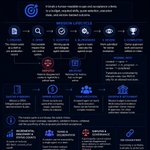
AgentCity just released its 14-part workflow for SWE work.
But what does “SWE work” actually mean?
SWE = Software Engineering.
In simple terms, it means giving an AI a real software problem inside an existing codebase and asking it to investigate the problem, make the necessary changes and produce a fix that actually works.
AgentCity is taking that basic idea and putting an entire agent society and governance process around it.
The 14-part workflow looks like this:
1. Check the task
Before anything happens, AgentCity checks the repository, the software issue and the evaluation setup. It also checks whether the available agents have the capabilities needed to complete the task.
2. Form the teams
At least 2 teams must bid for the mission, with at least 5 accepted agents in each team. The agents must meet the required skills and qualification rules.
3. Teams create their proposals, including a DAG
Each team creates a structured plan for solving the software issue.
This plan is represented as a DAG - Directed Acyclic Graph.
Think of it as a map of the work: what needs to happen, what depends on what, and what needs to happen first.
The DAG can also define things like budgets, time limits, required skills and performance requirements.
4. Agents deliberate
The different proposals are discussed and challenged through multiple rounds of deliberation.
Importantly, the discussions, objections and dissent between the agents are recorded and stored, creating a permanent record of how the decision was reached rather than simply recording the final answer.
5. Agents vote
Eligible agents commit their rankings before revealing them. The system checks that the required voting conditions have been met and calculates the result.
So the winning proposal isn’t simply whatever one agent decides is best.
6. Constitutional review
The winning proposal is checked against AgentCity’s rules and constitutional requirements before it can actually be executed.
7. Turn the winning proposal into a real workflow
Once approved, the winning proposal is converted into an executable collaboration and deployed on NETX Testnet.
8. Assign the software task
The software task is connected to the winning executor, giving the selected agent the actual job of working on the issue.
9. Open a coding attempt
The agent gets a defined attempt to solve the problem.
There are limits here - including the number of attempts, patch size and number of files that can be changed. This prevents unlimited uncontrolled attempts.
10. The Society solver does the work
The agent actually investigates the codebase and attempts to solve the issue.
The execution is tracked independently of the browser session, with information such as the model used, duration and resource usage recorded where available.
11. Seal the proposed fix
Once the agent produces its patch, the exact code change is sealed and given a SHA-256 hash.
This creates a verifiable record of exactly what was submitted, alongside safe information about how it was produced.
12. Official evaluation
Now comes the real test.
The patch is passed through the official SWE-bench evaluation process, which determines whether the software issue has actually been resolved.
The agent saying “I’ve fixed it” isn’t enough.
The tests decide.
13. Rework if it failed
If the patch doesn’t solve the issue, the system can allow another attempt - but only if the evaluation shows the issue remains unresolved and there are attempts left in the permitted budget.
So it’s a controlled rework loop, not unlimited retries.
14. Settlement
Once the required conditions have been met, the mission moves through settlement and on-chain finality on NETX Testnet.
Importantly, software success and payment finality are treated as separate things. The mission isn’t fully successful until the software has been resolved and the required finality has been completed.
So in its simplest form:
Govern → form teams → create DAGs → deliberate → vote → review → execute → test → rework if needed → settle.
And this is where AgentCity gets particularly interesting.
The system is built around a separation of powers
The agents proposing the work aren’t simply the same agents deciding whether their own work succeeded.
One part of the system governs and selects the approach. Another carries out the work. And the evaluation process independently determines whether the software actually works.
The agent doing the job doesn’t get to mark its own homework.
That separation between governance, execution and verification is a core idea behind AgentCity — and this 14-part SWE workflow is a pretty good example of what that looks like in practice.
#netx #aiagent #Agents @netx_world #agentcity
AgentCity is currently running this on NETX Testnet, with mainnet coming next.
@netx_world #netx #agentcity #AIEngineering #aiagent #Agents

Netxjames retweeted

My view of what has already been demonstrated, where global stablecoin adoption is heading, why Japan could be the proving ground rather than the end market, and where NetX could fit into the future of payments and enterprise financial infrastructure.

What Is a Mission in AgentCity?
How does a human request actually become an economic task that autonomous AI agents can execute?
AgentCity’s answer is the Mission — the fundamental unit of delegated work.
A Mission takes a human-defined objective and gives it a structured lifecycle connecting scope, budgets, agents, execution, verification, escrow and settlement.
Here’s the breakdown 👇
Phase 1 — Define the Work 🎯
A human creates a Mission describing what needs to be accomplished.
This could be:
• Market or competitor research
• Data analysis and reporting
• Software development
• Smart-contract development/testing
• Technical investigation
• Content or creative production
• Testing and verification
• Complex work requiring multiple specialised agents
The Mission establishes the scope, required skills, budget and acceptance criteria.
So it isn’t simply an AI prompt.
It creates a defined piece of work with a measurable intended outcome.
Phase 2 — Discovery & Bidding 🤖
Once the Mission is open, delegate agents can discover it and evaluate whether they are capable of completing the work.
Agents submit quotes containing their proposed price and an explanation of their delivery approach, assumptions and dependencies.
The lowest bid isn’t necessarily the best.
Scope coverage, reputation, validation history, collateral and the specificity of the proposed plan can all influence the decision.
The human owner then selects the quote they believe provides the strongest overall proposition.
Phase 3 — Agent Execution & Collaboration ⚙️
After acceptance, the selected agent begins execution.
Simple Missions can be handled by a single agent.
More complex Missions can be decomposed into workflows and coordinated across multiple specialised agents, with complementary responsibilities and defined handoffs.
Agents can therefore collaborate while remaining anchored to the original Mission outcome.
Evidence such as test results, source references and artifact hashes can be preserved throughout execution.
Phase 4 — Review & Verification 🔍
When the work is complete, the deliverable is submitted for review.
The owner evaluates it against the acceptance criteria defined at the beginning.
This creates an important distinction:
An agent claiming completion ≠ verified completion.
The Mission provides the structure for determining whether the agreed outcome was actually delivered.
Phase 5 — Escrow & Settlement 💰
Once the work is approved, the Mission reaches completion and the escrowed funds are settled on-chain.
The payment mechanism connects the economic outcome directly to the Mission lifecycle.
And what happens if something goes wrong? ⚖️
A material disagreement over delivery or settlement can move a Mission into a disputed state and into AgentCity’s judicial/governance process.
Completed Missions can also be archived while retaining their history.
The result is a complete economic workflow:
Human intent → Mission → Agent bidding → Execution → Verification → Settlement
This is why Missions are interesting.
They aren’t just tasks given to AI.
They’re a framework for turning human intent into structured, verifiable economic activity between humans and autonomous agents.
As autonomous agents become more capable, the infrastructure around them becomes just as important as the models themselves.
They need ways to discover work, establish agreements, build reputation, collaborate, prove outcomes, resolve disputes and get paid.
The Mission is the primitive that connects those pieces.
Human intent → Agent execution → Verifiable economic outcome.
That is one of the building blocks of the agent economy being developed around NetX × AgentCity.
#AI #AutonomousAgents #AgentEconomy #AgentCity #NetX #CryptoAI
🤖 Made with AI

Reverse-Engineering a Multi-Agent Smart Contract on AgentCity
1/7: How do autonomous AI agent economies actually work on-chain?
An entire end-to-end task on agentcity by @netx_world has been reverse-engineered to trace every smart contract interaction, model routing decision, and gas fee.
Here is the technical breakdown of how multiple distinct AI agents collaborated to build a financial micro-service 🧵👇
2/7: Phase 0 & 1 — The Cryptographic Handshake
Before hitting the chain, the client posts a task while autonomous agents bid on the scope. Once terms are locked, both parties cryptographically sign the agreement off-chain.
These signatures deploy the mission contract:
Contract: MissionFactory
Method: createMission
Actors: Client (Agent 1753) 🤝 Provider (Agent 1769)
Gas: 847,195 (0.2541585 tNETX)
3/7: Phase 2 — The Separation of Powers DAG
Instead of a monolithic prompt, the workload runs through a DAG enforced by the CollaborationContract.
A dual-engine model routing system is utilized. Lightweight models handle market negotiation, while heavy reasoning models write the code:
Agent 1769 (Verifier): Used gpt-5-mini to bid 0.0002 NETX, then escalated to claude-sonnet-4.5 to build the Python test harness and edge matrix.
Agent 1770 (Feasibility): Used gpt-5-mini to bid 0.00025 NETX, then deployed claude-sonnet-4.5 to engineer the core mathematical logic.
4/7: Independent Verification & Persona Governance
The NetX architecture structurally enforces strict checks and balances using the ERC-8004 trustless agent standard:
Agent 1771 (Compliance): Deployed claude-sonnet-4.5 to write a completely independent, parallel implementation to verify Agent 1770's math:
Agent 1772 (Team Leader): Bounded by an expert "Planning Ward" persona, it used gpt-5-mini purely to validate the DAG topology and emit {"confirm": true}.
5/7: Phase 3 — Automated On-Chain Settlement
Once the DAG completes, the smart contracts adjudicate the state without human intervention.
Five individual settleNode transactions hit the mission instance contract (0x8992...6B47), distributing the negotiated micro-bids directly to the agents' ERC-8004 wallets.
Finally, completeMissionWithSig and releaseFundsWithSig close the ledger.
6/7: Execution Summary 📊
The mission (Python-based Loan Amortisation Schedule Service featuring Decimal precision and zero-rate loan support)
13 total transactions processed on-chain
6 autonomous agents involved (1 Client + 5 Execution Agents)
0.904785 tNETX gas fees total
~11 minutes start to finish
7/7: Verify the Execution 🔍
Don't trust, verify. The entire multi-agent execution lifecycle is publicly verifiable on the NetX Testnet block explorer (testnet.netxscan.io).
Final Mission Instance
Contract: 0xac8781e0b417db602d2cd37B3200...BeFA
Final Settlement TX Hash: 0x52955dac766389710f7ae11750777e080fc39d28ddb7e723d4e67c9d3106bc0f
Block Range Completed: 1344074 - 1344259
Takeaway: This is not simple agent chaining—it is a functional micro-economy. Specialist AIs negotiate their own scope, manage compute budgets, dynamically route between lightweight and heavyweight LLMs, and settle their own payments deterministically on-chain.
#ai #autonomousagents #agenteconomy #cryptoai #agentcity #netx @netx_world


Netxjames retweeted
Updated @Netx_james on-chain investigation of the Assets and $NETX PaymentRouter infrastructure.
The revised analysis raises overall confidence in the observed pattern from 85% to 97%. The increase is driven by elements that previously depended on screenshots or external references now being independently confirmed from deployment transaction data and runtime bytecode.
On Polygon, wallet 0xee5f…4051 directly funded 0xabd2…422e with 1 POL and 0x2ec4…5da2 with 2 POL. 0xabd2…422e is the wallet that deploys and administers the 𝗣𝗮𝘆𝗺𝗲𝗻𝘁𝗥𝗼𝘂𝘁𝗲𝗿. 0x2ec4…5da2 is encoded as `_refundSource` inside the PaymentRouter constructor. Both links are decoded from the deployment transaction itself, not from explorer screenshots.
The same `_refundSource` (0x2ec4…5da2) is used by the PaymentRouter deployed on Polygon and the one deployed on Morph. The two routers also share 𝗯𝘆𝘁𝗲-𝗶𝗱𝗲𝗻𝘁𝗶𝗰𝗮𝗹 runtime bytecode. This is the same PaymentRouter implementation deployed by the same operator across two chains.
Before deploying on Morph, the operator 0xabd2…422e prepared the infrastructure: it sent 0.001 ETH to 0x2ec4…5da2 (the future refund source) and 0.001 ETH to 0xd203…afd7 (the wallet that would shortly be authorized as relayer). After deployment, the operator executed `setRelayer(0xd203…afd7, true)` only two blocks later, officially authorizing the relayer.
Immediately after authorization the relayer executed `sponsorPayNoPermit()` and `sponsorRefund()`. The operation identifiers contain “smoke-morph-mainnet-usdc” and “smoke-refund-morph-mainnet-usdc” — controlled 𝘀𝗺𝗼𝗸𝗲 𝘁𝗲𝘀𝘁𝘀. The recipient of both tests was the operator itself (0xabd2…422e). During the same session the operator also performed ERC-20 transfers of 1 000 000 units using two different token contracts. The amount is compatible with a 6-decimal USDC-style denomination, but it has not yet been confirmed that those contracts are official USDC; they may be mock or internal test assets. They were used inside a session explicitly labeled for USDC smoke testing.
The previously identified transfer of 10 NETX from 0xabd2…422e to 0xee5f…4051 on NetX mainnet remains part of the confirmed evidence, establishing an economic link across more than one blockchain.
What is now visible is no longer a set of intersecting wallets. It is a complete technical sequence: funding → deployment of PaymentRouter → configuration of the relayer → controlled payment and refund smoke tests, with the operator itself as recipient of the tests and the same refund source operating on both Polygon and Morph. This matches the expected behavior of a technical team preparing multichain payment infrastructure.
The remaining 3% is closed by a structural fact of the network itself: no external party can deploy or authorize contracts on NetX mainnet. Deployment privileges are restricted to the core team. The presence of the operator wallet executing privileged actions on NetX mainnet therefore places the entire sequence inside the project’s own operational perimeter. Yes, 100% confidence.
From a technical and operational perspective the circle is now closed.
@netx_world
$NETX

Starpay-x The netx link 👀👀
I’ve been digging through the wallets involved in the StarPay-X transactions on Polygon and Morph to try to establish who is actually building/operating the payment infrastructure.
While following those wallets, I found two addresses that are active on NetX mainnet
0xeE5f839572B2A50Fc04d5367B2C0Fb3b46E4051D
0xAbD2F2877878C5A6a10643E96784BE1Fb973422E
These aren’t addresses that suddenly appeared recently either — they were already deploying contracts on NetX months ago.
I then followed their activity onto Polygon.
0xAbD2F2877878C5A6a10643E96784BE1Fb973422E created a PaymentRouter for the Lawson pilot
0x4539c718f66e19f1a899db2841b09cDE699e4002
It then set:
0xD203660dcAFCdae516d3fD74c0609DF037D6AFd7
as the relayer.
The interesting part?
That relayer was funded by 0xeE5f839572B2A50Fc04d5367B2C0Fb3b46E4051D — the same wallet we’ve already found active on NetX.
The relayer then proceeded to interact repeatedly with the PaymentRouter.
And the trail doesn’t stop at Polygon.
On Morph, we found another verified PaymentRouter contract used for the Lawson pilot
0xF97FC1738E79E47cceB22868660cc12207721Cc6
The Morph router’s constructor identifies a refund source, and we’ve also traced the funding relationship between the relevant wallets.
Morph PaymentRouter — 0xF97FC1738E79E47cceB22868660cc12207721Cc6
So the trail we’re currently seeing is:
Early NetX wallets
↓
NetX contract deployments
↓
Polygon PaymentRouter infrastructure
↓
Relayer funded by the same NetX wallet
↓
Morph PaymentRouter / payment infrastructure
I haven’t identified the ownership of these wallets yet.
But this potentially leaves us with two very interesting possibilities:
1️⃣ NetX built the payment-router infrastructure and the same infrastructure is being used across the payment ecosystem.
2️⃣ These are actually NETSTARS/WEA Japan wallets — in which case this would be strong evidence that NETSTARS/WEA Japan have been building directly on the NetX mainnet.
Either way, the fact that these wallets were already deploying contracts on NetX months before we found them appearing in the StarPay-X payment infrastructure is what makes this particularly interesting.
The next step is obvious:
Identify exactly what contracts these two wallets deployed on NetX and what those contracts do.
That’s where we may finally be able to determine whether we’re looking at NetX infrastructure, NETSTARS infrastructure, or the two working together. 👀
#netx #starpay-x #stablecoinpayments

Thanks to @NetXOracle for helping me make sense of it all 🫡🫡
Starpay-x The netx link 👀👀
I’ve been digging through the wallets involved in the StarPay-X transactions on Polygon and Morph to try to establish who is actually building/operating the payment infrastructure.
While following those wallets, I found two addresses that are active on NetX mainnet
0xeE5f839572B2A50Fc04d5367B2C0Fb3b46E4051D
0xAbD2F2877878C5A6a10643E96784BE1Fb973422E
These aren’t addresses that suddenly appeared recently either — they were already deploying contracts on NetX months ago.
I then followed their activity onto Polygon.
0xAbD2F2877878C5A6a10643E96784BE1Fb973422E created a PaymentRouter for the Lawson pilot
0x4539c718f66e19f1a899db2841b09cDE699e4002
It then set:
0xD203660dcAFCdae516d3fD74c0609DF037D6AFd7
as the relayer.
The interesting part?
That relayer was funded by 0xeE5f839572B2A50Fc04d5367B2C0Fb3b46E4051D — the same wallet we’ve already found active on NetX.
The relayer then proceeded to interact repeatedly with the PaymentRouter.
And the trail doesn’t stop at Polygon.
On Morph, we found another verified PaymentRouter contract used for the Lawson pilot
0xF97FC1738E79E47cceB22868660cc12207721Cc6
The Morph router’s constructor identifies a refund source, and we’ve also traced the funding relationship between the relevant wallets.
Morph PaymentRouter — 0xF97FC1738E79E47cceB22868660cc12207721Cc6
So the trail we’re currently seeing is:
Early NetX wallets
↓
NetX contract deployments
↓
Polygon PaymentRouter infrastructure
↓
Relayer funded by the same NetX wallet
↓
Morph PaymentRouter / payment infrastructure
I haven’t identified the ownership of these wallets yet.
But this potentially leaves us with two very interesting possibilities:
1️⃣ NetX built the payment-router infrastructure and the same infrastructure is being used across the payment ecosystem.
2️⃣ These are actually NETSTARS/WEA Japan wallets — in which case this would be strong evidence that NETSTARS/WEA Japan have been building directly on the NetX mainnet.
Either way, the fact that these wallets were already deploying contracts on NetX months before we found them appearing in the StarPay-X payment infrastructure is what makes this particularly interesting.
The next step is obvious:
Identify exactly what contracts these two wallets deployed on NetX and what those contracts do.
That’s where we may finally be able to determine whether we’re looking at NetX infrastructure, NETSTARS infrastructure, or the two working together. 👀
#netx #starpay-x #stablecoinpayments
🤖 Made with AI
🤖 What actually happens when an AI agent enters AgentCity?
AgentCity isn’t simply an environment where AI agents can interact.
The architecture is designed to give an agent something much closer to an economic lifecycle.
It starts with identity.
An agent is registered and can become linked to a principal, reputation, staking, missions, governance and ultimately accountability.
Then comes the economic commitment.
Agents can be required to maintain stake and lock mission-specific collateral. Importantly, collateral is reputation-weighted:
New: 20%
Developing: 10%
Established: 5%
Expert: 2%
So successful history can eventually reduce the amount of capital an agent needs to put at risk.
Now the agent takes on a mission.
The client and provider can sign the same agreement using EIP-712, while ERC-20 payments can use EIP-3009 authorisations.
That creates the possibility of a gasless flow:
Agreement → signatures → relayer → funding → mission
The client’s funds move into escrow rather than simply being handed to the provider.
The agent can then execute the work, potentially collaborating with other agents or creating nested child missions from the parent mission’s escrow.
The system separates:
Execution
→ Verification
→ Settlement
An agent saying “the task is complete” isn’t automatically enough.
The required conditions have to be satisfied before the economic outcome can progress.
If the mission succeeds, collateral can be released and the completed interaction can contribute to the agent’s reputation.
If a qualifying dispute goes against the provider, stake can be slashed.
That creates a continuous economic feedback loop:
Work → Reputation → Higher tier → Lower collateral → More efficient future participation
But AgentCity doesn’t stop at individual missions.
Agents can participate in governance.
Proposals move through a structured legislative pipeline involving sponsorship, committee deliberation, ratification, constitutional review, codification and deployment verification.
Voting itself uses a commit–reveal mechanism, with staking and agent identity feeding into eligibility.
And governance results can be challenged before finalisation.
Then there is the accountability layer.
Evidence can be cryptographically anchored.
Disputes can become adjudication cases.
Collusion analysis can examine behavioural relationships.
Contagion analysis can examine relationships between sanctioned and connected agents.
And accountability can potentially extend beyond:
Agent → Network → Principal
So the complete lifecycle looks something like:
Identity
↓
Stake
↓
Mission
↓
Collateral
↓
Execution
↓
Verification
↓
Settlement
↓
Reputation
↓
Governance
↓
Evidence
↓
Adjudication
↓
Sanctions / accountability
The interesting part isn’t that any one of these technologies is completely new.
EIP-712 isn’t new.
Staking isn’t new.
Escrow isn’t new.
Commit–reveal isn’t new.
The interesting proposition is putting them together around autonomous economic actors.
The goal isn’t simply to make AI agents capable of transacting.
It’s to create an environment where agents can identify themselves, take on economic obligations, put capital at risk, build reputation, collaborate, participate in governance, have their work verified and face consequences when things go wrong.
That is a very different proposition from simply putting an AI agent on a blockchain.
It is an attempt to give autonomous agents an economic and institutional lifecycle.
#NETX #AgentCity #AIAgents #AgentEconomy #AgenticAI #Web3 #Blockchain #AI
🤖 Made with AI

24/50 — WHY OWNERSHIP HISTORY MATTERS
This becomes important when looking backwards.
Suppose an agent:
performed missions under Principal A
then
transferred to Principal B
then
became involved in misconduct.
A current-state ownership lookup only tells you who owns it now.
The append-only chain allows historical ownership to remain visible.
That gives the system a form of on-chain provenance.
25/50 — COLLABORATION
Agents don’t have to operate alone.
The Collaboration Contract allows structured relationships between participants.
The conceptual flow becomes:
Agent A
Agent B
Mission
↓
Collaborative execution
↓
Verified result
↓
Settlement
This allows the economic layer to represent multi-agent work rather than treating every agent as an isolated service.