

The Caribbean and Latin American news platform focuses on political, social, and economic development of the region.
Joined March 2024
- Tweets196
- Following15
- Followers929
- Likes8




Pinned Tweet
We're back.
Faster updates.
More documents.
More context.
Less speculation.
Follow for verified news and exclusive developments.
🔔 Turn notifications on.
1
732
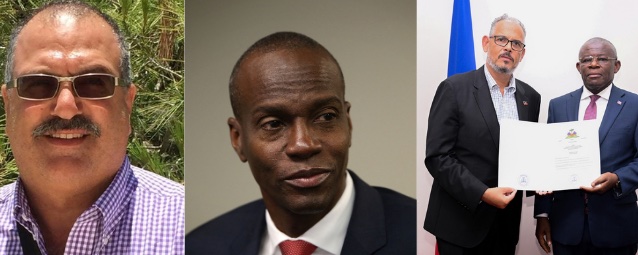

#Haiti’s Shadow Network: The Samir Handal Arrest, the Prime Minister’s Brother-in-Law, and a Government Drifting Away From Its People
When Samir Handal was arrested by the FBI on allegations linked to the conspiracy to kill or kidnap President Jovenel Moïse and suspected money laundering, attention focused on the charges.
Less discussed is that Samir Handal is the brother-in-law of Haiti's Prime Minister, Alix Didier Fils-Aimé.
That connection has drawn scrutiny because of business transactions involving members of the Handal family. In 2025, the vacant Best Western hotel in Pétion-Ville, vacant since 2019 and built for $15 million, was acquired in a $23 million deal facilitated by the Didier Fils-Aimé administration. Other properties, including a prominent restaurant in Pétion-Ville, have also been acquired and linked to the same family network. #Calan
40

#Haiti’s Shadow Network: The Samir Handal Arrest, the Prime Minister’s Brother-in-Law, and a Government Drifting Away From Its People
When Samir Handal was arrested by the FBI on allegations linked to the conspiracy to kill or kidnap President Jovenel Moïse and suspected money laundering, attention focused on the charges.
Less discussed is that Samir Handal is the brother-in-law of Haiti's Prime Minister, Alix Didier Fils-Aimé.
That connection has drawn scrutiny because of business transactions involving members of the Handal family. In 2025, the vacant Best Western hotel in Pétion-Ville, vacant since 2019 and built for $15 million, was acquired in a $23 million deal facilitated by the Didier Fils-Aimé administration. Other properties, including a prominent restaurant in Pétion-Ville, have also been acquired and linked to the same family network. #Calan
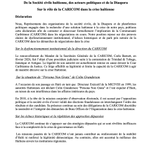
“Position Statement of Haitian Civil Society, Political Actors, and the Diaspora on CARICOM’s Role in the Haitian Crisis.”#Calan


2
126
“Position Statement of Haitian Civil Society, Political Actors, and the Diaspora on CARICOM’s Role in the Haitian Crisis.”#Calan


1
166
"Les solutions pour #Haïti doivent venir d'Haïti, de son gouvernement et de sa société. Pour réaliser des changements de fond, le pays a besoin d'un gouvernement légitime. Pour organiser des élections, il doit générer des conditions de sécurité."
Comme nous l’avons indiqué précédemment, des sources fiables confirment que les discussions avec l’Accord des Assises ont déjà été engagées. Les échanges préliminaires laissent entendre que les deux parties examinent de manière structurée le cadre, les modalités et les conditions susceptibles de permettre la conclusion d’un accord formel. #Calan

Les solutions pour #Haïti doivent venir d'Haïti, de son gouvernement et de sa société. Pour réaliser des changements de fond, le pays a besoin d'un gouvernement légitime. Pour organiser des élections, il doit générer des conditions de sécurité.
C'est à cela que nous travaillons : contribuer pour que les autorités haïtiennes soient dans les meilleures conditions possibles pour organiser des élections, afin que ces élections soient transparentes, légitimes et comptent sur la plus grande participation possible de la population. Et l'#OEA aide dans ce processus.
La communauté internationale doit apporter son soutien, mais sous la direction haïtienne, dans les conditions institutionnelles établies par Haïti et ses autorités.
Lors de son dialogue sur @CNNEE, le Représentant spécial du Secrétaire général pour Haïti, Alberto Föhrig @afohrig, a analysé la situation et réaffirmé le travail continu de l'OEA en soutien à Haïti.
1
204
“Solutions for #Haiti must come from Haiti, from its government and its society. To achieve deep-seated changes, the country needs a legitimate government. To hold elections, it must generate security conditions.”
As we noted earlier, reliable sources indicate that discussions with the #Assises Accord have already begun, and preliminary exchanges suggest that both parties are exploring the framework and conditions under which a formal agreement could be reached. #Calan
Les solutions pour #Haïti doivent venir d'Haïti, de son gouvernement et de sa société. Pour réaliser des changements de fond, le pays a besoin d'un gouvernement légitime. Pour organiser des élections, il doit générer des conditions de sécurité.
C'est à cela que nous travaillons : contribuer pour que les autorités haïtiennes soient dans les meilleures conditions possibles pour organiser des élections, afin que ces élections soient transparentes, légitimes et comptent sur la plus grande participation possible de la population. Et l'#OEA aide dans ce processus.
La communauté internationale doit apporter son soutien, mais sous la direction haïtienne, dans les conditions institutionnelles établies par Haïti et ses autorités.
Lors de son dialogue sur @CNNEE, le Représentant spécial du Secrétaire général pour Haïti, Alberto Föhrig @afohrig, a analysé la situation et réaffirmé le travail continu de l'OEA en soutien à Haïti.
1
141

#CARICOM’s July 7 showdown in #SaintLucia:
Regional leaders have taken the unprecedented step of sending the Secretary‑General dispute to the CCJ under Article 212, effectively putting CARICOM’s own leadership structure on judicial review. Trinidad & Tobago stood firm on its objection, Barnett stays in office while the Court weighs in, and Heads of Government quietly signaled a deeper governance overhaul is coming.
The real twist: CARICOM insists this isn’t a fracture, but a stress test, a bid to prove the Community can confront internal disputes without breaking regional unity. Whether that balance holds is now the question hanging over the summit. #Calan
193
#Haiti’s anti‑corruption shake up triggers international alarm:
#CARICOM, the #US, and the #EU are watching Port‑au‑Prince closely after Prime Minister Alix Didier Fils‑Aimé abruptly fired the #ULCC director Jacques Hans Ludwig Joseph and installed a replacement tied to former President Michel #Martelly, a move critics say guts Haiti’s main anti‑corruption watchdog just weeks after Didier’s Article 149 mandate expired. With the ULCC already central to investigations into graft and money laundering, diplomats warn the shake up looks like an attempt to weaken oversight at the exact moment Haiti is under pressure to restore credibility. As CARICOM leaders meet in Saint Lucia, the question is whether this decision signals deeper political interference and whether Haiti’s fragile institutions can withstand it. #Calan
340
#CARICOM confronts #Haiti’s Article 149 crisis as PM Didier stays in power past his constitutional deadline:
CARICOM is now staring down Haiti’s constitutional fault line: Prime Minister Alix Didier Fils‑Aimé is still governing even though Article 149 — the very clause used to appoint him — capped his authority at 120 days, expiring June 6, 2026. With the mandate lapsed and power still in hand, leaders in Saint Lucia must decide whether Haiti is operating outside its constitutional framework and what transition is needed to restore legality. We’ll continue to follow this story. #Calan
209
#CARICOM’s internal crisis breaks open in Saint Lucia:
As Heads of Government convene in Gros Islet, the summit’s sweeping agenda, regional security, climate resilience, economic integration, is being overshadowed by a governance clash that’s exposing deep institutional fault lines. Trinidad & Tobago is contesting the legality of Secretary‑General Carla Barnett’s reappointment and pushing the matter toward the CCJ, turning a high‑profile regional meeting into a stress test of CARICOM’s leadership architecture. With PM Philip J. Pierre presiding and delegations from #Jamaica, #Bermuda, and #Trinidad & Tobago on the ground, diplomats say the bloc is juggling two crises at once: the region’s external challenges and a leadership dispute at its core. We’ll continue to follow this story. #Calan
178
Why the #MacayaGroup is drawing serious scrutiny:
One of #Haiti’s elite private‑sector groups, Macaya has appeared in Washington lobbying disclosures tied to efforts that could tilt U.S. policy toward the interests of powerful business elites. Investigators and analysts say the group sits at the intersection of money, influence, and political obstruction, part of an entrenched network long accused of resisting reforms while leveraging international connections to protect its position. Critics warn this activity sidelines civil society, distorts democratic processes, and reinforces Haiti’s corruption crisis, linking private‑sector power to weak institutions, elite collusion, and the instability gripping the country. #Calan #Haiti
200
In a caution to #CARICOM, Eric Walcott warns that the bloc is entering a critical moment on #Haiti, where a single miscalculation could deepen regional instability and draw heavier U.S. involvement. He argues Alix Didier lacks broad public legitimacy and urges CARICOM Chair @PhilipJPierreLC to convene an emergency meeting with Didier and Dr. Charles Tardieu to set Haiti’s transition on a more credible path.
A Word of Caution to CARICOM
Over the years, I have had a front row seat watching generation after generation of leaders underestimate the will of the Haitian people and ultimately exhaust both their patience and their goodwill. Never before have we been at such an inflection point, where CARICOM has a genuine opportunity to shape a lasting pathway toward a peaceful transition of governance in Haiti.
The challenge, however, is whether CARICOM guided carefully by the Eminent People’s Group (EPG) will choose to act with courage. The next few days will be decisive. One wrong move could trigger a rapid descent into deeper chaos, and this time the consequences could be severe: social, economic, and humanitarian shocks capable of destabilizing not only the Republic of Haiti but the wider Caribbean region. And if CARICOM proves unable to resolve these issues, the #UnitedStates government may be compelled to intervene in Haiti and neighboring countries at a scale not seen in decades.
I urge CARICOM to widen its approach. Mr. Alix Didier Fils Aimé may lack both the constitutional legitimacy and the trust of the Haitian people to move the country forward on his own.
CARICOM must exercise a higher level of prudence in Haiti’s case. One viable option would be for the new Chairman of CARICOM Heads, Prime Minister of Saint Lucia Philip J. Pierre, to convene an emergency meeting between Mr. Alix Didier Fils Aimé and Dr. Charles Tardieu, the representative of the Haitian Presidential College (also known as the Assises). Such a meeting could help forge an agreement that restores a measure of good governance and sets Haiti on a path toward eventual elections.
Sincerely, Eric Walcott, MPA, CPM Special Coordinator on Haiti Institute of Caribbean Studies, Washington, D.C.
Note: The views expressed above are solely those of Mr. Walcott. He is the author of the foreword to “Haiti in the Balance: Why Foreign Aid to Haiti Has Failed & What We Can Do About It,” by Dr. Terry Buss, published by the Brookings Institution. Mr. Walcott remains closely engaged in discussions on Haiti. #Calan #Haiti
217
On Capitol Hill:
HB2643 — the Haiti Criminal Collusion Transparency Act, is advancing. After clearing the House, it now sits before the Senate Foreign Relations Committee, where lawmakers are drilling into the money trails linking elites, gangs, and corruption. The bill would mandate annual State Dept. reports and unlock targeted sanctions Washington’s strongest move yet against the networks fueling Haiti’s instability. We’ll continue to follow this story. #Calan
144
The corruption networks behind U.S. pressure on #Haiti:
Washington’s push on Prime Minister Fils‑Aimé is increasingly tied to concerns about entrenched elite networks that have shaped Haiti’s politics for decades. U.S. officials, including Ambassador Henry T. Wooster, have pressed for accountability and credible elections, signaling frustration with Fils‑Aimé’s dependence on business elites long accused of collusion with political actors and gang financiers. Sanctions from the U.S. and Canada have already targeted members of these networks, though critics say enforcement remains uneven. The tension erupted publicly on July 4, when Wooster’s remarks on elite–gang collusion were widely interpreted as a direct challenge to the government. Fils‑Aimé’s sovereignty‑focused response highlights the widening gap between U.S. expectations and Haiti’s leadership and raised new questions about how deeply corruption networks are shaping the country’s crisis. We’ll continue to follow this story. #Haiti #Calan
1
201