

Freshwater ecologist & river restoration specialist: interested in invertebrates and their habitats! Work at Staffordshire Wildlife Trust... views my own.
England, United Kingdom
Joined August 2017
- Tweets5.7K
- Following1.1K
- Followers1.3K
- Likes14.4K




Pinned Tweet
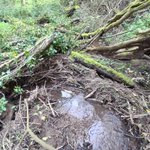
#WorldRiversDay Headwater & tributary streams make up >80% of the total channel length of river networks. These #Small_Streams are the key to the health, conservation & restoration of our main rivers @WildlifeTrusts @StaffsWildlife @PondRiverStream @RRC @BiodiversityEA

Nick Mott retweeted

Fallen leaves are the energy/carbon foundation for watercourses , creating shelter, microhabitats and feeding zones. Engineered channels transport water sediment and organic material out of the system destroying this link. Restoring diversity and dynamism encourages retention.

Nick Mott retweeted

The lowest point of land in Britain is a cast-iron post in a Cambridgeshire wood, and when it went in the ground it was level with the ground.
Stand next to it now and it is four metres over your head.
It is at Holme Fen, south of Peterborough, and in 1851 this was the edge of Whittlesey Mere, the largest lake in southern England. A syndicate of landowners drained the lake that year for farmland, and the engineer, who knew what happens to peat when you take the water out of it, drove an oak pile through 22 feet of it down to the clay and cut the top flush with the turf. A column from the Crystal Palace replaced it. Then they stood back and watched the land go down.
Nine inches in the first year. Eight feet by the 1890s. Today the ground around that post is 2.75 metres below sea level, and the post is a ruler nobody asked for, sticking out of a birch wood with guy ropes holding it up because the soil that used to hold it up has gone into the sky.
That is what drained peat does. It dries, it shrinks, and it oxidises, which means it turns into carbon dioxide and leaves. Peat takes a thousand years to lay down a metre. Under the plough it loses a centimetre or two of that every year, and the Fens have been under the plough since the Dutch engineers arrived in the 1600s. Peat soils farmed for crops are among the largest sources of carbon dioxide in Britain's whole land sector, and the fields doing it are growing lettuce.
Because that is what the Fens are for. A third of England's vegetables come out of this one flat black square: half the lettuce grown in Britain, three quarters of the celery, the carrots, the onions, the potatoes, the leeks, the beetroot. The bag of salad, the celery sticks, the chips. Every field of it is a few millimetres lower than it was last January, the pumps run day and night to keep the sea out of a landscape that is now beneath it, and the water the crops need is forecast to run short within ten years.
Before the drain this was eels, wildfowl, reeds, summer grazing, and a fen that had been quietly stacking carbon since the ice left. The cattle came and went on it for 5,000 years and the ground stayed where it was.
The salad has been on it for 170 years and the ground is four metres down. The post is still measuring.


Nick Mott retweeted

Our nation has 4.4 million miles of rivers, and they’re in crisis. Half are polluted. 80% have no protection. That puts our drinking water, nature, and our communities at risk.
Life depends on rivers. Rivers depend on you. 🌊 Watch how: youtu.be/chcpJ-D7BLM

Nick Mott retweeted

The rapidly changing climate is having many impacts.
The hot dry summer not only led to water shortages and low rivers but also increased nutrient pollution (due to lack of dilution).
Most English rivers suffering from raised phosphates.
Map by George Robson.

Nick Mott retweeted

I've added a Blog post to my website today. It's about springtails and the method I use to photograph them. There are lots around in our #Staffs garden at the moment. #collembola #photography

Nick Mott retweeted

The Least Adder’s Tongue Fern Ophioglossum lusitanicum on Wingletang St Agnes - one of Britain’s rarest plants

Nick Mott retweeted
Female & male pirate spiders Ero furcata from garden compost today. This sp has 2 abdominal tubercles not 4 of aphana/tuberculata. Distinguishable from cambridgei in most cases by ventral pattern on sternum (pic 3). Common but elusive sp, find egg sacs often but not adults 🕷️💚🍃


Nick Mott retweeted
Floodplains play a vital role in keeping rivers healthy and reducing flood risk to our communities. These rich ecosystems are also among the most biodiverse habitats on Earth. And among the most threatened.
🌾 Our floodplain restoration work: americanrivers.org/threats-s…

Nick Mott retweeted

White-clawed Crayfish (Austropotamobius pallipes) from a tributary of Lough Derg, Co. Tipperary, yesterday. I recorded both larger individuals and small juveniles, providing encouraging evidence of recent recruitment.
Ireland retains internationally important populations of this species, which is listed under Annex II of the EU Habitats Directive. However, its conservation status is now assessed as Unfavourable-Bad and deteriorating. Crayfish plague, a disease caused by the water mould Aphanomyces astaci, continues to spread and can eliminate entire local populations. Although some populations have persisted following outbreaks, there is little evidence of widespread recovery.
Surviving populations such as this one are therefore particularly important. Protecting their habitats, improving water quality and preventing further disease spread are essential to the species’ future. Anyone moving between rivers and lakes should check, clean and thoroughly dry equipment to help protect these remaining populations.


Nick Mott retweeted
The Endangered Species Act long protected species by preventing “harm” to their habitat. But the administration recently changed the definition of “harm” to exclude protected species' "habitat", leaving these places vulnerable to destruction.
🐌 Learn more: americanrivers.org/2026/08/t…

Nick Mott retweeted

Stomorhina lunata ♂ today on Ivy (Hedera helix) in Bengeo garden, highly migratory species that originates from N Africa with locusts as its host. It may now be using grasshoppers as its host in UK but there is no evidence of any permanent population. #LocustFly

Nick Mott retweeted

Our monthly read. 📖
Author Robert Macfarlane sets out on a journey to explore the question at the heart of the book: is a river alive? This is a journey will take him around rivers in far-flung corners of the world.
What's your favourite wild read?

Nick Mott retweeted

This is more activisty than I usually get, but these are weird times.
In collab with Harvard's Env Law & Policy Clinic, I authored a letter objecting to rescission of the #RoadlessRule, made public here so that you can draw upon it in your own comments.
emmettclinic.law.harvard.edu…

Nick Mott retweeted

Been preaching this for years to arbo's but they keep telling me it is to help assess trunk condition. I even see it on wildlife trust reserves. Irritates me no end.

Nick Mott retweeted

It is very common for people in the UK to kill ivy by cutting the stems because they don’t like how it looks or they think it is ‘strangling’ the trees.
It can take ten years for an ivy to reach maturity and flower. The birds and the bees will thank you if you let it grow.

Nick Mott retweeted

Beaver dams are constantly changing
As we head into autumn, we enter a key period for migratory fish, with species such as Atlantic salmon returning upstream to their natal spawning grounds.
1/8
Nick Mott retweeted
More records of Oak Jumping Spider (Ballus chalybeius) from a different part of the garden - 2 juv & this subadult male tapped from Choisya. Evidently oak is not essential, none nearby.
The spider overwinters as an immature, looking forward to seeing adults next year... 🕷️💚🍃

Nick Mott retweeted

England’s newest National Nature Reserve was declared today: Lyscombe Down, Dorset. A spectacular landscape coming back to life. At @NaturalEngland we are very proud to have worked with @DorsetWildlife & various amazing individuals to get this done, for everyone to enjoy forever.


