

For by grace are ye saved through faith; and that not of yourselves: it is the gift of God: Not of works, lest any man should boast. Ephesians 2:8-9 - KJV
NO DMs🚫
Joined July 2019
- Tweets15.4K
- Following1.7K
- Followers2.5K
- Likes49.1K




ɴɪᴄᴋ ✞ retweeted

🚨🚨📖 MAJOR FREE BIBLE STUDY RELEASE — THE COMPLETE BOOK OF EPHESIANS! 📖🚨🚨
🔗 FREE DOWNLOAD: versequest.com/wp-content/up…
1,137 PAGES | 155 VERSES | 6 CHAPTERS | KING JAMES BIBLE
Today, I am thrilled to announce the completion and release of one of the most comprehensive and detailed Bible commentaries we have produced at VerseQuest Ministries: EPHESIANS — VERSE-BY-VERSE COMMENTARY!
And IT IS COMPLETELY FREE!
This has been an enormous labor of love for the Lord Jesus Christ. My desire is not simply to produce another religious book or fill a digital library with impressive page counts. My desire is to help people understand what Almighty God actually said, why He said it, to whom He was speaking, and how His truth applies to the Christian life.
Every single verse in Ephesians receives its own thorough study, organized into five major sections:
📖 1. THE EXACT KJV VERSE — Every study begins with the Scripture itself, keeping the written Word of God as the final authority.
🔍 2. DETAILED PHRASE-BY-PHRASE EXPOSITION — Each verse is carefully examined, explaining its wording, context, doctrinal meaning, and practical application.
📚 3. KEY BIBLICAL THEMES — The central doctrines and teachings are identified and explained so readers understand what each passage establishes.
⚔️ 4. EXTENSIVE KJV CROSS-REFERENCES — Supporting Scriptures are organized into multiple teaching categories, with references and relevant verse excerpts provided right in the commentary. You can follow the biblical connections without constantly searching for additional reference material.
✝️ 5. DETAILED REFLECTION AND APPLICATION — Every verse concludes with substantial instruction examining what the passage means for Christian faith, spiritual growth, obedience, and daily living.
This commentary covers the extraordinary spiritual riches of Ephesians: salvation by grace through faith, redemption through Christ’s blood, eternal security, the sealing of the Holy Spirit, the mystery of the Church, Israel and the Church rightly divided, spiritual unity, the Christian home, marriage, walking in holiness, and the whole armour of God.
There is enough material here for years of personal Bible study, sermon preparation, Sunday school lessons, family Bible studies, and doctrinal research. Save the PDF, print a personal study copy if desired, and keep it in your digital Bible library. Whether you are a pastor, teacher, new believer, or someone who simply wants to understand the Scriptures more deeply, this resource was developed with you in mind.
And there is MORE coming! We also have Ephesians Without Confusion, a separate study designed to explore Ephesians from another angle. It is not intended to repeat this verse-by-verse commentary. Each of our different commentary collections is developed to bring additional teaching, distinctive insights, and deeper understanding rather than merely repackaging the same material.
I want people to have access to serious Bible teaching regardless of their financial circumstances. You do not have to purchase this commentary. It is FREE because I want the Word of God studied, understood, and shared.
It represents countless hours of careful study, writing, organization, and preparation, and I am thankful to the Lord for allowing us to bring this work to completion.
PLEASE TAKE ADVANTAGE OF IT. DOWNLOAD IT. STUDY IT. KEEP IT. SHARE THE OFFICIAL LINK WITH SOMEONE WHO LOVES THE WORD OF GOD.
We are continuing to advance the VerseQuest Bible study library every day, one chapter, one verse, and one book at a time.
The Word of God deserves more than a casual glance. Open the Book. Study the words. Rightly divide the truth. And give the glory to Jesus Christ!
“For by grace are ye saved through faith; and that not of yourselves: it is the gift of God: Not of works, lest any man should boast.” — Ephesians 2:8–9 (KJV)
#VerseQuest #Ephesians #KJV #BibleStudy #FreeBibleStudy #VerseByVerse #BibleCommentary #RightlyDividing


ɴɪᴄᴋ ✞ retweeted
🚨‼️This infographic explains how to recognize when self-reliance is replacing trust in God. It shows why Scripture must come first, why we should pray before we plan, surrender control of the outcome, remain teachable, and obey God even when we do not fully understand what He is doing.
The central truth is simple: use your understanding as a tool, but never use it as a throne.

ɴɪᴄᴋ ✞ retweeted

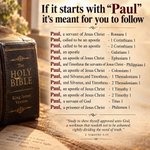
It's a false choice... Paul never contradicts Jesus; Paul speaks FOR the risen Jesus.
"For I neither received it of man, neither was I taught it, but by the revelation of Jesus Christ." (Galatians 1:12)
Paul: "...the things that I write unto you are the commandments of the Lord." (1 Corinthians 14:37)
On earth, Christ "was a minister of the circumcision" (Romans 15:8). From heaven, He sent Paul to the Gentiles (Acts 9:15). Even Peter called him "our beloved brother Paul" (2 Peter 3:15).
Following Paul IS following Christ: "Be ye followers of me, even as I also am of Christ." (1 Corinthians 11:1)

ɴɪᴄᴋ ✞ retweeted
🚨‼️I AM THAT I AM
This VerseQuest infographic examines Exodus 3:1–15 and the extraordinary moment when God revealed Himself to Moses at the burning bush. Through five essential KJV-based lessons, it explores the holiness of God’s presence, His covenant faithfulness to Abraham, Isaac, and Jacob, His eternal self-existence, and His knowledge of Israel’s suffering. It also explains why the LORD depends upon nothing in His creation and why His power, promises, and purposes never depend upon human ability. When Moses questioned whether he was qualified to confront Pharaoh, God answered with the assurance of His own presence. The central lesson is unmistakable: Moses asked, “Who am I?” God declared, “I AM THAT I AM.” The servant was inadequate, but the eternal, self-existent, all-sufficient God who sent him was not!


ɴɪᴄᴋ ✞ retweeted
🚨‼️This chart explains how faith comes by hearing the Word of God during the present Church Age, while the Rapture will bring the Church from believing without seeing into the visible presence of Christ. It traces the Gospel, the Church’s walk by faith, the Lord’s call from heaven, the resurrection of the dead in Christ, the transformation of living believers, and the transition from faith to sight. The central truth is that today we hear and believe, but one day the Church will hear the call and see the One it trusted all along.

ɴɪᴄᴋ ✞ retweeted
Five reasons why the PreTrib Rapture is necessary:
1) To end the Dispensation of the Grace of God (Eph 3:2) and to return to the Law of Moses.
2) To preach the Gospel of the Kingdom again in all the world (Mt 24:14).
3) To soon after commence the 7-year Tribulation Period (Daniel's 70th Week) for Israel with a return to the Prophecy program.
4) To pour out the wrath of God and the Lamb, as prophesied throughout the Bible.
5) To usher in the long awaited Marriage of the Lamb after Christ's Second Coming.

ɴɪᴄᴋ ✞ retweeted
How do I recognize when I’m leaning on my own understanding?
Key Passage: “Trust in the LORD with all thine heart; and lean not unto thine own understanding. In all thy ways acknowledge him, and he shall direct thy paths.” (Proverbs 3:5-6)
Proverbs 3:5-6 gives one of the clearest warnings in Scripture about a danger that rarely feels dangerous while we are doing it: “lean not unto thine own understanding.” Leaning sounds harmless. It does not sound like rebellion, idolatry, unbelief, or pride. Yet the picture is revealing. When you lean on something, you put weight upon it because you expect it to hold you. God is warning against placing the weight of your decisions, confidence, peace, direction, and obedience upon your own limited understanding instead of upon Him. Human understanding is not useless; God gave us minds and expects us to use them. But the mind makes a miserable god. The problem is not that you think; the problem begins when your thinking becomes the final court of appeal after God has already spoken. The safest mind is not the one that refuses reason, but the one that keeps reason beneath revelation.
The immediate setting of Proverbs belongs to Old Testament wisdom given within Israel’s Scriptures. It should not be ripped out of its context and turned into a formula promising every Church Age believer supernatural guidance for every trivial preference. Nor does “acknowledge him” describe how a sinner earns eternal life. Today salvation is by grace through faith in Jesus Christ, “not of works” (Ephesians 2:8-9). Yet the practical principle of Proverbs 3 is perfectly consistent with New Testament instruction. Romans 12:2 commands believers to be transformed by the renewing of the mind. Second Corinthians 10:5 speaks of bringing thoughts into obedience to Christ. James 1 tells believers to ask God for wisdom. Grace saves the believer, but grace does not authorize the believer to become his own final authority afterward. A saved man still has enough flesh to mistake his preference for wisdom and enough pride to call the mistake discernment.
So how can you tell when you are leaning on your own understanding? Usually not by whether you have thoughts, plans, opinions, or reasons. Those are normal. The warning signs appear when your thoughts become more authoritative than Scripture, when you need everything explained before you will obey, when prayer becomes an emergency brake instead of the steering wheel, when counsel feels offensive, when circumstances are allowed to overrule clear biblical truth, and when you become unable to trust God without first seeing how the outcome will work. Leaning on your own understanding is often revealed not by what you know, but by what happens when God refuses to explain Himself to you. The test comes when His word, His timing, His providence, or His command does not fit neatly inside your mental blueprint.
1. You Are Leaning on Your Own Understanding When Scripture Stops Being the Final Authority
The first warning sign is simple: you begin asking what makes sense to you before asking what God has said. Proverbs 14:12 says, “There is a way which seemeth right unto a man, but the end thereof are the ways of death.” Notice the danger: the way “seemeth right.” Error does not always arrive wearing a clown suit. Sometimes it looks reasonable, practical, modern, compassionate, efficient, or sophisticated. Eve looked at the forbidden tree and saw that it was “good for food,” “pleasant to the eyes,” and “a tree to be desired to make one wise” (Genesis 3:6). Her reasoning produced a conclusion opposite to God’s command. Sin has always enjoyed dressing itself in the respectable clothing of common sense. If what “seems right” contradicts the Book, the problem is not with the Book.

ɴɪᴄᴋ ✞ retweeted
The Rapture and the Call That Ends the Church Age of Faith
Key Passage: “So then faith cometh by hearing, and hearing by the word of God” (Romans 10:17).
One last sound, one last hearing — then sight forever.
Romans 10:17 gives one of the simplest explanations in Scripture for how faith is produced: “So then faith cometh by hearing, and hearing by the word of God.” During this present age, the Christian life begins and continues in a world where the Lord Jesus Christ is not physically standing before our eyes. The Gospel is preached. The sinner hears the Word of God. He believes the testimony God has given concerning His Son. Having trusted Christ, he then walks through this life “by faith, not by sight” according to 2 Corinthians 5:7. We believe a Book we can hold concerning a Saviour we presently cannot see. We pray toward heaven without seeing the throne. We worship Christ without seeing His face. We bury Christians while believing they will rise. The whole Church Age is marked by an extraordinary privilege: God has spoken, and faith takes Him at His Word before sight confirms what He promised.
The Rapture will change that condition for the Church in one staggering moment. First Thessalonians 4:16 says, “For the Lord himself shall descend from heaven with a shout, with the voice of the archangel, and with the trump of God.” The Church has spent generations hearing preaching about His coming; one generation will hear the summons connected with the coming itself. Believers have read, taught, memorized, defended, and preached the promise. Then the Lord arrives. The dead in Christ rise. Living believers are changed. Together they are caught up “to meet the Lord in the air.” For those believers, faith concerning Christ’s coming becomes sight because the One believed upon is suddenly before them. The last chapter of the Church’s earthly walk by faith closes not because faith was mistaken, but because faith has reached the Person it trusted.
The title The Rapture and the Call That Ends the Church Age of Faith therefore needs biblical precision. The Rapture does not eliminate faith from God’s universe, nor does it mean nobody after the Church’s departure will hear Scripture, believe God, or exercise faith. Revelation plainly shows people responding to God during the coming Tribulation. Romans 10:17 itself is not a direct Rapture verse but a statement concerning faith arising from hearing God’s Word. The point is narrower and greater: the Church’s present pilgrimage of believing Christ without seeing Him comes to its appointed end when Christ gathers His Body into His visible presence. Today we hear and believe; at the trumpet, the Church sees the One whose Word it believed all along.


ɴɪᴄᴋ ✞ retweeted

JESUS CHRIST SENT PAUL!
The Apostle Paul was not preaching his own opinions, ideas, or traditions of men. He was delivering the commandments of the RISEN LORD JESUS CHRIST!
1 Corinthians 14:37 KJV
“If any man think himself to be a prophet, or spiritual, let him acknowledge that the things that I write unto you are the commandments of the Lord.”
Paul received his gospel and apostleship by revelation of Jesus Christ!
Galatians 1:11–12 KJV
“But I certify you, brethren, that the gospel which was preached of me is not after man. For I neither received it of man, neither was I taught it, but by the revelation of Jesus Christ.”
The Lord entrusted Paul with the dispensation of the grace of God and the revelation of the Mystery concerning the Church, which is His Body.
Ephesians 3:1–9 KJV
This is why RIGHTLY DIVIDING the word of truth is so important!
We must distinguish God’s prophetic program concerning Israel from the Mystery revealed through Paul for the Body of Christ.
2 Timothy 2:15 KJV
To dismiss Paul’s apostleship and the doctrine Christ entrusted to him is to disregard the authority of the risen Lord who sent him!
Our saving gospel today is found in 1 Corinthians 15:1–4 KJV — Christ died for our sins, was buried, and rose again the third day.
Ephesians 2:8–9 KJV — Salvation is by grace through faith, not of works!
We do not elevate Paul above Jesus Christ. We acknowledge the authority of JESUS CHRIST speaking through His chosen apostle to the Gentiles!
MAKE ALL MEN SEE THE FELLOWSHIP OF THE MYSTERY!
Ephesians 3:9 KJV
TODAY IS THE DAY FOR SALVATION!!

ɴɪᴄᴋ ✞ retweeted

DOES BIBLE PROPHECY TEACH A NEW WORLD ORDER OR ONE WORLD RELIGION?
As a classic dispensationalist, I believe Revelation describes a future ruler who will exercise authority across nations, demand worship, and control who can buy and sell. To understand what that means, I start with Revelation 13.
1. What about a “New World Order”?
“New World Order” is a modern phrase. In Revelation 13:7, the beast is given authority “over all kindreds, and tongues, and nations” (KJB). Verses 16–17 describe a system in which buying and selling are restricted to those who have the mark, the name of the beast, or the number of his name.
I believe this points to the future authority of the Antichrist during the Tribulation. To connect a modern policy or organization to that prophecy, I would ask how it fits the specific details Revelation gives.
2. What about a “One World Religion”?
Revelation 13 gives us a specific object of worship. The world is directed to worship the beast. The second beast causes people to worship the first beast, and those who refuse to worship his image face death (Revelation 13:12–15).
Revelation 13:8 (KJB)
8 And all that dwell upon the earth shall worship him, whose names are not written in the book of life of the Lamb slain from the foundation of the world.
So when people use the term “one world religion,” I ask what they mean. Revelation describes enforced worship of the beast. It gives us no details about how today’s religions might fit into that future system.
3. What about the Ecumenical Movement?
Ecumenism generally refers to efforts toward unity among Christian churches. Interfaith dialogue refers to conversations among people of different religions. Protecting freedom of conscience means people can practise their faith freely.
I respect my neighbours’ freedom of conscience. As a Christian, I judge calls for religious unity by what they ask me to affirm. Jesus said, “I am the way, the truth, and the life: no man cometh unto the Father, but by me” (John 14:6, KJB). A call to treat people with dignity is consistent with sharing that truth openly.
I believe Revelation 13 will be fulfilled during the future Tribulation. When someone says a speech, a religious meeting, or a government policy fulfills it today, I ask them to show how it fits the passage in context.
My hope is in Jesus Christ. He died for our sins, was buried, and rose again. Eternal life is God’s free gift, received by grace through faith alone in Jesus Christ alone.
ɴɪᴄᴋ ✞ retweeted
🚨‼️One of the greatest mistakes a Christian can make is assuming that because his circumstances have gotten worse, God must have stopped working. Joseph was seventeen years old when his own brothers stripped him of his coat, threw him into a pit, and sold him into slavery. He had received dreams concerning his future, but now he was being carried into Egypt like a piece of merchandise. And just when things began improving in Potiphar’s house, he refused to commit adultery with his master’s wife and wound up in prison for doing right! What a fine advertisement for the modern prosperity gospel! Joseph obeyed God, maintained his integrity, resisted temptation, and received a prison sentence for his trouble. But Genesis 39:21 declares, “But the LORD was with Joseph.” The prison was real, the injustice was real, and the suffering was real. But so was the presence of Almighty God.
Now pay attention to something remarkable. Joseph’s brothers thought they were getting rid of him. Potiphar’s wife thought she was destroying him. The chief butler forgot about him after promising circumstances gave Joseph reason to hope for release. Every human being involved seemed to possess some measure of control over Joseph’s future, but not one of them understood what Almighty God was accomplishing. The brothers could sell him, the woman could accuse him, the prison keeper could confine him, and the butler could forget him. But none of them could prevent the famine that was coming or overthrow the providence that would place Joseph in a position to preserve his family. Men were making decisions against Joseph while God was accomplishing purposes through circumstances they did not understand. The enemies controlled their wicked intentions, but they never controlled the final outcome.
Years later, when Joseph’s brothers stood trembling before the man they had betrayed, he declared in Genesis 50:20, “But as for you, ye thought evil against me; but God meant it unto good.” Don’t run past those words. Joseph did not say their evil was actually good. He did not excuse their betrayal, rename their hatred as righteousness, or pretend that his years of suffering had been pleasant. He said they meant evil, but God meant good. The same event can contain the wicked intentions of men and the righteous providence of God without making God the author of their wickedness. And here is where some Christians need their theology straightened out. Just because somebody has done you wrong does not mean they have defeated God’s purposes for your life. The Lord does not need the cooperation of your enemies to accomplish what He has determined. He can overrule what they intended for destruction without ever approving what they did.
But don’t turn Joseph’s history into another prosperity sermon promising that every prison ends with a palace. Some faithful servants of God have died in prison. Others have gone to their graves without ever seeing their earthly circumstances corrected. Hebrews 11 makes that plain enough. Joseph’s testimony is not that every Christian will become wealthy after suffering, but that God’s providence is greater than human understanding and His faithfulness is not measured by immediate comfort. You may not understand why the betrayal happened, why the door closed, why the accusation prevailed, or why the answer has been delayed. Joseph didn’t understand everything while sitting in that prison either. Yet the LORD was with him. Never mistake a chapter of suffering for the conclusion of God’s purposes. The pit was not the verdict. The prison was not the end. And the God who knew what was coming long before Joseph understood what was happening has not surrendered His throne over your circumstances.

ɴɪᴄᴋ ✞ retweeted
🚨‼️This KJV-based infographic illustrates the danger of partial obedience through King Saul’s failures in 1 Samuel 13 and 15. Featuring Saul’s confrontation with Samuel, five key biblical lessons, and the warning that obedience is better than sacrifice, it reveals how impatience, selective obedience, religious excuses, and the fear of man led to Saul’s rejection as king. Its central message is unmistakable: God’s Word must be obeyed, not edited.


ɴɪᴄᴋ ✞ retweeted
Above All, Take the Shield of Faith
The Shield Too Many Christians Fail to Raise and the Fiery Darts God Says They Can Quench
Primary Scripture: Ephesians 6:16 (KJV)
Introduction
There is something remarkable about the way the apostle Paul introduces the shield of faith in Ephesians 6:16, and it deserves considerably more attention than it ordinarily receives. After instructing the Christian to put on the whole armour of God, after describing the spiritual warfare in which every born-again believer is engaged, and after identifying truth, righteousness, and the preparation of the gospel of peace, Paul writes, “Above all, taking the shield of faith, wherewith ye shall be able to quench all the fiery darts of the wicked.” Those words are not religious decoration. They are military instructions delivered by inspiration of the Holy Ghost to people who are already saved, already members of the body of Christ, and already involved in a spiritual conflict whether they recognize it or not. Every expression carries weight. Paul says “above all,” giving the shield particular emphasis. He says “taking,” establishing a responsibility that requires action. He identifies the shield as “faith,” not human reasoning, religious enthusiasm, or personal determination. He declares that the believer “shall be able,” identifying an ability supplied through God’s appointed defense. Then he makes the extraordinary statement that this shield can quench “all the fiery darts of the wicked.” Not merely the ordinary attacks, the weaker temptations, or the occasional discouragement, but all. There is enough doctrine, warning, correction, and encouragement in this one verse to occupy the attention of a serious Bible student for a considerable time.
The setting makes the instruction even more important. Ephesians 6:12 declares, “For we wrestle not against flesh and blood, but against principalities, against powers, against the rulers of the darkness of this world, against spiritual wickedness in high places.” The Christian is not fighting an imaginary opponent, nor is he instructed to view every disagreeable person as the enemy. The conflict involves spiritual adversaries operating beyond the reach of ordinary human weapons. Paul does not tell believers to manufacture supernatural power, pursue mysterious experiences, or imagine themselves capable of intimidating the devil. He commands them to be strong in the Lord and in the power of His might. The armour belongs to God. The strength comes from God. The instructions come from God. Nevertheless, the believer must obey those instructions. A soldier can possess excellent equipment and still expose himself by failing to use it. A man can understand the description of a shield without ever lifting one. A Christian can acknowledge that faith is important while repeatedly allowing fear, unbelief, bitterness, and discouragement to govern his decisions. That distinction between knowing about faith and actually exercising faith is one of the great practical lessons hidden in plain sight within Paul’s command.
The question, therefore, is not whether God has furnished His people with an adequate defense. The question is whether His people are taking the defense He has furnished. The devil has been opposing the work of God since the opening chapters of Genesis, and he has never lacked methods for attacking those who belong to the Lord. He can tempt a man with pleasure, intimidate him with suffering, discourage him through circumstances, and attempt to undermine his confidence in the promises of God. He can use lies that sound reasonable, accusations that sound convincing, and threats that appear overwhelming. Yet in the middle of this warfare stands a divine promise concerning the shield of faith. That promise must neither be weakened by unbelief nor distorted into the foolish notion that faith guarantees a life without trouble. God has not promised that the enemy will never shoot. He has declared


