

Have your best baby, anywhere.
- Tweets1.1K
- Following54
- Followers13.6K
- Likes2.4K






ALT Open Nucleus kit showing an electronic device and accessories against a black background. Text reads "Black Friday Sale" and "Buy one kit, get one free." Original price of $1,026 is crossed out, with a new price of $527 for two kits. Offer ends November 27, 2026.


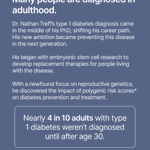
ALT An informational poster about type 1 diabetes diagnosis in adulthood. It discusses Dr. Nathan Treff's personal experience with a late diagnosis during his PhD, which inspired his research in embryonic stem cell therapies. The poster highlights that nearly 4 in 10 adults with type 1 diabetes weren't diagnosed until after age 30 and mentions research on polygenic risk scores.

ALT An individual in professional attire is pictured next to a quote about family health and genetic testing, attributed to Dr. Nathan Treff, Chief Clinical Officer of Nucleus.

ALT The image shows a promotional poster with a dark blue background. It features a graphic of a cheek swab kit and a smartphone displaying an app. The text reads: "An at-home cheek swab can reveal your genetic risk for type 1, type 2, and rarer forms of diabetes. Nucleus Health and Nucleus Preview screen for more than 2,000 conditions, giving you a clearer picture of your own health and what your future children could inherit.

ALT Informational graphic about IVF and embryo selection, featuring the text: "And if you're already undergoing IVF, or want to go further, you can reduce this risk through advanced embryo selection. Nucleus Embryo allows you to compare your embryos’ genetic risk for diabetes, so you can select an embryo with the lowest risk." The bottom includes a logo and website: mynucleus.com. The background is blue.

ALT Image with text about genetic counselors. The main message states that genetic counselors assist in understanding the influence of genetics on health. It describes them as healthcare professionals who translate genomic information for informed healthcare and family planning. Icons highlight three roles: interpreting genetic test results, evaluating hereditary disease risk, and understanding family history. The closing line emphasizes guidance with knowledge and compassion.

ALT The image is a graphic titled "How does Nucleus work with genetic counselors?" It describes three services: "Nucleus Health" for understanding results and discussing next steps with a doctor, "Nucleus Preview" for considering family planning and genetic risks, and "Nucleus Embryo" for analyzing embryo results and decision-making.

ALT Meet Nucleus' team of genetic counselors. The image features Lila Dayani, MS, LCGC, as the Director of Genetic Counseling. Lila is noted as a prenatal and reproductive genetic counselor and founder of Genevie Health. The description highlights contributions to reproductive genetics research and lectures at universities including UCLA, Loma Linda, and UC Irvine.

ALT A professional headshot of a person with curly hair is centered on a purple background. The text introduces them as part of Nucleus' team of genetic counselors, highlighting Andria Besser, MS, CGC, as Head of Medical Affairs. A brief biography mentions experience at NYU Langone Fertility Center and involvement in genetic counseling for reproductive medicine.

ALT A poster with the headline "My Diabetes Diagnosis Came Out of Nowhere. Today, Families Can Know Sooner." A highlighted section mentions a new Time essay by Nick Jonas about earlier detection. The poster includes an image of a Time magazine cover featuring the same headline and a photo of a person. The text emphasizes the importance of awareness for families. The source is Time, November 5, 2026.

ALT A promotional image for Nucleus Health and Preview features text about learning genetic risks for over 2,000 conditions, including diabetes, using an at-home cheek swab. Below the text, there is an illustration of a testing kit on a blue background.

ALT The image features a digital advertisement titled "Planning a family? You can go further." It talks about IVF and genetic risk concerning diabetes. Nucleus Embryo offers a service to compare embryos with a noted benefit of a 67% reduction in type 1 diabetes risk when selecting the lowest-risk embryo from five. The bottom includes a note about risk reduction statistics based on European ancestry, with a link to my.nucleus.com/stats. The Nucleus logo and a tablet displaying embryo comparison are also visible.

ALT A blue background with white text that reads: "For your health today. For the family you’re planning." Below is the text "LEARN MORE AT" followed by an underlined link, "mynucleus.com.


ALT Cover of Nature journal featuring the title "Highly efficient base editing at PCSK9 and normal human embryo development" along with a DOI link, set against a plain background. An arrow is present at the bottom right corner.

ALT The image explains a safer genetic editing method called base editing for human embryos to eliminate inherited diseases. It features a diagram with labeled stages: human zygote, cleavage-stage embryo, single cell, biopsy, and SNP array & genotyping.

ALT The image is a summary of key findings on DNA editing. It states minimal chromosome damage was seen with base-edited embryos compared to old CRISPR methods. Stem cell lines grew from edited embryos, with all methods confirming edits and proving approach normalcy. Delivery format impacted growth; protein injection allowed normal growth, while RNA did not. The summary emphasizes a gentler DNA editing method that allows edited cells to grow normally, maintaining intended genetic changes.

ALT The image is a screenshot of a quote by Dr. Nathan Treff, senior co-author and Nucleus' Chief Clinical Officer, discussing the implications of this study. It emphasizes the importance of ongoing research to expand options for having healthy babies, acknowledging current limitations despite technological advancements. The image includes a link to a full article on nature.com.


ALT A blurred image background with text discussing IVF statistics. The text states: "For the first time ever, the U.S. reached over 100,000 babies born through IVF in a year. Recent data from the Society for Assisted Reproductive Technology (SART) reported that there were 100,158 IVF babies born in 2024. In the United States, IVF currently accounts for 3% of all births.

ALT Text titled "What about other countries?" with statistics on IVF births: Over 13 million babies born globally since 1978. In India, up to 350,000 IVF cycles annually. In Australia, 1 in 16 babies through IVF. In the UK, 1 in 32 babies from IVF. In China, IVF births total 300,000 each year. In Japan, over 700,000 babies born through IVF in 2023. Background: blurred world map.

ALT The image contains two text quotes on a blurred background. The first quote, by Dr. Daniel Kort, MD, discusses factors driving increased IVF use, like awareness and access to care. The second quote, by Dr. Mark Surrey, MD, highlights IVF's effectiveness and the variety of reasons people choose it, including its role in embryo development, which other medical treatments may not offer.

ALT The image features a promotional poster for Nucleus IVF, displaying their logo and website URL, mynucleus.com/IVF. In the background, there is a blurred image of a person cradling a baby. The bottom of the poster lists multiple sources about IVF statistics and news.


