

Doer of the difficult. Champion for talent. Inventor of things. Builder of Machines. North Sea O&G, Nuclear Power, Subsea, Heavy Manufacturing.
UK
Joined December 2021
- Tweets25.9K
- Following1K
- Followers40.4K
- Likes29.3K





The Pale Blue Dot
The bitter lesson of space, is “look at Earth”, it’s ironic that whatever goes to space always ends up facing Earth. It’s also ironic that it’s a pale BLUE dot, and not a pale green dot.
“Earth” is complete misnomer it’s only 29% earth, the Earth is 71% water. We all live on a planet that is totally dominated by open water.
The ocean is vast, it’s open, it’s free, it’s also very accessible even for massive things… especially for massive things.
81% of world trade is by sea, $24.5 trillion.
If you control sea lanes and divert trade routes, you control 10s of trillions of dollars of capital flows, nation states thrive or die on these flows.
The majority of the planet’s mineral wealth is just sitting on the seabed waiting to be picked up.
Even seawater itself is a giant pool of minerals, the salt in the sea is ions of sodium, magnesium, potassium, calcium, chlorides.
It’s also the best heat sink in the solar system, any large thermal energy process is optimally located at sea.
“Maritime will be the new space”
… is totally right.
The ocean is many orders of magnitude more massive than space, because space is a void.
You can build a 1 million ton machine and float it out to sea, we’ve done that before, we can do it often.
A lot of Western nations are finding it’s very hard / almost impossible to build things on land where a society has strong property rights and distributed land ownership. Independent courts and strong property rights make infrastructure a challenge.
But this doesn’t apply in space, and it doesn’t apply at sea.
So the sea and the open ocean are going to be secured, and are going to be developed and industrialised. Because we can.
AI = Autonomy, and autonomy is a big unlock for 71% of our planet. The opportunity to go and build offshore in the maritime domain is huge.
It’s fully of resources, you can build bigger (stuff floats) you can run machines harder (unlimited heat sink), you can deliver to every major economy.
You don’t need anyone’s permission.

1/ It's such a rare experience that I feel so compelled by a founding team & mission. I hope you'll watch this very short video explaining the threat & innovation to respond to it. Maritime will be the new Space. Hats off to @mateocernosek @_Andrenam_
I competed once for this deal and lost to @firstround so I stayed close and led the next round. Gladly swallowed that pill.
Backwardation and Contango
Any senior person from the commodities sector will know that futures markets have structural regimes, and that different shaped futures curves force all market participants into different behaviours.
Backwardation is the normal structure for a futures market, for compute rapid obsolescence is a powerful backwardation force.
As supply expands in the future with new data centers getting built, future supply should be expanding which should depress forward prices and drive backwardation.
Perishable supply, an unused GPU-hour is not deferred it is lost forever. Providers will accept lower forward prices to avoid idle capacity in flooded spot markets.
Asymmetric hedging, service interruptions can irreversibly impair market share labs and enterprises will hedge against violent spot moves that can interrupt their service and permanently harm their market share.
Contango is the opposite of backwardation. Contango has rising compute prices out in the forward prices. Why might that happen?
Frontier release cycles, labs try to corner resource availability to dominate release points in the calendar.
Power bottlenecks, even if chips and models are available power can constrain supply and raise compute costs.
Rising interest rates, higher rates or debt costs increase the cost of holding / maintaining infrastructure. This will be passed forward in futures contracts.
New Hardware releases, new hardware releases can create price cliffs in the futures curve as new hardware increases the economic performance of the GPU-hour.
Likewise new model releases, can create price cliffs in the futures curve as new frontier model increases the economic value of the marginal frontier GPU-hour.
The singularity…
Anyone who believes in the singularity can simply buy the long end of the futures curve, because by definition they believe it is undervalued. This belief system should see value in any futures regime other than super duper contango.
Interesting times!
GPU-hour Futures
Several financial exchanges have developed compute futures. They’re due to start trading in November, following regulatory approval from CFTC who sought comment on compute derivatives in August.
Compute is the processing power and hardware infrastructure that machines need to train and run AI models. Much of the discussion around compute markets is about the capacity supplied by GPUs.
You do not have to own these chips. You can rent access to GPU capacity from cloud providers and specialist infrastructure companies. That makes it possible to put a price on the use of a particular type of processor, commonly expressed as the cost of renting one GPU for one hour.
Interestingly GPU-hours and not tokens are being securitized. Token derivatives might come later, but for now the derivative market is being built upstream of the models, and downstream of the chips.
This sets the first financial commodification point in the AI tech stack.
HOWEVER, not all GPU-hours are equal. The price can vary depending on the type and configuration of the GPU, its location, and the terms under which capacity is rented. That variability is one of the central challenges in creating a derivatives market for compute.
The idea is to create a futures contract whose value is tied to the cost of renting computing capacity. This can be a synthetic GPU-hour that represents a composite basket of chips, or it could be a contract for specific chip models.
Contracts have already been announced by CME Group and Silicon Data.
CME plans to list futures based on Silicon Data's H100 and B200 Rental Indices, which measure the hourly rental cost of two models of Nvidia GPUs. Each contract represents about a month of continuous capacity for a single GPU.
ICE is taking a different approach, working with two partners to list two types of compute futures. One set of contracts will reference Ornn's Compute Price Index, which tracks live-traded spot prices for GPU compute across major hardware types.
The other set is based on the COIL index developed by NATIVX, which takes a different approach by normalising compute prices for energy costs, helping make prices from locations with different power costs more comparable.
The most recent entrant is Nodal Exchange, which announced a partnership with Compute Desk, a provider of GPU rental price indexes, to launch its own set of compute futures. Although Nodal is smaller than CME and ICE, it has more than half of the open interest in the US electricity futures market, and that gives users a way to capture correlations between power and compute.
Why is this happening now?
The expansion of AI has made computing capacity a strategically important operating input. Companies developing AI models need access to GPUs, while cloud providers, specialist "neoclouds" and data centre businesses are investing in the infrastructure supplying that capacity.
Goldman estimates global AI investment will exceed $1 trillion in 2026 while McKinsey project $6.7 trillion in capital spending on data centres required worldwide by 2030.
McKinsey breaks this down as $5.2 trillion for AI workloads and $1.5 trillion for traditional IT.
Who will buy and sell these futures?
An AI developer expecting to rent large amounts of GPU capacity in future could take a futures position that gains value if the relevant compute benchmark rises, helping to offset a higher rental bill.
A provider investing in GPUs faces the opposite risk: it has invested in hardware whose earning power depends partly on future rental rates. It could use futures to reduce its exposure to falling prices.
This creates a need for hedging on both sides of the market, although neither would necessarily get a perfect hedge.
This can dramatically lower the existential risk faced by all parties and therefore dramatically reduce the cost of capital.
The challenge is fungibility, real prices vary by model and location.

Hyperbolic Paraboloids
In 2010, the Deepwater Horizon rig sunk in the Gulf and sadly claimed the lives of 11 men.
In the days and weeks that followed the Maccondo deepwater well flowed around 80,000 barrels per day into the Gulf at a depth of 5,000 ft below the surface.
Initially engineers thought it might have a been a problem with the float shoe. A float shoe is a one way valve that sits at the toe end of the pipe you run into an oil well to stop it collapsing.
To drill a well, you drill a hole, then you slide a pipe into your new hole, them you slide in a long tube down to the float shoe and you pump cement down the tube and up the outside of the pipe.
Once the cement cures, you drill a smaller diameter hole inside your new hole, and you just repeat this like a Russian doll.
Anyway, during Maccondo the entire subsea industry was given access to information to try and solve the unfolding crisis.
The float shoe was one suspect, the other was the Blow Out Preventer (BOP).
Now a subsea BOP is one helluva machine, it weighs 500 tons. It has to close several valves against pressures of 15,000 psi. It has to cut through six inches of hardened drill pipe.
It has to do all of that and seal.
There are API codes on how to design and test a subsea BOP, which means they are all the same.
In 2010, the BOP failed the prevent the blowout. It had one job.
The big problem with BOPs is that they are fundamentally ill designed. They must overcomes tremendous well bore pressure to close, they must also overcome tremendous shear resistance to cut drill pipe or drill collars.
The rams just don’t have the muscle to do it at such water depths, because of the constant entropy calculations of subsea accumulators.
What a BOP ram should do, is to use the well bore pressure to assist closing the rams. This changes a headwind to a tailwind.
This is actually quite easy to do, and the tech and designs exist (they’re just not what the API code describes).
The other interesting requirement is sealing, the best way to seal an 18-3/4inch well bore is with a gate valve.
Making gate valves this large is a real challenge, you have to machine a 24x24inch inconel block to a flatness of 2 helium bands, you have to do the same with the seats…
Or at least that was (still is) the conventional wisdom.
A much better (more sophisticated) approach is to understand that a BOP valve block has a well bore, but also has large cross bores that intersect the well bore.
When the wellbore pressure is applied to the BOP block, it deflects. The apertures in the ram body yawn wider, and the flatness that you spent so much time and effort producing is no longer flat. Not when it matters.
In fact the entire sealing contact plane across the gate block, the seat, the body all take on the hyperbolic paraboloid shape.
The contact stress around the seal is highly non-axi-symmetric which is fundamentally in contradiction to prevailing wisdom.
It’s always important to remember that as intended is not as drawn, and that as drawn is not as built, and as built is not as strained.
There are really 3 tiers of difficulty to MechE
You can design to drawn, you can design to built, and you can design to strained.
There’s a part of this that is competence, but really you have to deeply love what you are doing to be able to think about asymmetrical contact surfaces under various load conditions and face separation risks for stuff like this.
It’s a bit of a curse in that every time I see a tube of Pringles, I think of gate valves, industrial codes, bubble tests, and accumulator constant energy calcs with the laborious NIST table work.
But I’m also very confident I was the bleeding frontier of how to solve this esoteric issue from 2010-2015 and I paved a lot of SOTA into the record.
What I really enjoy now, is knowing how to get to the frontier of understanding for such things, and how to make progress into the abyss of problems that limit what we can do.


HVDC Transmission
One of the biggest changes for future infrastructure is the emergence of High Voltage DC transmission.
As the story goes, in the original 1880s build out it was Edison and Westinghouse who battled with AC and DC technologies for electricity distribution systems.
AC won the day, because it was the only way to move power any meaningful distance. Back then, DC was limited to just 1 mile.
But then semiconductors came along…
In 1957, high power semiconductors completely upended transmission technologies. Now DC outperforms AC on distance, cost and efficiency.
Modern DC has no reactive power losses, no skin effect, and use 50% less copper.
The semiconductor technology breakthroughs came about in the 50s and entered commercial markets worldwide in the 1970s. But then Insulated Gate Bipolar Transistors (IGBTs) and Voltage Source Converters (VSCs) also hit commercial markets in the 1990s.
Countries that developed before 1999 are mostly still stuck using an AC backbone, but countries that developed later had the advantage of building their most valuable machine (the grid), on a DC backbone.
A DC backbone allows asynchronous transmission over transcontinental distance. Some DC systems today stretch 2,000 miles, connecting day and night, connecting sunshine and wind.
HVDC technology today is able to connect countries separated by seas and oceans, creating new markets and exchanges for balancing power. There’s even a project to connect to UK to Morocco, laying cables around the Iberian peninsula.
The ability to lay HVDC cables in seawater simplifies the deployment somewhat as countries with highly ossified infrastructure and land ownership can shift huge power volumes up and down their coastlines. Moving power East-West arbitrages diurnal cycles and moving power North-South arbitrages seasonal variances.
The capacity keeps rising too, with companies already marketing cables able to carry 3.5GW. In China they are laying UHVDC where voltages of 1.1 million volts are common.
In the 2030s we will see multi-million volt cables being laid across oceans, which starts to get interesting for the system architecture of grids.
It’s not crazy to consider that some sort of pan transmission system emerges with huge asynchronous arteries laid in corridors that carry electrical power.
Why will this happen?
Well today electricity prices are highly heterogeneous, industrialised nations pay around $50/MWh but developing nations pay $100-200/MWh and in poorer nations it costs $350/MWh.
Around 1.5 bn people enjoy cheap energy, whereas 6.5 bn people live with high electricity costs.
Most of the problems in the world; war, disease, climate, population, they are actually poverty problems, and at the root of the poverty problem is cheap electricity (there are still some idiots out there).
Almost every other major problem in the world stems from the lack of cheap and abundant power. Even the expansion at the industrial frontier is rapidly becoming limited by the availability of power.


I’m visiting the People’s Democratic Republic of El Segundo this week. Think of me as a Primary Integrator.
I guess I’m a buyer (not investor) of:
• all types of balance of plant
• all types of heavy power electronics
• all types of transmission
• all types of switchgear
• all types of power to synthetic molecules
• industrial control software
• forgings and forging equipment
• automated welding and inspection
• primary energy sources, such as nuclear reactors
I’m a worldwide seller of:
• sovereign scale power infrastructure (GW)
• national transmission backbone
• transoceanic telecom
• 5yr contracts of 50MW - 1.500MW power
• whitespace
• jurisdiction arbitrage (eg US jurisdiction servers in Japan/EU on local latency)
• clean water
Happy to meet anyone who can figure out an intro. Genuinely, if anyone wants to talk about anything to do with heavy industry, or ask any esoteric questions happy to meet up.
Happy to offer specifications, boundaries and interfaces, strategic direction.
What is he talking about? Think of me as a program originator for trade deal allocations:
• $600 billion US-EU
• $900 billion US-Japan-South Korea
• $1,400 billion US-UAE
• $950 billion US-KSA
• $250 billion US-Taiwan
• $200 billion US-Switzerland/Liechtenstein
That’s $4.5 trillion of commitment looking for projects. Stop sending InMail and just meet me for a coffee.

Building a Quayside
There are simply no enough deepwater quaysides in America, and a big part of the problem is nobody has built one in a very long time.
A quayside is essentially a huge wall, but you can’t easily build the wall because the place you want to build it is in the sea.
So you have to first build a dyke.
A dyke is a very simple thing, but it can be tricky to do if you are not dutch. Building a dyke involves dumping some rocks and then covering them with silt until you have a dyke that is able to keep the seawater out.
Once you have done this you can then do the excavation of your quay and build your quay walls.
Once the quaywalls are standing and set, you can then backfill the quayside with sand and cement to create a major structure.
Once the quay is complete you then remove the dyke and allow the quay to flood.
Congrats, you just built a quayside.
If you want to build big ships you will need a dry dock, a dock consists of 3 quayside walls and a dry dock consists of 3 quayside walls plus a set of locks (a sort of big gate to keep the sea out).
A dry dock allows you to lay a keel and build a hull and when you are finished you can float the hull by slowly filling the dock, then float out by opening the locks.
This is a safe and easy way to build large ships.
Alternatively you can build a ship above water and then launch it down a launch way into the water, but this is a bit more risky (as North Korea recently found).


So AI has solved a way to do integer multiplication faster than n log (n), but AES encryption is still not cracked…
because they haven’t announced that?
🫤
Solving encryption would allow a foundation lab to vastly increase their training dataset, and have a huge competitive advantage by scaling their pre-training.
But solving encryption is difficult.
Instead of solving the difficult problem with enormous technological and commercial advantages… we now believe the labs have solved mathematically impossible problems that have little or no commercial impact?
That is what we are to believe.
😐
very cool and all, but I might prudently choose to live by some slightly different assumptions about SOTA.
Trigger warning - Candid Manufacturing Commentary
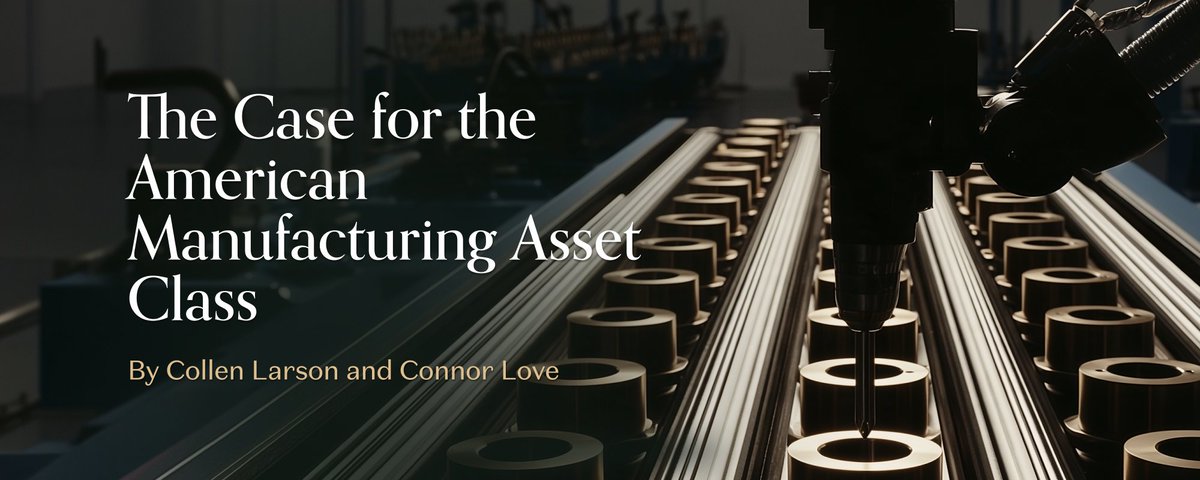
Connor’s article is great, and asks a lot of the right questions. But I almost fell off my chair at the attached chart.
A machine shop with fewer than 20 employees is too small.
Not being rude, I’m not sure how they are even viable? It must require heroic sacrifice from everyone involved.
This explains much of the discourse on X of recent years. Such small machine shops are not normal. All the shops I have visited in US were 50+ people and I honestly was not aware of this dramatic skew to the low end.
First of all, that’s too small to train new machinists. It’s just too expensive and too burdensome to train new workers if they are >5% of your throughout. That’s half your margin. Gone.
If you have only 5 employees then training a new person means the company operates at a loss for 2-3 years. Heroic sacrifice.
Machining is made-to-order, orders are lumpy, you cannot absorb volatility unless you have scale. Volatility bears a cost. Above a certain size the volatility smoothes out, suddenly you can manage and plan things. Below this size things want to break up like floating ice. I’m surprised it’s sustainable?
The average machine shop size in Europe is 106 employees. In USA it is 6! Further European machine shops are shrinking due to China-pressure and many European shops are worried about getting too small and their economics breaking, according to the chart below they are on average 20x bigger than American shops.
Looking at the chart below I would guess most of these businesses struggle to break even year on year?
It is also incredible that only 9 shops in USA have more than 500 employees??
Germany has 12,066 machine shops and 700 of them have more than 500 employees.
Seven hundred to nine!
The US industrial base looks to be shattered. To which I mean it is fragmented in the extreme. It needs massive consolidation to create more viability.
This might be unpopular, but come on now.
You need to put a lot of machine units on a single site, two aisles of 15-20 bays with a central throughway and you need a full 100ft span and 25 ton SWL runway crane coverage overhead with 100s of ft of rail. This is a minimalist setup.
Anything less will lose money due to volatility and underutilisation. The level of duplicated effort across 8,000 shops with fewer than 5 staff is a tragedy.
This is not good capital allocation, and the market seems to be screaming it.
Just make them bigger, duh.
How did this happen? Because this is not the shape of the industrial base that won WWII.


Hydrocracking Diesel
There’s a diesel supply crisis on the cards…
What can be done about it?
Refineries can raise diesel output, but only within some hard physical limits. In the current crunch (big loss of GCC + Russian refining capacity) the unconstrained systems are already near those limits.
Refineries operate seasonally. They build up massive stockpiles of feedstock over the year, and do refinery runs over the summer months and sell down their product until the following year. This gives the refinery time to plan and reconfigure for refining its feedstock blend into its product fractions.
Well summer just finished, S&P Global Energy has said August 2026 global runs were more than 6 million b/d below the prior year.
That means about 8% less fuel for the haulage industry for the next 8-10 months. That’s going to mean an inflation bout and this is why the bond market is insulted.
When you crack a barrel of oil it does not become only diesel. Typical yields are roughly 45% gasoline-range material and about 30% middle distillates, boosting one cuts the other.
The main response has been to run much harder and defer maintenance. Refineries have extended their runs to try and keep up, US is at 98% utilisation and Europe is at 100%.
Adding capacity is a 5-8 year undertaking, because of a lack of forging capacity (the root cause of many issues).
Globally US Gulf Coast PADD 3 is where the oil industry swings refinery fractions for this sort of crisis. You need big hydrocrackers. We have Motiva Port Arthur (large hydrocracker on a 600,000+ b/d plant), Marathon Garyville, Exxon Baton Rouge and Baytown, and Valero’s Port Arthur and St. Charles hydrocrackers.
But they are all already at their ceiling.
India, South Korea and Singapore all have facilities that can respond and will make a huge windfall here, but the crisis is probably going to bite, and it’s going to hit products with high last mile transport costs the hardest.
This means low ticket things such as food.
This is generally a difficult thing for incumbent governments to deal with, often because they don’t understand their economies/ supply chains, don’t do any planning or resilience management until Journalists start asking them about it. Journalists are retroactive by definition.
I always think refineries make for the best aerial photos? Am I wrong?

Stainless Steel
Steel is iron + carbon, usually something like 98.00-99.98% iron and 0.02-2.00% carbon.
Stainless steel is that, plus at least 10% chromium. Someone realised that if you add chromium to steel the steel is nice and shiny and it remains shiny because it forms an oxide layer that isolates the iron from atmospheric O2… thereafter it does not rust.
some extra slightly more complicated stuff, firstly there are 3 main types of steel..
• Autenite (the blue zone)
• Martensite (the white zone)
• Ferrite (the pink zone)
Each of these is a different crystal structure, Ferrite is Body Centric Cubic, Austenite is Face Centric Cubic and Martensite is a Body Centric Tetragonal.
FCC has more space to hold additional atoms than BCC does, so the Austenite edge is where a lot of alloy recipes cluster.
Stainless Steel is also a steel alloy with 3 elements. Iron + Nickel + Chromium
Stainless is usually >8% nickel and >16% chromium.
It’s also known as 3 series, which makes this all easy to remember.
The 3 types overlap like a Venn diagram to create A+M, F+M and A+F.
Now you can get as complicated as you like with alloys, and some applications you might add molybdenum too. But the chart below shows where the different commercial grades sit.
As move towards an economy with giant vertically integrated companies, the need for commercial grades changes a little (liability stays on one balance sheet) and we might see some more unusual things being used.
But here is the phase diagram for stainless steel, it’s basically a map of crystal structures. Crystals are important and understand them better has a lot of hidden benefits.

Frooooom…
Agents have gone from 0.3 trillion to 7.4 trillion average weekly token consumption in just 6 months, that’s a 24x gain or 576x annualised.
That’s +57,600% compound growth
At this rate, the world will consume 1 billion times more tokens by 2030!
Token consumption is exploding, but at the same time tokens are deflating. Jevon’s hypothesis is fully validated. Can anyone still dispute it?
Incredibly even as tokens deflate the marginal token actually becomes greater utility, because tokens are not really fungible. Tokens keep getting smarter.
For tokens… utility keeps rising, cost keeps falling, output keeps growing.
It’s triple exponent growth. It’s a supersonic boom.
At some point soon, it is going to reach macroeconomic scale and when it does the whole global economy is going to kick very hard.
It’s going to create an unprecedented glut downstream of AI and unprecedented scarcity upstream of AI.
You have to get upstream of it, upstream of AI is chips, infra, fabs and energy. Everything downstream of AI is in the flood path of a huge glut.

Humans are the minority user of AI
Agents burn nearly 5x the tokens people do, up 14x since February
More charts in State of Markets II: a16z.news/p/state-of-markets…

AI is Heavy Industry
I know this is obvious but let’s just spell it out, the things that AI can do very well become rapidly commoditised.
It started with copywriters, then html.
These things quickly became democratised and commodified, they gradually become demonetised. Practically free.
Distribution channels still make money, but content creation is becoming a glut.
To put this in simple terms… downstream of AI you get a glut, upstream of AI you get scarcity.
This generalises across pretty much everything, it’s going to take some time for AI to be applied to all the applications of the economy and that’s much easier in some places than it is in others, but it already feels inevitable that most things will come to be organised this way.
What does that mean?
It means the economy can be MUCH bigger, it means humans can slowly vacate the things downstream of AI and focus their efforts into the things upstream of AI. In past industrial revolutions entire social classes disappeared and new social classes emerged. That’s going to happen again here.
What do we have upstream of AI?
Energy, infrastructure, chips. That’s about 15% of the economy by GDP, to me this means reorganising (moving those workers downstream of AI into jobs upstream of AI) can lead directly to a 6-7x larger economy.
Upstream of AI is Heavy Industry, the future for humans is heavy industry. That’s doesn’t mean you have to be a forgemaster, a plumber or a welder. But it means the company you work at will likely do a fair bit of forging and welding.
Now, there will still be lawyers and accountants just as there are still farmers and fishermen today.
But the belly of the middle class are going to move out of offices and ditch their keyboards, and they’re going to be armed with an iPad and back outdoors, or on the shopfloor and not necessarily wielding the tools, but building commissioning, doing asset management and organising maintenance.


Refractory Tiles
A “refractory” is a material that is resistant to decomposition by heat, or chemical attack and that retains its thermophysical properties at high temperatures.
Typically they are inorganic, non-metallic compounds that may be porous or non-porous and their crystallinity varies wildly.
Historically they are oxides, carbides or nitrides of… silicon, aluminum, magnesium, calcium, boron, chromium and zirconium.
This gives you 21 base refractory ceramics.
Each of the 21 base compounds then have a variety of crystal phases.
Further you can dope the crystals with interstitial atoms, disrupting the lattice and creating other thermophysical properties.
There are also refractory metals which tend to be more complex atomically and less performant. Then there are “other” refractories like graphite.
But it feels like the crystal doping problem is the tech tree branch that unlocks performant heat shields and such.
Making the tiles, fitting the tiles, replacing the tiles, these are understood. The materials… there is work to be done. It’s a big search space and crystallography is difficult.
But…
Crystallography is really a math problem.


Humanoids
You can build up various economic hypotheses of the future around a few product specs that already exist today.
One useful such data point is the Unitree R1
$4,900
0.25 kW
25 kg
That’s $200/kg and 10 W/kg
For context a car is $40/kg and 100 W/kg
For a robot l, R1 is lightweight, low power and cheap. It doesn’t really have hands, or brains, but it does have some actuators and can move and labour. It’s crude, but it’s kinda functional and mass produced so a decent(ish) economic marker.
It doesn’t have full capabilities today, and your extended family would still laugh if you got one now, but this is clearly a transitory phase. Some time between 2030 and 2035 they’re going to become fully capable.
A good(ish) way to think about humanoids is:
P(value) = intelligence x dexterity x labour
These capabilities likely all come in one product (although you might pay an intelligence subscription), but it probably makes sense to think about them separately.
The energy cost of intelligence is going to continue to fall, but it’s going to have extreme (ludicrous) Jevon’s feedback. Unit cost will fall, volume will soar.
The energy cost of dexterity splits between intelligence opex and energy sunk into manufacturing. Labour energy cost is fixed in the Newtonian laws of motion.
I generally think humanoids will be
~ 50kg
~ 500 watts
For the mechanical stuff, plus there will be some onboard edge compute, maybe 200 watts.
Offboard intelligence, could be 50 - 1,000 watts, depending on what you want to pay for.
Scaling off the R1 gives us something like $10,000 + $200/mnth.
That’s less than a car, and most households have no problem affording 2 or more cars. Will owning a robot(s) mean less reason to travel in your car? Maybe.
We live in a world with 8bn people and 1.2bn cars. The world would like to have 5-6x more cars than we currently have, and I think there’s world demand from residential markets as a default for 1:1 robots:people (more in wealthier places).
That’s 8bn robots, or 200million tonnes of robots, and 4TW of power for mechanical work.
For context Toyota produces around 16-17 million tonnes of cars / year and the world has maybe 2bn tonnes of cars today.
So the 8bn robot figure is quite reachable from our current material stock.
Robotics are far more power constrained than material constrained, also there is the compute.
The compute is also far more power constrained than material constrained.
This points to a world where power and energy (or events) are more valuable than material possessions.
But the other big thing that is missing here is industrial demand. Yes residential demand looks big and long running, but industrial demand is much bigger.
Residential demand serves consumer desires, industrial demand serves capital growth. Both are self recursive.

Nordstream v’s Troll v’s the Future
The famous Nordstream pipeline that connected Russia to Germany, and was widely regarded as the backbone of German energy policy carried 55 bcm (billion cubic meters) of energy into Germany each year, this is equivalent to 65 GW of power. For context, the German grid consumes 45-65 GW of electricity.
So yes, Nordsteam was major strategic infrastructure.
Nordstream connected Germany’s industrial base to Russia’s huge Western Siberia gas field. But Nordstream is no longer operational (a different post).
Troll A (see repost), is the largest object ever moved by humanity. Troll A is a North Sea gas platform (a big one). Troll A produces 42 bcm of gas which is around 52 GW of power.
Troll A is also major strategic infrastructure, a single platform that is comparable to the power consumption of Germany. Let that sink in for a moment.
There are 590 energy structures in the North Sea basin today (British, Norwegian and Dutch sectors). Around 300 of those are operational oil and gas facilities and the other 300 are largely retired oil and gas platforms, but there are also many offshore wind farms.
Offshore wind has some economic questions around it (I don’t care about the wind turbine part here) but as an industrial technology it has originated a bunch of breakthrough transmission grid technologies, globally the grid is otherwise lethargic on new technology.
All of the most interesting new grid technologies in the world are from the North Sea’s offshore wind sector.
HVDC is a transmission breakthrough.
Rather than the limits of AC which can only move power 400miles, HVDC can move power 3-4,000 miles.
This is transformational in terms of strategic infrastructure. You can build dramatically more resilience and effective grids merely by being able to build giant grids.
HVDC has been around for a long time, but North Sea’s wind has figured out all sorts of new systems and products rectification, conversion, storage.
The world buys $3.5 trillion of electricity and this figure is going to be more like $15-20 trillion by 2050.
For context, the global economy spends $10 trillion on energy today. So electricity is about 35% of energy, this figure is going to 70% over the next generation.
Around $2.6 trillion of the $3.5T goes to generation, and around $0.9 trillion goes to transmission.
For humanity to build the future that we are already talking about, transmission revenues will need to be $5-7 trillion.
Historically global transmission capex is $200bn, but is currently running at $550bn.
You can see that transmission is $0.9 trillion revenue and $550bn capex. A transmission system is 60% capex!
For humanity to build out our Grid of the Future, just scaling current global averages (very rule of thumb), that means $3-4 trillion of global transmission capex… annually.
There’s a small number of people who know how to build this stuff, they’re all clustered into the same places.
(people keep asking me what I’m building, and I keep dropping clues, but everyone assumes these are just “information posts” 😂)
Coming to a global economy near you soon.


Troll A
If you want to build something big, do it at sea.
The Troll A platform has a displacement of 1.2 million tonnes, that’s 6,600 Boeing 747s (for context that’s 4x more jumbo jets than were ever built (1,540)).
Troll A was installed and commissioned in 1995, it has been on site for 30 years now. Last year (2025) it produced 42 billion cubic meters of natural gas per year, that’s a continuous energy flow rate of 53 GW.
(for context, the state of Texas is currently consuming 75GW of power)
The platform is 1,640 feet tall and is operated by a crew of 40. In 2006 Katie Malua held a concert for the crew in the concrete base of the platform which at the time was 1,000ft below the North Sea.
You can only visit via helicopter trip and before you make the trip you have pass a safety course.
This involves strapping yourself into a fake helicopter which is then dropped into a swimming pool and tipped up side down… only if you successfully escape the up side down submerged chopper are you then allowed to fly on the real helicopter.

