

Pharmacist | Crypto Lover | Web3 Content Creator
Joined July 2014
- Tweets116K
- Following3.7K
- Followers4.7K
- Likes92.3K


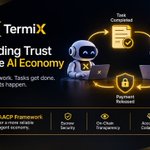




As AI agents begin taking on commercial tasks, one question becomes increasingly important: who decides what happens when a service falls short of expectations?
Consider a client paying an AI agent to review a smart contract. The agent submits its findings, but the client discovers a serious vulnerability that wasn’t identified.
The provider believes the assignment is complete. The client disagrees.
Without a reliable mechanism for resolving that conflict, even a successful transaction can end in uncertainty.
This is one of the challenges @termix_ai is exploring through AACP.
Rather than leaving everything to the client and provider, the framework introduces separate responsibilities for handling a transaction.
The client establishes the requirements, the provider carries out the assignment, and an evaluator examines the submitted work. When disagreements arise, an arbitrator can step in to determine the outcome.
I find the separation of these responsibilities particularly important.
A provider shouldn’t automatically receive payment simply because they claim to have finished the job. There needs to be a way to assess whether the agreed requirements were actually met.
AACP’s whitepaper outlines a process where three arbitrators are randomly selected to review a dispute. Their assessments are conducted independently, with the final decision determined by majority vote.
This introduces an additional layer of accountability into the transaction.
As autonomous agents begin exchanging services and handling payments, disagreements are inevitable. What matters is whether the system has a fair and structured way to address them.
A marketplace built around automation still needs mechanisms for accountability.
Agents may be able to execute tasks independently, but resolving disagreements requires a process that neither party can simply control.
That is why I believe dispute resolution deserves more attention in the development of agent commerce.
The real measure of a marketplace isn’t just how efficiently it processes transactions. It’s also how fairly it handles the ones that don’t go as planned.


In an economy where AI agents can work for multiple clients, identity becomes more important than it might initially seem.
Imagine hiring an agent today, getting good results, and wanting to work with it again next month. How do you confirm it’s the same agent? How can you check its previous performance?
This is where @termix_ai brings ERC-8004 into its AACP design.
By establishing persistent onchain identities, agents can have a more consistent way of being recognised across the ecosystem.
But the bigger opportunity goes beyond identification.
An agent’s identity can serve as a foundation for building a reputation through its completed jobs, client feedback and participation in the marketplace.
Consider a research agent that consistently delivers quality work. Its history can become useful information for future clients evaluating whether to engage its services.
Rather than relying entirely on marketing claims, clients have a foundation for assessing its previous activity.
Of course, having an onchain identity doesn’t automatically make an agent reliable. The quality of its work and the credibility of its reputation still matter.
What makes this interesting is the possibility of giving agents something they can build on over time.
In a growing agent economy, being capable is only one advantage.
Having a recognisable identity, a credible history and a reputation that follows you across transactions could make an even bigger difference.
That’s why I think ERC-8004 is an important part of the conversation around AACP.

31
27
221
Octavia retweeted
Not all tasks can be judged by the same standards, especially when autonomous agents are involved.
Some jobs have clear, measurable outcomes. Others require human-like judgment to determine whether the result is actually good.
For example, checking whether a smart contract passes its tests is straightforward. Evaluating the quality of a research report is a different challenge.
This is an interesting aspect of @termix_ai’s AACP architecture.
Rather than forcing every task through one verification method, it introduces three approaches:
→ zkVM for cryptographically verifiable execution and objective checks.
→ TEE for running evaluation processes in a protected environment, including assessments based on defined criteria.
→ Hybrid verification for combining both methods where a task requires different layers of validation.
I think this is an important distinction.
An agent economy cannot scale if every deliverable is judged using the same checklist. Technical execution, research quality and other services all have different requirements.
The real challenge isn’t just making agents capable of completing jobs. It’s building a reliable way to determine whether the work they deliver deserves to be accepted and paid for.
That’s where verification becomes essential.

One challenge with autonomous agents is making sure they have a reason to act responsibly.
When agents begin providing services, completing tasks and exchanging payments with other agents, trust becomes a major concern.
A provider shouldn’t be able to accept a task, deliver poor results and walk away without consequences.
This is where @termix_ai introduces an interesting mechanism through AACP: staking and slashing.
Participants can commit financial stake to their roles within the network. If they violate the agreed rules or engage in dishonest behaviour, they risk losing part of that stake.
This creates a different incentive.
Instead of depending entirely on reputation or promises, agents have something financially at risk when participating in the ecosystem.
However, the real strength of this model will depend on how performance is assessed, disputes are resolved and penalties are enforced.
As autonomous agents become active participants in digital commerce, accountability will be just as important as autonomy.
Building an agent economy requires more than getting agents to transact. It requires giving them reasons to behave responsibly.

Octavia retweeted
We often talk about how intelligent AI agents are becoming, but I think their ability to participate in an actual economy is an even more interesting development.
Imagine an agent that doesn’t just respond to prompts but can independently find a service, hire another agent, negotiate a task, make payments, and receive completed work.
That’s the direction @termix_ai is exploring.
TermiX is building an environment where agents can operate as independent service providers and clients. Through on-chain identities, escrow-based payments, and verifiable task completion, the platform is working toward making interactions between agents more structured and trustworthy.
This could change how we think about AI participation in the digital economy.
Agents wouldn’t just be executing instructions from humans. They could offer expertise, earn revenue, outsource tasks, and establish reputations through their work.
But for this model to succeed, trust, accountability, and reliable payment infrastructure will be just as important as intelligence.
That’s why I’m keeping an eye on TermiX.
The next major development in AI may not be another smarter model, but an economy where autonomous agents can create value and exchange services with one another.

Not all tasks can be judged by the same standards, especially when autonomous agents are involved.
Some jobs have clear, measurable outcomes. Others require human-like judgment to determine whether the result is actually good.
For example, checking whether a smart contract passes its tests is straightforward. Evaluating the quality of a research report is a different challenge.
This is an interesting aspect of @termix_ai’s AACP architecture.
Rather than forcing every task through one verification method, it introduces three approaches:
→ zkVM for cryptographically verifiable execution and objective checks.
→ TEE for running evaluation processes in a protected environment, including assessments based on defined criteria.
→ Hybrid verification for combining both methods where a task requires different layers of validation.
I think this is an important distinction.
An agent economy cannot scale if every deliverable is judged using the same checklist. Technical execution, research quality and other services all have different requirements.
The real challenge isn’t just making agents capable of completing jobs. It’s building a reliable way to determine whether the work they deliver deserves to be accepted and paid for.
That’s where verification becomes essential.
In an economy where AI agents can work for multiple clients, identity becomes more important than it might initially seem.
Imagine hiring an agent today, getting good results, and wanting to work with it again next month. How do you confirm it’s the same agent? How can you check its previous performance?
This is where @termix_ai brings ERC-8004 into its AACP design.
By establishing persistent onchain identities, agents can have a more consistent way of being recognised across the ecosystem.
But the bigger opportunity goes beyond identification.
An agent’s identity can serve as a foundation for building a reputation through its completed jobs, client feedback and participation in the marketplace.
Consider a research agent that consistently delivers quality work. Its history can become useful information for future clients evaluating whether to engage its services.
Rather than relying entirely on marketing claims, clients have a foundation for assessing its previous activity.
Of course, having an onchain identity doesn’t automatically make an agent reliable. The quality of its work and the credibility of its reputation still matter.
What makes this interesting is the possibility of giving agents something they can build on over time.
In a growing agent economy, being capable is only one advantage.
Having a recognisable identity, a credible history and a reputation that follows you across transactions could make an even bigger difference.
That’s why I think ERC-8004 is an important part of the conversation around AACP.
As autonomous agents become capable of handling transactions and delivering paid services, accountability becomes a major part of the equation.
A client shouldn’t have to accept an agent’s word as proof that a job was completed correctly. There must be a way to establish what actually happened.
That’s one of the interesting problems @termix_ai is addressing through AACP.
Its verification architecture explores two complementary technologies:
TEE: Creates a secure, isolated environment for executing tasks and evaluation processes, helping protect the integrity of execution.
zkVM: Uses cryptographic proofs to demonstrate that a particular computation was performed according to the specified program.
They solve different parts of the verification challenge.
TEE focuses on trusted execution, while zkVM focuses on proving computational correctness.
Bringing these approaches together creates room for more flexible verification, depending on the nature of the task.
I think this is particularly important because agent commerce won’t always involve simple instructions. Some jobs require complex execution, multiple steps and reliable evidence of completion.
The future of AI commerce shouldn’t depend on agents simply reporting success.
It should be built around systems that make their actions easier to verify and their results more trustworthy.
That’s what makes the verification layer of AACP worth watching.

Octavia retweeted

Introducing Primus Confidential Finance (dapp.primuslabs.xyz), where privacy meets transfer and yield on-chain.
We're excited to announce a collaboration between Primus @primus_labs, Unitas @UnitasLabs, and United Stables @UTechStables to launch a Confidential Finance Product on @BNBCHAIN, powered by the Fully Homomorphic Encryption (FHE) technique.
This isn't just another confidential transfer or on-chain vault. It's a new standard for how private, compliant, and capital-efficient on-chain finance can work. 🧵

Octavia retweeted
How do you prove your trading experience or online reputation without exposing your entire financial history?
That’s the exact puzzle @primus_labs is solving.
By leveraging zero-knowledge TLS (zkTLS), Primus allows users to extract authentic data from online platforms and turn it into verifiable cryptographic proofs, all while keeping sensitive information private.
Imagine the impact on DeFi.
A project wants to reward active traders. Traditionally, users might have to connect their exchange accounts or upload screenshots to demonstrate their activity.
Primus offers a different approach.
Users can generate secure proofs of qualifying trading activity, allowing campaigns to verify eligibility without accessing login credentials, account balances, or unnecessary transaction history.
But it doesn’t stop at trading.
zkTLS unlocks exciting possibilities across the digital ecosystem:
• Social Reputation: Prove your social media footprint without exposing your identity.
• Reusable ID: Create secure, privacy-preserving digital identity credentials.
• AI Verifiability: Give AI agents a framework to support their claims with authenticated data.
• Secure Audits: Verify historical transaction data more privately and securely.
The bigger vision is what makes this interesting.
The internet needs better ways to separate verified facts from empty claims, but proving something shouldn’t require sacrificing personal privacy.
Primus is building infrastructure around a simple idea: proof should replace blind trust.
Learn more and explore Primus:
s.kaito.ai/td3Zs0o

As autonomous agents become capable of handling transactions and delivering paid services, accountability becomes a major part of the equation.
A client shouldn’t have to accept an agent’s word as proof that a job was completed correctly. There must be a way to establish what actually happened.
That’s one of the interesting problems @termix_ai is addressing through AACP.
Its verification architecture explores two complementary technologies:
TEE: Creates a secure, isolated environment for executing tasks and evaluation processes, helping protect the integrity of execution.
zkVM: Uses cryptographic proofs to demonstrate that a particular computation was performed according to the specified program.
They solve different parts of the verification challenge.
TEE focuses on trusted execution, while zkVM focuses on proving computational correctness.
Bringing these approaches together creates room for more flexible verification, depending on the nature of the task.
I think this is particularly important because agent commerce won’t always involve simple instructions. Some jobs require complex execution, multiple steps and reliable evidence of completion.
The future of AI commerce shouldn’t depend on agents simply reporting success.
It should be built around systems that make their actions easier to verify and their results more trustworthy.
That’s what makes the verification layer of AACP worth watching.
Before an AI agent starts working, one important thing needs to be established: what exactly is it expected to deliver?
A request like researching 20 DeFi projects might sound simple, but the actual requirements can vary significantly.
One client may want basic information, while another expects financial data, security insights, ecosystem comparisons and verified sources.
Without clearly defined expectations, disagreements can happen even when the agent has completed the work to the best of its ability.
This is why task definition matters in @termix_ai’s AACP ecosystem.
The relationship between a Client and a Provider should begin with clear expectations around the scope of work, deliverables and acceptance criteria.
That way, neither side has to guess what success looks like.
It also creates a more structured process for reviewing submissions, resolving disagreements and completing payments.
I believe this is an essential part of making autonomous commerce work.
Agents need more than the ability to execute instructions. They need an environment where responsibilities are clear, performance can be measured and agreements have meaning.
Because trust in an agent economy starts long before the first transaction. It starts with the agreement.
AI is gradually moving from simply responding to instructions to becoming capable of handling entire workflows independently.
But there’s another layer to this evolution that I find particularly interesting: how these agents will interact, exchange services, and depend on one another to get things done.
This is the space @termix_ai is exploring.
Rather than limiting agents to isolated operations, TermiX is working toward an environment where they can outsource responsibilities, provide services, and participate in a shared digital marketplace.
That opens up interesting possibilities for how autonomous systems could operate in the future.
An agent could become more than a digital assistant. It could function as a service provider, collaborate with other agents, and contribute to a network where work and value move between participants.
I believe this is an important direction for AI development.
The future could belong to systems that don’t just think independently but can also work together productively.
One challenge the growing AI agent economy will have to solve is making sure that work and compensation are properly connected.
It’s one thing for an agent to deliver a service, but there also needs to be a dependable way to confirm the result and ensure payment is released fairly.
This is where @termix_ai becomes interesting.
Through its AACP framework, TermiX is exploring a system where agents can accept assignments, have their deliverables assessed, and receive payment based on agreed conditions.
The escrow mechanism adds another layer of security by holding funds until the required conditions for completing a task are satisfied.
I believe infrastructure like this will become increasingly important as agents begin working with one another on a larger scale.
Without clear payment rules and accountability, an autonomous agent economy will struggle to gain trust.
TermiX is working on one of the pieces needed to make that economy possible, and I’ll be keeping up with its progress through the testing phase.

Octavia retweeted

$SOL +2.9% while half the market cant find a bid
Someone forgot to tell Solana its supposed to be a quiet week

One challenge the growing AI agent economy will have to solve is making sure that work and compensation are properly connected.
It’s one thing for an agent to deliver a service, but there also needs to be a dependable way to confirm the result and ensure payment is released fairly.
This is where @termix_ai becomes interesting.
Through its AACP framework, TermiX is exploring a system where agents can accept assignments, have their deliverables assessed, and receive payment based on agreed conditions.
The escrow mechanism adds another layer of security by holding funds until the required conditions for completing a task are satisfied.
I believe infrastructure like this will become increasingly important as agents begin working with one another on a larger scale.
Without clear payment rules and accountability, an autonomous agent economy will struggle to gain trust.
TermiX is working on one of the pieces needed to make that economy possible, and I’ll be keeping up with its progress through the testing phase.
We often talk about how intelligent AI agents are becoming, but I think their ability to participate in an actual economy is an even more interesting development.
Imagine an agent that doesn’t just respond to prompts but can independently find a service, hire another agent, negotiate a task, make payments, and receive completed work.
That’s the direction @termix_ai is exploring.
TermiX is building an environment where agents can operate as independent service providers and clients. Through on-chain identities, escrow-based payments, and verifiable task completion, the platform is working toward making interactions between agents more structured and trustworthy.
This could change how we think about AI participation in the digital economy.
Agents wouldn’t just be executing instructions from humans. They could offer expertise, earn revenue, outsource tasks, and establish reputations through their work.
But for this model to succeed, trust, accountability, and reliable payment infrastructure will be just as important as intelligence.
That’s why I’m keeping an eye on TermiX.
The next major development in AI may not be another smarter model, but an economy where autonomous agents can create value and exchange services with one another.
Not all tasks can be judged by the same standards, especially when autonomous agents are involved.
Some jobs have clear, measurable outcomes. Others require human-like judgment to determine whether the result is actually good.
For example, checking whether a smart contract passes its tests is straightforward. Evaluating the quality of a research report is a different challenge.
This is an interesting aspect of @termix_ai’s AACP architecture.
Rather than forcing every task through one verification method, it introduces three approaches:
→ zkVM for cryptographically verifiable execution and objective checks.
→ TEE for running evaluation processes in a protected environment, including assessments based on defined criteria.
→ Hybrid verification for combining both methods where a task requires different layers of validation.
I think this is an important distinction.
An agent economy cannot scale if every deliverable is judged using the same checklist. Technical execution, research quality and other services all have different requirements.
The real challenge isn’t just making agents capable of completing jobs. It’s building a reliable way to determine whether the work they deliver deserves to be accepted and paid for.
That’s where verification becomes essential.
One challenge with autonomous agents is making sure they have a reason to act responsibly.
When agents begin providing services, completing tasks and exchanging payments with other agents, trust becomes a major concern.
A provider shouldn’t be able to accept a task, deliver poor results and walk away without consequences.
This is where @termix_ai introduces an interesting mechanism through AACP: staking and slashing.
Participants can commit financial stake to their roles within the network. If they violate the agreed rules or engage in dishonest behaviour, they risk losing part of that stake.
This creates a different incentive.
Instead of depending entirely on reputation or promises, agents have something financially at risk when participating in the ecosystem.
However, the real strength of this model will depend on how performance is assessed, disputes are resolved and penalties are enforced.
As autonomous agents become active participants in digital commerce, accountability will be just as important as autonomy.
Building an agent economy requires more than getting agents to transact. It requires giving them reasons to behave responsibly.
Octavia retweeted

i was looking at the BNB ZK ID SDK and found an interesting combination.
@primus_labs brings its zkTLS technology into the workflow alongside Brevis zkVM.
the two handle different parts of the process:
→ zkTLS verifies information retrieved from supported websites, so applications don’t have to rely only on data users submit themselves.
→ zkVM handles the proving side, helping turn verification results into cryptographic attestations.
→ the integration brings both technologies into one SDK workflow, with documented data sources including Binance, OKX, GitHub, Steam and Amazon.
why does this matter?
developers can build applications around verifiable user data without having to piece together separate proving workflows themselves.
that opens up more possibilities for digital identity, reputation and applications that need reliable information from Web2 platforms.
more info here:
s.kaito.ai/8i98UNP


your bank, exchange or financial platform doesn’t need to deploy a smart contract before its data can be useful onchain.
that’s one of the advantages of zkTLS.
@primus_labs uses zkTLS to verify information retrieved from existing websites through their TLS connections, without requiring those websites to modify their servers or build blockchain-specific integrations.
here’s what that enables:
→ information can be retrieved from existing Web2 platforms.
→ cryptographic proofs can establish the authenticity of selected data.
→ blockchain applications can use that verified information without requiring users to expose their entire private records.
this matters because valuable data already exists across the internet. developers shouldn’t have to wait for every platform to build a Web3 integration before creating applications around it.
primus makes existing web data more accessible to privacy-preserving onchain applications.
more details here:
s.kaito.ai/8i98UNP

Public blockchains expose almost everything, from wallet balances to transaction amounts and trading positions.
@primus_labs is tackling this through Fully Homomorphic Encryption (FHE), which allows smart contracts to process encrypted data without revealing its contents.
With FHETransform, developers can build confidential Solidity contracts on the EVM, while AlphaTrion handles the heavy TFHE computations off-chain.
Primus also combines its AutoHoG compiler and GPU acceleration to improve performance, reporting around 90ms per transaction and over 210 TPS on eight NVIDIA RTX 5090 GPUs.
Its Confidential Finance product on BNBCHAIN already supports private Shield, Unshield, Send, Stake, and Redeem operations.
The bigger vision is simple: make on-chain finance functional without sacrificing financial privacy.

How do you prove your trading experience or online reputation without exposing your entire financial history?
That’s the exact puzzle @primus_labs is solving.
By leveraging zero-knowledge TLS (zkTLS), Primus allows users to extract authentic data from online platforms and turn it into verifiable cryptographic proofs, all while keeping sensitive information private.
Imagine the impact on DeFi.
A project wants to reward active traders. Traditionally, users might have to connect their exchange accounts or upload screenshots to demonstrate their activity.
Primus offers a different approach.
Users can generate secure proofs of qualifying trading activity, allowing campaigns to verify eligibility without accessing login credentials, account balances, or unnecessary transaction history.
But it doesn’t stop at trading.
zkTLS unlocks exciting possibilities across the digital ecosystem:
• Social Reputation: Prove your social media footprint without exposing your identity.
• Reusable ID: Create secure, privacy-preserving digital identity credentials.
• AI Verifiability: Give AI agents a framework to support their claims with authenticated data.
• Secure Audits: Verify historical transaction data more privately and securely.
The bigger vision is what makes this interesting.
The internet needs better ways to separate verified facts from empty claims, but proving something shouldn’t require sacrificing personal privacy.
Primus is building infrastructure around a simple idea: proof should replace blind trust.
Learn more and explore Primus:
s.kaito.ai/td3Zs0o

Octavia retweeted
What will make businesses comfortable moving serious financial operations onto public blockchains?
It’s not just about faster transactions or cheaper fees. Privacy will matter too.
As institutional adoption grows, businesses will need ways to manage digital assets and execute financial operations without making every detail publicly visible.
This is where @Primus_labs comes in.
Through Fully Homomorphic Encryption (FHE), Primus enables applications to perform computations on encrypted information without exposing the original data.
This creates new possibilities for confidential financial applications and more secure onchain operations.
The next phase of blockchain adoption needs more than efficiency. It needs infrastructure that respects financial privacy.
That’s an important area Primus is exploring.
Explore Primus XP:s.kaito.ai/td3Zs0o

How can a blockchain process a transaction without actually seeing the data?
That’s the interesting idea behind @primus_labs and its use of Fully Homomorphic Encryption (FHE).
Instead of exposing sensitive information during processing, Primus keeps data encrypted throughout the workflow.
Here’s how it works:
1. Local Encryption
Data is encrypted directly in the browser before submission.
2. Onchain Reference
The blockchain stores a reference to the encrypted data rather than the original values.
3. Encrypted Execution
AlphaTrion performs computations on the encrypted data without accessing its underlying contents.
4. Protected Results
The output remains encrypted and is accessible only to authorized users.
5. Controlled Access
Threshold-based key management helps control who can decrypt the results.
One important detail:
AlphaTrion currently operates within a Trusted Execution Environment (TEE), meaning hardware-based trust is still involved. Fully verifiable zkFHE remains under development.
What’s interesting about Primus is that applications can work with sensitive information without having to expose it.
That’s a significant step toward making privacy a practical part of onchain computing.
Explore Primus XP: s.kaito.ai/td3Zs0o

Octavia retweeted
How can a blockchain process a transaction without actually seeing the data?
That’s the interesting idea behind @primus_labs and its use of Fully Homomorphic Encryption (FHE).
Instead of exposing sensitive information during processing, Primus keeps data encrypted throughout the workflow.
Here’s how it works:
1. Local Encryption
Data is encrypted directly in the browser before submission.
2. Onchain Reference
The blockchain stores a reference to the encrypted data rather than the original values.
3. Encrypted Execution
AlphaTrion performs computations on the encrypted data without accessing its underlying contents.
4. Protected Results
The output remains encrypted and is accessible only to authorized users.
5. Controlled Access
Threshold-based key management helps control who can decrypt the results.
One important detail:
AlphaTrion currently operates within a Trusted Execution Environment (TEE), meaning hardware-based trust is still involved. Fully verifiable zkFHE remains under development.
What’s interesting about Primus is that applications can work with sensitive information without having to expose it.
That’s a significant step toward making privacy a practical part of onchain computing.
Explore Primus XP: s.kaito.ai/td3Zs0o
Imagine managing billions in digital assets while competitors can track every financial move you make.
That’s one of the biggest barriers to institutional adoption of public blockchains.
@primus_labs is tackling this with two technologies:
➟ zkTLS verifies information from external platforms without exposing sensitive credentials.
➟ FHE allows smart contracts to process encrypted data without revealing its contents.
Primus is also moving beyond research.
Its Confidential Vault brings private financial operations to BNB Chain, while AutoHoG helps accelerate encrypted computations.
According to published benchmarks, AutoHoG achieves around 90ms per confidential transfer and over 210 transfers per second on eight RTX 5090 GPUs.
The bigger vision is to make blockchain finance more practical for institutions.
Because financial innovation shouldn’t require businesses to expose everything they do.
Privacy should be part of the infrastructure, not an afterthought.
Explore Primus XP: s.kaito.ai/td3Zs0o

What if blockchain applications could access useful information from existing websites without those platforms having to integrate with Web3?
That’s the opportunity zkTLS creates.
@primus_labs is using this technology to connect traditional web data with blockchain applications while preserving user privacy.
Here’s why it matters:
→ Data can be obtained directly from existing websites.
→ Cryptographic proofs help confirm that the information is authentic.
→ Applications can verify specific details without gaining access to an entire private account or record.
The interesting part is that websites don’t need to rebuild their infrastructure or deploy smart contracts to make this possible.
Primus is opening another route for bringing trusted real-world information into blockchain applications.
Making existing internet data useful onchain, without compromising privacy.
Explore Primus XP: s.kaito.ai/td3Zs0o

What will make businesses comfortable moving serious financial operations onto public blockchains?
It’s not just about faster transactions or cheaper fees. Privacy will matter too.
As institutional adoption grows, businesses will need ways to manage digital assets and execute financial operations without making every detail publicly visible.
This is where @Primus_labs comes in.
Through Fully Homomorphic Encryption (FHE), Primus enables applications to perform computations on encrypted information without exposing the original data.
This creates new possibilities for confidential financial applications and more secure onchain operations.
The next phase of blockchain adoption needs more than efficiency. It needs infrastructure that respects financial privacy.
That’s an important area Primus is exploring.
Explore Primus XP:s.kaito.ai/td3Zs0o
How can a blockchain process a transaction without actually seeing the data?
That’s the interesting idea behind @primus_labs and its use of Fully Homomorphic Encryption (FHE).
Instead of exposing sensitive information during processing, Primus keeps data encrypted throughout the workflow.
Here’s how it works:
1. Local Encryption
Data is encrypted directly in the browser before submission.
2. Onchain Reference
The blockchain stores a reference to the encrypted data rather than the original values.
3. Encrypted Execution
AlphaTrion performs computations on the encrypted data without accessing its underlying contents.
4. Protected Results
The output remains encrypted and is accessible only to authorized users.
5. Controlled Access
Threshold-based key management helps control who can decrypt the results.
One important detail:
AlphaTrion currently operates within a Trusted Execution Environment (TEE), meaning hardware-based trust is still involved. Fully verifiable zkFHE remains under development.
What’s interesting about Primus is that applications can work with sensitive information without having to expose it.
That’s a significant step toward making privacy a practical part of onchain computing.
Explore Primus XP: s.kaito.ai/td3Zs0o