

Content in obscurity & cosseted by mild eccentricity. Objectivity is giving all a fair hearing. It does not equate to false moral equivalence. RT ≠ endorsement
Search and ye shall find
Joined March 2009
- Tweets26.9K
- Following636
- Followers3.6K
- Likes1.4K





Dead in the water.

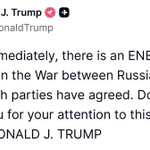
President Trump today advanced an important discussion with several European leaders about the need for a broader European security architecture that can help establish the conditions for lasting peace.
Building on his leadership and the substantive work undertaken this week in Brussels with Ukraine, NATO, and our European partners, @SEPeaceMissions and I wanted to share some of the objectives guiding our ongoing discussions.
For more than 30 years, Europe and Russia have struggled to establish a sustainable security framework. Decades of mistrust, competing security concerns, and the devastating consequences of this war make this an extraordinarily difficult challenge, but one that is essential to lasting peace.
Our objective is to develop practical arrangements that address the security concerns of all sides, reduce the risk of future conflict, and create a more stable and predictable security environment.
We are exploring five principal goals: permanent security consultations, reliable crisis communications, greater military transparency, reciprocal measures to reduce escalation risks, and an enduring framework for long-term European security and stability.
Any arrangements must fully respect the sovereignty, territorial integrity, and independent decision-making of every nation. Each country will retain authority over its own security and alliances, and no country would have a veto over another’s sovereign choices. NATO will remain central to European collective defense, and this initiative would build upon existing institutions and commitments.
We will continue consultations through the Shell Bay format with Ukraine, NATO, the EU, and our European partners, expanding engagement to ensure that all relevant perspectives and ideas are considered. We will also engage Russia as part of the peace negotiations.
Next week in Abu Dhabi, the United States will convene the first trilateral peace discussions with Ukraine and Russia since February. All parties remain intensely engaged in preparing for substantive and productive negotiations. We will consult closely with our European partners on the sidelines and, if progress is made, aim to move toward a broader multilateral format with their direct participation.
These ideas continue to evolve, and we welcome thoughtful input. Creating the right structure will be critical to ending this war and transitioning from conflict toward conditions that make possible a durable peace.
This is difficult, detailed work. There are no easy solutions. But the opportunity to help end this devastating war and build a foundation for a more peaceful, secure, and prosperous Europe for generations to come makes it a challenge well worth undertaking.
We will see how these discussions develop and continue working intensively with all parties toward President Trump’s objective of a comprehensive and lasting peace.
I strongly suspect the "ceasefire" in that location is nothing more than a chance for The Kremlin to build up its troops number and ordnance in that location. Once over, the surrounding area will pay a heavy price under renewed fire.

Je viens d'apprendre avec émotion qu'un drone à réaction russe vient de s'abattre sur la gare de Dnipro, avec un très lourd bilan.
J'adresse au Président @ZelenskyyUa et au peuple ukrainien mes condoléances et notre solidarité.
Nous devons, dans ce contexte, aspirer à bien plus qu'un cessez-le-feu localisé comme celui qui vient d'être négocié localement à Olechky. Il est intolérable que la Russie continue d'opposer son refus à toutes les propositions en ce sens, en continuant de miser sur l'escalade et en visant les civils.
Nous devons ensemble redoubler d'efforts pour une paix juste et durable et amener la Russie à la table des négociations.
Nikolai Holmov retweeted

Russians have a word for action performed for appearance rather than effect: показуха (pokazukha). It captures European leaders’ persistent habit of labelling Russian attacks – even industrial arson – on their soil as “hybrid.”
If Moscow now regards Europe rather than America as its principal adversary, that habit is becoming more dangerous. A determined foe will keep probing for credible response limits until it encounters one. Yet hybrid is too elastic a label to establish one.
Europe’s hybrid показуха must end. Retire this strategically vapid term.

For the first time since World War II, “Europe, rather than the United States, has become Russia’s principal geopolitical adversary,” writes Dmitry Adamsky.
foreignaffairs.com/russia/ho…

I'm not entirely sure that this is accurate, as Trump is clearly trying to won the Nobel apPEACEment Prize

Quite.

Well, well. Putin has suddenly discovered international law and freedom of navigation. Russia violates the UN Charter, its treaties with Ukraine and its commitments under the NATO–Russia Founding Act. Yet its message to everyone else is: “Please honour your obligations. We have no intention of honouring ours.”
Reciprocity matters. Russia cannot systematically undermine the international order and expect that to carry no consequences for its own interests.
Why this sudden concern for maritime law? One plausible explanation is anxiety over the Danish straits, through which Russia ships its Baltic exports. Moscow understands the vulnerability of that route.
Restrictions on passage through straits already have precedents: Türkiye invoked the Montreux Convention to bar belligerent warships following Russia’s invasion of Ukraine. The legal framework is different, but the strategic lesson is clear: aggression can have consequences at maritime chokepoints, too.
And Moscow might usefully be reminded of its own past argument: nobody is stopping anyone from setting new precedents. Russia should remember that new precedents can apply to Russia, too….
Nikolai Holmov retweeted

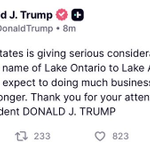
🚨 BREAKING: Ontario Premier Doug Ford just canceled Elon Musk’s Starlink contract and banned all U.S. companies from government contracts in response to Trump’s economic war with Canada.
“It’s done, it’s gone,” Ford said. “We won’t award contracts to people who enable and encourage economic attacks on our province and our country.”
And just to be clear: “They only have President Trump to blame.”
So Trump starts a trade war, and now American businesses are getting locked out of Canada. This isn’t “tough negotiating”—this is our closest ally shutting the door on us while Trump pretends he’s “winning.”
MAGA wanted an economic war? Well, they just got one. And it’s American companies and workers who are about to feel the pain.
FOLLOW:@johnfkjuniorq
Readers added context they thought people might want to know
This isn't new. Doug Ford cancelled Ontario's Starlink contract in March 2025, during that year's tariff fight. Ontario also banned U.S. companies from bidding on provincial contracts at that time. It did not happen this week. broadbandbreakfast.com/ontario-wont-r… globalnews.ca/news/11067542/…
Nikolai Holmov retweeted

However, let's recognize @elonmusk's bravery. Meddling in Europen politics and attacking the EU itself when you want regulatory privileges and frequency permissions is a bold business strategy.

More reporting suggesting that Musk does indeed have his finger on Starshield's operability. Quite a lot of power for a ketamine-addicted trillionaire in bed with hostile foreign regimes. You might even say this endangers U.S. national security. wsj.com/world/trump-called-m…


Nikolai Holmov retweeted

If we cannot be 100% certain that a technology will be available when we need it most, we cannot trust it at all.
That’s how trust works. Either it’s absolute, or it doesn’t exist.
Agree with Marek. I would also add that any successor is far from being identified from the outside or from within The Kremlin itself. Talking for the sake of talking is not the way forward at this point.

Nikolai Holmov retweeted

Russian savagery on full display. Only a total and utter idiot would trust their leadership, or feel they could exert influence over these barbarians.
I pray every day for a Ukrainian victory over evil on all fronts.

A Russian ballistic missile attack on Kyiv. Once again, no early warning from our partners. The main target was energy infrastructure, specifically CHPP-4. Unfortunately, it was hit. A residential building was also damaged, and rescuers are currently putting out a fire there. Our systems detected these missiles only when they were already virtually on approach to Kyiv. CHPP-4 is one of Kyiv’s key energy facilities.
According to our intelligence, the Russians are preparing further ballistic missile launches. The facts show that the Russians do not consider themselves bound by what the President of the United States said. Ukraine supported an energy ceasefire. Russia is targeting yet another power plant and the lives of our people.
And this is absolutely unjust: when they are destroying our energy infrastructure, and Ukraine is not even receiving early warnings about ballistic missile launches. It is important that the world does not stay silent about this. And it is important that the United States really see what is happening and who is responsible for this war continuing.
Please stay safe tonight and tomorrow. We are working to replenish our air defenses with anti-ballistic missiles.

Nikolai Holmov retweeted
Hey, @elonmusk, big man, are you playing politics with your products again?
As your European customers, we are watching you.

⚡️ 'This cannot be a coincidence' — Ukraine's Starlink access restricted without warning, Zelensky adviser says.
Ukraine relies on Starlink to operate its mid-strike drones in Russian-occupied Ukraine.
kyivindependent.com/this-can…

If true, I have to admit that no matter how hard I try and find my surprised face......I just can't find it. So predictable.

❗️Last night, the operation of Starlink terminals in Ukraine was restricted.
Connectivity began to drop when moving at speeds exceeding 160 km/h. As a result, a number of critical missions were disrupted.
SpaceX likely took these measures at the request of the Trump administration. Also last night, when Kyiv was attacked by ballistic missiles, Ukraine did not receive intelligence regarding their launch— a failure that could have led to higher casualties.
Ukraine did not attack Russian oil refineries, yet Trump has already begun imposing sanctions on my country. Meanwhile, sanctions against Russia have been eased.
Perhaps even worse, is that he publicly declared self-imposed "red lines" rather than keeping any NATO reaction under NATO wraps for enemies to guess at.

NATO yesterday: We are trained, we are ready. General Alexus Grynkewich, NATO’s Supreme Allied Commander Europe (SACEUR).
Last night: Russia attacked two civilian ships with drones; one ship sank, and so far, only one crew member has been rescued. This happened just a few kilometers off the Bulgarian coast. Six days ago, Russia had already attacked two civilian ships just off the Bulgarian coast; one ship was sunk in that incident as well.
NATO today: All our officers and politicians have hair appointments. We’ll look into the incident later.
Update: It was just a hybrid Russian attack, with a hybrid sinking and hybrid fatalities.
Nikolai Holmov retweeted

I am a member of the Norwegian Nobel Committee.
There are five of us. Five people, appointed by a parliament most of the planet could not find on a map, who decide, once a year, which human being the world has agreed to call good.
I know. I know. I think about it on the tram.
We meet in a building on Henrik Ibsens gate, a street named after a man who wrote almost exclusively about people discovering they are frauds, which nobody on the committee finds funny except me. There is a room with a long table and the portraits of the dead laureates looking down, Mandela, the Dalai Lama, a great many earnest men in spectacles, and one portrait we do not discuss, which is Kissinger, 1973, awarded while the bombs were still falling, after which two of our predecessors resigned and the satirist Tom Lehrer said political satire was now obsolete. We keep him on the wall. A reminder. Every family has the uncle.
It is October in Oslo, which means the sun gives up around four in the afternoon like a civil servant, and it rains the particular Norwegian rain that isn’t quite falling, just hanging there, judging you. I arrive with wet shoes. I always arrive with wet shoes. There is coffee, because this is Norway and there is always coffee, we drink more of it per person than almost anyone alive, and someone’s wife has sent kanelboller, the cinnamon buns, and we sit, five Norwegians, damp, caffeinated, sugared, and we decide the moral standing of the entire species.
Let me tell you how it actually works, because the world imagines a cathedral and it is, I promise you, a book club with a mandate.
287 nominations this year. 208 people, 79 organizations. Anyone can nominate, that’s the secret nobody understands: a professor, a parliamentarian, a former laureate, so the “nominee” list is meaningless, it’s a suggestion box, and every autumn some congressman nominates his own golden retriever and the press writes “SHORTLISTED.” Nobody is shortlisted. There is no short list the public ever sees. There is us, and the coffee, and the rain, and the portraits, and a Norwegian stubbornness that is older than the prize itself.
We read reports. The institute’s advisers write them, thick dull documents, and we argue. Our chairman told the BBC once that in the final meeting “there is a high temperature.” High temperature, for a Norwegian, means someone slightly raised an eyebrow and then apologized for it. We don’t do high temperature. We do a long silence, and then Kristin says “well,” and everyone knows exactly what “well” meant, and it’s settled. That’s our shouting. “Well.” You’d have to be raised here to hear the violence in it.
Now. This year. I will not say the name, because we never say the name, but you know the name.
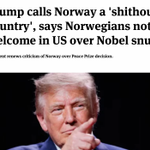
A certain head of state wanted this prize the way a child wants a thing in a shop window, which is to say loudly, and in public, and with the full belief that wanting it was itself the argument. He said he deserved it. He said he’d ended eight wars, a number that grew most times he said it, like a fish. He had other heads of state phone us. Israel’s prime minister posted it on the internet, “Give him the Nobel.” The leaders of Cambodia and Pakistan announced they’d nominated him, as though announcing it were part of it, as though we tally mentions. A man flew around the globe collecting endorsements for a Norwegian committee the way you’d collect signatures for a petition to the council about a noisy dog.
And here, uff da, is the detail I treasure, the one that makes me smile into my coffee. The nomination deadline is the 31st of January. He took office on the 20th. So for all the phone calls, all the posts, all the gilded lobbying, the only nominations that could possibly count for this year’s prize were filed in the first eleven days of his term, before he had, by his own arithmetic, ended a single one of the eight wars. He campaigned all year for a prize whose window had shut while he was still hanging up his coat. We didn’t have to reject him. The calendar did. We just watched. Norwegians are very good at watching. We have long winters.
People think we sit there weighing his deeds. We don’t. That’s the thing I can’t make the world understand. We’re not grading his homework. We don’t owe anyone the prize for a ceasefire, however real, however loud the announcement. “He made peace” is not a sentence that ends in a medal, the way he believes it does, the way he believes every good thing ends in his name on it. The will of a dead Swede says the prize goes to whoever did the most for fraternity between nations. A dead Swede, I should add, who made his entire fortune inventing dynamite and selling arms, and spent his last years horrified at his own obituary, which called him a merchant of death, and so bought his way to immortality as a man of peace. The whole prize is one guilty arms dealer’s attempt to launder his name. We are, all of us, administering a dead man’s public relations. I find this clarifying. It keeps me humble. It should keep everyone humble, and it keeps, by my count, no one humble at all.
So who did we give it to?
An eighty-five-year-old woman. A judge. Born in Durban, under apartheid, granddaughter of a Tamil man who came to South Africa as indentured labor, a bus driver’s daughter from the poor Indian quarter, who became the first non-white woman to run a law practice in her province, who defended Mandela’s people when defending them was dangerous, who sat on the Rwanda tribunal and the court at the Hague, and who, at eighty-five, is right now a judge weighing whether a genocide is a genocide. When we told the world, our chairman said the rule of law “underpins the system we have set up to ensure peace,” and that “peace requires justice.” She wasn’t even in Oslo. She was in Nuremberg. In courtroom 600. The actual room where they tried the Nazis. You cannot stage that. God staged that, and God, it turns out, is a better satirist than any of us.
She did not phone us. She did not post. No prime minister demanded it for her on the internet. She had, as far as our deliberations are concerned, the one qualification the loud man could never manufacture, which is that she wanted the work and not the medal. The medal finds those people. It flees the ones who chase it. This is not a rule we wrote. It’s just the only pattern the hundred-odd years of our mistakes has ever shown.
The reaction from across the ocean was immediate. His spokesman posted that we “place politics over peace.” Ja. Perhaps. We’re five damp pensioners in a rainy city; of course it’s political, it was always political, it was political when we gave it to a sitting American president nine months into his first term for the promise of things he had not yet done, and we have been quietly embarrassed about that one for fifteen years, so believe me, we had a particular reason this year to prefer a woman with fifty years of verdicts behind her over a man with eight wars in front of him and a deadline already behind him.
Here is what he will never understand, the thing I’d tell him on the tram if he ever took one. We are the one prize he cannot buy, cannot post his way to, cannot have a friendly dictator phone in for him. Not because we’re incorruptible, nei, we’re as vain and wrong and human as the portraits on our wall. But because the entire point of the thing, the only power a small cold country’s book club has ever held, is that it goes to the person not performing the wanting. The moment you demand it, you’ve proven you don’t understand what it’s for, and proving that is itself the disqualification. He ran the most expensive campaign in the history of the prize and the campaign was the reason. He was never losing to Navi Pillay. He was losing to the concept.
It’s dark now. Four o’clock dark. The buns are gone. Kristin said “well” an hour ago and we all went home. I’m on the tram with my wet shoes, and somewhere across the water a very powerful man is explaining to a camera that the prize is rigged, that we’re corrupt, that he’ll win it next year, and he genuinely might, we’re only five idiots and we’ve been wrong before, Kissinger is still on the wall.
But not this year. This year an old woman in Nuremberg, in the room where the law once stared down the exact kind of man who thinks wanting a thing loudly enough should make it his, got a phone call she didn’t ask for.
That’s the job. We don’t reward the man who ends the war and announces it.
We reward the woman who spent fifty years deciding what a war was.
He’ll never see the difference. That’s rather the whole point of him.
Takk for i dag. I have to change trams.
"destroy the enemy's ability to sustain aggression.....". Is that like, destroying it's oil refineries? Asking for a friend.....

In @WarsawForum, NATO’s top commander Gen. Alexus Grynkewich outlined the Alliance’s “theory of victory”:
▪️ Stop the initial attack, strike from all directions and destroy the enemy’s ability to sustain aggression.
▪️ The aim is to end aggression. NATO does not seek the enemy’s “strategic defeat.”
▪️ The risk of a major attack is currently “fairly low” while Russian forces remain concentrated in Ukraine.
▪️ Respond to Russian hybrid attacks with coordinated Allied action and greater support for Ukraine.
▪️ Ukraine has stabilised the front and will emerge stronger from the coming winter.
Asked what keeps him awake at night: My job is to keep others awake.

I'm sure that Deloitte's fee was commensurate to say the least

Accountancy firm helped in falsifying documents to evade tax on Roman Abramovich's wealth, BBC finds bbc.in/4jXmgdk

