

Closing the gap between information that can be produced and information that can be acted on.
Decentralized
Joined December 2023
- Tweets705
- Following25
- Followers779
- Likes405





Olena retweeted

Code (and math) are where AI is making the biggest steps towards total automation.
Because it can check if its outputs work on its own.
Most other things aren't so easily checked. That's where it needs external judgement, often human judgement.
And that's where @OlenaProtocol comes in.

Olena retweeted
We often run reality-benchmarked claims like "France will win the World Cup" to compare the system against prediction markets. And we're doing really well so far on that score!
But questions like this are where Peer Prediction really stands out.
Everyone knows Sinners won by $165M. Nobody knows how much of that was the film and how much was the marketing.
Studios can't decompose it with internal data.
Box office prices success in a single bundle: film × push × release date. It can't offer any more specific insights.
And no prediction market can either. A counterfactual has no ground truth settlement. Nothing ever resolves.
But unbundling that package unearths information that is worth billions. Sinners became Hollywood's referendum on whether original films still work, and studios are setting next year's slates based on how they read it. If the film won, you greenlight originals. If the marketing won, you don't.
Peer prediction doesn't need ground truth yet still involves incentives that reward honest best estimates. So we can produce a similar type of discipline that makes markets such a powerful crowd wisdom tool, and unearth the information buried in that bundle, because it's also located in people's minds.
Everyone who watched those movies knows what they saw whether it was marketing that got them in the door or not.

Olena Asks: how likely is this claim to be true?
With equal marketing support and equally favourable release dates, Sinners still outgrosses One Battle After Another.
predict.olena.xyz/questions/…
Olena retweeted

Think you’re good at predicting what happens next?
⚽ Will France win the World Cup?
🤖 Are today’s AI guardrails doing more harm than good?
🌍 Is the WLD token a net positive for World ID’s mission?
Make your predictions and build your forecasting track record on Olena: predict.olena.xyz/

Olena retweeted
We've had quite a few new sign ups. Here's a quick lowdown on how the scoring works.
Your response to a given claim asks you two questions, and you’re scored on both answers.
1. Your probability: your genuine best estimate.
2. Your prediction of the crowd: where you think everyone else’s answers will lie on the distribution.
Two answers, two scores.
Your own probability is scored on being surprisingly popular. You score well when answers near yours show up more often than people expected.
So if most people predict that almost nobody will answer around 70%, but then a meaningful number of people do answer around 70%, that area was surprisingly popular. The people who gave those answers are rewarded, because they contributed information the crowd had underestimated.
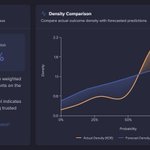
Your crowd prediction is scored separately. Here the goal is simpler: how accurately did you predict what everyone else would say? If you expected high confidence in the accuracy of the claim, and most people were in the 80-100% region, you score well. If you expected uncertainty either by clustering in the centre, or by a wide spread of views, and these turned out to be true in each case, you also score well. If the line you draw doesn’t look anything like the crowd’s distribution, you’ll score badly.
Why two scores? Because the crowd prediction creates the baseline for the surprisingly-popular score. The system can only tell what was surprising by comparing what actually happened with what people expected to happen.
Together, the two scores make honesty your best strategy. Your crowd prediction should be honest because it is scored on accuracy. And your own probability should be honest because your private information is your best clue about where other informed people may also land. You don’t exist in a vacuum, if you’ve seen information that caused you to hold a certain view, other people will have seen it too.
That is the clever mechanism at the heart of Olena’s Peer Prediction Protocol. Prediction markets create strong incentives to tell the truth when a question will soon be resolved by a ground truth. Peer Prediction brings a similar logic to a much wider range of questions, because it doesn’t require a ground truth to produce truth-telling incentives.
In doing so it expands the wisdom of crowds into almost any domain where people hold useful private information.

Olena retweeted
The 2nd Peer Prediction Competition starts tomorrow! 🚀
A quick note on how to participate:
• Joined our last competition or already have an Olena account? Participate through the website:
predict.olena.xyz/
• New to Olena? Register through either the website or the World Mini App:
world.org/ecosystem/app_b8f6…
See you on the leaderboard!
Excited to announce the protocol upgrades are complete & the 2nd peer prediction competition starts Wednesday.
Many improvements. The app should be easier to navigate & scores easier to understand.
We're also launching a @worldnetwork mini app.
Try it: world.org/ecosystem/app_b8f6…

Olena retweeted
Spot on. AI is ushering in the self service economy.
The ability to verify determines the extent one can service themselves.
It's the space between full outsourcing and full self-service that @OlenaProtocol will operate in.
Judgement-as-a-service.
ft.com/content/47f4d549-4560…


Olena retweeted
Let's provide some signal on this.
predict.olena.xyz/questions/…

It will significantly increase my opinion of @Anthropic if they do not back down, and honorably eat the consequences.
(For those who are not aware, so far they have been maintaining the two red lines of "no fully autonomous weapons" and "no mass surveillance of Americans". Actually a very conservative and limited posture, it's not even anti-military.
IMO fully autonomous weapons and mass privacy violation are two things we all want less of, so in my ideal world anyone working on those things gets access to the same open-weights LLMs as everyone else, and exactly nothing on top of that. Of course we won't get anywhere close to that world, but if we get even 10% closer to that world that's good, and if we get 10% further that's bad)
CC @DarioAmodei
firefly.social/post/bsky/pv7…


Olena retweeted

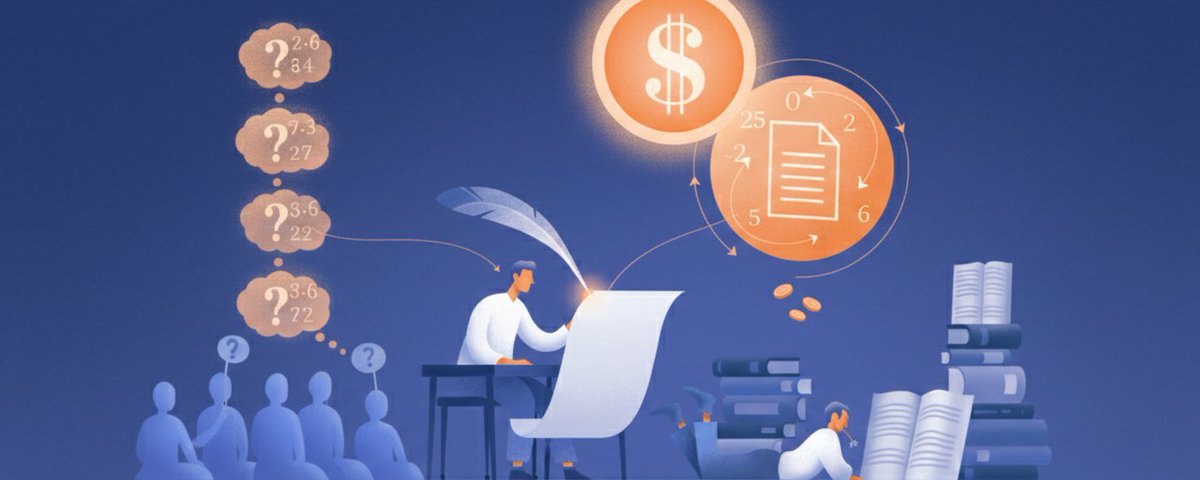
Joining our first peer prediction competition tomorrow and not sure how it works? Here’s a quick guide to doing well.
And if you're curious what it looks like, here's a sneak peek at how you'll answer questions: peerprediction.olena.xyz/#ho…
Olena retweeted
So what kinds of things are we going to canvas opinion on?
Pretty much anything b/c peer prediction can settle on anything.
“Ireland’s housing completions exceed X in 2026.”
“Netflix’s best era is behind it.”
“The Bear is better than Succession.”
“VAR is net positive for football.”
“P Diddy's sentence was too light”
We’ll include some clean, near-term resolution prediction market-type questions to showcase the predictive ability of the model against hard data.
But the bigger goal is to get people comfortable with a simple idea: you can put a useful probability on almost anything. What is knowledge, if not simply information sitting in people’s minds, after all?
If we find great utility in assigning odds to a stock’s performance or whether a country is headed for recession, why not assign them to counterfactuals, motivations, hidden incentives, and the stories everyone argues about but nobody can “prove” on demand?
I hope - and expect - we’ve built a system that can produce reliable odds on these messier questions too. If we get that right, our inherently uncertain world can become a little more certain.
Olena retweeted
No wallets. No mnemonics. No repeated signing.
Passkeys + session keys = sign once, Web2 UX on Web3.
This is how dapps should feel (built with @cartridge_gg ) 👇
Olena retweeted
Building seamless decentralized systems is hard, but this stack made it possible 🤝
• @Starknet execution layer
• @worldnetwork proof of human
• @Nethermind World↔Starknet bridge
• @cartridge_gg on-chain onboarding
• @drand_loe time-lock encryption (by @protocollabs)
Olena retweeted

Bullish on three things:
1. Peer prediction markets
2. New application in Web3
3. @OlenaProtocol
Registrations are open for our Peer Prediction Competitions (link below).
Secured by Starknet (execution) + World ID (identity) 🤝
Our protocol incentivises honest reporting for any question - not just event-settled ones - and statistically aggregates inputs into a sharper crowd forecast.
First questions drop in 7 days. Monthly competitions. Participants share 1% of future token supply.
Register via World ID, receive voting power (VP), earn Olena Reward Tokens (ORT) by performing well.
Shout-out to @Nethermind for their work on the World–Starknet Bridge.
Happy forecasting. If you tell the truth and your truth is insightful, you’ll do well. That’s all you need to know!
Olena retweeted

This has been our main obsession @OlenaProtocol for ~2 years, so it's surreal to finally say that registrations are open.
The core problem we've been trying to solve is how to get accurate crowd predictions on questions that don't resolve cleanly without needing deep liquidity or an oracle to verify the answers.
Prediction markets are great, but they have two bottlenecks.
1. Liquidity: Markets only get sharp when they attract enough participation, and that only reliably happens for near-term questions with fanatical bettors. Long-horizon, niche, complicated questions? They sit empty or thin.
2. Settlement: Most of what society actually argues about ("Are tariffs helping the economy?" "Is immigration too high?") doesn't have a clean outcome to resolve against. No oracle. No answer key. And without one, forecasts drift toward what's popular, not what's true. Truth is a weak equilibrium in the attention economy.
So we decided to tackle this problem from first principles. The mechanism is strangely elegant. Ask people what they believe and what they think others believe. Score the gap between what people predicted vs what was actually reported. It's called Bayesian Truth Serum (BTS), and over many rounds, the best strategy is boring yet powerful. Tell the truth and be well-calibrated.
We spent 2 years adapting BTS for continuous probabilities, hardening it against cartels, and wiring it to leverage @Starknet for execution and @worldnetwork ID for identity verification.
The result is a protocol for collective human intelligence. Sharp crowd forecasts for questions prediction markets and traditional forecasting tournaments can't touch.
First competition starts in 7 days. If you're the type of person who sees things others haven't caught up to yet, this is your arena.
Register now👇
Registrations are open for our Peer Prediction Competitions (link below).
Secured by Starknet (execution) + World ID (identity) 🤝
Our protocol incentivises honest reporting for any question - not just event-settled ones - and statistically aggregates inputs into a sharper crowd forecast.
First questions drop in 7 days. Monthly competitions. Participants share 1% of future token supply.
Register via World ID, receive voting power (VP), earn Olena Reward Tokens (ORT) by performing well.
Shout-out to @Nethermind for their work on the World–Starknet Bridge.
Happy forecasting. If you tell the truth and your truth is insightful, you’ll do well. That’s all you need to know!
Olena retweeted
Some updates on @OlasProtocol.
Firstly, we're changing our name. There's another Olas project & we've come to an agreement with them to rename.
Secondly, after a gargantuan R&D effort, the launch of our Peer Prediction Protocol is imminent. Firm date soon but days not weeks.
Olena retweeted
This is precisely what we're building at @OlasProtocol . Algorithmic enforced incentives rather than monetary ones.
There will be money in our 'markets' but primarily in a semi-fixed budget anti-spam role.
Sharpness comes from our Bayesian Truth Serum based scoring system.

Olena retweeted
The market for @OlasProtocol is becoming clearer and clearer.
We need incentives and models for human generated data. Our Peer Prediction Protocol is just that - the crowd signal engine the internet needs.

Oxford researchers just confirmed what we feared:
The internet as we knew it is dying.
AI content went from ~5% in 2020 to 48% by May 2025. Projections say 90%+ by next year.
Why? AI articles cost <$0.01. Human writers cost $10-100.
But the real crisis is model collapse. When AI trains on AI-generated content, quality degrades like photocopying a photocopy. Rare ideas disappear. Everything converges to generic sameness.
It's recursive. Today's AI slop becomes tomorrow's training data, producing worse output, which becomes training data again.

Olena retweeted

Most media is owned by a few. It's time to change that 📰🌐
We sat down w/ @C1aranMurray of @OlasProtocol to explore how blockchain incentives & collective intelligence can combat misinformation & fuel a new era of decentralized journalism🔍📢
🎧Listen: cryptoaltruists.com/blog/cry…
We discuss:
⛓️ How blockchain can combat misinformation & fake news fueled by generative AI
🤝 Why decision-making tools like Bayesian Truth Serum & Surprisingly Popular Aggregation are key to elevating credible journalism
💸 How crypto incentive mechanisms and micropayments enable open, decentralized publishing protocols

Olena retweeted
The centralization of media and the rise of AI has fueled a news landscape plagued by misinformation & distrust 🤖⁉️
Next week we welcome @C1aranMurray of @OlasProtocol to explore how decentralized incentives & open publishing can rebuild trust in media 📰🌐
Live Tuesday 🗓️