





Olix retweeted

Felicidades, Leo Messi, por el Premio Princesa de Asturias de los Deportes 2026.
Un reconocimiento más que merecido a tu extraordinario talento, que ha dejado una huella imborrable dentro y fuera del campo, convirtiéndote en un referente mundial del fútbol por tu excelencia, tu compromiso con el deporte y tu solidaridad.
Una trayectoria llena de éxitos en la que el FC Barcelona ha sido una parte fundamental de tu vida y de tu historia. Un vínculo inseparable que forma parte del legado del Club y del que siempre será un orgullo que sigas formando parte.

You need 4 hours for a dinner. They want you to take the whole Saturday.
This Lekki hall books by the hour.
fiilar.com/listings/jowel-s-…


I laugh when I see people increasing the number of GPUs to increase the speed performance of the system not knowing that not all part of the system can be parallelized. Stop burning capital
Olix retweeted

I have never met a successful person that was a quitter. Successful people never, ever, give up!
not gonna lie, ai don make my life easier man. the things I get done within a short period of time is insane. now we need to get to that level of not caring about the code but the output. I just wanna see result!

If you shoot in Lagos, stop asking the group chat for a studio at 11pm on Friday.
This one is in Lekki. See the hours. Book.
fiilar.com/listings/modern-c…

We've now added video tours on the Fiilar app, allowing hosts to upload videos of their space so users can experience its quality before booking.
apps.apple.com/ng/app/fiilar…
I can't even fathom what Elon is doing for humanity! This guy is alien, warped in human clothing. what he is pulling off doesn't make sense
Only him ——
electric, self-driving, flying cars -- OpenAI, reusable spaceships, planetary expansion, new internet network that decides wars, PayPal, X, solar, Neuralink, hyperloop
brother how??

Olix retweeted

Roadster xitter.cf/i/broadcasts/1yKAPwNgg…


Now you can watch the video of the space or venue you're interested in, giving you that firsthand feeling l. Check the Fiilar app today
apps.apple.com/ng/app/fiilar…
Olix retweeted

Lagos Life launched on October 1st. Just 9 days later, over 4.7 million people have played the game.
Today, I’m excited to announce that Vatar, the parent company behind Lagos Life, has closed a $500K angel round led by AB Hassan (@ijbguy), Nathan Nwachuku (@_KingNath), and GB Agboola (@TechProd_Arch).
Lagos is just the beginning. We’re building entire worlds, and there’s so much more to come. 🌍
vatar.com

Day 4: About GPUs: From iPhone to CUDA
Today I learned a bit more about how GPUs work, using the iPhone Duo example and NVIDIA CUDA to connect the ideas.
The main thing that clicked for me is this:
A GPU is really good at doing lots of small calculations at the same time.
For example, when a phone combines multiple camera frames to improve a low-light image, the maths at each pixel can be very simple:
C[i] = A[i] + B[i]
But that same operation has to happen across millions of pixels, very quickly. That is where parallel processing becomes powerful.
CUDA helped me understand the programming side too: you write a kernel, run it across many threads, and also think carefully about how data moves through memory.
My biggest takeaway: GPU performance is not just about having more cores. It is also about parallelism, memory movement, and how the work is structured.
Still learning, but GPUs make a lot more sense to me now.
#GPU #CUDA #ParallelComputing #Engineering #LearningInPublic

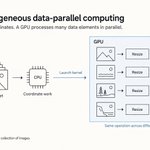
Day 3: Heterogeneous Data-Parallel Computing
Today, I learned about data-parallel computing: applying the same operation to multiple elements or chunks of a dataset in parallel.
Why do we need it? Imagine processing a million student images; for example, resizing every image. Processing them one after another could take a long time. Because resizing one image does not depend on resizing another, we can distribute the work so that many images are processed at the same time.
As datasets grow across fields such as education, astronomy, and biology, we need efficient ways to process data, train models, and turn raw information into useful results.
Modern CPUs already support parallel execution through multiple cores and hardware threads. However, GPUs are designed to handle large amounts of similar work simultaneously, making them well suited to many data-parallel workloads. The speedup depends on the workload; transferring data and coordinating work also take time.
Heterogeneous computing means using different types of processors together, such as a CPU and a GPU. In a typical CUDA application, the CPU manages the overall program and launches suitable computations on the GPU. This allows each processor to contribute to the workloads.
To explore this, I will be learning about CUDA, which stands for Compute Unified Device Architecture. CUDA is NVIDIA’s parallel computing platform and programming model. CUDA C++ extends C++ with features for GPU programming. Running CUDA GPU code requires a compatible NVIDIA GPU, but that GPU can be in a personal computer, workstation, or cloud server—it does not have to be in a dedicated GPU server.
I also learned about threads. A thread is a sequence of instructions that can be scheduled for execution. In CUDA, a GPU function called a kernel is executed by many threads, with different threads typically working on different data elements. Threads can also cooperate and synchronize, so data-parallel work does not always mean every thread is completely independent.
Over the next few days, I plan to focus on understanding these concepts. I will use AI to help generate CUDA C++ examples, then read, run, and experiment with them to understand how the code works.
#BuildInPublic #AIInfra #DevOps #GPU #MLOps #Cloud #Kubernetes #Parallel #Computing #Hardware
