

Philosophy PhD, Orthodox Christian, software engineer, classical guitarist, powerlifter, vegan. Mostly theology/philosophy, but eclectic enough to annoy all
Joined May 2022
- Tweets2.6K
- Following673
- Followers2.3K
- Likes4.6K




"...[all] such other qualities as we are wont to ascribe to God and His environment...do not indicate what He is, but what He is not. But when we would explain what the essence of anything is, we must not speak only negatively. In the case of God, however, it is impossible to explain what He is in His essence...For He does not belong to the class of existing things....God then is infinite and incomprehensible and all that is comprehensible about Him is His infinity and incomprehensibility." - St. John of Damascus
Sijuwade's "Orthodox" case that Christians and Muslims don't worship the same God depends on his *defining* God's *essence* as including paternity/generation. ("'God’ refers to the Father, whose essence—whose very whatness—is to be the uncaused source (archē) of the other divine persons" (p.61).) Two problems with this that seem to me devastating: First, the Orthodox position is that we can have no knowledge of God's essence, much less give it a "real definition." Second, St. Gregory the Theologian, in Theological Oration 29.16, explicitly says that "Father is not a name either of an essence or of an action," but rather a *relation*. In other words, for St. Gregory, it is essential to understanding the Trinity properly that one NOT say paternity is part of the essence.

The fourth century Pseudo-Clementine Homilies portray the apostle Peter as abstaining from all meat, and both the church Historian Eusebius and St. Augustine report the same of the apostle James. Clement of Alexandria makes the same claim for the apostle Matthew. (Clementine Homilies 12.6; Ecc. History II:23; Contra Faustum 22.3; The Instructor II:1.)
Noticed the interesting fact that the react native docs use function expressions in defining components and the regular react docs use function declarations.
Anyone else still on team declaration?
Since at least the Song Dynasty (960-1279), the "four gentlemen" have been a popular subject of painting, beginning in China, but spreading also to Japan and Korea. The "four gentlemen" represent four plants (plum blossom, orchid, bamboo, chrysanthemum) which also symbolize key qualities of the Confucian noble person. The plum blossom blooms in winter and heralds the spring, and represents hope and endurance through harsh conditions. The orchid, though fragile, is gentle and elegant. Bamboo is sturdy and upright, hard to break, though its ability to bend and inner emptiness represent humility. Chrysanthemum is dignified and gives its fragrance and beauty even as other flowers begin to wither away.

"No streams of blood are among [the holy ascetics], nor cutting up of meat, nor heaviness of head, nor dainty cooking, neither are there unpleasing smells of meat among them, nor disagreeable smoke, neither runnings and tumults, and disturbances, and wearisome clamors; but bread and water, the latter from a pure fountain, the former from honest labor. But if any time they should be minded to feast more sumptuously, their sumptuousness consists of fruits, and greater is the pleasure there than at royal tables...This table even angels from heaven beholding are delighted and pleased. For if over one sinner that repents they rejoice, over so many just men imitating them, what will they not do? There are not master and slave; all are slaves, all free men....
Wherein therefore are we different from ants, when compared with them? For like as they care for the things of the body, so also do we; and would it were for these alone: but now it is even for things far worse. For not for necessary things only do we care like them, but also for things superfluous. For those insects pursue a business free from all blame, but we follow after all covetousness, and not even the ways of ants do we imitate, but the ways of wolves, but the ways of leopards, or rather we are even worse than these. For to them nature has assigned that they should be thus fed [by the eating of much meat], but us God has honored with speech, and a sense of equity, and we have become worse than the wild beasts." - St. John Chrysostom, Homily 69 on Matthew
Thomas Ward on the Lord’s Prayer as a prayer for wholeness
"We all have an idealized vision of 'normal life,' and while its precise contours differ for each of us, what is common to our visions is a kind of balance or harmony of the various tasks we need and want to do...We all recognize how hard this unity is to maintain, but we long for it. These, I think, are some helpful ways to appreciate Lady Philosophy's [the interlocutor in Boethius' *Consolation of Philosophy*] linking of our desire for happiness with a desire for unity. Only the simple live balanced lives. God alone enjoys the truly simple life. Our own thwarted--often self-thwarted--pursuit of an integrated or unfragmented life attests both to our desire for the simple God and to the impossibility of finding the unity we seek in this world of entropy and metabolism...
This explains, in a purely natural way, why practices of prayer or meditation are so important. To do these well is not only to be free of distraction but to be fully present in the moment--not in the merely colloquial sense of paying attention but the literal sense of having all of oneself engaged...which is just what Jesus taught his disciples to do. Look to the deepest source of your being (Our Father, who art in heaven, hallowed by thy name). Ask for the harmony and simplicity of heaven to be manifest here below (thy kingdom come, thy will be done, on earth as it is in heaven). Elaborate that request by connecting the needs of your body with your relationship with God (give us this day our daily bread); by confessing the need for God's help in restoring your imperfect relationships with God and those around you (forgive us our trespasses as we forgive those who tresspass against us); and by asking for continual assistance to avoid whatever is incompatible with the happiness you truly seek (lead us not into temptation, but deliver us from evil). Prayer, by this template or others, is the unifying activity *par excellence*, uniting us with the simple God and, thereby, bringing unity to our fragmented selves." (After Stoicism, pp.114-115)
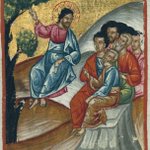
(Image: Jesus teaching his disciples, from a 17th century Arabic manuscript of the Gospels.)

"The appreciation of beauty in art or nature is not only (for all its difficulties) the easiest available spiritual exercise; it is also a completely adequate entry into (and not just analogy of) the good life, since it is the checking of selfishness in interest of seeing the real." - Iris Murdoch


Jeremiah retweeted

Vance is confronted by the emotional husband of a soldier killed in Iran War and acts like he had no idea anyone ever died:
Q: It's a hard price to pay. There's a failure in the leadership. How will the leadership be held accountable?
Vance: If there were failures... This is the first time I've heard of this.
"For the role of tradition is today no different from what it ever was. In season and out, the extension or radiation of revelation through time always serves the same essential function, which is to recall men from their attachment to time itself. In the midst of all the many changes both within us and out, the point of tradition is to provide human beings with openings onto the eternal—moments in which all movement is taken into itself, places where all of space becomes centered, and where we are brought face to face with what truly abides beneath the shifting surface of contingency. A ritual gesture, the implacable face in an icon, the poise of a spiritual master, a place of pilgrimage, the chanted words of a sacred text, a flower. These are all modes of tradition. These are the echoes and reflections of God.” - James Cutsinger

Remember: Whatever desires you have for your life or day, whatever talents and opportunities you are given, whatever you THINK God has called you to, you KNOW you are called to be virtuous, to love and serve your neighbor, to find your delight in Him through the goodness and beauty He imparts to all around you. If you can go through your day doing whatever duties are presented to you; if you can show patience and attentive kindness to those around you; if you can live self-consciously in the presence of Goodness and Beauty; then you will have done the most important thing. You will have done enough.

Jeremiah retweeted

I once had a crazy idea for a government service where each town would have a whole building containing thousands of books that people could borrow -- for free!--for weeks at a time. Would love to get that off the ground some day.
"There is, O monks, an unborn, unoriginated, uncreated, unformed. Were there not, O monks, this unborn, unoriginated, uncreated, unformed, there would be no escape from the world of the born, originated, created, formed. Since, O monks, there is an unborn, unoriginated, uncreated and unformed, therefore is there an escape from the born, originated, created, formed." Buddha, Udana 8.3, Khuddaka Nikāya of the Pali Canon

St. Athenagoras of Athens, one of the first apologists for Christianity, writing ~177 AD, insists that Christians cannot countenance the killing of even an unjust man, and that to intentionally watch a person being killed is to incur guilt in his death: "For when they know that we cannot endure even to see a man put to death, though justly; who of them can accuse us of murder or cannibalism? Who does not reckon among the things of greatest interest the contests of gladiators and wild beasts, especially those which are given by you? But we, deeming that to see a man put to death is much the same as killing him, have abjured such spectacles. How, then, when we do not even look on, lest we should contract guilt and pollution, can we put people to death?" (Apology, Ch. 35)
