

Physician, author, ML enthusiast. Interested in biology of aging. Tweets = own. 📸: George Dunbar
Detroit, MI
Joined August 2013
- Tweets4.5K
- Following880
- Followers538
- Likes1.5K




Vik Dhillon retweeted

Rumor is P = NP, specifically there is a promising route to 3-SAT in O(n^{808017424794512875886459904961710757005754368000000000})
Vik Dhillon retweeted

So some elaboration on this -
ETH is a much stronger statement than P≠NP. It's a bit surprising that it's not true but it doesn't really break much.
The bounds are technically sub-exponential, but "2^n / complicated log sqrt expression" is still very close to exponential.
Given how well SAT solvers work in practice, and have for decades, some slightly tighter bounds aren't extremely surprising. There are SAT solvers which have been proven to be <O(2^n) for a long time, just with exponents smaller than 2.
What this amounts to is that for any function O(k^n), there's some algorithm that can do better than any value k, if you make n absurdly big. That's a cute result, but we already knew that many NP problems are easier to solve in practice than in theory, and n really doesn't need to be very big for this to be a pretty meaningless statement in practice.
Ultimately though, and this is something I have some unpublished work on myself that I need to get out there soon, the difficulty of NP problems really has dramatically more to do with the structure of the problem than it does the number of variables. You can have small NP problems that are almost as hard as brute force, and you can have others with millions of variables that can be solved quickly. With NP problems in particular, it's clear that the tools we're applying are simply dramatically too primitive to understand what's actually going on.


The computer science collaboration will understand and explain a result concerning the Exponential Time Hypothesis (ETH), a longstanding conjecture about the computational complexity of Boolean formula satisfiability, a problem deeply related to the P vs. NP problem.
Surprisingly, our system has recently proved that the ETH is false, a result that was subsequently verified in Lean.
The refutation of the ETH reopens questions about how much faster these tasks could become, and may help guide the search for better algorithms. Finding such algorithms, and turning theoretical advances into practical improvements, will require significant further research.
Our system found its natural language disproof for the ETH we reached out to to @rrwilliams. Ryan will form a collaboration with Russell Impagliazzo and Ramamohan Paturi to verify and shepherd this result. Impagliazzo and Paturi, along with Francis Zane, are the original proposers of the Exponential Time Hypothesis, and Williams has refuted strong versions of the ETH, used ETH for hardness results, and connected algorithms and lower bounds.
This group asked us to make all raw data of the results public to facilitate independent verification by the community, which we have done by posting the natural language proof and Lean formalization to our GitHub repo. The group also invites the community to help organize an open examination of the ETH claim and to discuss the broader questions that AI-generated breakthroughs raise about verification, access, credit, and the future of research.
github.com/openai/math/blob/…

Vik Dhillon retweeted

We are announcing three new discoveries in mathematics, computer science, and physics about harmonic analysis, complexity theory, and quantum field theory.
openai.com/index/building-sc…

Vik Dhillon retweeted

OpenAI is downplaying this for PR reasons. If you’re a mathematician, you must feel like a nuclear bomb hit, and you’re at ground zero.
Reasoning models are two years-old. In that time they went from incapable of basic arithmetic to solving problems humans couldn’t solve for decades.
Math is only the beginning. AI will revolutionize the entirety of the human scientific endeavor. Most of us don’t appreciate what that means.
What a time to be alive!
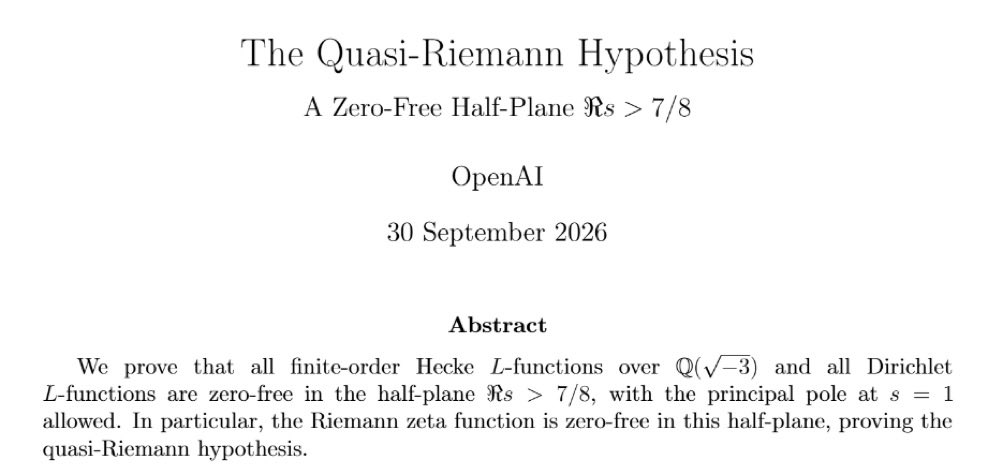

We’re releasing a broad range of new mathematical results produced by an internal frontier model.
We’ve been consulting with the independent Advisory Group on Mathematics and Artificial Intelligence at the Institute for Advanced Study, and we have drawn on their advice and public recommendations to inform how we release these results.
github.com/openai/math

Vik Dhillon retweeted

Aging has a language. 🧬 We’re teaching AI to read it.
On the cover of Cell: compact Longevity-LLMs, jointly trained by Insilico Medicine and @liquidai, demonstrate SOTA performance on LongevityBench.
Powered by these models, Longevity Claw nominated 328 candidate gene targets for aging research.
Small model. Big questions. Open source. 🧵👇
#insilicoSOTAFM
Vik Dhillon retweeted

Today, we're excited to share early progress on using Gemini to accelerate scientific discovery in the real-world. We present an extension of Co-Scientist which we use to collaborate with scientists across materials science, biology, and computer science.


Vik Dhillon retweeted

New in @BloodJournal: A comprehensive preclinical study evaluated ziftomenib using leukemia cell lines, primary patient samples, xenografts/PDXs, gene-expression profiling, and structural crystallography.
Ziftomenib suppressed MEIS1/HOXA signaling, induced differentiation, and caused leukemia regression in NPM1m/KMT2Ar models.
CRISPR-engineered MEN1-mutant models showed retained activity against T349M and G331R—but resistance with M327I/G331D. #AML
doi.org/10.1182/blood.202503…

Vik Dhillon retweeted

New work from our lab out today in @NatureCellBio led by @jaynathemistry!!
nature.com/articles/s41556-0…
🧵 on how clonal hematopoiesis turns the bone marrow niche into an accomplice:

Vik Dhillon retweeted

1/6 MYC has long been considered “undruggable.” Instead of trying to drug the protein, we went after its RNA. This work is part of our long-standing effort to expand the druggability of genetically defined disease targets at the level of mRNA.
Vik Dhillon retweeted

Our paper, “Prognostic impact of FLT3-ITD microclones in young adults with acute myeloid leukemia treated with intensive chemotherapy”, is now published in @BloodPortfolio 🤩
Many thanks to all co-authors and collaborators!
Free access (until Sept. 18): authors.elsevier.com/a/1nWx4…

Vik Dhillon retweeted

🔆🔆🔆Matching T-cell receptors (TCRs) to their cognate peptides presented on MHC molecules (pMHCs) from sequence data alone is one of the most important unsolved problems in computational immunology. I've been presenting this work for over a year and am excited to finally share the preprint and public code.
A transformative collaboration for our lab with @quaidmorris (see tweetorial 👇👇with links). Led by first authors @Olga_Lyu, Jonathan Levine & Melissa Pathil, with S. Martis, A. Streltsov, Z. Sethna, Y. Elhanati (@elhanati_yuval), Vinod Balachandran (@TheVinodLab)!!!
@MSKCancerCenter

Can we predict which T cells recognize which peptides? A lot of the signal is hiding in AlphaFold3's hallucinations.
enFoldX: instead of one predicted structure, we use the whole noisy ensemble to predict TCR:pMHC binding.
💻github.com/jonlevi/enFoldX
biorxiv.org/content/10.64898…

Vik Dhillon retweeted

In Georgia I entered a Chick-fil-A drive-thru line of forty cars.
I turned off my engine. I prepared to wait the way my ancestors waited out a siege.
Six minutes later I was holding chicken.
I do not know what happened to the other thirty-nine cars. The line moved like water that had somewhere to be.
A young woman walked between the cars taking orders on a small tablet, on foot, in the sun, smiling like the sun was her idea.
I said thank you.
She said, "My pleasure."
I did not think about it then. I should have.
At the window I thanked the young man for the food.
"My pleasure."
I thanked him for the sauce.
"My pleasure."
I thanked him for thanking me—
"My pleasure."
I want to be clear about what was happening.
This was a duel.
In Japan I trained in courtesy for forty years. Bowing angles. Seasonal greetings. The correct depth of apology for seventeen distinct situations.
I was a white belt in that drive-thru.
I escalated. I used my most formal English. I thanked him on behalf of my entire family line.
He said, "My pleasure," and gave me extra sauce.
Extra sauce. Unprovoked. A counterattack.
I returned the next day to reclaim my honor.
It was Sunday. The restaurant was closed.
All of them were closed. In the entire country. They close every Sunday, and they have closed every Sunday since the beginning, because the founder made a promise, and the promise did not expire when he did.
I stood in the empty parking lot and understood I had lost twice.
Once to a teenager with sauce.
Once to a man I will never meet, who kept his word so long it became a building.
In my country we say a samurai's word is his life.
I had never seen a restaurant say it back.
I returned Monday. I ordered. And this time I said it first, before she could.
"My pleasure."
She smiled and said, "It sure is."
America, I surrender.
It was my pleasure.
Vik Dhillon retweeted

Researchers from the Crispino Lab Team at @StJudeResearch led by Dr. Jeremy Wen and Anitria Cotton identify menin as a key regulator of #megakaryocyte proliferation and fibrosis in #myeloproliferative neoplasms.
Learn more here at @Cancer_Cell:
🔖 bit.ly/4wGXEZy


Vik Dhillon retweeted

From proposing hypotheses to designing experiments, AI agents are starting to reshape scientific discovery. But the hardest part is testing these ideas in the real world.
Our essay explores the growing validation bottleneck and outlines four priorities for policymakers and funders. → goo.gle/4poACUT

Vik Dhillon retweeted

We just updated our manuscript "Understanding Language Model Scaling on Protein Fitness Prediction". Where we explained why larger pLMs don’t always perform better on mutation effect prediction. We extended beyond ESM2 to models like ESMC, ESM3, SaProt, and ESM-IF1.
#ProteinLM

Vik Dhillon retweeted

Excited to share our study on immune interactions in extramedullary (lung) acute myeloid leukemia (AML) out today at @NatImmunol !! Acute respiratory failure frequently occurs in AML due to leukemia infiltration of the lungs. The question is why and what can we do to suppress it. @VarvaraParask in the lab started this work by mapping AML:stromal and AML:immune cell interactions using scRNA-Seq and Visium/Xenium @10xGenomics spatial tools.
nature.com/articles/s41590-0…

Vik Dhillon retweeted

We’re introducing GeneBench-Pro, a research-level benchmark for a harder kind of AI progress: how well agents can navigate messy biological data, choose the right analysis path, and make judgment calls that real computational research depends on.
openai.com/index/introducing…

Vik Dhillon retweeted

scRNAデータのバッチ間の統合など、生命情報科学や公衆衛生学的な解析用ソフトウエアを人間よりうまく生成するAIプラットフォームを構築したという論文。間にLLMgがはまっている。これは読まないと不味そうな気がする。Nature。
nature.com/articles/s41586-0…

Vik Dhillon retweeted

Ummm…

