

Evidence-based financial education and fun stats. Part research, part ramblings. Tweets ≠ advice. YouTube vids at https://teapawt.org/t.co/Q5xmqlofr3
USA
Joined September 2020
- Tweets10.6K
- Following70
- Followers3.3K
- Likes9.8K





I maintain that one can typically extract any given requisite income more efficiently than a covered call "income" fund, even after taxes, from a simple, diversified mix of traditional low cost index funds.
Long tweet ahead. Strap in.
What do I mean by “more efficiently?” The same income with lower risk or more income at the same risk. Conveniently, we typically see both - more income and lower risk.
There will, of course, be some specific short periods of choppy sideways markets when assets converge where I'm wrong on this but I think on average, for any reasonably long horizon, I won't be (even with the newer, fancier iterations of these products). We care about how the portfolio delivers income across the whole decumulation period, not over a snapshot of a month or 2.
(Let’s also go ahead and get this out of the way - no one is suggesting you just buy the underlying index and come out ahead. That’s not the argument. I’m talking about using a diversified portfolio for current income today. So please don’t come at me with that accusation.)
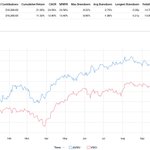
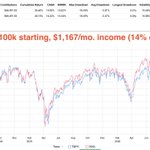
I've attached a few examples of this concept using older funds with at least a little bit of history.
I've described these older products like PBP and XYLD as comparatively more "blunt" - full overwrite coverage and ATM options - compared to newer iterations like SPYI and GPIX that are more nuanced and active, don't write on the whole equity book, and use OTM options.
Proponents of covered call "Income" funds reflexively say these older ones are the "worst" examples to use and that I'm being unfair and idiotic in doing so. I do so purely to get a longer observable time period for more robust data, i.e. more observations, which is Stats 101. I'm happy to run the numbers with the newer products too, and I've done that, but most of them are only a few years old at most and haven't even seen the environment in which they'd shine. I make sure to explicitly point this out in all my articles on these funds.
The trap the influencers and novices continually fall into is thinking the implementation and management of any given covered call product is what makes or breaks it. It's not. It's the fundamental inefficiency and asymmetry of the covered call trade itself. They think the next iteration of a flashy high-yield covered call product will finally be the holy grail to break the curse and solve the issues. It won't. Ironically, the only way to do so is to remove the covered call trade entirely.
I mentioned this in my first blog post on this topic years ago. First QYLD and XYLD from Global X were the new hot thing among yield chasers. Then they moved on to JEPQ and JEPI from JPMorgan, and QYLD and XYLD were viewed with disdain. Now it's ostensibly GPIQ/GPIX from Goldman and QQQI/SPYI from NEOS, which Goldman is acquiring. Now anyone who even mentions JEPQ or JEPI is labeled a moron.
But NEOS and Goldman can’t change option math. Meet the new boss, same as the old boss.
These products satisfy a psychological desire to avoid liquidating shares. Totally understandable. But appreciate that they are not magically dismissing sequence risk, improving realized Safe Withdrawal Rate, or allowing for earlier retirement. Your favorite finfluencer is probably claiming it’ll do all 3. The marketing materials of these products even sometimes hint at such fanciful abilities.
(Previously, it was admittedly arguably logistically harder to liquidate shares too. Fair. But nowadays, the broker can auto-sell for me and transfer cash to my bank account monthly without me logging in or lifting a finger. Same outcome.)
Those same people will say this is a new wave of retirement products that opens new doors (“this time is different”) and that I’m just not up to date on the recent research. I think this is pretty silly fundamentally even if only for the fact that markets are still markets. But the irony is we’ve had boatloads of research on this type of product because it’s existed for decades, long before NEOS tacked on some tinsel like 1256 treatment and a long call leg. Those are probably improvements, no doubt, but they don’t move the needle on the elephant in the room I mentioned earlier - the CC trade itself. The “research” they’re citing is marketing literature from the fund provider, who probably pays the influencer anyway.
The CC trade necessarily caps upside and doesn’t adequately mitigate the downside proportionately. This is what we mean by “inefficiency” and “asymmetry.” Lower volatility of these products is just less market exposure. You can do that by …owning less of the market.
In point of fact, the behavior of the fund often doesn’t look dissimilar from just holding the underlying + cash, which I’ve shown here, and which many smarter than me have also shown. Appreciate the hilarious irony that despite what content creators in this space will tell you, a naive 90/10 underlying/cash allocation often beats the flashy, complex, expensive “income” product by virtually any measure.
To add insult to injury, these products always carry pretty hefty fees, comparatively, which almost always easily cancel out any purported tax benefit from ROC, which I’ve also shown: optimizedportfolio.com/roc-c…
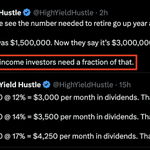
I sympathize with the novice investors because I believe they want to believe the empty promises. But these products often don't even pass the sniff test. If it sounds too good to be true, it probably is. If a YouTuber is talking about retiring early on 12% yield with only $300k when the conventional rules of thumb fly in the face of that assertion, your spidey sense should at least be tingling and you owe it to your future financial well-being to at least do more research.
As an aside, sequence risk is a big factor here that every single finfluencer I've seen hawking these products loves to ignore completely: optimizedportfolio.com/seque…
It’s neither obvious nor intuitive that the high distribution rates like 12% are not really returns. Ben appropriately calls it an “illusion.” That’s how you can end up with a fund like QYLD with a distribution rate of 12% and a long term total return of only 9%. The return can be less than the distribution rate. Many don't realize this. In short, these funds often end up having to distribute from their own capital base, because the prospectus says they have to distribute but it doesn't say they must earn more than they distribute.
Don’t get caught up in the mental accounting of viewing yield and price return separately. As always, total return is all that matters at the end of the day. That’s what’s paying your bills.
To keep numbers nice and round, I used $100k starting and $1k/mo. income (12% distribution rate) for all these.
In short, if you want the most income and the most stability thereof, the evidence, even over short recent periods for newer products, shows covered call funds are probably not the way to go (at least not going all in on them). Only time will tell, though, how that claim matches up with one’s personal retirement horizon, but then that’s my argument for diversifying broadly in the first place…
Let me know what I forgot or if I can clarify anything or answer any questions, but you’ll probably find those answers in existing posts where I’ve already broken all this down into even greater detail:
optimizedportfolio.com/qqqi/
optimizedportfolio.com/jepq/
optimizedportfolio.com/gpiq/


I can't comment on that specific thread because Jay blocked me a while ago for providing those inputs.
Inputs on that particular product are here: optimizedportfolio.com/qqqi/
Inputs on that type of product in general are here: teapawt.org/OptimizedPort/status/2…


7
753

Probably not. I’ve had it confidently tell me factually incorrect information quite a few times. Outside of finance, clients have also had me review analyses from it that were mostly nonsense. Long way to go. Ironically though, the value in the advisor for many is the human aspect with hand holding and correcting behaviors. An AI can’t replicate that, at least not yet.
61
No.
Tweet dropping next week on this fanciful idea that high yield means you can retire way earlier.

1
8
885
Cliff makes good content and knows his stuff. Give him a follow.

I’ve added some followers as of late.
If you’re new here, let me introduce myself:
I’m a 27 year old CFP®, who holds the Tax Planning Certified Professional® designation as well as an MBA with a concentration in finance.
I work with next-gen professionals and there are no investment minimums to work with me. I also offer flat-fee financial planning.
If you’re looking for organization, planning, and having someone looking around every corner of your financial life, I’m always ready to have a conversation.
2
15
2,939

Optimized Portfolio | John Williamson, APMA® retweeted

"There's no reason to hire you, show me your performance agains the S&P 500"
This is what so many people say
But this just shows how little they know about financial planning and the value of advisors
The industry used to be just about stock picking but it has changed
For a long time, the model looked like this:
• Investment management first
• Planning as an afterthought
• Product sales disguised as advice
• Hundreds of households per advisor
• One meeting a year (if that)
That model is breaking
Here’s what it’s shifting toward instead:
➡️ From investment management to true planning
Investments still matter, but they’re just one part of planning.
Tax strategy, cash flow, business planning, equity comp, estate planning, insurance, and major life decisions now drive the real value.
➡️ From selling products to actually advising
Clients are tired of feeling like every meeting ends with a pitch.
They want objective advice, not commissions or incentives driving recommendations.
➡️ From 300–750 “clients” to 100 great ones
The old model required scale.
The new model requires depth.
Fewer households, more intentional work, better outcomes.
➡️ From annual reviews to ongoing engagement
Life doesn’t happen once a year, and neither should planning.
Taxes, income changes, business decisions, equity events, and family changes require proactive, recurring conversations.
➡️ From “assets we manage” to everything with a dollar sign
Clients don’t think in silos.
Their financial life includes:
• Business decisions
• Compensation
• Taxes
• Debt
• Insurance
• Real estate
• Estate planning
Good advisors help across all of it.
I've mentioned leverage a lot in the $OVL conversation.
Many seem to see and praise its outperformance without realizing it's entirely due to its higher beta in a bull market. Congrats; you discovered leverage. Specifically, about 110% in this case, i.e. VOO is a beta of 1 and OVL is about 1.10 via its put spreads.
So let's say you don't need income and your stated reason for buying it is "outperformance." A few people have explicitly said this to me.
If you're not leverage-constrained, you don't need to pay OVL's hefty fee for 1.10 beta. 95/5 VOO/UPRO achieves roughly the same exposure at 1/10 the cost.
More importantly, if you're okay with 110% stocks, why not 125%? Or 150%? Or 200%, which has historically been the optimal leverage on the S&P? See what I'm getting at...
As an aside, this is also why I mention we have risk-adjusted metrics like Sharpe, Sortino, etc. that compensate for this beta adjustment to allow for fairer comparison.
If OVL delivered actual alpha, the conversation might be a bit different, but as you can see, it doesn't, or at least it hasn't so far.
This is also why I said I think OVL made more sense with its older, lower, modest yield around 3%, effectively just juicing the S&P a bit with its option overlay.
It's funny to me that income bros have accidentally discovered and embraced leverage under the guise of "income" and call it "outperformance." But I like it. It opens the conversation (and gets me more website traffic 😜).
Granted, daily reset LETFs aren't ideal either, but they're what we've got.
@DirexionLETFs needs to bring back the 1.35x monthly reset LETFs. 😢

Thanks! Missed this a week ago somehow, sorry. Yes, exactly that - same number of slices but the slices get smaller. Influencers are happy to gloss over that fact and pitch "keep all your shares" as a benefit. Number of shares is pretty meaningless; we care about the value thereof. All that matters is the total surface area of all your slices (i.e. total return).
1
34
I was thinking about this exact thing today, Craig. I fear the influencers aren't aware of - or just don't care about - the potential repercussions of telling people they can retire on $300k and spend 12%. That's why I have no patience with these guys and don't pull punches.
1
1
30
10% withdrawal rate is probably unsustainable long term but I guess we'll see. It would roughly match the absolute best case historically.
25
Tax bill on liquidating huge blocks to reallocate is probably greater than periodic LTCG from just liquidating small bites of existing shares over time for income, not to mention capped upside. Just something to think about. teapawt.org/OptimizedPort/status/2…

I maintain that one can typically extract any given requisite income more efficiently than a covered call "income" fund, even after taxes, from a simple, diversified mix of traditional low cost index funds.
Long tweet ahead. Strap in.
What do I mean by “more efficiently?” The same income with lower risk or more income at the same risk. Conveniently, we typically see both - more income and lower risk.
There will, of course, be some specific short periods of choppy sideways markets when assets converge where I'm wrong on this but I think on average, for any reasonably long horizon, I won't be (even with the newer, fancier iterations of these products). We care about how the portfolio delivers income across the whole decumulation period, not over a snapshot of a month or 2.
(Let’s also go ahead and get this out of the way - no one is suggesting you just buy the underlying index and come out ahead. That’s not the argument. I’m talking about using a diversified portfolio for current income today. So please don’t come at me with that accusation.)
I've attached a few examples of this concept using older funds with at least a little bit of history.
I've described these older products like PBP and XYLD as comparatively more "blunt" - full overwrite coverage and ATM options - compared to newer iterations like SPYI and GPIX that are more nuanced and active, don't write on the whole equity book, and use OTM options.
Proponents of covered call "Income" funds reflexively say these older ones are the "worst" examples to use and that I'm being unfair and idiotic in doing so. I do so purely to get a longer observable time period for more robust data, i.e. more observations, which is Stats 101. I'm happy to run the numbers with the newer products too, and I've done that, but most of them are only a few years old at most and haven't even seen the environment in which they'd shine. I make sure to explicitly point this out in all my articles on these funds.
The trap the influencers and novices continually fall into is thinking the implementation and management of any given covered call product is what makes or breaks it. It's not. It's the fundamental inefficiency and asymmetry of the covered call trade itself. They think the next iteration of a flashy high-yield covered call product will finally be the holy grail to break the curse and solve the issues. It won't. Ironically, the only way to do so is to remove the covered call trade entirely.
I mentioned this in my first blog post on this topic years ago. First QYLD and XYLD from Global X were the new hot thing among yield chasers. Then they moved on to JEPQ and JEPI from JPMorgan, and QYLD and XYLD were viewed with disdain. Now it's ostensibly GPIQ/GPIX from Goldman and QQQI/SPYI from NEOS, which Goldman is acquiring. Now anyone who even mentions JEPQ or JEPI is labeled a moron.
But NEOS and Goldman can’t change option math. Meet the new boss, same as the old boss.
These products satisfy a psychological desire to avoid liquidating shares. Totally understandable. But appreciate that they are not magically dismissing sequence risk, improving realized Safe Withdrawal Rate, or allowing for earlier retirement. Your favorite finfluencer is probably claiming it’ll do all 3. The marketing materials of these products even sometimes hint at such fanciful abilities.
(Previously, it was admittedly arguably logistically harder to liquidate shares too. Fair. But nowadays, the broker can auto-sell for me and transfer cash to my bank account monthly without me logging in or lifting a finger. Same outcome.)
Those same people will say this is a new wave of retirement products that opens new doors (“this time is different”) and that I’m just not up to date on the recent research. I think this is pretty silly fundamentally even if only for the fact that markets are still markets. But the irony is we’ve had boatloads of research on this type of product because it’s existed for decades, long before NEOS tacked on some tinsel like 1256 treatment and a long call leg. Those are probably improvements, no doubt, but they don’t move the needle on the elephant in the room I mentioned earlier - the CC trade itself. The “research” they’re citing is marketing literature from the fund provider, who probably pays the influencer anyway.
The CC trade necessarily caps upside and doesn’t adequately mitigate the downside proportionately. This is what we mean by “inefficiency” and “asymmetry.” Lower volatility of these products is just less market exposure. You can do that by …owning less of the market.
In point of fact, the behavior of the fund often doesn’t look dissimilar from just holding the underlying + cash, which I’ve shown here, and which many smarter than me have also shown. Appreciate the hilarious irony that despite what content creators in this space will tell you, a naive 90/10 underlying/cash allocation often beats the flashy, complex, expensive “income” product by virtually any measure.
To add insult to injury, these products always carry pretty hefty fees, comparatively, which almost always easily cancel out any purported tax benefit from ROC, which I’ve also shown: optimizedportfolio.com/roc-c…
I sympathize with the novice investors because I believe they want to believe the empty promises. But these products often don't even pass the sniff test. If it sounds too good to be true, it probably is. If a YouTuber is talking about retiring early on 12% yield with only $300k when the conventional rules of thumb fly in the face of that assertion, your spidey sense should at least be tingling and you owe it to your future financial well-being to at least do more research.
As an aside, sequence risk is a big factor here that every single finfluencer I've seen hawking these products loves to ignore completely: optimizedportfolio.com/seque…
It’s neither obvious nor intuitive that the high distribution rates like 12% are not really returns. Ben appropriately calls it an “illusion.” That’s how you can end up with a fund like QYLD with a distribution rate of 12% and a long term total return of only 9%. The return can be less than the distribution rate. Many don't realize this. In short, these funds often end up having to distribute from their own capital base, because the prospectus says they have to distribute but it doesn't say they must earn more than they distribute.
Don’t get caught up in the mental accounting of viewing yield and price return separately. As always, total return is all that matters at the end of the day. That’s what’s paying your bills.
To keep numbers nice and round, I used $100k starting and $1k/mo. income (12% distribution rate) for all these.
In short, if you want the most income and the most stability thereof, the evidence, even over short recent periods for newer products, shows covered call funds are probably not the way to go (at least not going all in on them). Only time will tell, though, how that claim matches up with one’s personal retirement horizon, but then that’s my argument for diversifying broadly in the first place…
Let me know what I forgot or if I can clarify anything or answer any questions, but you’ll probably find those answers in existing posts where I’ve already broken all this down into even greater detail:
optimizedportfolio.com/qqqi/
optimizedportfolio.com/jepq/
optimizedportfolio.com/gpiq/
1
113
@incomeetfguy , I'm genuinely confused and curious why you say you'd reply more if I had a blue check. Does that help your impressions score or something more versus someone who doesn't have one? Assuming you have a reply you're considering for any given scenario, I would think you'd want to defend your ideas for posterity and for your own followers anyway regardless of whether or not the person to whom you're considering replying has a blue check or not. Maybe I'm missing something. Please enlighten me. I had one but dropped it because I got no obvious tangible value from it.
1
166
Always aim to fully understand the product you're buying, especially if you're an influencer being paid to post purposely misleading AI slop to promote that product to unsuspecting novices, and especially if you're one of those novices who heard about it from that influencer.
I don't know who the specific people you're referring to are and what specifically they're saying (feel free to include examples), and It's good for people to understand that ROC ≠ NAV erosion, but brother, it sounds like you're not reading the prospectus and that you don't understand the "backlash" (or total return).
The prospectuses of all these products mention distributions come out of NAV. They have to. Because that's how it works. That's also sort of common sense. Because cash can't be created out of thin air. Screenshots below are directly from TDAQ's prospectus.
I'd submit the "handing your money back" quip is a turn of phrase to mean handing back part of your total return (since that's what's happening), possibly as destructive ROC (at least that's how I use it), not a suggestion of a Ponzi scheme (that would be handing you other people's money), though maybe you can show me people out there saying the latter. I say the same thing about cash dividends. Your own invested capital is being handed back to you and is labeled a "distribution," and you may or may not get a tax break on what is effectively a withdrawal. Once again, realize the labels don't matter. Your expenses don't care what the cash is called. For example, TDAQ has about an 18% distribution rate, paid monthly. That means I can liquidate 1.5% of my QQQM position monthly and achieve roughly the same outcome.
I don't want to speak for other people and again, I don't know the specific examples you're citing, but I think the "smoke and mirrors" critique can describe the obfuscation via complex options strategies, financial jargon, juicy yields, and empty promises to extract large fees from investors who aren't equipped to adequately evaluate what they're buying. Frankly, it's clearly working, because even you yourself don't seem to understand the very products you own and talk about, or at least you pretend you don't for engagement on here.
Again, I'd encourage you to please research this stuff more and aim to fully understand these products before promoting them to novices who don't know any better, and definitely please refrain from using purposely misleading slop to do so. You said you don't understand the backlash. There's your answer. Can't have it both ways.


1
6
945
Sharpe is looking at avg volatility over that whole period. Sounds like you'd be more interested in Calmar, the ratio of return to max drawdown. I explained the details of all these here: optimizedportfolio.com/risk-…

1
55