

https://teapawt.org/t.co/uCM8MTj9aO
Ukraine
Joined May 2025
- Tweets192
- Following0
- Followers711
- Likes4





Pinned Tweet
Zero metadata. One frame. Exact coordinates anywhere on Earth.
Stop guessing-master real-world geolocation in our practical GEOINT training:
DM @OsintFlow
Email: [email protected]
WhatsApp: +380 96 810 7341
🤖 Made with AI
Taranis AI
Taranis AI is a tool for gathering and cataloging information from websites. You create a list of sources to collect data from, then a list of keywords, after which you can gather the information while the connected AI sorts, groups, tags, and assists in analyzing it in every possible way.
Overall, it is quite solid, especially if you need to monitor many sources on an ongoing basis. However, it is poorly suited for one-off or occasional use because the interface is overly convoluted, and the sheer number of settings is enough to make your eye twitch. Therefore, diving into all of this only makes sense if you plan on using it long-term.
> github.com/taranis-ai/tarani…
> taranis.ai

109
BBOT (Update 3.1.0)
BBOT is a multifunctional scanner designed to automate information gathering and monitoring. It can gather information about websites, scrape data from websites, analyze emails, usernames, organizations, and so on. In total, over 100 modules are available, organized into groups.
> github.com/blacklanternsecur…
> blacklanternsecurity.com/bbo…

Verity - image and video verification
Verity is a system for authenticating media content. The idea is to combine several methods of verifying images and videos and display verifiable indicators and the basis for a conclusion on authenticity.
The conclusion is formed based on several checks:
• Verification of cryptographically signed information regarding the origin and editing of media content (C2PA Content Credentials);
• Searching for similar images using digital fingerprints;
• Extraction of EXIF and other technical metadata;
• Cross-referencing detected text and other indicators with external verification sources;
• Verification of specific claims regarding time, weather, and geographical location.
→github.com/Mintahandrews/ver…
→verity.codemintah.dev/
The sound idea behind this tool is that a simple authenticity check does not guarantee the absence of a fake, because a genuine image (or video) can be used with a distorted context-and as a result, it turns out that the image is real, while the message is fake. Therefore, although the tool is new, it is potentially promising

160
Satellite Imagery & Mapping Training
Discover the techniques used to analyse satellite imagery and maps, and learn how to apply them in practice.
The course combines practical instruction, real-world examples and hands-on exercises.
What you’ll learn:
🔹 The fundamentals of geospatial analysis.
🔹 How to work with satellite imagery and maps.
🔹 Photo metadata and digital image analysis.
🔹 Topographic analysis and comparing map data.
🔹 Interpreting light and shadows.
🔹 Image verification and practical geolocation techniques.
Lifetime access to course recordings and learning materials.
🎓 Certificate upon completion.
Register here:
- [email protected]
- t.me/osintflow_connect

An interesting comparative study on the effectiveness of AI for photo geolocation by Bellingcat
The tests used the most popular models (Claude, Grok, Gemini, ChatGPT, Mistral, models from Moonshot AI Kimi, GeoSeer, and GeoClip); each model was evaluated on 52 photos. Scoring was based on two benchmarks: roughly identifying the region and accuracy within the final few kilometers.
In short, the bottom line is this: some models show very respectable results, but not a single model performs perfectly, and human involvement remains necessary for precise location determination—especially for verifying results, as all tested models made errors in certain tests while presenting them as the correct answer.
The top-performing models localized more than 50 percent of the photos to within 25 kilometers, with at least 10 of the 52 photos pinpointed to within a single kilometer.
Article: bellingcat.com/resources/202…

As for the models themselves:
- On average, Gemini 4 Argon achieved the best results. By this same average metric, Claude (Opus and Fable) performed slightly worse, but it consistently ranked near the top in all tests. Next in the rankings are GPT-6 Astra and GPT-6.1 Sol, also with consistently high results.
- Grok and the open-source models produced average results along the lines of "turn left once you enter Africa" and "half an arm's length on the map." On the flip side, Grok burned through the most tokens (in terms of dollar cost), which is technically a first-place finish in its own right.
- Based on the best balance of accuracy and cost, Argon and Opus take top honors.
- Models specializing in geolocation:GeoSeer Fast showed a decent average result (slightly worse than GPT-6), but frequently glitched out and threw timeout errors. GeoSeer Agent glitched out as well, and in some tests refused to process photos altogether.GeoClip posted one of the worst results (on the upside, it's free😆).
3
206
GEOINT Training
Learn how to turn satellite imagery and maps into actionable intelligence. Explore techniques for geolocation, terrain analysis, tracking movements, assessing routes and logistics, and identifying changes on the ground.
The training combines practical methods, real-world cases and hands-on exercises.
Training format
- Real-world case studies and hands-on exercises.
- Lifetime access to training recordings and materials.
- Certificate upon completion.
🎓 Certificate upon completion
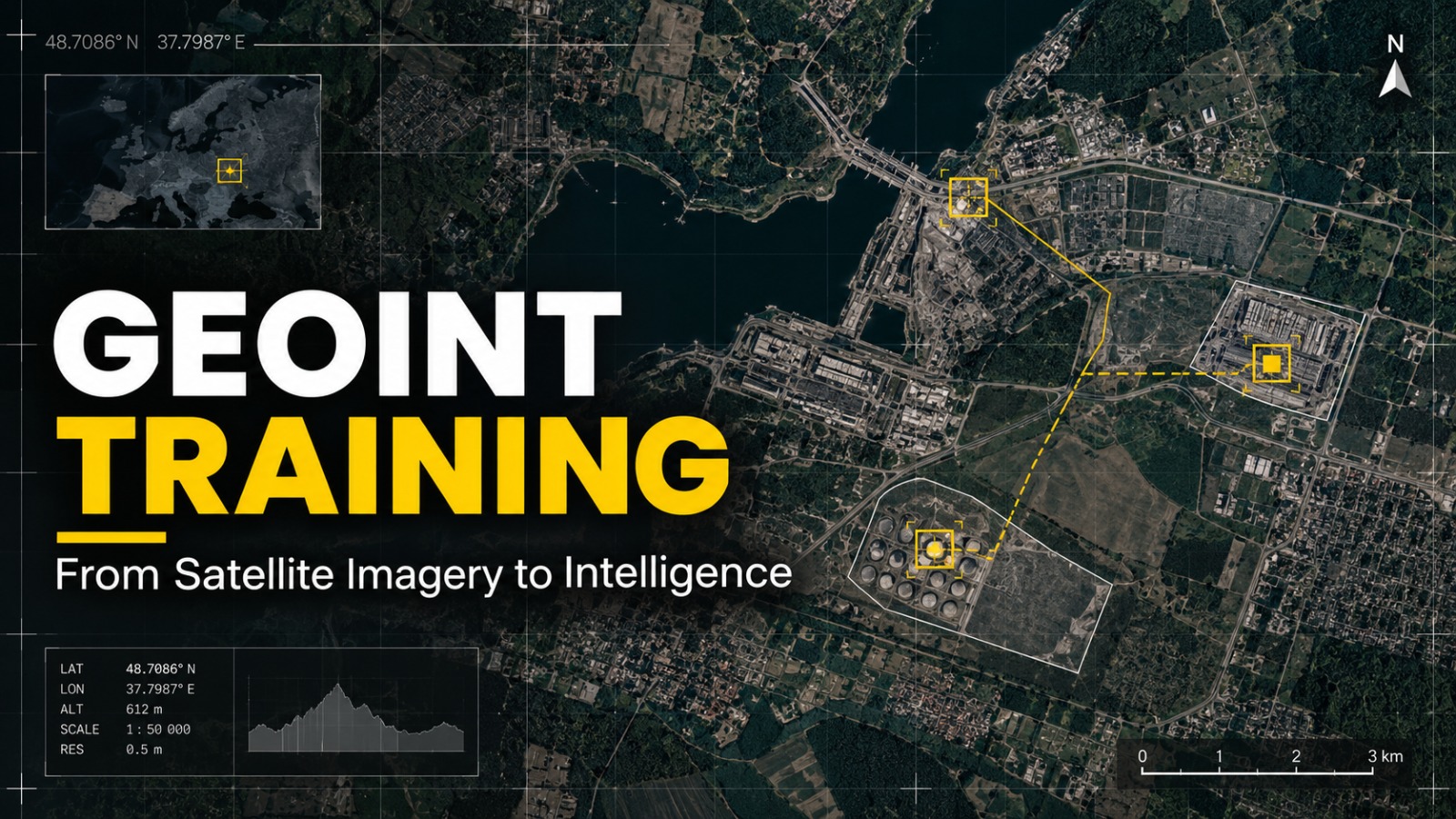
The training covers:
- The GEOINT workflow: planning, information collection and analytical techniques.
- Photographic metadata analysis and digital image forensics.
- Map comparison, topographic analysis and chronolocation.
- Light and shadow analysis to determine time, azimuth and location.
- Practical exercises in geolocation, event verification and situational reconstruction.
Register here: t.me/osintflow_connect

1
2
613
When I started writing this post, I tried to recall at least one case where publicly available webcams played a key role in achieving a goal — and I couldn't 😄. I only remembered a couple of situations where a camera happened to be in the right place, but even then, it simply allowed me to get my bearings on the ground and gauge what was happening there right at that moment. Which is useful, but by no means always necessary.
Although that doesn't rule out that a camera might still come in handy in certain situations. So it's worth knowing where to look for publicly accessible online cameras:
- earthcam.com - a massive directory of cameras worldwide. You can search by list or select on a map
- youwebcams.org - also a camera directory; shows the camera image, its location on the map, and a description of what it displays
- worldcams.tv/map/ - a map of camera locations. There aren't that many of them there, but as a useful feature, each one is marked with an icon — tourist, industrial, landscape, etc.
- windy.com - a map of tourist cameras. The list changes depending on the location selected on the map
- cipher387.github.io/webcamcs… - a Google CSE for searching cameras across 10 sources. You can search, for example, by city
- sunders.uber.space/ - a map of surveillance camera locations (not just publicly accessible ones). Shows where the camera is mounted, its direction, and viewing angle
323
How and where to track international shipments.
The first thing to remember is what information to pay attention to:
- exporter / importer. I.e., who is supplying the goods and who is receiving them;
- shipping company. This isn't always important, but if such information is found, it's worth recording;
- country of origin / country of destination. I.e., the country where the product was manufactured and the final destination where it is heading;
- products shipped;
- transaction dates.
Resources where you can look for shipment information:
en.52wmb.com - this is a database of export-import operations. It contains a massive amount of data, including customs declaration information, details about companies, counterparties, products shipped, and supply routes. But all of that is in the paid version 😎. The free version has significantly less. Therefore, if you are going to work extensively in this area, this is definitely a resource where it makes sense to buy a subscription
importgenius.com - this is also import / export customs data. Quite an informative resource even in the free version
exportgenius.in - this is a resource with data on imported product categories by country: partners, ports, and names of importing companies
track-trace.com/container - uses a shipping container number to determine which company it belongs to and provides a link to the company's website to track it
opensupplyhub.org - search worldwide supply chain data by facility name, country, company, product type, and other filters. Mainly useful as a source of information about the product manufacturer. Their database isn't very large, but it's worth checking. Furthermore, it's worth searching here not only for the finished product, but also for the raw materials from which it is made
1
206
How Russia is preparing the next generation of occupiers starting right from kindergarten — read about it in our new investigation on our website.
osintflow.com/en/news/russia…
The Russian Ministry of Education has declared 2026 the "Year of Preschool Education." Following the introduction of additional classes into the school curriculum and Medinsky's rewriting of history textbooks, the propaganda machine has now set its sights on kindergartens.
This article reveals how moral and patriotic upbringing is currently being implemented in Russian preschool education institutions. It explores how children as young as three—at an age when a child is just learning to tell right from wrong—are instilled with the notion that a patriot is a soldier ready to die for Russia's interests, while "heroes of the SMO" who are supposedly "helping a brotherly nation" are held up as role models.

212
We are starting a series of posts dedicated to the theoretical foundations of OSINT. For convenience, they will be tagged with #osint_theory
When you're just getting started with OSINT, based on the definition, it might seem like the most important thing is the actual gathering of information itself. And, of course, this is an important stage, but it might turn out that you dig up a gazillion pages of information and then just stare blankly at that entire volume, trying to extract what's important/necessary and filter out the directions that lead nowhere. This is especially true if we are talking about a large-scale investigation.

1
1
201
The standard situation looks like this: at the start, you have just a few facts, a lot of assumptions, and zero evidence. The entire essence of your work will consist of finding the maximum amount of evidence so that, as a result, you end up with a minimum of assumptions and a large number of facts.
1
15
How do you know if the evidence is solid? It should be such that, by using it, you could convince a complete skeptic of the reliability of the obtained data. In practice, it works very simply: first, look at the found information as a lie, and then list the arguments proving its truth. And ask yourself the question: "Do I believe it?". If the answer is "yes" - great, if "no" - keep looking.
Another important point is not to get fixated on verifying a specific assumption. Try to look broader and work in other directions; perhaps, in the process, you'll manage to find additional evidence.
13
Tools for investigating TikTok accounts:
dfir.blog/unfurl/ - this tool isn't specifically for TikTok, but it's useful for quickly gathering basic information about a video. You paste a link, and it generates a diagram showing the author's username, ID, and the date and time of publication;
bellingcat.github.io/tiktok-… - useful if you just need to find out the publication date and time. Paste the link, get the date and time;
anything.rip/ - downloads videos from TikTok;
exportcomments.com - downloads video comments. You can view them right there or save them as xls or csv (the table format will be: user-date-text-id);
omar-thing.site - shows account information: avatar (can be downloaded), name, ID, bio, language, country, creation date, follower count, video count, and likes;
urlebird.com - for viewing videos without registering or having an account. It shows statistics for both the account and the video, and you can download the video directly from there.

1
2
438
✔️ Tips:
➕ There is a slight nuance with video links: if you copy one from the mobile app, it will be in the format vm.tiktok… you need to remove this "vm". To do this, open the link in a browser, the "vm." will disappear, and at the end of the link there will be a "?" followed by a bunch of characters. Delete this "?" and everything after it as well.
➕ You can find out a TikTok User ID quite easily: open any video by the desired author in a browser, then press ctrl+U to view the page source. Hit ctrl+F there, and in the search bar enter: "author":{"id". The value after the colon will be the User ID. This also works in reverse - if you type the ID after tiktok[.]com/@, you will be taken to the author's page.
141