

From wallets to dapps to your favorite DEX, DeFi runs on Pocket. Unstoppable open data with more than half a trillion relays served.
Globally Distributed
Joined October 2016
- Tweets7.3K
- Following1.1K
- Followers43.7K
- Likes6.3K





Pinned Tweet
Service Owner Updates: 🧵
PSM4Win v0.1.14 is out now. This is a priority upgrade adding support for the new HA Relay Miner setup, and additional server configuration options for multi-port services.
github.com/pokt-network/PSM4…

POKT Network retweeted

Always TLDR.
Building something from scratch is harder when you cannot yet see the final product clearly. You may have a goal in mind. But.
That has been one of the biggest lessons while working in general beyond my skill set.
Testing prior to further building exposed the problem: some checks confirm economic information, while others only confirm that our systems are working correctly.
Price comparisons show that our value is within tolerance of another source. They do not prove full independence, especially when providers may rely on overlapping market data, which in many cases due to crypto adoption, is still overlapping.
Testing early saved us from building more work on top of a weak foundation.
We are redesigning the core responses of the oracle so every check clearly states:
What it proves
What it does not prove
Which block and timestamp were used
Which sources were consulted
How independent those sources really are
What threshold defines agreement
Whether the result is reproducible and signed
Evidence-backed — every claim is supported by recorded evidence.
Independently verifiable — another party can check the result without trusting your system alone.
Reproducible — the same inputs and method can recreate the result.
Auditable — the process, sources, conflicts, and changes are preserved for review.
The goal is to make uncertainty visible, preserve disagreements for review, and ensure that the scoring layer never hides conflicting evidence.
This is the kind of infrastructure we are building on base:0x764a726d9ced0433a8d7643335919deb03a9a935 for the agent economy: data that can be retrieved, checked, reproduced, and trusted by both people and machines.
Test the foundation before scaling the building.
It may feel slower at the beginning, but it prevents much larger rebuilds later.
And always stick to your core values.
Evidence-backed — every claim is supported by recorded evidence.
Independently verifiable — another party can check the result without trusting your system alone.
Reproducible — the same inputs and method can recreate the result.
Auditable — the process, sources, conflicts, and changes are preserved for review.
@POKTnetwork
POKT Network retweeted

I didn't start as a dev. I joined Pocket Network as a creator, watching builders bring ideas to life.
Seeing what was possible made me want to construct this future, not just observe it.
Pocket gave me the space to build. Here’s my journey to launching Schemify: 🧵

Want your agents keeping an eye on the action at @infiniFi ? Now they can. 23 routes including yields, farms, opportunities, and votes. Test it for yourself:
agent.pocket.network/service…

POKT Network retweeted

🚀 Pocket Network AI智能体服务黑客松提醒
作品提交的截止日期是北京时间10月12日中午
如果您正在构建中,现在是时候将想法部署到测试网,准备提供服务了
请确保您的端点正常工作,测试交易准备就绪,并且代码库清楚地解释了您的服务能够为AI智能体做什么
此处提交:forms.gle/KHicKy1h6RggWMf18


🚀 Agentic Services Hackathon reminder
Submissions close Oct 12, 2026 at midnight EST.
If you’re building, now is the time to move from idea → testnet-ready service.
Make sure your endpoint works, your test tx is ready, and your repo clearly explains what your service does for agents.
Submit here: forms.gle/KHicKy1h6RggWMf18

PMIC Macro Signals on the Agentic Portal: 26 scored briefs (inflation, labor, rates, housing, energy, bank health) built from 323 official series (FRED, BLS, IMF, World Bank, ECB). Each returns a 0–100 score with trend, drivers and sources.
agent.pocket.network/service…

POKT Network retweeted
TLDR.
Today we shipped Build A of the explorer.pocket.network/serv… Scoring Service to MainNet.
@poktnetwork
This is more than a scoring update.
It is another step toward building our own continuously maintained financial-data system for crypto treasuries—one that does not depend on a single explorer, vendor, API, or convenient data pathway to know what is happening.
All 22 protocols passed Beta testing before the MainNet release. The collector now performs self-checks before publishing data, so it can identify incomplete responses, stale values, missing addresses, and other problems before they become part of a score.
For on-chain holdings, the collector can now read wallets directly from:
Base
Arbitrum
Polygon
Avalanche
BNB Chain
That matters because explorers are useful, but they are not guaranteed infrastructure. They can be rate-limited, incomplete, unavailable, or unable to display a particular token correctly. When an explorer does not respond, the system can query the chain directly instead of stopping at the first unavailable data source.
We also hardened deployment. The deploy script now stops rather than accidentally issuing a new access token. Small operational protections like this are important when a service is continuously collecting data and serving paid, on-demand responses.
We then began Build C, which adds a formal rule for debt and obligation visibility.
A protocol does not receive full credit simply because someone found a recent report. We now distinguish between:
Obligations that are adequately disclosed.
Obligations that are only partially visible.
Obligations for which there is insufficient recent evidence.
Protocols with incomplete but usable debt reporting receive a 10-point deduction rather than being treated as if their liabilities were fully known.
Using that framework:
Origin received its first score after we researched and recorded its debt positions.
Synthetix was documented separately, including its large sUSD payback. Because that repayment is planned through future SNX issuance rather than current treasury assets, it is treated primarily as future-token dilution and supply risk rather than an immediate treasury deduction.
Euler and Silo remain without scores until newer obligations evidence is available.
Silo’s Stream claim is not being misclassified as Silo protocol debt.
We also added annualized income and spending figures where the evidence was sufficient:
📈Sky: approximately $166.3M annualized inflow versus $40.6M annualized spending.
📈Lido: approximately $31.9M annualized inflow versus $43.8M annualized spending.
📈Aave: $75.6M annualized income using its most recent quarterly pace.
For Aave, we deliberately used the conservative figure. Quarterly income declined from $37.9M to $24.6M and then to $18.9M. Using the latest quarter multiplied by four is more appropriate for forward-looking replenishment and runway analysis than using an average that assumes the earlier, stronger quarters will return.
We also changed the pricing architecture.
CoinGecko is now the primary market-price source, with CoinMarketCap as the backup. But many DeFi positions are not directly priced by either provider. Vault shares, lending receipts, and similar positions are therefore valued using their own on-chain exchange rates where possible.
The system flags positions that have only one usable price source. These are not silently treated as equivalent to fully corroborated prices. They receive an evidence-risk flag and, where appropriate, a valuation haircut or lower confidence classification.
The yETH Recovery vault was also found at two Yearn addresses. For now, it is being held as pending formal YIP-90 classification rather than being counted as freely liquid treasury capital. The system will not treat an asset as liquid simply because a wallet balance exists.
Every change was tested on Beta before going to MainNet. The headline scores remained stable:
Yearn: 76
Aave: 44
That stability is important. The goal is not to manufacture score movement. The goal is to improve the evidence, coverage, reproducibility, and honesty of the result.
The work in progress is Build B.
Build B creates a shared price bank on the backend. Prices are collected, normalized, versioned, and continuously saved. A signed copy is then sent to the hub so on-demand requests can use a known, auditable price snapshot instead of rebuilding the entire market-data process from scratch.
Build B will also add on-chain pricing for:
Curve LP tokens.
Uniswap LP positions.
Balancer LP tokens.
The hub side is already deployed for testing.
This architecture lets us price and preserve the data continuously, then serve paid agentic responses on demand. A request does not need to wait for the entire research process to begin from zero. It can use the latest validated snapshot, show when the data was collected, identify what changed, disclose any gaps, and trigger a fresh reconciliation only when the request requires it.
That is the larger objective:
Build an independent, continuously checked treasury-data system that can use public sources without becoming dependent on any single public source.
The system is designed to know not only what it believes, but also:
Where the number came from.
When it was observed.
Whether it was independently corroborated.
Whether the asset is actually liquid.
Whether obligations are visible.
Which values were estimated.
Which data was unavailable.
What changed since the previous snapshot.
How confident the final score should be.
The scoring service is the output. The more important product is the evidence and valuation infrastructure underneath it.
Building our foundational layers.
base:0x764a726d9ced0433a8d7643335919deb03a9a935


🚀 Agentic Services Hackathon reminder
Submissions close Oct 12, 2026 at midnight EST.
If you’re building, now is the time to move from idea → testnet-ready service.
Make sure your endpoint works, your test tx is ready, and your repo clearly explains what your service does for agents.
Submit here: forms.gle/KHicKy1h6RggWMf18
POKT Network retweeted

Read it. All of it. 👇
THIS is @POKTnetwork

TLDR.
I spent the weekend expanding PMIC
The headline isn't 6 new services
It's 60 live data verticals on Pocket MainNet
base:0x764a726d9ced0433a8d7643335919deb03a9a935
That changes what this can become
PMIC is moving from a handful of crypto/market signals toward a broad agentic intelligence layer covering markets, companies, pharma, government, public-sector activity and more.
The existing service IDs haven't changed:
Macro & Markets
Company Fundamentals & Filing Risk
Pharma Safety & Approval Signals
Public Sector Signals
And the important part:
They're LIVE on MainNet
No new registration
No new integration
The on-chain service cards were updated today with the expanded verticals
Now agents can ask questions like:
“Is money flowing into or out of crypto?”
67/100 — Rising.
Stablecoins: $312B, +1.1% this month
DeFi TVL: $95B, +7.6% this month
Not just raw numbers
A standardized interpretation of what those numbers mean.
“Is @POKTnetwork actually growing or is it just hype?”
76/100 — Growing
10.7B relays last week
+42% over 30 days
Staked apps: 220, a 52-week high
Now take that same infrastructure outside crypto.
“Are big institutions piling into Nvidia?”
27/100 — Distributing.
Holders +16%
Dollars held +34%
But the pace is slower than Nvidia's historical pattern, keeping the score low.
And that creates something interesting:
The system doesn't just give an answer.
It can surface signals worth investigating.
“Is the FDA cracking down harder on drugmakers?”
68/100.
54 warning letters in September, up from August — roughly average for the year.
“Is Congress passing laws or completely gridlocked?”
84/100 — Busy.
16 laws, 735 bills, September
This is where the vertical expansion gets interesting.
The same basic architecture can turn massive public datasets into machine-readable intelligence products that agents can discover, query, compare and act on.
Markets
Companies
Government
Pharma
Regulation
Public-sector activity
And dozens of other verticals
The opportunity isn't simply “more data.”
It's more contexts in which an agent can buy a standardized answer instead of spending minutes or hours assembling, cleaning and interpreting the underlying data itself
That's the exponential part
One infrastructure layer
60 verticals
Thousands of possible questions
Thousands of potential agent workflows
And each vertical can become its own paid intelligence product
Explore the live services:
You can already see where this is heading.
And the next major market dates are already on the calendar:
📅 CPI — Oct 14
📅 PPI — Oct 15
PMIC isn't just adding data.
It's building a marketplace of answers for agents.
60 verticals is the beginning.
Once you understand what's possible with Pocket, you realize that the possibilities are endless. Any data. Any aggregation. Any transformation. Not just simple read-only lookups. Read/write/transform.
Deploy data. Get paid. Easy.
TLDR.
I spent the weekend expanding PMIC
The headline isn't 6 new services
It's 60 live data verticals on Pocket MainNet
base:0x764a726d9ced0433a8d7643335919deb03a9a935
That changes what this can become
PMIC is moving from a handful of crypto/market signals toward a broad agentic intelligence layer covering markets, companies, pharma, government, public-sector activity and more.
The existing service IDs haven't changed:
Macro & Markets
Company Fundamentals & Filing Risk
Pharma Safety & Approval Signals
Public Sector Signals
And the important part:
They're LIVE on MainNet
No new registration
No new integration
The on-chain service cards were updated today with the expanded verticals
Now agents can ask questions like:
“Is money flowing into or out of crypto?”
67/100 — Rising.
Stablecoins: $312B, +1.1% this month
DeFi TVL: $95B, +7.6% this month
Not just raw numbers
A standardized interpretation of what those numbers mean.
“Is @POKTnetwork actually growing or is it just hype?”
76/100 — Growing
10.7B relays last week
+42% over 30 days
Staked apps: 220, a 52-week high
Now take that same infrastructure outside crypto.
“Are big institutions piling into Nvidia?”
27/100 — Distributing.
Holders +16%
Dollars held +34%
But the pace is slower than Nvidia's historical pattern, keeping the score low.
And that creates something interesting:
The system doesn't just give an answer.
It can surface signals worth investigating.
“Is the FDA cracking down harder on drugmakers?”
68/100.
54 warning letters in September, up from August — roughly average for the year.
“Is Congress passing laws or completely gridlocked?”
84/100 — Busy.
16 laws, 735 bills, September
This is where the vertical expansion gets interesting.
The same basic architecture can turn massive public datasets into machine-readable intelligence products that agents can discover, query, compare and act on.
Markets
Companies
Government
Pharma
Regulation
Public-sector activity
And dozens of other verticals
The opportunity isn't simply “more data.”
It's more contexts in which an agent can buy a standardized answer instead of spending minutes or hours assembling, cleaning and interpreting the underlying data itself
That's the exponential part
One infrastructure layer
60 verticals
Thousands of possible questions
Thousands of potential agent workflows
And each vertical can become its own paid intelligence product
Explore the live services:
You can already see where this is heading.
And the next major market dates are already on the calendar:
📅 CPI — Oct 14
📅 PPI — Oct 15
PMIC isn't just adding data.
It's building a marketplace of answers for agents.
60 verticals is the beginning.
The agentic portal continues to grow with services like these that improve the total health of the blockchain ecosystem.
We’re building a more transparent, evidence-based way to evaluate DAO financial health—bringing together public governance decisions, treasury data, spending commitments, and on-chain activity to produce clearer views of liquidity, runway, and sustainability.
The challenging part is that DAO finances are rarely presented in one consistent format. Treasury assets can sit across multiple wallets, chains, protocols, and governance-controlled contracts.
Budgets may span several years, while reported reserves and on-chain balances can use different definitions.
We’re also carefully distinguishing actual spending from internal transfers, investments, and approved—but not yet funded—commitments.
The goal is to make the analysis more accurate, comparable, auditable, and fair, while respecting source attribution and avoiding the publication of unnecessary sensitive details.
Built on base:0x764a726d9ced0433a8d7643335919deb03a9a935
Built for agent.pocket.network/
@POKTnetwork

POKT Network retweeted
Another service deployed in less than 2 hrs with PSM.
FCK YEAH!
These are stacking like intended and allow for huge growth. Can't wait to see the updated @POKTnetwork stats a month from now.
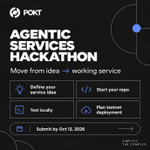
🚀 Pocket Network Agentic Services Hackathon reminder:
Now is the time to move from idea → working service.
Define your service, start your repo, test locally, and begin planning testnet deployment.
Don’t wait until the final days to deploy and test.
Submit by Oct 12: forms.gle/KHicKy1h6RggWMf18

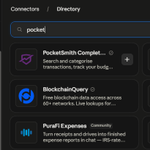
The Service Builder MCP has been updated to include details for all of the above, so if you're not using the app, make sure you connect Claude to:
mcp.pocketmcp.network/mcp
Customize > Connectors > Custom Connector, drop the link in, done.