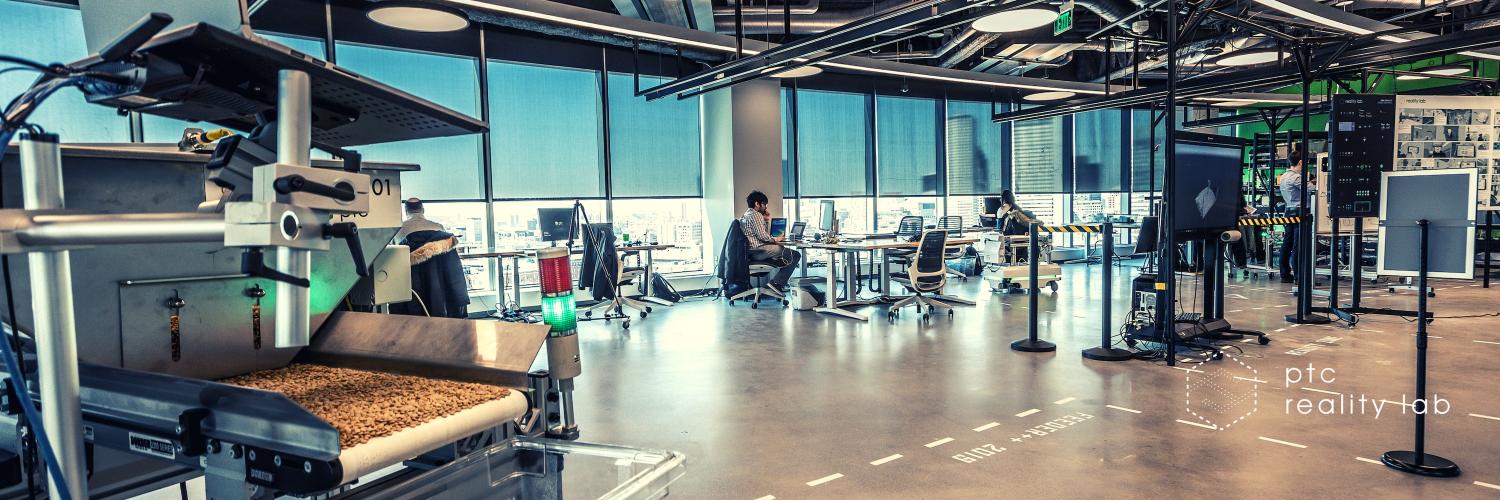

The #PTCRealityLab researches the future of Human-Machine Interaction at @PTC. Meet us here: https://teapawt.org/t.co/cVmALaBjt6
Worldwide
Joined October 2018
- Tweets333
- Following374
- Followers1.3K
- Likes370
#SpatialComputing collaboration between @medialab Space Exploration Initiative, @PTC_RealityLab and @NASA (data). Live demo at MIT Media Lab Members Week media.mit.edu/events/mit-med…. Credit: Cody Paige, Don Haddad, Steve Xie, Valentin Heun, and respective Teams.
Architecture Scale AR is what we envision as a core foundation of a #distributed, collective and physically embodied #Metaverse

Finally, with MobileTutAR we present an #AR tutorial system for machine operation tasks using human segmentation point cloud and video. Holograms of users can now be added to our #Metaverse environment
Spatial Sensors and a real-time REBA (Rapid Entire Body Assessment) score informs where the process is slow and where the worker may be in danger of stressing their body with a color coded joint visualization
With Spatial Sensors we can perform spatial analytics on a sequence of tasks for a specific procedure inside of this distributed collaborative #Metaverse
Spatial Sensors are #VuforiaSpatialToolbox tools that track human pose movement inside of a bounding area. These are programmable and linkable to any other tool in the #AugmentedReality environment
With human pose estimation, we can have a full collaborative environment where a remote user can dive in and assist a collocated user. It is a full #AugmentedReality co-authoring environment that updates in real-time
This brings us to our concept of the Instant #Metaverse. Using only mobile devices, we can create an instant @Vuforia Area Target, localize ourselves in the environment, and calibrate real-time point clouds into the scene without deploying any cumbersome technology
With a full synchronization between @Vuforia Area Targets, the #VuforiaSpatialToolbox and our remote virtualizer we can achieve real-time spatial holoportation. In a cyber-physical #Metaverse, we can be present somewhere else with full 3D spatial context
Sequential Spatial Envelopes allow for the creation of groups and sequences. With a drag-and-drop data flow between sandboxed #AR tools we can create more complex applications such as a path planning system for an MIR100 robot.