

Anatomy and history enthusiast. Posts about the history of Medicine. The official Past Medical History account. #histmed
London, England
Joined January 2016
- Tweets1.2K
- Following43
- Followers34.1K
- Likes2.4K




A remarkable study of the structures beneath the skin. This anatomical illustration is by Antonio Scarpa (1752–1832), from his 1801 work on diseases of the eye.
Image: Saggio… (1801), scan via Historical Medical Books, University of Virginia; public domain.

A hand and a wedding ring—and a new way of seeing inside the body.
On 22 December 1895, Wilhelm Conrad Röntgen made this famous X-ray image of his wife Bertha’s left hand: one of the first radiographs of a human body.
Image: via Wikimedia Commons (public domain).

Thomas Linacre (c.1460–1524), physician to Henry VIII, was the first president of the Royal College of Physicians, founded in 1518.
Portrait traditionally identified as Linacre, copied by William Miller, 1810; via Wikimedia Commons (public domain).
#HistoryOfMedicine

A coronal section of the thorax and abdomen from Johannes Sobotta’s Atlas of Human Anatomy, first published in 1904. The detail in this anatomical illustration is remarkable.
#Anatomy #HistoryOfMedicine

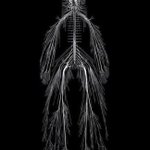
In 1888, Rufus B. Weaver created a complete dissection of the human nervous system, later known as “Harriet”. The story is remarkable, but surviving evidence does not establish that Harriet Cole consented to the use of her body.
Read: pastmedicalhistory.co.uk/the…

My first article in almost a year is out: The Great Smog of London, 1952—how a public health disaster changed policy and our understanding of air pollution.
Read it here: pastmedicalhistory.co.uk/the…

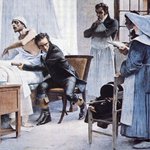
In 1816, René Laënnec used his stethoscope to examine a patient at Paris’s Necker Hospital. Théobald Chartran later depicted the scene—a moment in the history of clinical diagnosis.
#HistoryOfMedicine
Image: Chartran, via Wikimedia Commons (public domain).

After several months offline, Past Medical History is back!
I’ve finally restored the website, and all my old articles and content are available again.
Thank you so much for your support and patience while I worked on bringing it back.
pastmedicalhistory.co.uk

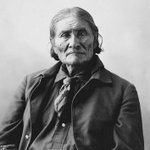
A photo portrait of the Bedonkohe Apache leader and medicine man, Geronimo. Taken in 1898 by Frank A Rinehart. #histmed #historyofmedicine #pastmedicalhistory

U.S. Public Health cancer awareness poster circa. 1950 #histmed #publichealth #beatcancer #pastmedicalhistory #historyofmedicine


Prof. Sambhu Nath De (1915 – 1985), who discovered the cholera toxin and successfully demonstrated the transmission of the cholera pathogen. #histmed #historyofmedicine #microbiology #pastmedicalhistory

William T.G. Morton (1819-1868) - the American dentist who first publicly demonstrated the use of inhaled ether as a surgical anaesthetic in 1846. The promotion of his questionable claim to have been the discoverer of anaesthesia became a life long obsession for him. #histmed

American Civil War solider with gangrenous wound of the elbow. #histmed #history #militarymedicine #historyofmedicine #pastmedicalhistory

The frog test - injecting the urine of a pregnant woman into the African clawed frog causes an ovulation response. From the 1940s to 1960s, tens of thousands of frogs were injected with human urine and used as pregnancy tests in this way. Image credit: bit.ly/3G0eBqZ

A portrait of Rudolf Virchow, painted by the artist Hugo Vogel in 1861. Virchow was a German physician, anthropologist, pathologist, prehistorian, biologist, writer, editor, and politician, known for his advancement of public health #histmed #historyofmedicine #pastmedicalhistory

Book plate from 1920s showing the 'proportions of a healthy child' #histmed #historyofmedicine #pastmedicalhistory

Andreas Vesalius (1514-1564) - anatomist, physician, and author of the influential 'De humani corporis fabric' #histmed #historyofmedicine #anatomy #pastmedicalhistory

Beautiful coronal section of the thorax and abdomen from Johannes Sobotta's atlas of human anatomy, 1st published in 1904 #anatomy #histmed #historyofmedicine #pastmedicalhistory

A photo of Henrietta Lacks in the late 1940s. Henrietta's cancer cells are the source of the HeLa cell line, the first immortal human cell line, one of the most ground-breaking and controversial scientific discoveries of the 20th century. #histmed #historyofmedicine
