

Helping DePIN networks verify physical presence through independent Bluetooth observations. Building on @solana · @colosseum hackathon
Joined September 2026
- Tweets35
- Following23
- Followers9
- Likes27



It’s incredibly disappointing to announce that we won’t be able to submit Pathnod to the @colosseum hackathon 🥲
After a month of hard work, we were excited to have our project reviewed by the Colosseum team, but it seems the stars weren’t aligned for us this time.
For reasons we still don’t understand, our GitHub accounts were suspended on Sunday, October 11. This has left us unable to access our project’s repo or sign in to Colosseum with the project owner’s account to submit :/
It’s frustrating to stop so close to the finish line. We’re hoping to hear back from @github support soon so we can understand what happened and find a solution. We also have several other projects underway that are now blocked.
Huge thanks to Colosseum for an incredible hackathon!!!
See you!

DePIN networks pay hardware for being somewhere.
The weak part is still the check. GPS can be spoofed. Uptime can be self-reported.
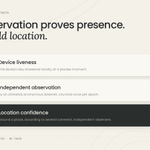
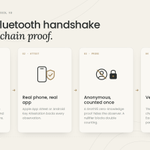
We’re testing a nearby phone that challenges the device over Bluetooth. If it can’t answer in time, it doesn’t count.
Early prototype. @colosseum hackathon.
This is the key point.
Collecting data is relatively easy.
Making the observation independently verifiable is the hard part, exactly what we’re prototyping with Pathnod.

I keep thinking about what @vangrid_io on @arc actually enables.
An agent can now request something software normally cannot fetch:
fresh reality.
That feels less like AI hiring humans and more like an API for the physical world.
Need to know what a loading dock looks like today?
Post a bounty.
A human goes there, captures it, and the result comes back as spatial ground truth.
Basically an API call… with legs.
But this is where things get interesting.
Normal APIs return deterministic data in milliseconds.
Reality does not.
People arrive late. Lighting changes. Objects move. Captures can be incomplete. Reconstruction quality varies.
So the real infrastructure challenge is not just payments.
It is turning a messy physical-world task into something agents can request, verify, and trust programmatically.
That means clear capture specs, quality thresholds, deadlines and machine-readable acceptance rules matter as much as fast settlement.
To me, that is where @vangrid_io could build a serious moat.
The winner in Physical AI may not be the network with the most scans.
It may be the one where an agent can ask reality a question…
and reliably get an answer.
1
2
53
Exactly the problem we’re working on with Pathnod.
Independent Bluetooth observations + hardware attestation instead of self-reported GPS.

Paying people to map cities sounds innovative until you realize 90% of them will try to game the system with fake GPS data.
Hardware-level proof is the only thing standing between a useful spatial dataset and terabytes of spoofed junk. Most DePIN mapping attempts burn 6-figure budgets on spam filtering because bad actors automate fake submissions from their bedrooms faster than real users can walk the streets.
If a decentralized network can't mathematically verify physical camera movement and device telemetry on-chain, it’s not collecting data - it’s just subsidizing emulators.
That’s the hardest engineering hurdle @vangrid_io actually has to solve: turning random raw smartphone scans into cryptographically verified 3D assets before the bounty pays out.
Do you trust hardware-attested smartphone sensors to weed out sybils, or will every map-to-earn model inevitably collapse under farm exploits?

1
35
The model: networks fund observations in USDC, observers are paid for the first independent observations of each device. No token.
Today: a devnet prototype with an ESP32 reference device, built for the @colosseum hackathon. Open source.
1
7
If you run a physical network: how do you check today that your devices are really where they say they are?
Replies and DMs are open.
github.com/Pathnod · pathnod.com
7